Just now, Xiaohongshu has open-sourced dots3-note, a model from the same series that achieves a full score of 42 points in IMO.
Finally, the counterpart version of Xiaohongshu's IMO full-score gold-winning model has been open-sourced!
Last month, Xiaohongshu's self-developed large model "dots-note-3.0" set a historical record: for the first time ever, an AI obtained an officially verified full score of 42 points in the International Mathematical Olympiad. Since then, the most concerned question in the community has been when the model will be open-sourced.
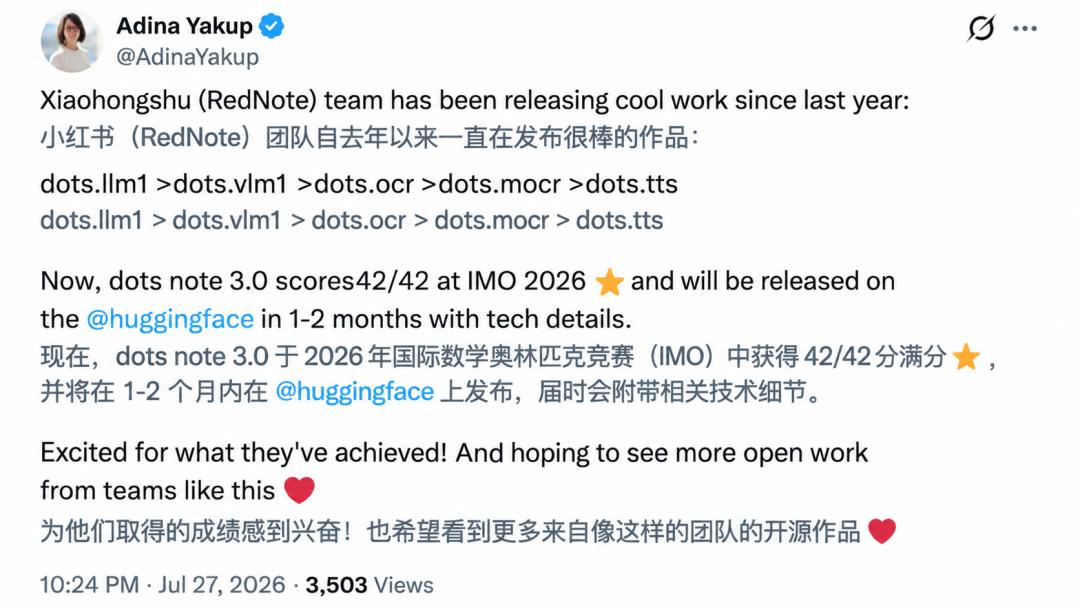
Adina Yakup, Head of HuggingFace AI Research and Community Ecosystem. Source: X Post
Just today, the Xiaohongshu Dots Model Lab (hereinafter referred to as Dots Lab) announced the open-sourcing of dots3-note preview! It is also the first open-source release of the dots3 series of models, targeting long-horizon tasks that are more realistic and harder to evaluate.
In terms of parameters, dots3-note preview has a total of 280B parameters, of which 16B are activated parameters, supports an ultra-long 512K context window, has multi-modal understanding capabilities for text, vision and speech, and is optimized for complex reasoning, Agent and multi-modal perception.
API Portal: https://dots.ai/platform/
Huggingface: https://huggingface.co/dots-studio/dots3-note-prev
GitHub:https://github.com/studio-dots-ai/dots3-note-prev
The full score in the IMO has verified the model series' capabilities in mathematical reasoning and proof, and this open-sourcing brings the challenge to another category of scenarios that are more difficult to standardize: travel planning, wedding preparation, and store operation. This type of task has no unique correct answer, and the time span can extend to several hours, days or even longer.
dots3-note preview focuses on long-horizon tasks, which also aligns with the main development line of current Agents: they are increasingly required to independently undertake longer and more complete work. OpenAI once disclosed that in May this year, more than 70% of users let Codex handle work that takes humans more than one hour to complete; by June, the top 1% of active users by internal usage of OpenAI generated more than 60 hours of agent turns per day.
However, when tasks are applied to different scenarios, the difficulty level quickly diverges. Unlike scenarios where Agents perform relatively maturely such as mathematics, coding and engineering, real-life environments are more open-ended and requirements are more ambiguous. dots3-note preview chooses to set its "examination room" here, putting forward higher requirements for its own long-horizon planning, judgment and error correction capabilities.
According to data from multiple mainstream benchmarks, on a wide range of reasoning and agent tasks, the model is on par with or even outperforms large-scale models with several times its own parameter size, and its visual capabilities stand out among models of the same size.
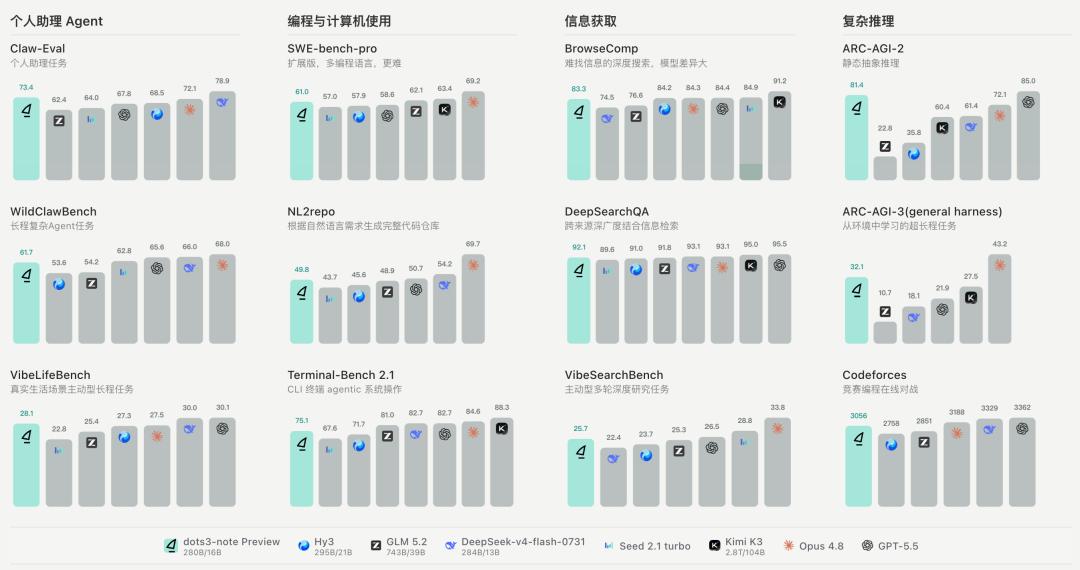
Source: Official Technical Blog
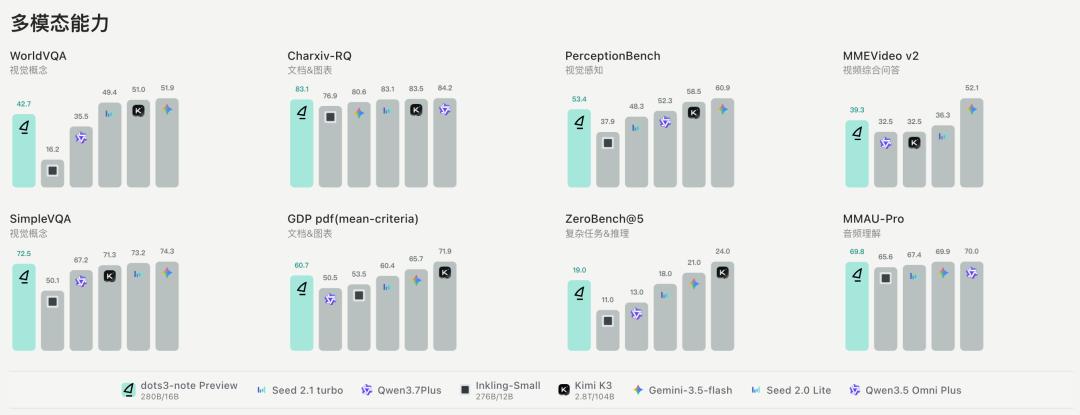
Source: Official Technical Blog
Previously, Xiaohongshu has successively open-sourced the text large model dots.llm1, the multilingual document layout parsing model dots.ocr, and the multi-modal visual understanding large model dots.vlm1. This latest open-sourcing fills in the last missing piece of the Agent puzzle.
First-hand Hands-on Test:
Can It Truly Complete Complex Tasks?
The real capability of a model cannot be fully judged by leaderboards alone. Next, through several cases, we will see how this model independently pushes forward tasks with scattered information, numerous steps and continuously changing environments, and delivers final results.
Taking Over Slay the Spire II
First, let dots3-note preview take over a game of Slay the Spire II.
The difficulty of this game lies in that every choice, including which route to take, which card to pick, whether to challenge an elite enemy, how to spend gold coins, and whether to rest or upgrade at the camp, will affect the survival probability after dozens of rounds. A locally optimal choice may easily lay hidden dangers for the subsequent boss battle.
The model has not received dedicated training for this game in advance, but it can learn the mechanics of cards and enemies based on battle feedback, while managing health, card decks, gold coins and potions, constantly weighing between shops, camps and elite battles, and eventually play through to the 33rd floor.
Solving ARC-AGI 3 From Scratch
In the long-horizon reasoning task ARC-AGI 3, the rules are completely unknown, and the model needs to observe the interface, put forward hypotheses, and then verify them through operations.
dots3-note preview gradually discovers the rules of synchronous up-down movement and left-right mirroring of the two squares, and figures out the mechanics of dangerous tiles, movable markers, pressure switches and gates.

Whenever a hypothesis is wrong, it will activate the Self-Critiquing mechanism for re-evaluation, and write the revised rules into memory.md, a file similar to the model's notepad that continuously stores the dynamic understanding of the environment.


In the end, the model solves all 6 levels through 320 steps of operations.

Solving Home Renovation Problems With Image Understanding
Continuous learning and reasoning capabilities ultimately need to be applied to real life.
For example, here is a typical home renovation problem: upload the floor plan and the parameter screenshots of two refrigerators at the same time, and add the supplementary information that the wall on the side of the kitchen adjacent to the study already has a 1.5-meter-long countertop, and you want to place the refrigerator on this wall. Can the refrigerator still fit?
Key information is scattered in different images and text descriptions. The model needs to combine the floor plan, the size of the existing countertop and the specifications of the two refrigerators to calculate the remaining space on the wall, and give a matching conclusion. It also proactively reminds the user to re-measure the size on site for confirmation.
The whole process involves visual spatial understanding, complex reasoning and tool invocation, which also reflects the model's ability to generate customized answers based on the user's actual living environment.

Using the same floor plan as before, we ask the model to design several sets of solid wood style renovation plans for the study.
The model retains the previously identified size and lighting information, searches relevant Xiaohongshu notes, organizes four sets of solid wood style plans and generates a web page, continuously completing image understanding, calculation, retrieval and content generation.

Completing End-to-End visionOS Application Development
Finally, let's see if dots3-note preview can independently complete a full end-to-end software engineering task: we ask it to "refer to the design of Xiaohongshu to develop a native Apple Vision Pro application".
After receiving the task, the model does not rush to write code. It first understands the product requirements and refers to 9 interface diagrams, independently determines the development plan, including adopting the SwiftUI+RealityKit technical route, and planning different modules such as the organization of windows, immersive spaces and 3D product displays. After the plan is finalized, it continues to prepare materials such as local images and 3D models, and then gradually completes the code implementation.
The entire project generates 12 Swift files and 1876 lines of code, implements interfaces for information feed, personal profile, private messages, products, etc., and integrates USDZ 3D models. After that, the model automatically generates the Xcode project, calls xcodebuild for compilation, and completes the check in the visionOS Simulator, finally showing "BUILD SUCCEEDED".
From requirement understanding, technology selection to code implementation, compilation and verification, this full development process is successfully completed end to end.
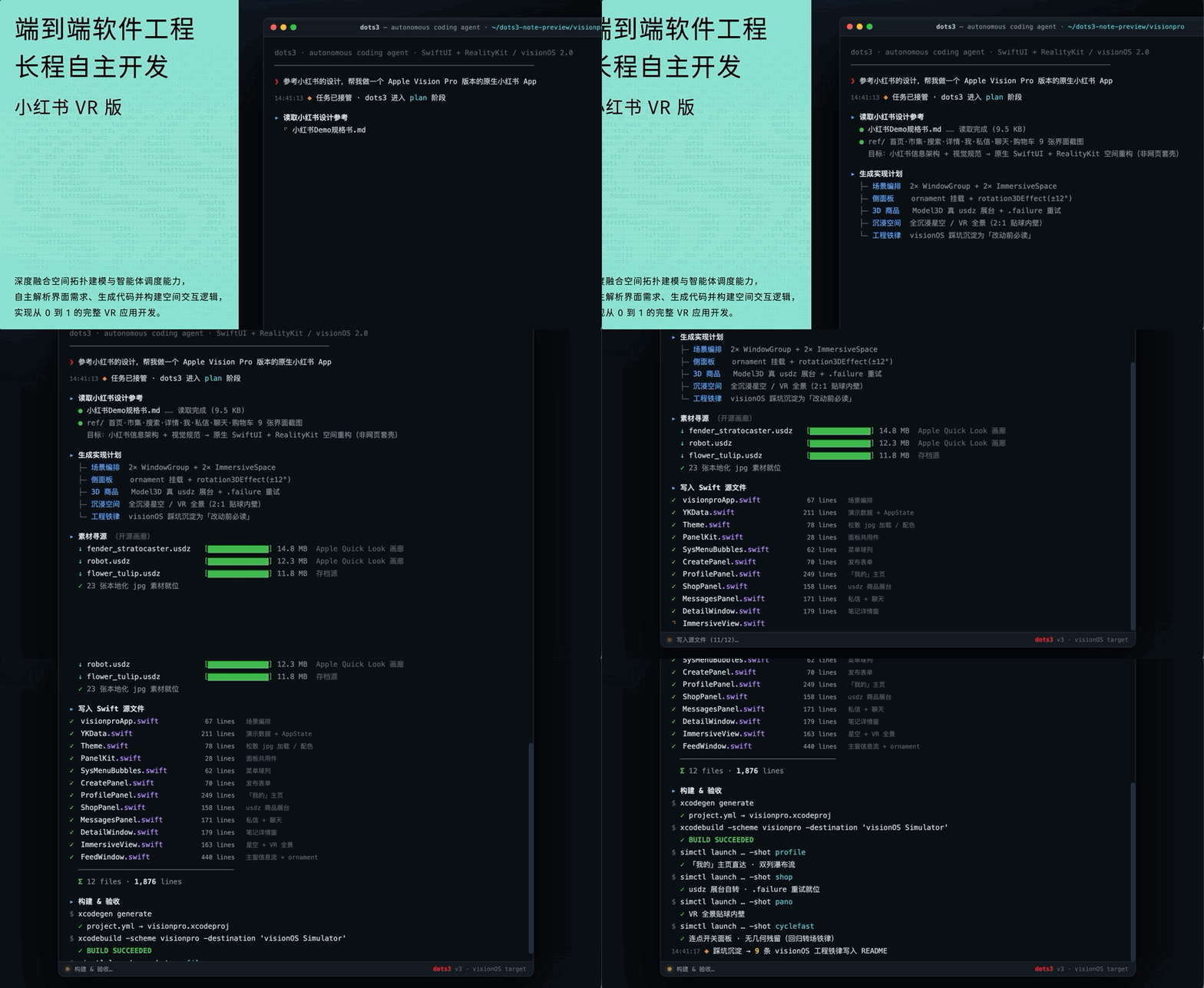
Judging from the final finished product, it already has a relatively complete set of spatial interactions. The information feed can be scrolled, notes can be opened to their detail pages, and personal profiles and private messages can be expanded as independent windows.
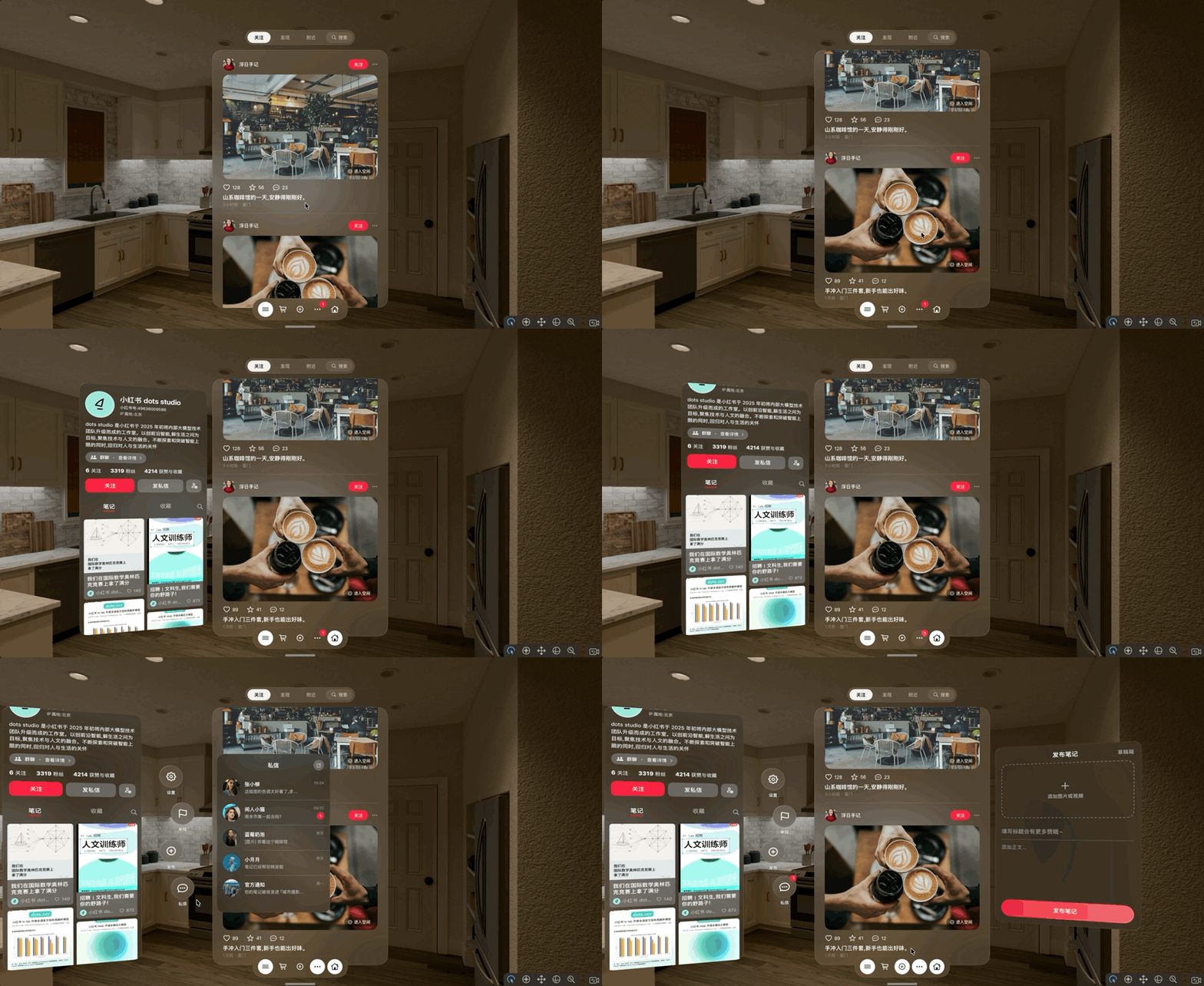
Users can also directly view and switch between different 3D products in the shopping interface.

There Are No Standard Correct Answers,
The Model Needs to Keep Learning and Correct Its Own Mistakes
Judging from several sets of hands-on tests, the most prominent capability of dots3-note preview is to explore and memorize new information at the same time, and adjust after encountering changes or judgment errors until the final result is delivered. How does it achieve this? The key lies in two things: learning and memorizing truly useful information, and promptly detecting and correcting deviations in its own judgments.
The first problem Dots Lab needs to solve is: can the model keep learning from the environment and users after the training process is completed.
To train this capability, Dots Lab has built thousands of ultra-long-horizon novel environments that do not rely on prior knowledge, allowing Agents to continuously explore in scenarios they have never encountered before, and learn new rules and knowledge through interaction with the environment to support subsequent decision-making. In addition, when the task length significantly exceeds the model's context window, the model cannot always rely on the existing information in the context. After reinforcement learning training, it will gradually learn how to retain information that is useful for solving subsequent problems. This capability has been verified on ARC-AGI 3.
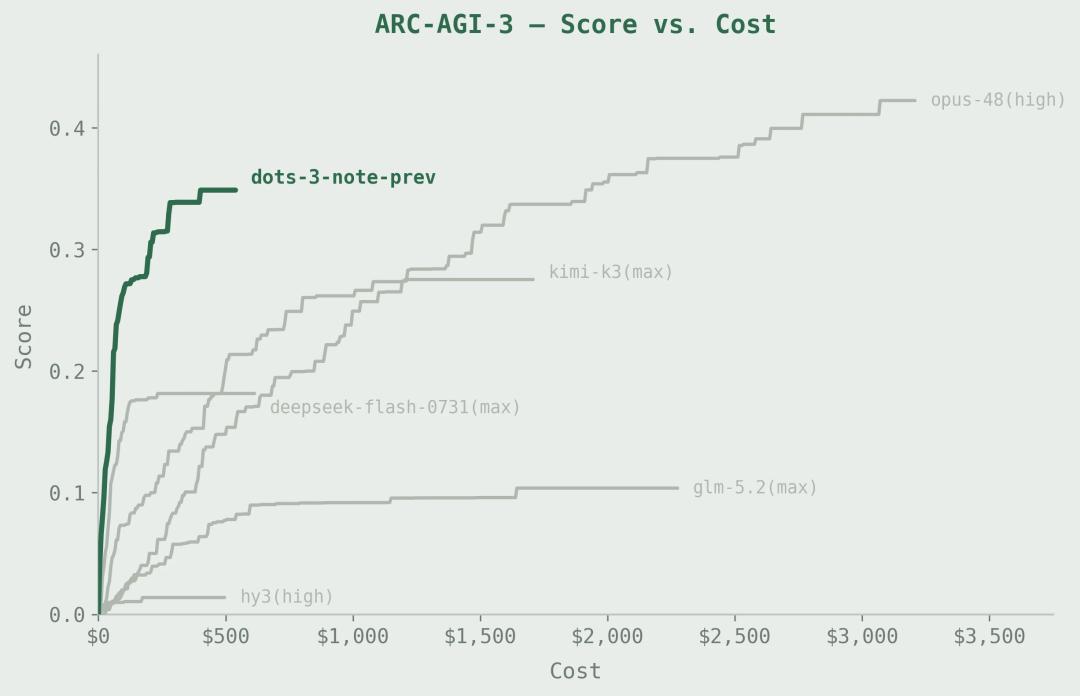
As can be seen from the figure below, dots3-note preview achieves a score of about 0.35 on ARC-AGI-3 at a cost of less than 500 USD. Although its absolute score is lower than Claude Opus 4.8 (high), its cost efficiency is significantly higher.
However, to train such a process, another major problem will be encountered: The exploration cost of long-horizon tasks is extremely high, and a single exploration run for an Agent may take more than ten hours. If the value-free reinforcement learning method that relies on end-of-trajectory rewards continues to be used, the training signal can only be obtained after the entire trajectory is completed, which is not only inefficient, but also makes it difficult to attribute the final success or failure to a specific previous step.
Actor-critic methods such as PPO can alleviate this problem, but traditional critics usually estimate the value of the current state through a single forward calculation with fixed computing power. When facing complex Agent tasks, the actor can repeatedly reason, call tools and then decide the next step, but the critic cannot do so, which easily leads to inaccurate judgment of the current progress.
Dots Lab proposes TEMPO (Test-time-scaled Value Estimation with Macro-step Policy Optimization), which splits a very long trajectory into multiple macro-steps, each containing multiple rounds of interaction between the model and the environment. After a phase ends, the model temporarily switches from the actor role to the critic role, estimates the future return of the current state through reasoning, tool invocation and test-time scaling, and then converts this evaluation into the training signal for the unfinished trajectory.
It is worth noting that during the TEMPO training process, the model needs to learn not only how to act, but also how to evaluate how well