Google is no longer chasing the cutting edge, and DeepMind may conduct large-scale layoffs.
Last week, the atmosphere of farewell was thick at Google's Mountain View headquarters. Many employees seized the opportunity to schedule 1-on-1 meetings with Jeff Dean and Quốc Lê, who are leaving the company to start their own ventures.
Many of these employees are colleagues from DeepMind (GDM), and the meetings carried a subtly delicate vibe. A large number of staff are worried about the prospects of their department and their own job security.
Dean's new company Discovery Loop has a business focus that fully overlaps with DeepMind's work, and the other three co-founders who have been disclosed are all senior Google employees. In the face of great uncertainty surrounding GDM, these meetings have also become opportunities to show loyalty: employees may get transferred to other teams through referrals from their former bosses, or get priority access to interview opportunities at Discovery Loop.
Exclusive information obtained by ifanr/APPSO shows that Google's DeepMind team will no longer pursue R&D of cutting-edge models, but will shift its focus to Flash-level models that deliver higher cost performance. In addition, with the restructuring of GDM, the team may face large-scale layoffs, with the proportion of affected employees reaching 1/3 or even higher.
People familiar with the matter revealed to ifanr/APPSO that the main purpose of the restructuring is to streamline several types of redundant personnel, such as employees who were recruited for algorithm positions but do not actually engage in algorithm-related work.
The GDM team has around 7,000 to 8,000 members. Details such as whether the layoffs will happen in the end and when they will take place have not been confirmed yet. Per usual practice, employees can also transfer internally to avoid being laid off; some teams have already been merged into teams managed by other Google executives, which will be elaborated later.

Before this article was published, Google officially released Gemini 3.7 Flash to the public, less than a month after the previous version 3.6 Flash. Earlier, APPSO hasexclusively reported that the delayed delivery of Gemini 3.5 Pro caused internal dissatisfaction.
We have learned that Google has no plans to update the Pro model in the short term, and more resources are being tilted to the Flash model: Google's AI business is undergoing a major directional adjustment.
Based on available information, Google will no longer bet on ultra-large-scale cutting-edge/flagship models at the same level as Fable/Opus in the short term, but will focus on lightweight Flash models that continuously optimize for lower costs.

ifanr/APPSO also learned that despite the "Dogfood" culture in Silicon Valley companies (using their own products to identify and solve problems), the core GDM team has never actually used Gemini as their primary daily model. Non-core teams are still required to use the Gemini model.
As of press time, Google has not responded to ifanr/APPSO.
On August 13, Reuters reported that Google co-founder Sergey Brin had been motivating the GDM team in recent months, and most recently stated at an all-hands meeting in April that he hoped Gemini would catch up with other cutting-edge models. According to our understanding, this information is outdated.
It's not that training Pro models is unaffordable, it's that Flash models deliver far better cost performance
Google is not "de-academizing" or completely indifferent to falling behind on flagship models.
In fact, Google is the originator of many key technologies in AI-related fields such as algorithm architecture, machine learning, and computing power hardware. Technologies including DistBelief/TensorFlow, Word2Vec, Transformer, BERT, and even the Google Brain project, one of the predecessors of the GDM organization, have played a pivotal role in the evolution of AI. And Google will continue to commit to making breakthroughs in key technologies at this level.
These achievements rely on outstanding talents, and also benefit from Google's long-standing high degree of tolerance for innovative research and side projects.
However, on the path to catch up with OpenAI, Anthropic, and a host of Chinese open-source model vendors, Google is currently in a state of being overwhelmed. Unlimited betting on cutting-edge models is no longer feasible, at least at the current point in time.
Google has now "accepted reality". The continuous evolution of Flash models costs less and delivers more visible results. Not only can they help Google's existing core products realize "AI+" with lower inference costs, but they are also sufficient to fill the workload of the GDM team.
Over the past period of time, GDM has struggled to secure the resources needed to train powerful models. The foundation model/model product teams of many large tech companies around the world are facing a similar situation.
According to ifanr/APPSO's understanding, GDM's overall OKR score for the most recent performance review year is 0.5 (on a 1-point scale) — it is no longer that GDM wants to train larger and more powerful models, but that a team performing so poorly cannot obtain more resources than before.
Core products such as Search, Gmail, Android, YouTube, and Maps serve billions of ordinary people every day — at this user scale, the AI computing power requirements of these products are no less than those of GDM.
For example, Search uses proprietary models to understand request intent, analyze semantics, and deliver search results, and these models require TPU clusters to achieve high concurrency and low latency; YouTube heavily relies on TPUs to recommend videos, match ads, and review content uploaded by users; TPU clusters also undertake functions such as photo recognition, semantic search, and photo enhancement for Google Photos.
It would certainly be a good thing if GDM could train larger and more powerful models, but for a giant company with a multi-business group structure like Google, the benefits are very limited.
As mentioned earlier, for every existing Google product that can be empowered by "AI+", they never need an ultra-large-scale cutting-edge flagship model. What they need is a fast model that is smart enough and has negligible inference costs. It's not that training Pro models is unaffordable, it's that Flash models deliver far better cost performance.

You can win even without ranking top 3
Our previous report pointed out that the Gemini 3.5 Pro model, which was only tested internally and never released to the public, has already fallen behind its competitor Meta's Muse Spark 1.1 (the 1.2 version further shifted to an open-source strategy) on today's mainstream benchmarks.
Globally, Gemini has dropped out of the top 3 of North American foundation models, and its momentum is even weaker than Grok. There are rumors that Google is no longer competing for a top 3 ranking, which aligns with the exclusive information mentioned above and is close to the real situation.
This is not a big problem, as Google's ecosystem foundation remains solid.
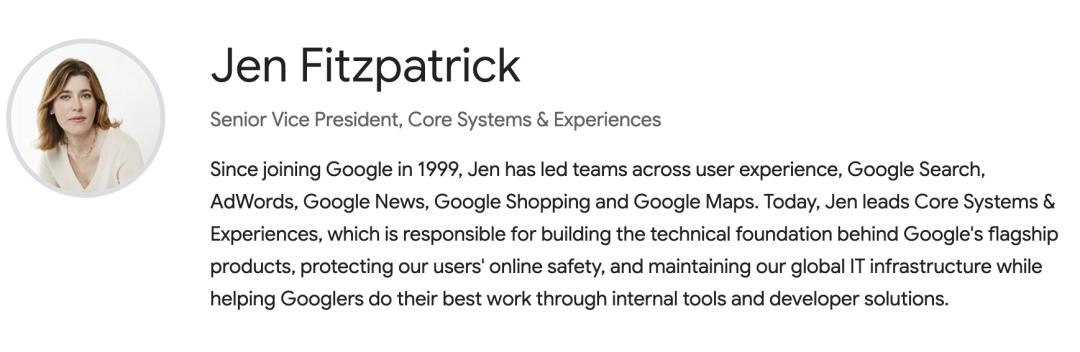
When it comes to AI, Google/GDM is no longer a "cutting-edge model laboratory" that needs to compete directly with OpenAI, Anthropic, and MSL. Instead, the company as a whole is refocusing on how AI models and technologies can serve existing core products and deliver better experiences. These products, of course, include Search, which falls under the purview of Jen Fitzpatrick, Google's Senior Vice President of Core Systems and Experiences.
In addition, Google Cloud (GCP), managed by Thomas Kurian, is also Google's cash cow. Search and other businesses together with GCP contribute 73% of the total revenue of parent company Alphabet. Now none of them are constrained by GDM anymore.
Demis Hassabis, who has always been a popular figure at Google but never wanted to be one, has finally stepped down from his role as the de facto head of GDM, and now serves as Alphabet's Chief Scientist and Chairman of DeepMind; his successor Koray Kavukcuoglu has much less real power than Hassabis.
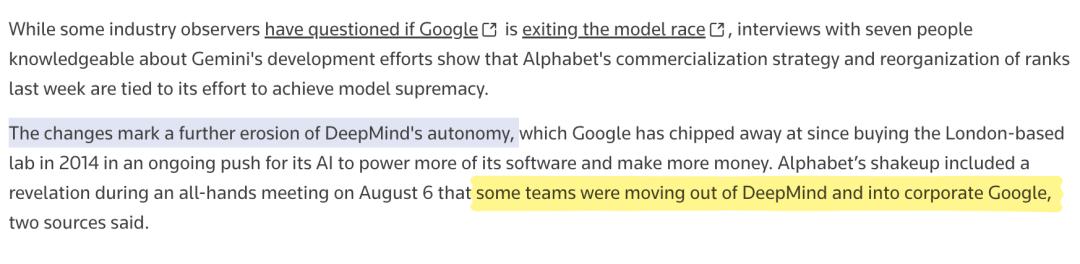
As things stand now, after this restructuring, the top-level reporting line for Google's AI-related businesses will lead to Fitzpatrick, who has gained more real power. This situation independently learned by ifanr/APPSO is consistent with Reuters' report. Reuters pointed out that some former GDM teams have been merged into other business units of the company, and their autonomy has been eroded.
It is worth mentioning Josh Woodward, Vice President of Google Labs, Gemini Products, and AI Studio, who has been one of the keynote speakers at the last few Google I/O conferences.
Although the underlying Gemini model has had a bumpy journey, the performance of the upper-layer Gemini App is still satisfactory enough for Google's senior management. Google CEO Sundar Pichai announced the news of Dean's departure and GDM's restructuring last week, and his first tweet after that officially announced that the monthly active users of the Gemini App have exceeded 1 billion — 600 million of which are new users added since last May.
At this point, the Gemini App has become Google's 14th independent product with over 1 billion monthly active users, and it is also the fastest growing one. In his tweet, Pichai specifically thanked Woodward:

If Fitzpatrick, Kurian and others are Google's generals guarding its existing territories, then Woodward is more like the operator driving breakthroughs in new businesses, representing the next generation of Google's core executives.
Overall, the adjustments taking place inside Google also reflect the changes in mindset of Silicon Valley giants as they gradually enter a mature stage in the AI era.
Over the past few years, the entire industry has been indulged in the grand narratives of the arrival of AGI and the Scaling Law. Tech giants have purchased massive amounts of computing power, offered unprecedented large paychecks to young "genius" researchers, and launched a consumption war of monthly version releases on model benchmarks.
But the fanaticism may be fading. Even a powerhouse like Google has reached the time to put an end to the vanity of blindly pursuing cutting-edge achievements.
This article is from the WeChat official account "ifanr" (ID: ifanr), written by Du Chen, and published with authorization from 36Kr.