The breakneck development of domestic AI is never meant to provide tools for the cutthroat involution in the automotive industry.
Big names in the Silicon Valley AI circle have had a rough time lately.
In June, Zhipu AI released GLM-5.2; in July, Moonshot AI launched Kimi K3; at the end of July, DeepSeek made a comeback with V4-Flash; on July 31, ByteDance officially unveiled Seedance 2.5; and on August 3, Alibaba's Qwen3.8-Max also debuted. In just eight weeks, five Chinese enterprises launched five large language model products with performance close to the global cutting edge of the AI sector. The mid-2026 has almost become a carnival season for Chinese AI.
Data from independent evaluation agency Artificial Analysis shows that the cost of running complex real-world workloads with DeepSeek-V4-Flash is only $0.03, while using Claude Fable5 costs $3.15, a price gap of more than 100 times. Industry analysts believe that this is the most significant change in the AI industry since the official release of DeepSeek-R1 in January 2025, and the progress of Chinese enterprises in related fields is no longer just a breakthrough of a single company. The launch of the five new models mentioned above means that China now has a replicable system capable of producing models close to the global cutting edge.
Bloomberg thus put forward the concept of "Death Zone", that is, under the impact of such open-source competitors, any player without cutting-edge technology or breakthrough pricing will face elimination.
It is worth noting that this wave of Chinese AI has not been limited to the internet circle within China. For example, at the Qualcomm Automotive Technology and Cooperation Summit in early June this year, Li Bin, founder of NIO, explicitly stated that "automobile companies today must become AI companies, and current smart cockpits must become AI cockpits". Over the past eight weeks and even the past two years, domestic automotive groups have been striving to integrate AI technology into their own systems.
At the mid-2026 time node, all domestic automotive groups and most auto brands have made full arrangements in dimensions including AI data, cloud computing power, vehicle-end computing power, self-developed chips, AI operating systems, and large AI models. BYD launched the "Xuanji" intelligent vehicle architecture and announced that it will continuously invest more than 100 billion yuan in R&D funds. Geely has built a "General Vehicle Brain" and announced that it will realize multi-domain collaboration of cockpit, intelligent driving and chassis. Xpeng has adjusted its positioning to be a "global-oriented embodied intelligence company", while Li Auto regards 2026 as "the last window to board the train to become a leading AI enterprise".

Figure | Building a full-scenario full-field super universal AI assistant like Cortana is the ultimate goal of the global artificial intelligence industry. The large language models currently popular are only a very initial small step towards this goal.
On one hand, Chinese AI has realized a replicable production system, and on the other hand, Chinese automotive groups have collectively bet their fate on AI. This was supposed to be a perfect mutual pursuit, but when we look at the auto market performance in the first half of 2026, we find that the other side of the story is far from such a taken-for-granted beauty.
The impact of Chinese large language models on US peers in the commercial sector has been discussed in our article "Four Strong Chinese AI Firms Smash US Tech Hegemony" published on the C Dimension account of Auto Community last Friday, which also made a preliminary discussion on what assistance AI technology at the current stage can provide for automotive enterprises. But what about the deeper level?
01
The faster the computing power runs, the deeper the wheels get stuck
The answer starts from this set of misalignment. Precisely because of the current explosive progress speed of domestic AI enterprises, with a large number of cheap models and faster iteration speed, to some extent, it once made automakers regard AI as a specific medicine to resist market competition. No matter empowering products through AI, or carrying out management and development relying on AI.
In the past two years, from BYD's 100-billion-yuan investment, to Geely's multi-domain brain construction, to new power brands collectively labeling themselves as AI companies, the whole industry has accepted the judgment of Li Bin from NIO — automobile companies must be AI companies.
However, the data of the first half of 2026 has cracked this consensus. According to the statistics of the China Passenger Car Association (CPCA), the retail sales of domestic passenger cars in the first six months fell by 20.2% year on year, with a clear contraction in terminal demand. But ironically, more than 600 new cars were launched to the market in the same period. The consequence is that less than 30 models achieved monthly sales of over 10,000 units in the first half of this year, and more than half of the new cars even failed to reach 1,000 units in monthly sales.
Cui Dongshu, Secretary-General of CPCA, published an article on his personal official account at the end of last month summarizing the recent trends — from the sales profit margin trend over the years, the profit performance of the auto industry in 2024 has shown weakness, with the sales profit margin of only 4.3%, a sharp drop from the normal historical level; the industry sales profit margin dropped to 4.1% in 2025. The industry sales profit margin further dropped to 3.8% from January to June 2026.
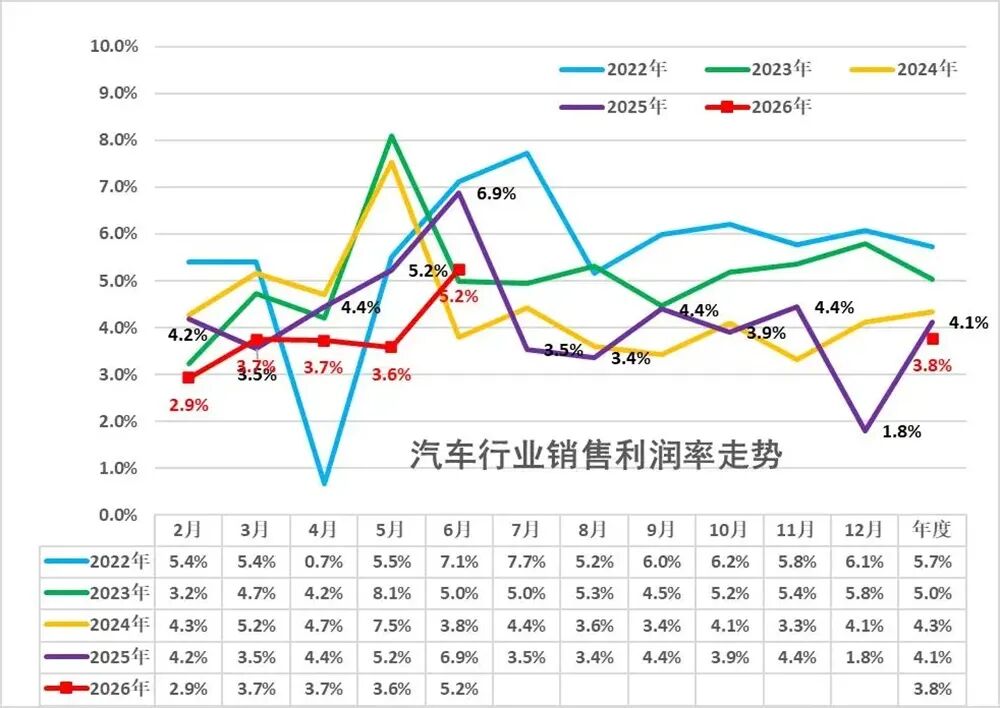
Figure | The chart is from the push on Secretary-General Cui Dongshu's personal official account
The problem does not lie in AI itself, but where the efficiency released by AI goes. Although since the second half of 2024, the global progress of applying AI to automotive production and design has been fruitful. But the reality is that, at least in China, the time saved by enterprises through the implementation of AI technology has almost all been used as ammunition for involution to "draw the line".
In the past, a team spent two or three years polishing a car. Now, with the release of computing power, the speed of model modification is increased, the generation replacement is advanced, and for the segmented market that used to take half a year for research, decisions can be made to launch projects only based on the AI-generated competitor briefing.
On July 14, He Zhiqi, a senior executive of BYD, shared a set of data: from January to May this year, a total of 542 new cars were launched, with an average of 3.6 cars per day. He said bluntly: "It's completely crazy. This is a car, a new model usually requires an investment of more than 1 billion yuan and a development cycle of more than two years, but its popularity can't even last for three months, it gets cold before it's even warmed up. With so many new cars, the overall domestic market has still dropped by 20%, the competition is not just fierce, it's brutal..."
The overflow of supply can only rely on price cuts to boost sales. In the first half of the year, the terminal average price cut of passenger cars exceeded 10%, and official price cuts of 20,000 to 30,000 yuan have become an unspoken rule.
What's more worthy of vigilance is the impulse to shrink the verification link. When virtual simulation can replace 60% of real vehicle road tests, the industry once equated efficiency with "less road testing".
At the Chongqing Forum in June this year, Li Shufu poured cold water explicitly: Automobiles are related to life safety. R&D can be accelerated, but the test links must not be reduced. Simulation and digital twin cannot completely replace closed venue and real road verification. Li Fenggang from Beijing Hyundai also said bluntly that some brands cut tests to catch up with the schedule, making consumers de facto test drivers.
After all kinds of embarrassing cases accumulated, the regulatory authorities will no longer just give advice, but issue warnings and conduct direct interviews. This summer, the Ministry of Industry and Information Technology interviewed multiple enterprises twice, requiring thorough investigation of loopholes in reliability, durability and new technology verification. The new regulations on the type test of new energy vehicles are soliciting public opinions, planning to take 30,000 kilometers of reliability driving test as a unified threshold, which will be implemented from 2027. This means that the path of using virtual mileage to offset real vehicle road tests has been blocked.
The "Death Zone" mentioned by Bloomberg originally refers to enterprises without technical differentiation will be eliminated by low-cost models. But in China's auto market, the first to be pushed to the edge are exactly those industrial products rushed out by the AI assembly line, with neither real demand nor sufficient verification depth.
The cheaper the computing power, the lower the threshold for car manufacturing, and the more cannon fodder there will be. AI was supposed to be the ticket to new quality productivity, but for now it has become an accelerator for involution.
02
Invest computing power in "quality"
The way out is not to abandon AI, but to turn the pointer back.
The first thing to do is to use AI to cut down pseudo-demands. Large models can ingest national vehicle registration data, user complaints and charging maps, to calculate which segmented markets cannot support a car. At the current stage, various mid-sized, full-sized 6-seat SUVs have been overcrowded, and blindly launching such products will only lead to them becoming cannon fodder. But in the current county and township markets, there is a lack of compliant commuter cars priced at 50,000 yuan level. This gap was ignored in the past.
If AI calculates that the break-even line of a certain project cannot be supported, the project should be stopped. In another way of thinking, if each automaker launches fewer industrial garbage products with monthly sales of only hundreds or even dozens of units, then the hundreds of millions or even billions of yuan saved in R&D investment and mass production costs will become the net profit of the enterprise, right?
At present, the China Association of Automobile Manufacturers (CAAM) has indicated that the capacity utilization rate has dropped to 70%, and capacity clearance is more urgent than expansion, which clearly opposes involution. In this general environment, AI tools that completely eliminate emotional factors can just act as the advisor who dares to say "no" to all stakeholders during decision-making.
In the verification link, AI should be used to increase depth, not to save procedures. Generative simulation can run through extreme working conditions of the past year in one day — heavy rain, dark ice, continuously damaged roads, sensor failure, these long-tail scenarios are fully tested in the virtual world, and then the real vehicle road test will complete the 30,000 kilometers test in accordance with the new regulations. BYD's Xuanji architecture and NIO's World Model are both based on this logic. Cars are still manufactured in a rigorous cycle, but the hidden dangers are much fewer when they leave the factory. If the cars do not break down easily, there is no need to make apologies through official price cuts, the price system is stabilized, the overall profit margin is improved, and then there will be a solid foothold.
The change of the intelligent driving cost structure is also forcing the industry to change its way of survival. In the past, relying on high-computing power chips plus closed algorithm packages, automakers could charge 20,000 to 30,000 yuan for intelligent driving optional packages, which was one of the few configurations that could get a premium. Now, with the implementation of domestic chips and open-source models, the hardware cost is decreasing, the old path of relying on piling up configurations to tell stories is no longer feasible, but it brings the opportunity for intelligent driving to sink into 100,000-yuan level vehicles.
BYD has deployed urban intelligent driving navigation on its Seagull model, and Geely uses a unified architecture to allow vehicles to iterate functions monthly, these are very positive examples. Their purpose should not be to crush peers, but to turn cars from one-off hardware into continuously operated terminals. Care services, parking assistance, personalized route subscription, these subsequent revenues are the new profit growth items after hardware price normalization.
Another positive example is the recently restructured Saidou Auto, which simply puts AI at the forefront of product definition. It adopts a multi-party shared governance structure to avoid short-term KPI kidnapping, first allows the model to digest real travel data, clarify the scenarios before locking the architecture and deciding what car to build, instead of welding the car body first and then thinking about intelligence.
Compared with continuing to rush into the overcrowded 6-seat SUV red ocean, this brand chooses to start by answering "how can a car meet a specific life goal". It defines the enterprise-level application of AI as making each car more properly positioned rather than ripening more new cars. Of course, for now, we can only say that this is "theoretically good", and its future still needs to be tested by the market.
Since last year, the aggressive overseas expansion strategy of Chinese automotive enterprises is a very positive example in the AI sector, as it has opened up another path. Its primary premise is to launch localized adapted products in 18 European countries, avoid price wars, and obtain premium by providing cars that meet local regulations and driving habits, then combine with the AI base to greatly reduce the cost of adapting to road conditions in different countries.
The excess capacity that cannot be absorbed in the domestic market can be exported through technical adaptation, rather than dumped at low prices. Enterprises integrate cockpit and intelligent driving technologies into products through industry-investment integration, no longer reduce costs by delaying payment to suppliers, but by improving the efficiency of the whole chain.
When the industry no longer competes on who launches cars faster, but competes on whose cars have fewer faults, and whose experience can be updated frequently, the price war will lose its fuel. Eventually, the competition system will return to a benign level.
The "Death Zone" mentioned by Bloomberg is harsh but honest, players without breakthrough pricing will exit sooner or later. For China's auto industry, breakthrough pricing does not mean selling cars at lower prices, but manufacturing cars that are worth every penny.
In the summer of 2026, Silicon Valley is losing sleep over China's low-cost models, and at the same time, China's auto industry should also wake up. The regulatory authorities have set the bottom line for hastily developed cars, and users' wallets are also tired of the addition and subtraction of configurations. Computing power is the ticket to new quality productivity, but it should not be a whip that drives the industry to run wildly, but a welding gun that reinforces the big stage shared by enterprises and consumers in the automotive market.
The five Chinese models released in these eight weeks prove that we have established a sound system in AI production. The next step depends on whether the automotive industry can take over this achievement. The future winner will definitely not be the company that launches 10 models a year with AI, but the company that uses AI to make a car sell well without price cuts, and can lead the standards to the global market.
In this big era where everything is driven by AI, the essence of competition in the auto industry should not be to compete whose products are cheaper. The key to winning is whose cars are more trustworthy and more valuable. AI can help us go through this path, but there is a premise — enterprises must first learn to slow down, spend time on the cars, not just rush to finish before the press conference.
This article is from the WeChat official account "Auto Community" (ID: iAUTO2010)