Humans have been trying to get AI to write code for them for 70 years.
The rhetoric of AI-driven programming displacing human developers has been ubiquitous, but if we extend the timeline, we will find that humanity has been attempting to get AI to write code for 70 years. In 1952, Hopper envisioned programmers "returning to being mathematicians"; in the 1980s, MIT's "Programmer's Apprentice" accurately foreshadowed today's AI pair programming; in the 1990s, Microsoft's "Intentional Programming" even sought to eliminate source code text files — every time pioneers believed "this will succeed", reality offered far more complex answers.
In Section 11.3 of the 4th Edition of *The Construction of Software*, Professor Zou Xin systematically breaks down the rise and fall logic of five AI-assisted programming paradigms. After reading this 70-year historical thread, you will gain something far more valuable than debating "whether you should feel anxious": judgment. You will clearly see the actual effective range of this current technological trend, and your exact position as an engineer.
The following content is excerpted from Section 3, Chapter 11 of Zou Xin's work, published by CSDN with authorization.
To understand the "present" and "future" of AI programming, we must first understand its "past". This article deeply reviews several key historical nodes, analyzes the lessons and experiences of various technological breakthroughs, and reveals the essence of the current technological wave. Enabling tools to assist or even automate all links of programming has always been the core aspiration of software engineers and computer scientists. Every era has seen the emergence of new technologies that were expected to deliver great results, accompanied by a large amount of hype and bubbles.
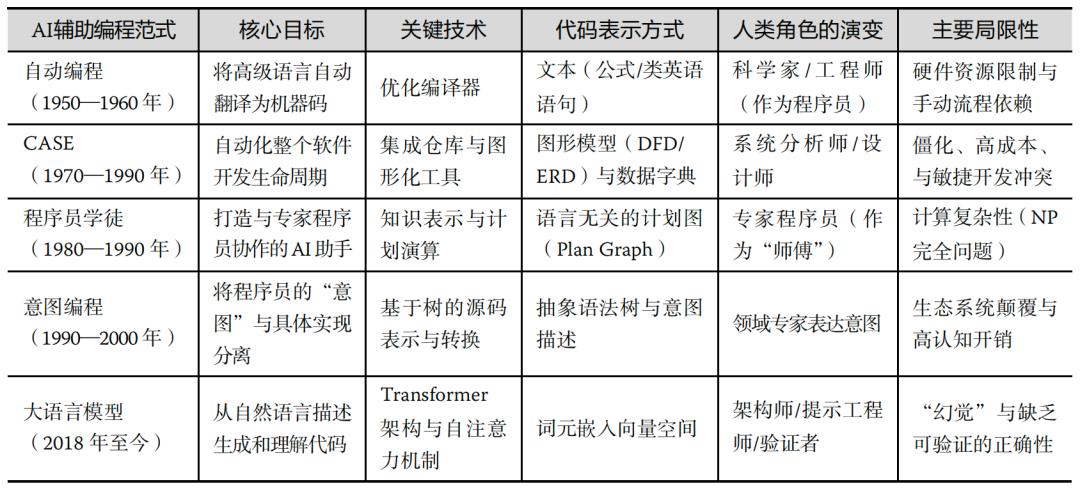
To help readers build a clear knowledge framework, Table 1 outlines 5 major AI-assisted programming paradigms, comparing them across dimensions including core objectives, key technologies, code representation methods, the evolution of human roles, and main limitations.
Table 1: 5 Major AI-Assisted Programming Paradigms
01
The Genesis of Automation — The Dream of Symbolic AI
The Machine That Can Reason
In the early days of computer software development, scientists generally believed that since programs are essentially a series of logical operations on data, this process should in theory be mathematically provable and automatable. This idea was fully embodied at the 1956 Dartmouth Conference, which not only formally established "Artificial Intelligence" as an academic discipline, but also clarified its core vision. The conference proposal boldly conjectured: "Every aspect of learning or any other feature of intelligence can in principle be so precisely described that a machine can be made to simulate it."
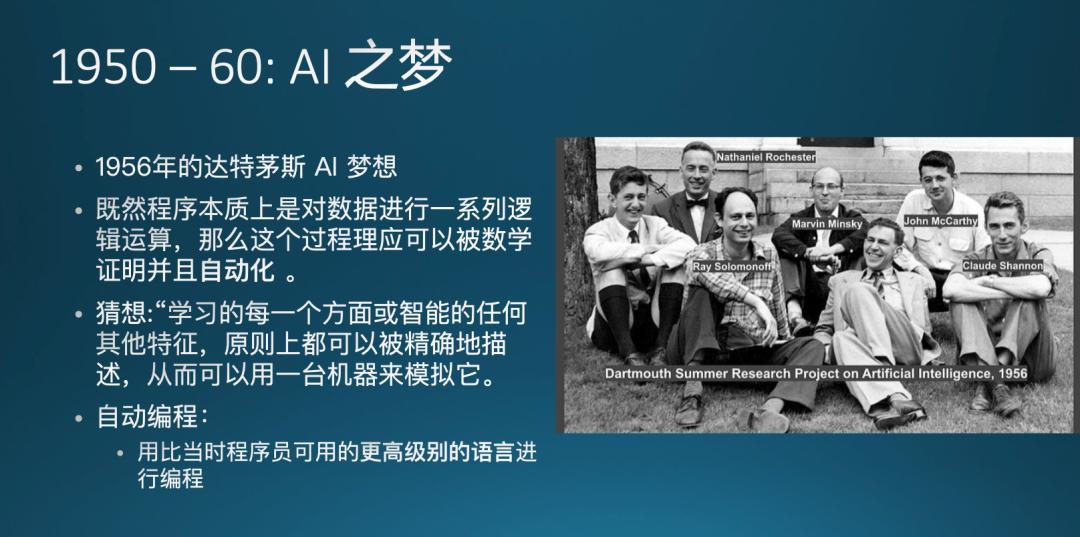
Under this grand blueprint, "automatic programming" was not an isolated technical problem, but an inevitable corollary of the entire vision. The ideas of the pioneers at that time far exceeded modern compilers: they hoped to simulate the entire thinking process of human programmers from understanding problems to generating code. This vision defined automatic programming as a core AI problem centered on knowledge, abstraction and formalization, and the mainstream paradigm to solve it was Symbolic AI. Its core creed is: intelligence originates from logical operations on symbols, and these operations are based on a set of clearly encoded knowledge and rules.
Despite the grand vision, the hardware at that time was extremely primitive. Programming in the 1950s and 1960s was extremely arduous: programmers needed to write code by punching holes in cards, then load stacks of punched cards into computers. Computer memory was extremely scarce and expensive, and there were no interactive computing environments. The implementable "automatic programming" vision at that time referred to "programming in a way closer to natural language or human mathematical expressions than machine language". This was the first step for human programmers to move towards a higher-level abstraction of machine instructions, a challenge that was later realized by COBOL (Common Business-Oriented Language) and FORTRAN respectively.
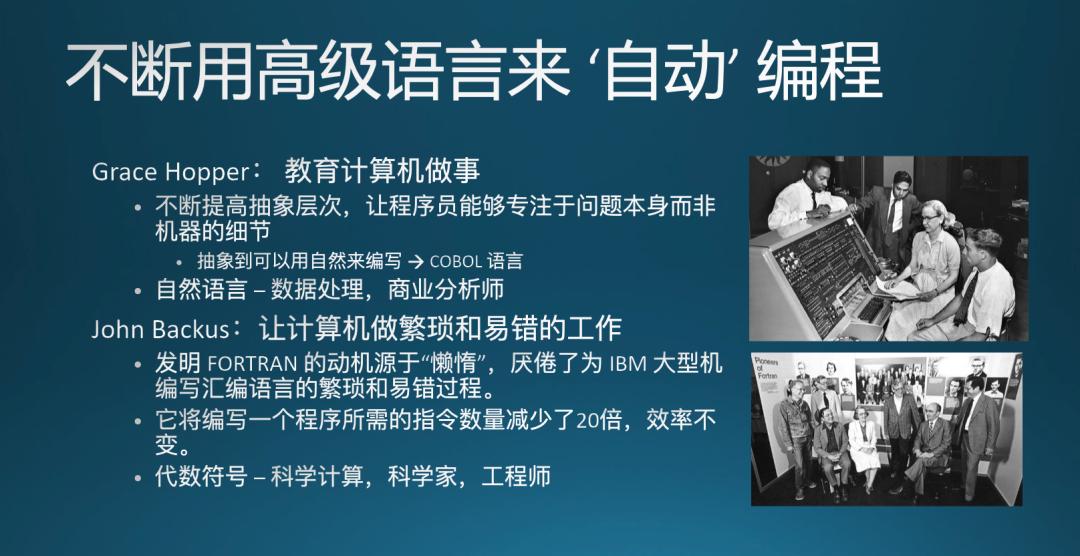
Grace Hopper was a key pioneer in this field. Her work on the UNIVAC I computer laid a practical foundation for "automatic programming".
- In her landmark 1952 paper *The Education of a Computer*, Hopper elaborated on her grand vision of programming automation. She proposed the concept of layered operations, aiming to gradually liberate humans from tedious programming labor. She envisioned that the "education" process of computers would evolve from executing basic machine instructions, to being able to understand and call subroutine libraries, and eventually even perform symbolic operations such as automatic differentiation. The core philosophy of this paper is that by continuously raising the level of abstraction, programmers can "return to being mathematicians", focusing on the problems themselves rather than the details of machines.
- COBOL: Hopper's work was not limited to scientific computing. She firmly believed that computer programs could be written in English, so that people without a mathematical background could also use computers, especially for business applications. With the continuous efforts of many developers, COBOL was born, and it dominated the field of business software development for the next few decades.
John Backus and FORTRAN
If Hopper's work opened the door to automation for business computing, John Backus and his team at IBM defined the future of scientific computing through FORTRAN.
- Backus once confessed that his motivation for developing FORTRAN came from "laziness", because he was tired of the tedious and error-prone process of writing assembly language for various IBM mainframes.
- FORTRAN (1957): As the world's first optimizing compiler, FORTRAN (Formula Translation) broke the prevailing bias at the time that "machine code cannot be as efficient as handwritten assembly". It successfully generated high-efficiency programs comparable to those written by expert programmers, reducing the workload of writing instructions to 1/20 of the original, and thus quickly gained widespread recognition in the scientific and engineering communities.
Historical Context and Limitations of the Era
The emergence of high-level languages and compilers was undoubtedly a revolution. However, from the very beginning, this revolution also revealed two fundamental contradictions in software engineering that still affect us to this day.
First, the trade-off between abstraction and performance was born. The core goal of high-level languages is abstraction — hiding the complex details of machines, so that programmers can work in a way closer to human thinking. But this abstraction does not come without a cost: early programmers had deep doubts about its performance. FORTRAN proved through its optimization capabilities that high-level abstraction can coexist with high performance. This established a basic rule for the application of programming languages and software tools: developers crave higher-level abstraction, but will only adopt it when performance is acceptable. This rule has been repeatedly verified in the rise and fall of later CASE tools, 4GL (Fourth-Generation Language) and even early interpreted languages.
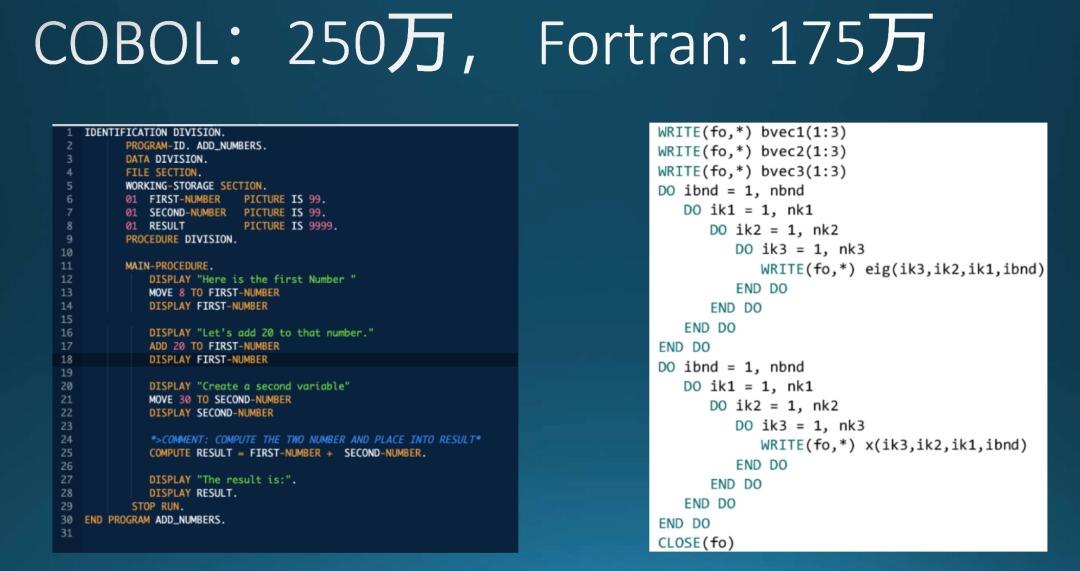
Second, two distinct programming cultures began to take shape. FORTRAN adopted algebraic notation and was designed specifically for scientific and engineering computing, with scientists and engineers as its target users. COBOL, on the other hand, used English-like syntax to process business data, targeting business analysts. These two languages embodied a division between two philosophies: they targeted different markets, ran on different hardware, and spawned their own independent ecosystems of tools, experts and cultures — "scientific computing" and "data processing". This division lasted for more than a decade, until the rise of general-purpose programming languages such as C gradually bridged the gap.
02
Industrialization of Software: The Rise and Fall of CASE
The "Software Crisis" and the Call for Engineering Discipline: Software Engineering
With the popularization of computer applications and the rapid expansion of software system scale, software development encountered severe "growing pains" in the late 1960s and 1970s. Projects generally faced delays, budget overruns and poor quality, a phenomenon known as the "software crisis". To address this challenge, the term "software engineering" formally appeared in academia in 1968. Its core idea is to draw on the principles of traditional engineering disciplines to introduce more rigorous, predictable and systematic management methods for software development. This pursuit of engineering discipline laid the ideological foundation for the birth of a new category of tools.
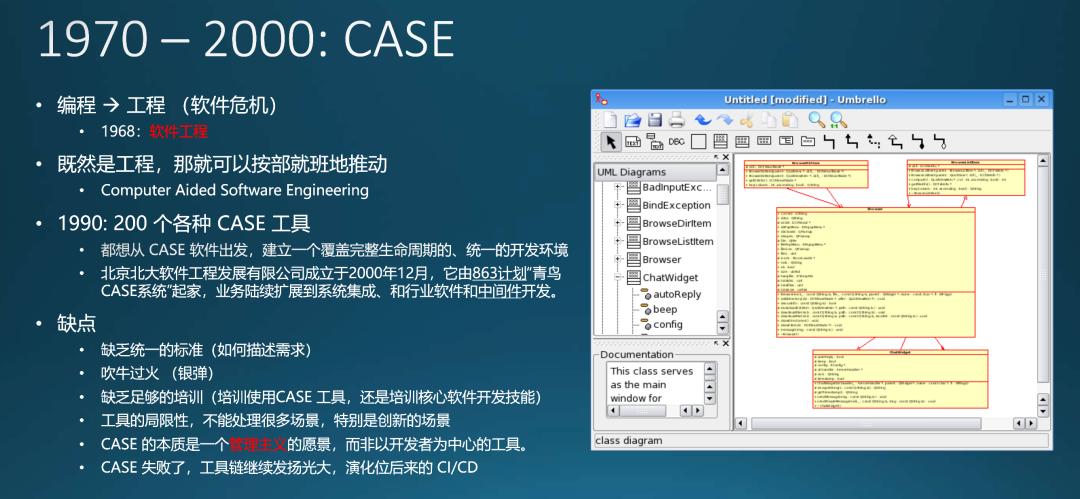
The Promise of CASE: Computer-Aided Software Engineering
The core vision of CASE (Computer-Aided Software Engineering) is to use computers to automate and integrate the entire software development lifecycle — from initial requirements analysis to final system maintenance. Its goal is to shorten development time, reduce costs and improve software quality through automation. This idea was deeply inspired by CAD (Computer-Aided Design) tools used for hardware design.
A typical integrated CASE environment consists of the following key components.
- Upper CASE and Lower CASE: This classification reflects the different positioning of tools in the software development lifecycle. Upper CASE tools focus on early, abstract stages such as requirements analysis and system design. They provide graphical modeling tools that support methods such as Data Flow Diagrams (DFD), Entity-Relationship Diagrams (ERD) and structure charts. Lower CASE tools focus on later specific implementation stages, such as automatic code generation, debugging, testing and reverse engineering.
- Central Repository: This is the technical core of the CASE environment. It is a central database or data dictionary used to store all artifacts generated during project development, including diagrams, data definitions, screen layouts, business logic, etc. This repository is designed to ensure consistency across all development activities and provide a "single source of truth".
The late 1980s to early 1990s was the heyday of CASE tools. Numerous products emerged on the market, and major software companies all wanted to build a unified development environment covering the entire lifecycle based on CASE tools.
The code generation wizard in Microsoft's Visual Studio (see the figure below) is also one of the few successful cases of this "automatic code generation" idea. It successfully built the basic framework of most Windows applications, greatly lowering the threshold for developers to get started with complex frameworks (such as multi-window document processing applications).
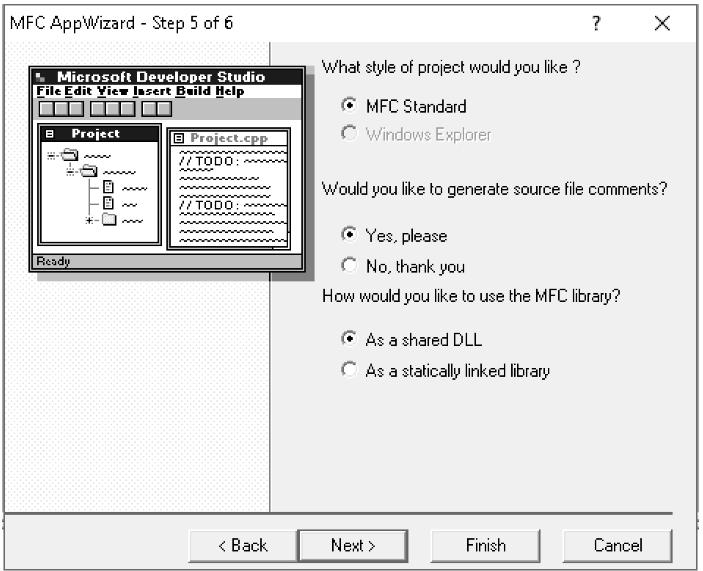
MFC AppWizard allows programmers to easily configure various desktop applications and automatically generate runnable basic framework code
Unfulfilled Promises: Critical Reflections on CASE
Despite the grand vision of CASE, it did not achieve the expected success in practice, and began to decline in the mid-1990s. Its failure was caused by multiple reasons, as detailed below.
- Technical and Economic Barriers: CASE tools themselves are extremely complex, with a steep learning curve. At the same time, they are very expensive and often require proprietary hardware support, making them affordable only for large enterprises.
- Methodology and Standard Wars: CASE tools are usually tightly bound to specific development methodologies (such as structured analysis and design). This "methodology lock-in" makes tools from different vendors difficult to be compatible and integrated. When Object-Oriented Programming (OOP) rose, traditional CASE tools seemed completely incompatible. Various incompatibility issues were not alleviated until the Unified Modeling Language (UML) was formally established as an industry standard in 1997.
- Conflict with Emerging Paradigms: The top-down, centrally controlled "waterfall" development process enforced by CASE tools ran counter to the agile development ideas that were emerging at the time. Agile methods emphasize "individuals and interactions over processes and tools", while CASE tools appear too cumbersome and rigid. In addition, the popularization of personal computers, the rise of the open source movement, and the emergence of distributed development models all made people prefer lightweight, composable tools rather than a monolithic all-in-one environment like CASE.
The essence of CASE is a set of tools oriented to managementist visions rather than centered on developers. It attempts to solve the software crisis from the perspective of management and cost control. Therefore, the core value proposition of CASE tools is to provide project managers with control, predictability and automated documentation. Functions such as central repositories and diagram consistency checks were originally designed to enforce top-down design and prevent developers from deviating from preset tracks.
However, for many front-line developers, these tools are seen as rigid, tedious shackles that stifle creativity, and many programmers do not have a good impression of such tools. This exposes a fundamental problem: CASE tools are designed for the managers who purchase them, not necessarily for the developers who must use them, let alone for various innovative application development scenarios.
When a whale falls, all things thrive. Although the grand integrated vision of CASE has been shattered, many of its ideas and functions have survived in the form of independent tools and become indispensable parts of modern development environments. In the post-CASE era, these functions have evolved into leading products in their respective fields: UML modeling tools (such as Rational Rose), version control systems (such as SVN, Git), IDEs with integrated debugging functions, and CI/CD (Continuous Integration/Continuous Deployment) systems. The modern developer's toolbox is, to a large extent, a recombination of these unbundled CASE components, except that this combination is more flexible, customizable, and controlled by the developers themselves.
03
Intelligent Collaborator: "The Programmer's Apprentice"
A New Vision: AI Assistant
While CASE tools tried to standardize software development with industrial processes, the MIT Artificial Intelligence Laboratory proposed a completely different vision. They did not try to replace or strictly control programmers with an all-powerful system, but aimed to create an intelligent assistant — The Programmer's Apprentice, to work side by side with human expert programmers. The job of this apprentice is to handle repetitive, patterned programming tasks, thus freeing human programmers to focus on more challenging architectural design and algorithm innovation. This idea accurately predicted the core concept of today's "AI pair programmer" more than 30 years ago. The project leaders (Charles Rich and Richard C. Waters) planned that:
The goal of the Programmer's Apprentice is to establish a theory of how expert programmers analyze, synthesize, modify, explain, specify, verify and document programs. This research goal spans the two major fields of Artificial Intelligence (AI) and Software Engineering (SE) (see the figure below).
From the perspective of artificial intelligence, we choose the programming domain as a starting point for researching fundamental problems in knowledge representation and reasoning. From the perspective of software engineering, we are committed to automating the programming process by applying artificial intelligence technologies.
