Gemini 3.7 Flash Launches Swiftly, Google Is Forced to Participate in the "Price War"
Just three weeks after the release of Gemini 3.6 Flash, Google has rolled out another swift update.
On August 13 local time in the United States, Google launched Gemini 3.7 Flash. This upgrade focuses on programming, agent applications, Web development, and complex knowledge work. Google officials even explicitly defined it as "the most intelligent Flash-level workhorse model for coding and agent use cases to date."
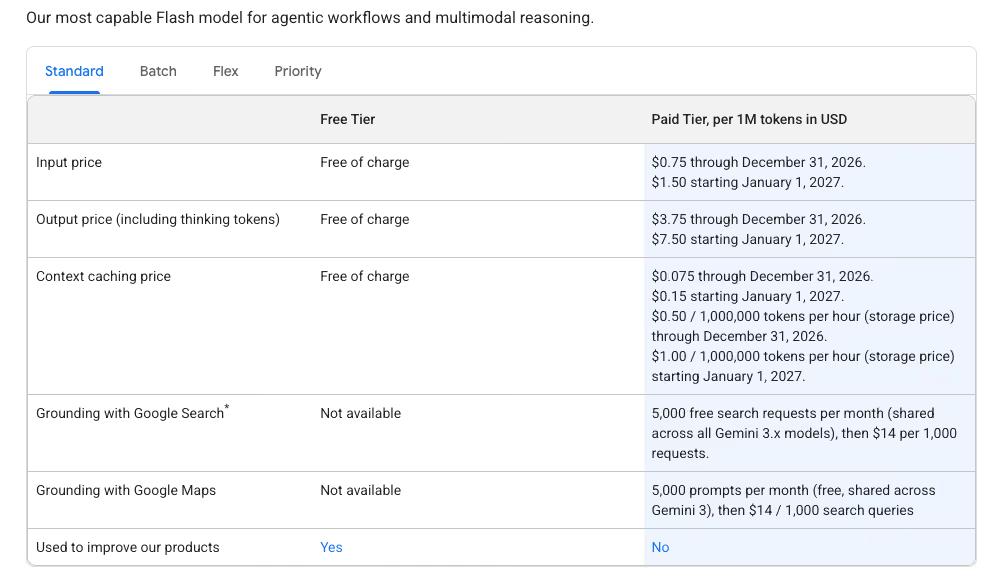
Apart from optimizing model capabilities, Google has also been forced to pull the "price lever" to attract customers by highlighting cost-effectiveness: before the end of 2026, the entry price for Gemini 3.7 Flash API will be halved directly, down to $0.75 per million input Tokens and $3.75 per million output Tokens.
Google hopes that through this high-frequency iteration and low-price strategy, the model can reduce failed retries and manual intervention in complex multi-step tasks, thereby helping developers significantly cut deployment costs in real business scenarios.
01
Programming, Agents and Multi-Model Collaboration
Gemini 3.7 Flash retains the advantage of multimodal input in its basic specifications, supporting text, image, audio and video input, with the context window maintained at 1 million Tokens and the output limit raised to 64K Tokens.
The model also introduces adjustable thinking configurations, allowing users to flexibly balance output quality, inference cost and response speed across different tasks.
The most core change in this upgrade lies in the way the model handles practical engineering tasks.
Google stated that Gemini 3.7 Flash demonstrates stronger adaptability when encountering obstacles, can actively clarify user intentions, and execute specific instructions more rigorously. At the same time, by allocating more computing resources to multi-step planning and tool calling, it reduces the need for endless loop retries and manual supervision in engineering workflows.
In actual code debugging and complex problem-solving tasks, the generation quality of Gemini 3.7 Flash has achieved a substantial leap compared with the previous generation, especially when dealing with long-horizon software engineering and production-grade code, the first-pass accuracy has been significantly improved for the first time.
In the field of Web development, the new model can not only generate fully functional pages and complex applications with fewer prompts, but also accurately restore UI interfaces that fully match the design according to design systems, reference images and even simple interface screenshots.
For complex document understanding and enterprise automation workflows, the inference accuracy of the new model has also achieved a substantial increase. To demonstrate the practical deployment capability of the new model, Google showcased multiple real cases covering different fields at the launch event:
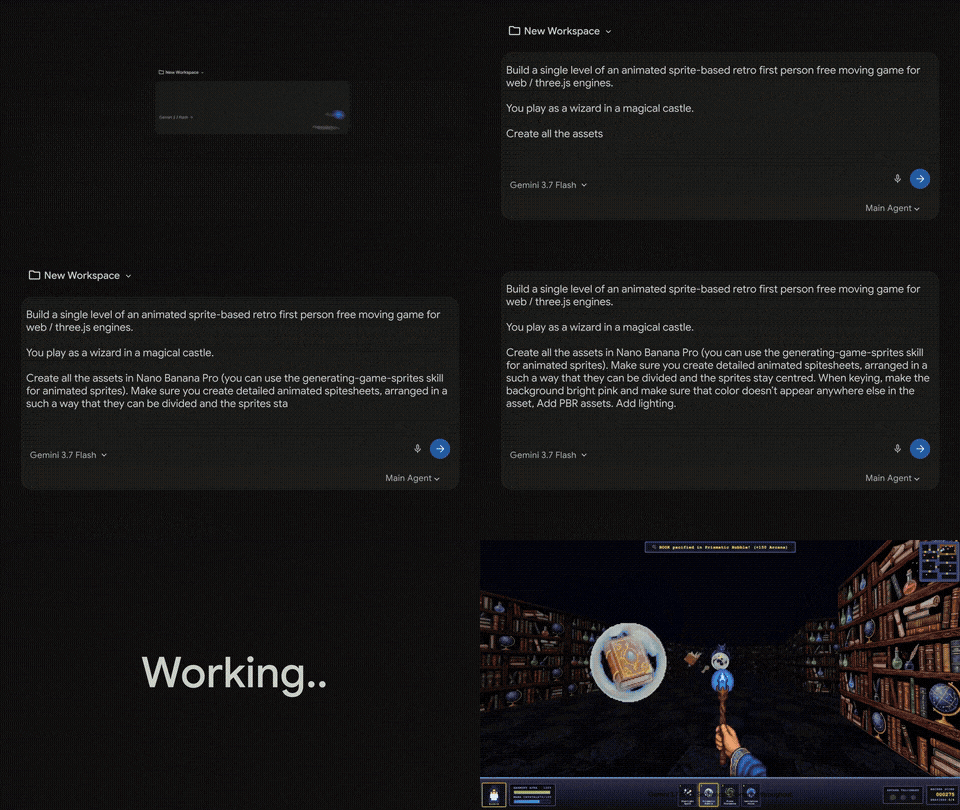
The first case is generating 3D games from simple text. Developers only need to input a simple text prompt, and Gemini 3.7 Flash can instantly build a playable 3D game framework, and collaborate with the Nano Banana model to dynamically generate characters, props and surface textures in the game in real time.
The second case is generating interactive landing pages in a single pass. Gemini 3.7 Flash can act as the master model to coordinate multiple sub-agents, and call Gemini Omni at the same time to create dynamic interactive components with parallax effects, directly outputting runnable web pages.

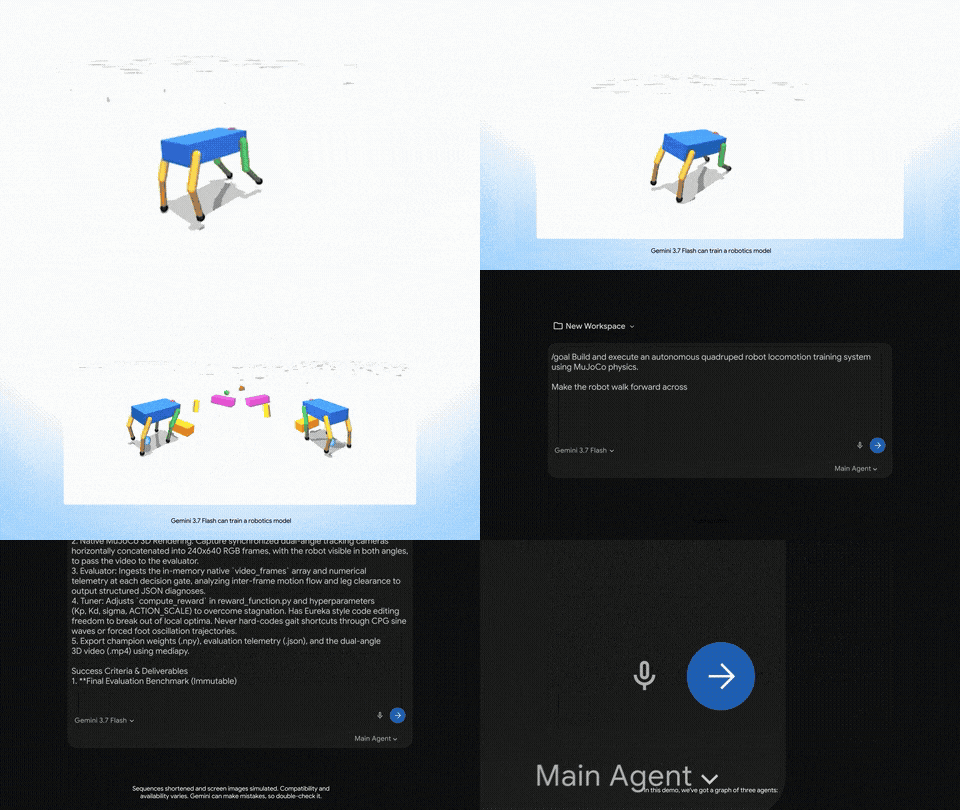
The third case is assisting robot training. In a graph loop containing three agents, Gemini 3.7 Flash uses its multimodal understanding capability to help robots with environmental perception and decision-making, thereby significantly accelerating the learning and training speed of robots.
The fourth case is dynamic transformation of static PDFs. The model can directly read a complex static annual report PDF, automatically parse and convert it into a dynamic web page containing real-time charts, interactive data and core insight summaries.

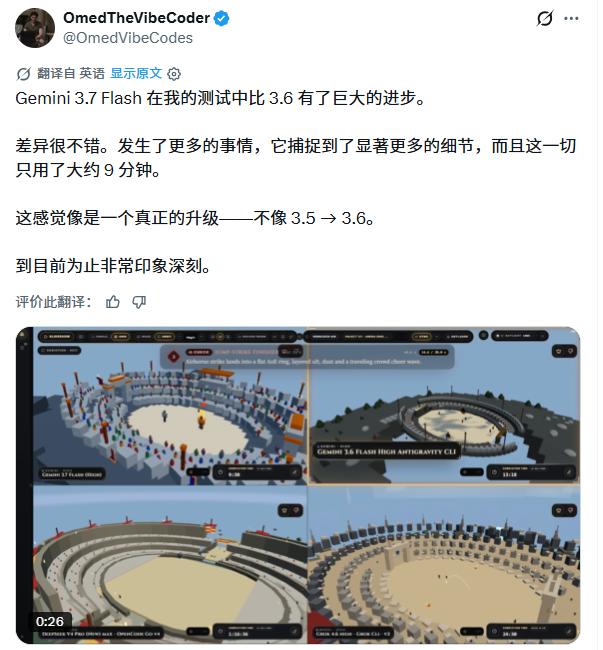
Software developer @OmedVibeCodes said that the new model demonstrated extremely high detail capture capability in a 9-minute-long test, with progress far exceeding previous versions.
Security researcher Florian Roth tested the model's performance in security event triage using the THOR benchmark. Among 189 real-world security findings, Gemini 3.7 Flash achieved a 100% threat capture rate and 0% critical omission. More importantly, it greatly reduced false positive alarms, preventing analysts from being overwhelmed by invalid reviews, making it the best security triage model he has ever tested.
02
Benchmark Performance Improved, But No Comprehensive Advantage Formed
Judging from the overall results of industry benchmark tests, the improvements of Gemini 3.7 Flash are relatively concentrated, but it has not achieved an all-round crushing of all competitors.
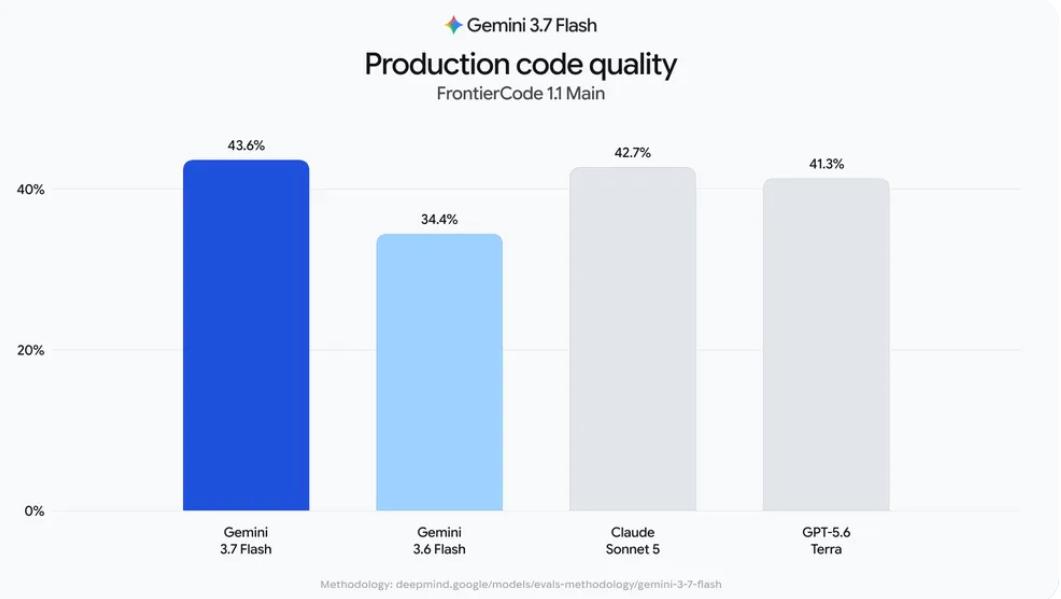
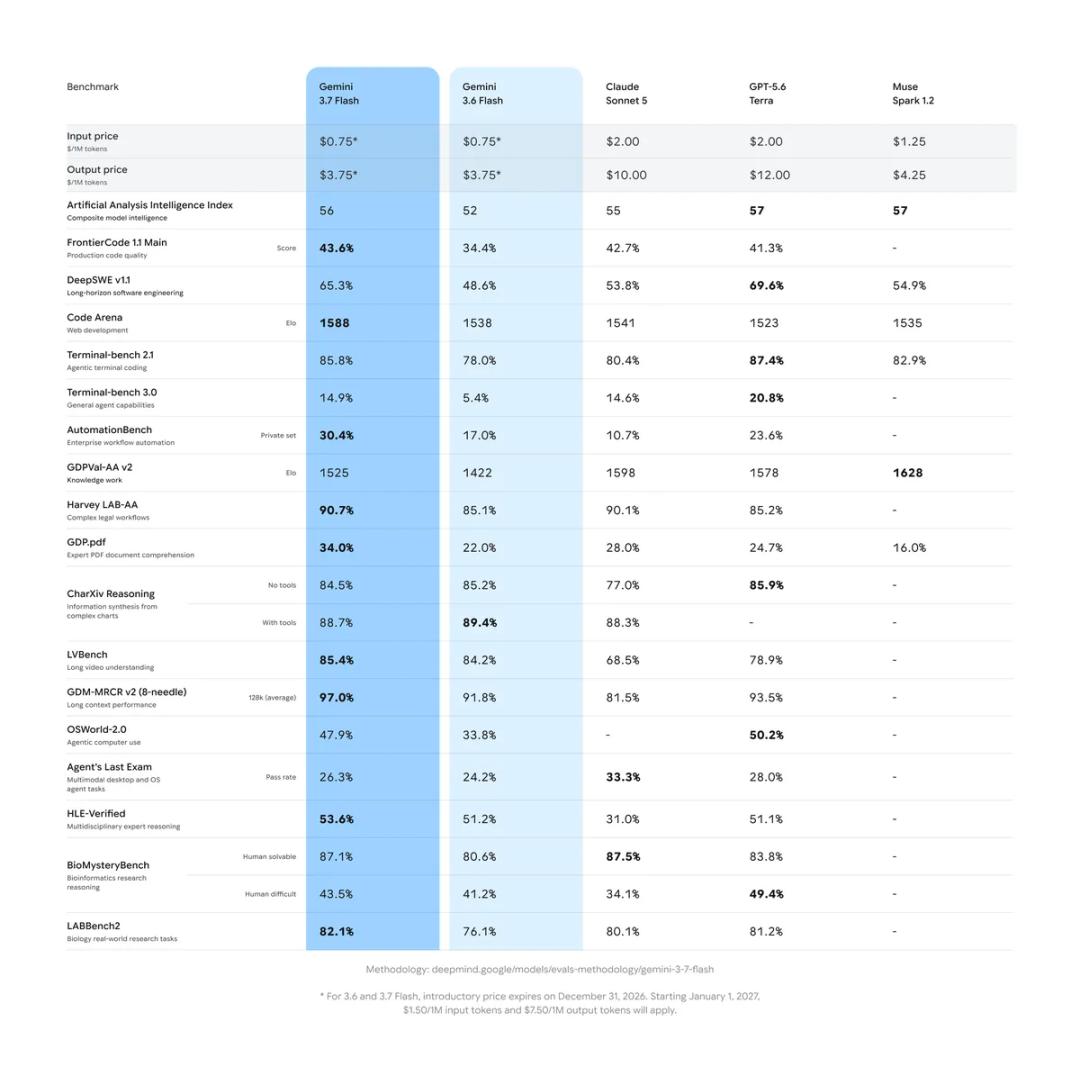
In the Production Code Quality (FrontierCode 1.1 Main) test, Gemini 3.7 Flash scored 43.6%, beating Claude Sonnet 5 (42.7%) and GPT-5.6 Terra (41.3%).
In the AA-AnalystAgent complex document and table analysis test by third-party institution Artificial Analysis, Gemini 3.7 Flash even achieved the highest pass^5 score of 60%, leading Claude Opus 5 (54%).
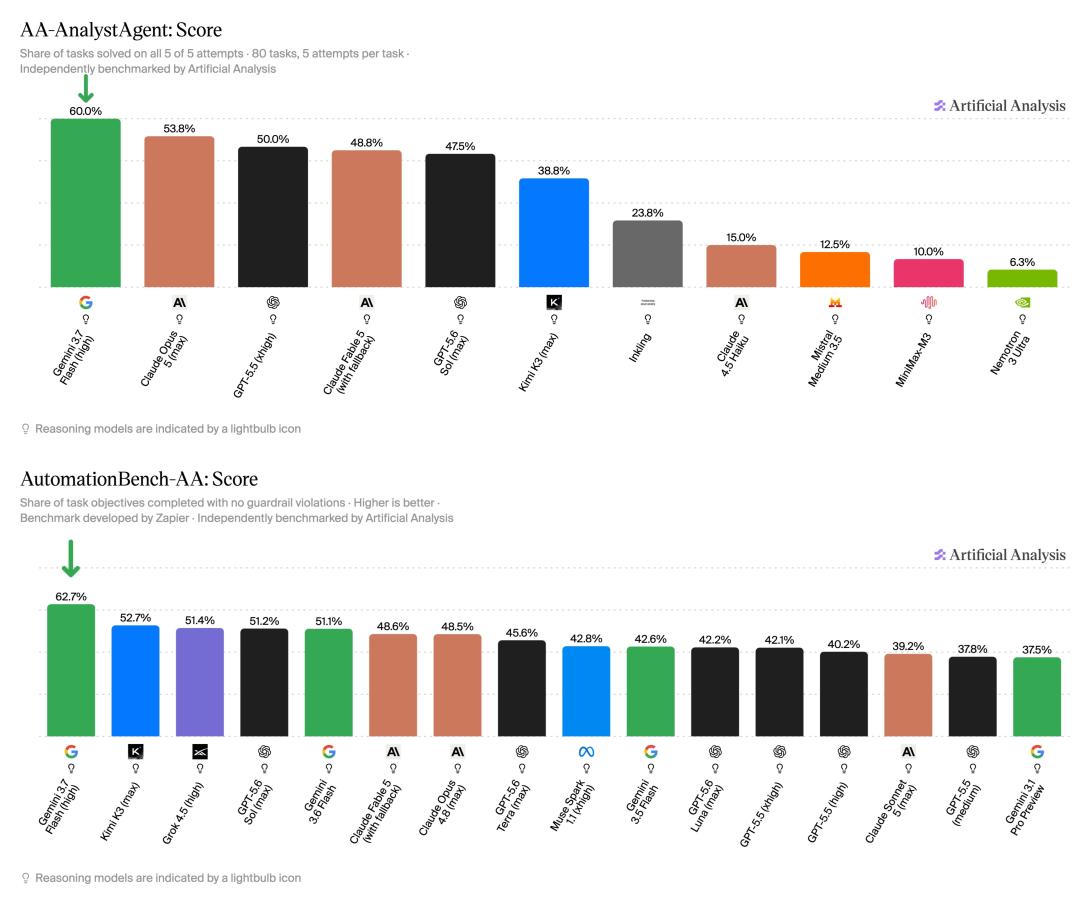
At the same time, it reached 62.7% in the AutomationBench-AA test, also leading Kimi K3 (53%) and GPT-5.6 Sol (51.2%).
However, in some extreme scenarios, competing products still maintain their leading positions.
For example, in the long-horizon software engineering test DeepSWE v1.1 from Artificial Analysis, the 65.3% score of Gemini 3.7 Flash is lower than the 69.6% of GPT-5.6 Terra; in the Terminal-bench 2.1 terminal coding test, it is slightly inferior to GPT-5.6 Terra at 85.8% vs 87.4%. While in the Agent's Last Exam multimodal desktop test, Claude Sonnet 5 leads with a 33.3% pass rate over 26.3% of Gemini 3.7 Flash.
Comprehensive evaluation data from Artificial Analysis shows that the intelligence index of Gemini 3.7 Flash in high inference mode reaches 56 points, 4 points higher than the previous generation, extremely close to GPT-5.6 Terra (57 points). At the same time, its output speed is as high as 340 Tokens per second, and the average task duration is only 1.7 minutes, nearly 40% faster than GPT-5.6 Terra. This high-speed inference capability has successfully brought it into the Pareto optimal frontier of "intelligence and completion time".
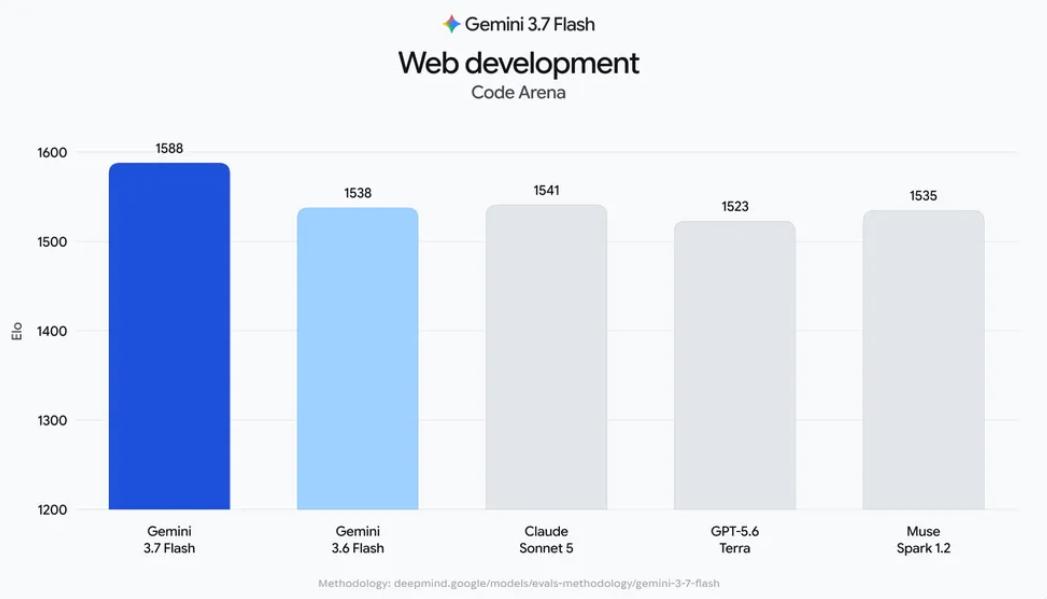
In the Arena evaluation specially set up for web development, mathematical reasoning and multi-turn conversation, the ranking of Gemini 3.7 Flash has also achieved a leapfrog rise.
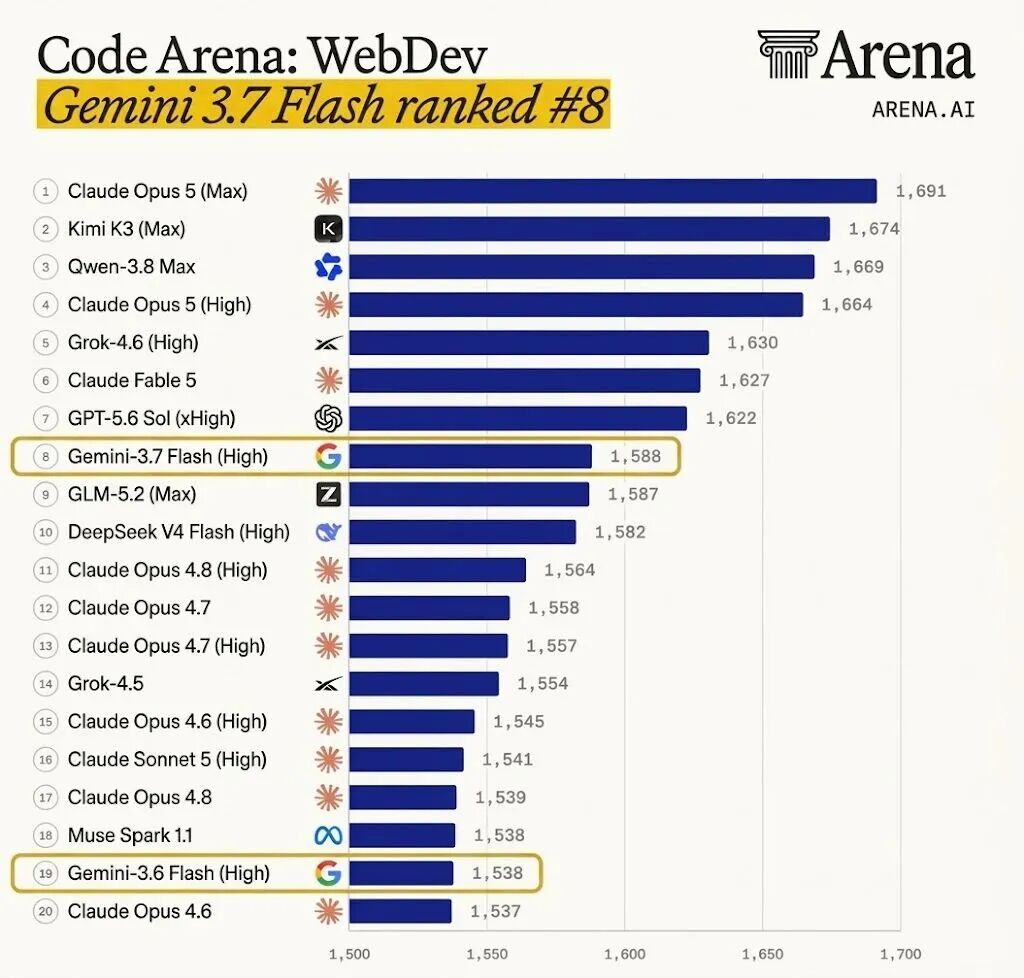
However, external observers such as LuminaBench also pointed out that the performance of Gemini 3.7 Flash is "disappointing". They believe that while it does make progress compared with 3.6 Flash, it lacks highlights overall and still lags behind Terra in multiple benchmark tests. Google urgently needs Gemini 4 to deliver more convincing performance, and the current version is obviously not enough to turn the tide.
Overall, the positioning of the new model is clear: it performs brilliantly in programming, web development, document understanding and regular agent tasks, but still has shortcomings in some highly complex terminal environment simulations.
03
Google Is Forced to Pull the "Price Lever"
Apart from capability improvement, pricing strategy is another strategic focus of this release.
Before December 31, 2026, Google offers extremely favorable promotional prices for developers: only $0.75 per million input Tokens, and only $3.75 per million output Tokens. This is equivalent to a direct 50% discount on the original standard price of Gemini 3.6 Flash.
On January 1, 2027, the price will return to $1.50 per million input Tokens and $7.50 per million output Tokens. This means Google has reserved a multi-month low-price window for the market.
For developing autonomous agents, the unit price of Tokens is only part of the total cost. An agent task in real business often requires multiple model calls, tool execution and error retries. If the model is cheap but prone to frequent errors, causing the program to fall into loop retries or require manual intervention, the total operating cost will be even higher in the end.
Google's emphasis on higher first-pass execution success rate and more rigorous instruction compliance this time is precisely to directly address this pain point.
Cost calculation from Artificial Analysis shows that at the current discounted price, the average cost per task of Gemini 3.7 Flash in high inference mode is about $0.40, and it further drops to $0.26 in medium inference mode.
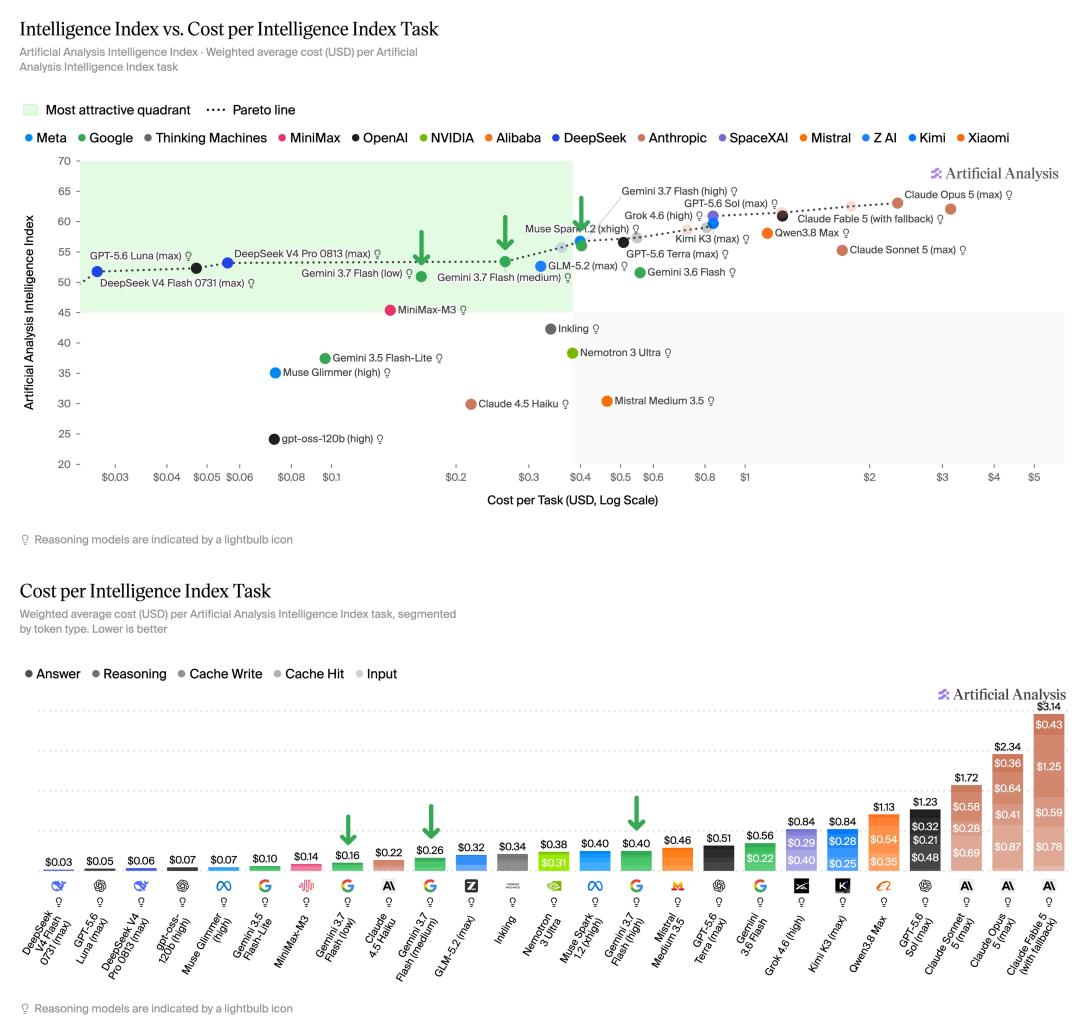
Google is trying to prove that by improving the reliability of the model in real code bases and business processes, it can largely help enterprises truly hit the key point of cost reduction and efficiency improvement.
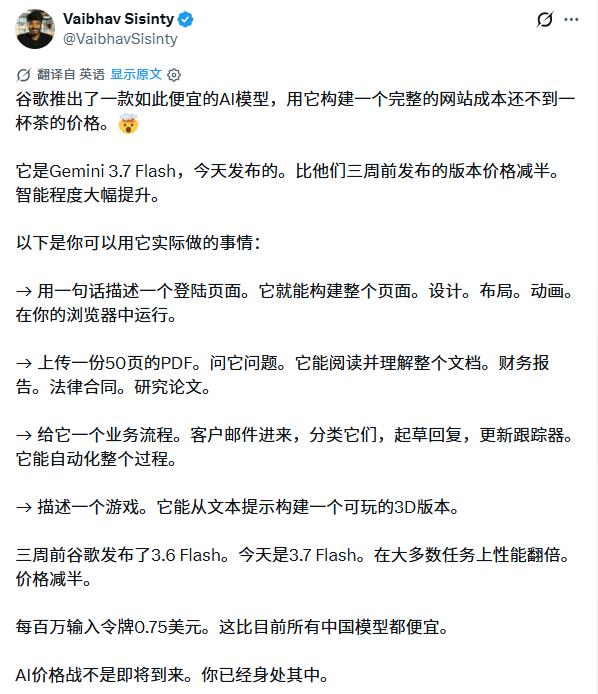
Developer @VaibhavSisinty commented that Gemini 3.7 Flash is so cheap that "the cost of building a full website is less than the price of a cup of tea". At only $0.75 per million input Tokens, it is already lower than all Chinese models at present. In his view, the AI price war is not coming soon, it is already underway.
After the release, Gemini 3.7 Flash has been quickly integrated into all Google's products and development platforms.
Developers can now call the model directly through channels such as the Gemini API. Enterprise customers can deploy their businesses through the Gemini Enterprise Agent Platform and Gemini Enterprise platform. For individual users, Google AI Pro and Ultra subscribers can directly experience 3.7 Flash in their personal AI agent Spark.

At the same time, Google has updated its protection rules for chemical, biological, radiological, nuclear risks and cyberatt