The black whale emerges from the water, and the second half of DeepSeek begins.
DeepSeek's most promising project has arrived, where everything can be a plugin. Harness is not meant to imitate anyone, but to hand over the right of definition to the open-source community.
On the evening of August 13, the official DeepSeek team finally made a statement and released two important updates. First, the official stable version of DeepSeek V4 Pro was launched, with simultaneous updates rolled out on the APP, web platform and API. Users can select the "Expert Mode" on the APP or web platform to use the brand new official V4 Pro model, while the API model name remains unchanged.
Second, the "DeepSeek Harness Team" represented by a black whale avatar released its first public announcement, declaring that the developer preview version of Harness is officially launched, with its source code open-sourced under the MIT license.
As previously previewed, the official V4 Pro version made its debut simultaneously with the in-house developed Harness. Since we have already introduced V4 Pro in detail before, this article will focus on analyzing what makes DeepSeek Harness so noteworthy.
And after this day, will DeepSeek evolve from a pure model company to an entity that is far more difficult to define?
01
The exact same model can perform completely differently with a different execution wrapper
To understand why Harness is important, we first need to grasp a counterintuitive fact: in the Agent era, it is not the model alone that determines whether an AI can effectively complete work tasks.
On August 6 and 11, Composio, an intelligent agent tool company, conducted two rounds of test experiments to verify the value of Harness. Researchers connected the exact same DeepSeek V4-Flash to eight different Harness instances, which are execution systems wrapped around the model, and tasked them with completing 30 multi-step tasks respectively. These tasks are not simple Q&A sessions: they require the Agent to access real applications such as Gmail, Google Calendar, GitHub and Slack, call tools and modify the application status. Each task can run for a maximum of 15 minutes, and is deemed successful only after all checkpoints are passed.
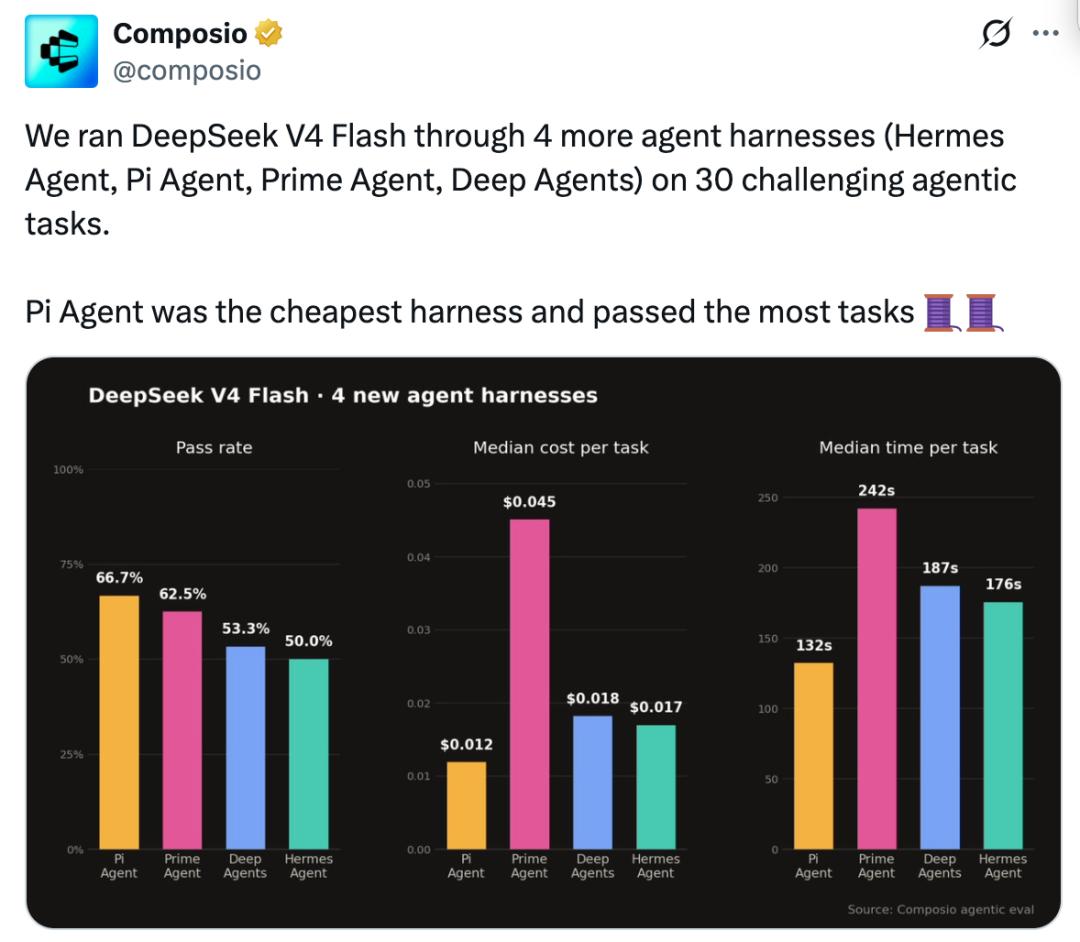
The results show considerable gaps. The top-performing Pi Agent passed 20 tasks, while the lowest-performing OpenCode only passed 14; the 8 Harness instances ran a total of 240 times with only 129 successful attempts; among the 30 tasks, only 6 were completed by all Harness instances. In terms of cost, for Claude Code, Codex and DeepAgents that all completed 16 tasks, the estimated cost per successful task is approximately $0.195, $0.081 and $0.045 respectively. For the exact same model, the cost gap is more than four times.
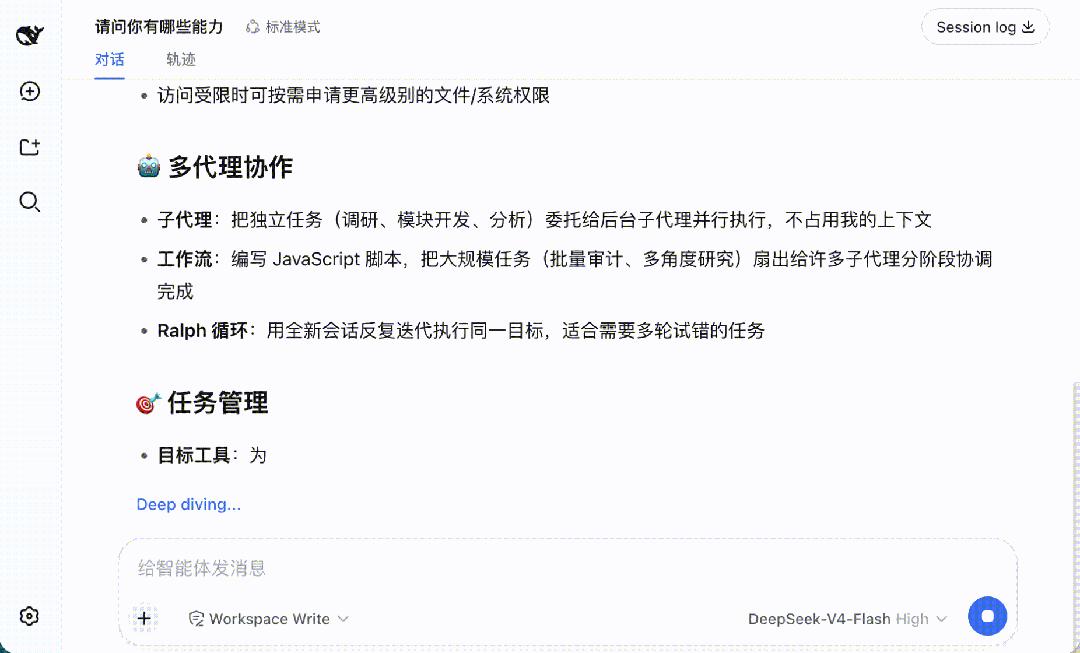
This means that the model sets the upper limit of capability, while Harness determines how much of this upper limit can be finally realized and how much it will cost. When a long task is running, the execution system needs to make constant judgments: what to keep and what to discard in the context, when to call which tool, whether to retry or switch to another path when a tool reports an error, whether to trust the model's claim that the task is completed and whether to verify it again. If any step is not handled properly, even if the model has the correct idea, it may fail at the last moment when actually modifying files or submitting code.
It is worth mentioning that this is one of the very few projects that opened internal beta testing in advance since DeepSeek rose to fame.
Multiple developers got access to the Harness internal beta before the official release. Some testers found that letting the same V4-Flash complete the same game on DeepSeek Harness, Reasonix and Codex respectively would produce completely different results. This proves that when the model is completely identical, the tools, prompts, context organization and execution strategies provided by the execution system are enough to significantly change the final output.
This is exactly why DeepSeek attaches great importance to self-developed Harness. DeepSeek internal teams once believed that Agents need to solve the problem of continuous learning, and ultimately accelerate AI R&D with the help of AI. Following this logic, Harness is not an external programming tool, but a workbench for models to enter real R&D tasks.
In addition, for a company that relies on low prices and model capabilities to gain a foothold, if task delivery, failure feedback and developer entry are long-term hosted on other people's systems, even if it has advantages in pricing, it cannot determine how many Tokens a task will consume, how many retries are needed, and when the task is truly completed.
02
Everything is a plugin, DeepSeek does not position itself as a substitute for any existing product
What exactly is Harness? The most convenient description on the market is "DeepSeek's version of Claude Code". But most people who have used the internal beta version agree that this positioning is inaccurate.
According to DeepSeek's official documentation, the core design philosophy of Harness is "Everything is a plugin". It is built on the Cordis plugin system, and all Agent capabilities including models, tools, skills, conversations, sandboxes, storage, loops, scheduling and UI are composed of combined plugins. Developers do not need to modify the Harness source code, and can select, replace or extend any capability through configuration.
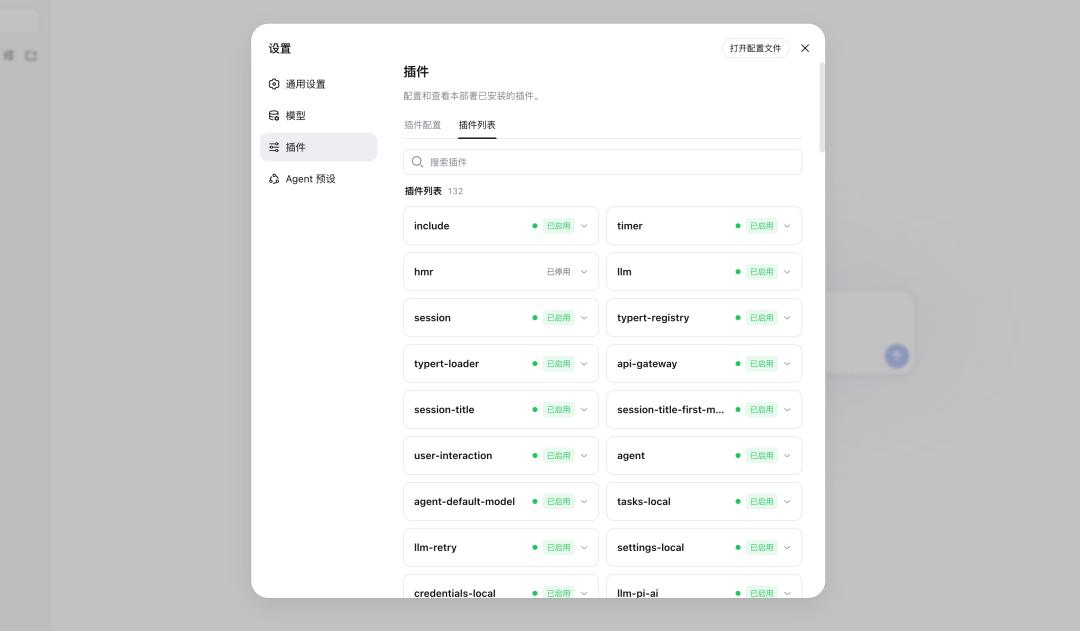
This is not at the same level as the plugins we usually understand. VS Code plugins add extra features to the editor, and Codex plugins add new tools to the Agent; while Harness plugins can replace the Agent's core model, toolbox, rules and even its entire user interface.
According to multiple people who participated in the internal test, developers were extremely enthusiastic about developing plugins during the beta period, "Everyone stopped doing regular beta testing and started writing plugins". Hundreds of plugins emerged in just a few days: some people completely redesigned the entire working interface, some implemented "long-term cross-session memory plus background self-evolution" purely with plugins, allowing the model to regularly review its own work records and compress temporary experience into permanent knowledge.
Some reviewers commented that open-source community governance may also be a difficult problem that DeepSeek will face next.
Another key design is traceability. Harness adopts an append-only conversation log, everything the model sees - system prompts, chain of thought, tool calls and results, sub-agent scheduling, and every context injection will be fully recorded. Context compression will not delete the original history, it only uses replacement events to change the appearance that the model sees afterwards. Developers can trace back by source in the Trajectory view, which supports restoration, forking, retrieval and playback. The official document summarizes this principle as "Anything visible to the model has been recorded".
This is a typical system engineering mindset. It is reported that Cui Tianyi, the head of the DeepSeek Harness team, graduated from the Department of Computer Science of Zhejiang University, worked at Jane Street, a quantitative trading institution, for 9 years, joined DeepSeek in March 2026, and the Harness project was established internally in May. The core barrier of high-frequency quantitative trading systems has never been how smart the strategies are, but stable execution in extremely complex environments, abnormal fallback, full-process log tracing and controllable risks - which is exactly the missing piece that AI Agents need to move from demonstration to production. One beta developer described its performance when running long tasks as "extremely stable": the task will automatically save progress when interrupted, and resume running next time without restarting from scratch.
It is worth noting that Harness does not lock itself into DeepSeek's own model ecosystem. It supports connecting to nearly 40 large model providers by default, including Kimi, OpenAI, Anthropic and Google. Other companies tend to provide a ready-to-use Agent product, but DeepSeek Harness is more like a set of components, where developers can decide for themselves what the Agent should look like and how it should work.
Of course, the official team remains sober. The announcement states that as an early preview version, "there are still many details to be improved and polished, and core plugins and basic interfaces will be iterated rapidly in subsequent updates". In fact, one of the media outlets that participated in the internal test, ifanr, exclaimed that it is hard to imagine that DeepSeek, which is famous for its fast iteration speed, now also takes more than half an hour to run a programming task. The v0.1 version number also indicates that this black whale has just surfaced, and is far from being able to swim freely.
03
From selling Tokens to delivering verifiable results, the ambition of the black whale
The public launch of Harness coincides with a major shift across the entire AI industry.
In the past few years, competition among large model companies has focused on parameter scale and benchmark scores. But in 2026, the basic capabilities of leading models are rapidly converging, the gap in single-turn Q&A performance is narrowing, while the price war is becoming increasingly fierce. The business model of simply selling Tokens has a clearly visible ceiling. The industry has gradually realized that the core value of the AI industry does not lie in model output, but in scenario implementation - with the same Token consumption, casual Q&A creates little value, while fixing a Bug or completing a feature development can generate several times more commercial value.
DeepSeek's new release means its transformation from selling computing power to delivering tangible results. Under the old model, customers pay according to Token usage, regardless of whether the model has actually solved the problem; under the new model, the payment anchor shifts from how much computing power is consumed to what tasks have been completed.
The DeepSeek Harness release has received widespread praise from developers for another reason. DeepSeek does not define the Agent itself, but leverages the diffusion capability of the open-source community to promote the Harness solution. This is a more ambitious but also more difficult path.
In addition, Harness is targeting a mature market that has already been validated by Claude Code and Codex. The latter two, backed by the model iteration capabilities and commercial resources of Anthropic and OpenAI, have obvious first-mover advantages. After open-sourcing, many issues remain unresolved: whether the plugin ecosystem can thrive spontaneously, whether developers are willing to entrust their production environments to a 0.1 version product, and whether the payment habits in the domestic market can support the new "pay by results" logic. DeepSeek itself also stated that core plugins and APIs will continue to evolve rapidly, which means early adopters have to bear the cost of interface changes.
On August 13, two product launches took place on both sides of the Pacific Ocean. Elon Musk endorsed Grok 4.6, calling it "smart, fast and extremely cost-effective"; DeepSeek did not make any fancy statements, and only kept rolling out updates.
Between the hustle and bustle and silence, lies the divide between two different business philosophies.
We want to call it DeepSeek's "most promising project in history" not because it is already the strongest today. V4 Pro still lags behind SOTA models, Harness is only a v0.1 developer preview version, the market reaction after the price increase remains to be seen, and ecosystem construction is still a long journey. Potential is potential precisely because it has not been fully realized yet.
But if we look at the longer timeline, from R1 to V4, from models to Harness, every step DeepSeek takes is heading in the same direction: pushing cutting-edge capabilities down to an affordable cost, and then connecting these affordable capabilities to production-ready systems.
The black whale has already surfaced. How far it can swim, lies in the future belonging to the open-source community.
This article is from the WeChat official account "Phoenix Tech", Author: Dale, Editor: DONG Yuqing, published by 36Kr with authorization.