Even before most people have figured out the ropes of working a regular factory job, this Chinese robotics enterprise is poised to land on the moon.
This August, the red-hot commercial aerospace sector has not only ignited the investment market, but also assigned a batch of robots brand-new tasks.
With rocket launches becoming increasingly frequent and satellite constellations being built at a faster pace, China's commercial aerospace industry is facing a more concrete problem: after equipment is sent into space, who will handle its transportation, installation and maintenance?
These dirty and strenuous tasks cannot all be left to astronauts.
As a result, a number of robotics companies have started to set their sights on space. One of them is a robotics company established not long ago: Lunar Trek Dynamics — it is not hard to see from its name that the company has great "ambition" for the sea of stars.
According to reports, Lunar Trek Dynamics has begun to explore robots for lunar surface operations and on-orbit services, and plans to launch relevant engineering prototypes in phases from this year to the first half of 2028.
However, Lunar Trek Dynamics is a young company founded in 2024. It was not until June this year that it launched its first product: the L1, the first dual-wheel-legged humanoid robot, which is currently being verified in the factories of leading domestic enterprises, trying to complete basic tasks such as sorting.
In terms of order volume, according to the data disclosed by the company, the current total is only at the level of a few hundred units; another more impressive figure is that "many factories have put forward a cumulative deployment demand of about 1,000 units".
In other words, from the current point in time, even before Lunar Trek Dynamics can make its robots formal workers on the assembly line with their jobs fully confirmed, how does it start to plan to send robots into space, even to the moon?
Lunar Trek Dynamics aims to reach the Moon with its "cerebellum"
The reason why Lunar Trek Dynamics dares to extend the application scenarios of its robots from factories to the Moon is related to its chosen technical route.
At present, most humanoid robotics companies are building a smarter "brain" for their robots: enabling them to perceive the surrounding environment, understand human instructions, and decide what to do next on their own.
Lunar Trek Dynamics is betting heavily on the "cerebellum" of robots instead.
For example, if the "brain" is responsible for telling the robot "move the box to the shelf", the problem solved by the "cerebellum" is how much force to use when stretching out the hand, how to stabilize the body when the box suddenly becomes heavier, and how to adjust immediately when the object slips from the hand.
To a certain extent, this may be the key factor that determines whether a robot can smoothly work in a factory.
To this end, Lunar Trek Dynamics has developed a control engine named RACE, whose core is to combine the "reduced model" with reinforcement learning.
The so-called "reduction" is a bit like "reduction of a fraction" in mathematics: a problem seems very complicated at first, you first remove the parts that do not affect the answer, and only keep a few values that truly determine the result.
Still take moving boxes as an example. Dozens of joints all over the robot's body are moving, but to lift the box steadily, there are only a few things that need to be focused on most: how heavy the box is, whether the hand is gripping it firmly, and whether the body will lose balance after picking it up.
When the box becomes heavier, adjust the grip force and standing posture; when the box starts to slide down, grip it tightly immediately. As long as these key changes are captured, the robot does not need to learn how to carry each new type of box from scratch.
According to the data disclosed by the company, this method can compress the training data required for some tasks from the level of ten thousand or even millions to a double-digit scale. The control system equipped on the L1 can also achieve an update frequency of 1000Hz, which is equivalent to adjusting the robot's movements thousands of times per second.
This set of capabilities happens to have a certain connection with space operations.
On the Moon, the data, computing power and energy available to robots are more limited, and there is communication delay, so it is impossible to wait for engineers on Earth to remotely control every step the robot takes. When encountering soft ground, load changes or physical imbalance, it must rely on its own control system to respond in time.
Factories and the Moon are far apart, but one basic problem that robots need to solve remains unchanged: in the face of constantly changing forces and environments, can the body stabilize itself and continue to complete the movements.
This explains why Lunar Trek Dynamics set its sights on space so early. But the fact that the technical logic can connect factories to the Moon does not mean that the product has been fully validated.
At present, the L1 has just entered factories, and Lunar Trek Dynamics still needs to prove first: whether this "cerebellum" that sounds suitable for the Moon can help customers finish the work on Earth properly.
Before landing on the Moon, stay on Earth to work first
The first job Lunar Trek Dynamics arranged for the L1 is very simple: moving goods.
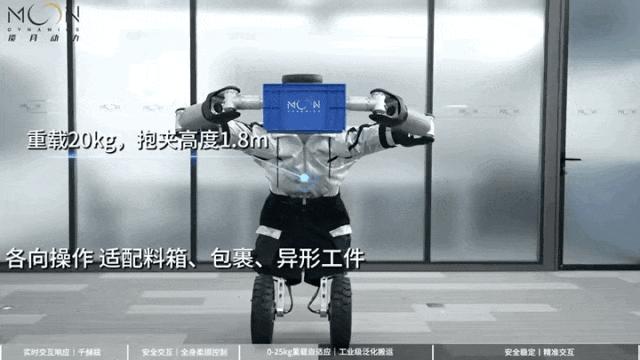
This robot is 165 cm tall, weighs 60 kg, and is equipped with a wheel under each of its two legs. It does not need to walk step by step like a biped robot, and can complete movements that ordinary wheeled robots are not convenient to do by bending over, squatting down and adjusting its center of gravity.
According to the data disclosed by the company, the L1 can carry a maximum load of 25 kg while moving, and it is mainly designed for tasks such as handling, stacking, loading and unloading, and logistics sorting.
These tasks seem simple, but they are very suitable for testing whether Lunar Trek Dynamics' "cerebellum" is really useful.
Traditional robotic arms are good at repeating the same movement at a fixed position. Once the product model changes, and its weight, size and placement position change, the program often needs to be reset.
In contrast, traditional human workers can pick up different boxes, weigh their weight roughly, and adjust their posture conveniently.
What Lunar Trek Dynamics hopes the L1 to fill is the gap between the two: it can not only work repeatedly for a long time like a machine, but also adjust its movements at any time according to the object in its hand like a human.
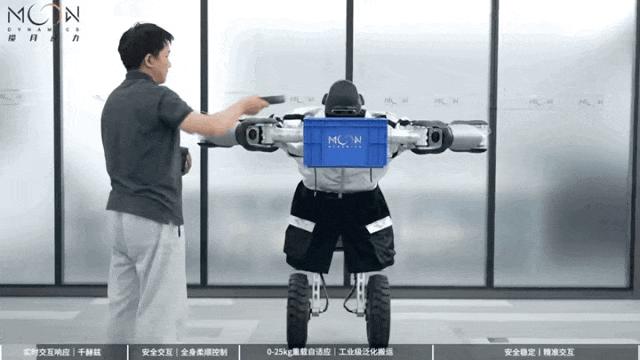
According to reports, the L1 has now entered scenarios such as auto parts production, magnetic material processing, and logistics warehousing for verification, trying to complete tasks such as spring box handling, stacking, loading and unloading, magnet block loading, and warehouse sorting.
However, there is still a huge gap between "entering the factory for verification" and "formally becoming a worker in the factory".
If a robot wants to run continuously on a real production line, customers will observe how much work it can do in a day, how many times it needs manual assistance, how long it takes to recover from a fault, and whether the saved labor cost can cover the procurement and maintenance expenses.
After passing these tests, it is possible for the prototype to become equipment that customers are willing to purchase in batches.
The previously mentioned hundreds of units of orders at least indicate that some customers are willing to give it a try. As for the cumulative deployment demand of about 1,000 units put forward by many factories, it is obviously far away from actual procurement, delivery and acceptance.
At present, Lunar Trek Dynamics has not publicly disclosed how many of these orders have been delivered, nor has it disclosed the continuous operation time, task completion efficiency and customer repurchase situation of the L1 in factories.
The hundreds of units of orders are more like a ticket to enter factories, not a report card that proves the commercialization has been fully realized.
However, the deployment of robots in factories is the only way for Lunar Trek Dynamics. Only when the robots handle different objects every day and face different weights and unexpected situations, can the company continuously verify whether the "cerebellum" can adapt to space operations.
Only after finishing these tasks properly on Earth can Lunar Trek Dynamics be qualified to answer the next question: how far is a robot that can adapt to factory environments from being able to adapt to the Moon?
There is no after-sales service on the Moon
Lunar Trek Dynamics is very serious about sending robots to the Moon.
According to the plan announced by the company, from this year to the first half of 2028, Lunar Trek Dynamics will launch engineering prototypes for space operations in phases, and successively carry out verifications under conditions of simulated lunar soil, low gravity, extreme temperature and complex communication.
According to reports, Lunar Trek Dynamics is also recently discussing the possibility of robots participating in space infrastructure construction with institutions including aerospace research institutes. If this direction is finally implemented, the robots will not only face handling and sorting tasks, but also may participate in lunar surface equipment installation, on-orbit maintenance and facility maintenance.
However, the ideal is plump, but the reality is skinny. Letting robots work alone on the Moon is even more troublesome in some aspects than sending astronauts there in person.
Vacuum, extreme temperature difference, radiation and lunar dust may all cause the materials, joints and electronic equipment on the robot to malfunction. Low gravity will also change the way robots move and carry objects, and the movements that have been well practiced on Earth may not work as usual on the Moon.
Once the robot falls, gets stuck or breaks the equipment by mistake, the problem will be even more difficult to deal with.
In the factory, there are dedicated personnel monitoring the robot. When a problem occurs, the robot can be shut down for maintenance, the unstable program can be further debugged, and the failed movement can be repeated.
But on the Moon, should we expect astronauts to act as full-time nannies for robots, or expect aliens to help?
Therefore, in addition to being able to complete tasks, space robots must also minimize the occurrence of faults. Even when encountering situations that they have never practiced before, they must stabilize their bodies, adjust their movements, and even find ways to recover from accidents on their own.
This is also the reason why Lunar Trek Dynamics divides its space robot development into multiple phases: first develop engineering prototypes, then gradually test them in simulated lunar soil, low gravity and extreme environments. Only after passing each level can the company know how many capabilities of the "cerebellum" used in factories can be brought to space.
More realistically, what Lunar Trek Dynamics has announced so far is still a product plan starting from engineering prototypes. The company has not disclosed clear aerospace customers, project orders or launch missions. Even if the prototype passes ground tests, there is still a long way to go before the robot can actually board a rocket.
However, it is always a good thing to set the goal of exploring the sea of stars.
In the long run, human beings will definitely expand their footprints from Earth to farther space, and so will robots. Someone has to take the first step.
Maybe one day in the future, a small step taken by a robot will also become a big step for mankind to move towards space.
References:
AI Tech Review "Robots in Space: Science Fiction or Reality?"
This article is from the WeChat Official Account "Blue Word Plan", written by Chester, and authorized for release by 36Kr.