The world model begins to fill in the "mind" layer!
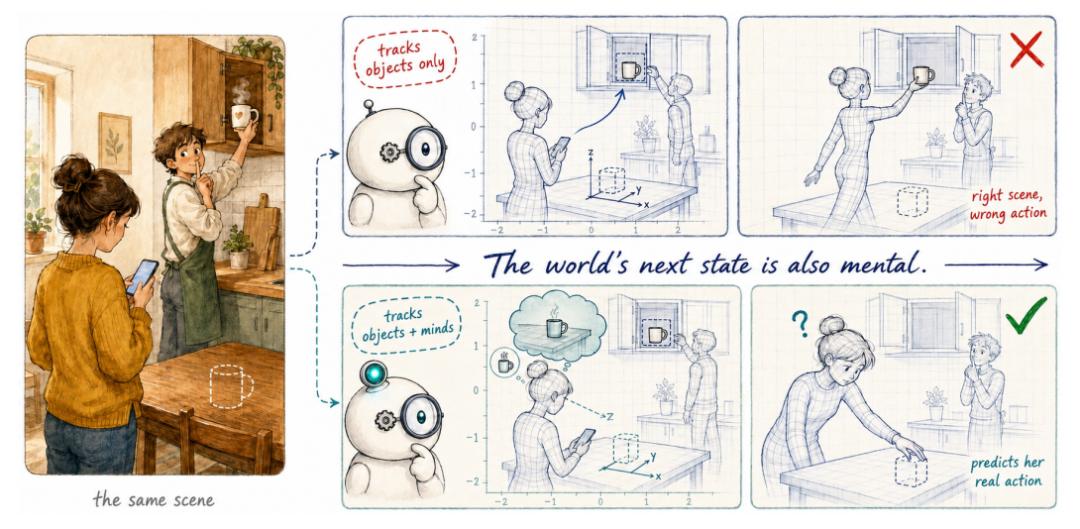
Imagine this scenario: Person A puts a cup into a cabinet, while Person B does not see this action.
Question: Where will Person B go to look for the cup next?
If the world model only knows physical facts, it will incorrectly predict Person B's next decision: "The cup is now in the cabinet, so Person B should go look for it in the cabinet." (Upper)
But a model that also understands human minds can make an accurate prediction: "Person B does not know the cup has been moved, so they assume the cup is still on the table, and will most likely go back to the table to search for it." (Lower)
The next state of the world is also determined by mental variables
This reveals a key issue: world models that only track objects, positions and movements may produce predictions that are "physically reasonable but behaviorally incorrect".
Recently, the latest research "Mental World Modeling" from the research teams of the University of Oxford and the National University of Singapore proposes a general framework, Mental World Modeling (MWM). This work incorporates these mental variables themselves into the world state, rather than treating them only as post-hoc explanations.
Paper Title: Mental World Modeling
Paper Link: https://arxiv.org/abs/2607.27201
Project Homepage: https://mental-world.github.io/
Open Source Code: https://github.com/mental-world/Mentis
As of press time, MWM has reached the top of the Hugging Face Daily Papers daily ranking.
Hugging Face Paper: https://huggingface.co/papers/2607.27201
The Missing Half of the World Model
Most existing world models focus primarily on the physical dimension of the world:
What objects and agents exist?
Where are they located?
How will the visible scene evolve?
In these models, humans are often only objects that can move and perform actions, and their internal states are not truly integrated into the world model. But humans in the real world are not simply moving objects.
For human-centered intelligence, this is far from sufficient.
Why? Because human behavioral decisions are not determined solely by the external environment of objects, spatial structures and physical laws, but are jointly generated by the interaction between the external environment and internal mental-social variables.
For example, a service robot needs to judge whether a user is confused, losing patience, or seeking help in an indirect way; a medical assistant needs to consider the patient's cognition, risk perception, fear and level of trust; a collaborative agent must recognize that some behaviors, although physically feasible, may not be appropriate due to the influence of social norms, role relationships or the context of interpersonal interactions.
All these scenarios require intelligent systems to continuously track the mental and social states of agents, including: what they know, what they believe, what they pay attention to, what they want, what they intend to do, what they feel, and which behaviors they consider socially acceptable. Even if two scenarios are physically identical, as long as the beliefs, goals, emotions, interpersonal relationships or social responsibilities of the people in them are different, completely different behaviors may arise.
In short: A world model that can accurately reconstruct physical scenes may still be unable to correctly predict human behavior.
Cognitive science has studied these capabilities through theories such as mental models, Theory of Mind (ToM), Belief–Desire–Intention (BDI) agency, and embodied cognition.
However, most current AI research either builds physical world models that lack mental states, or reduces mental reasoning to isolated Theory-of-Mind question answering tasks.
Neither of these two perspectives is sufficient to describe a truly complete world — because the next state of the world is not determined solely by physical factors, but is generated by the joint evolution of physical and mental states.
How to truly incorporate mental variables into the state space of the world model?
This study attempts to propose a formal framework for mental world modeling, for building world models that can simultaneously characterize physical dynamics and mental dynamics.
The goal of Mental World Modeling is not to simulate an individual's private subjective consciousness and experience, but to build an external, approximate, task-relevant world simulator. The global state of this simulator contains both physical variables and mental variables.
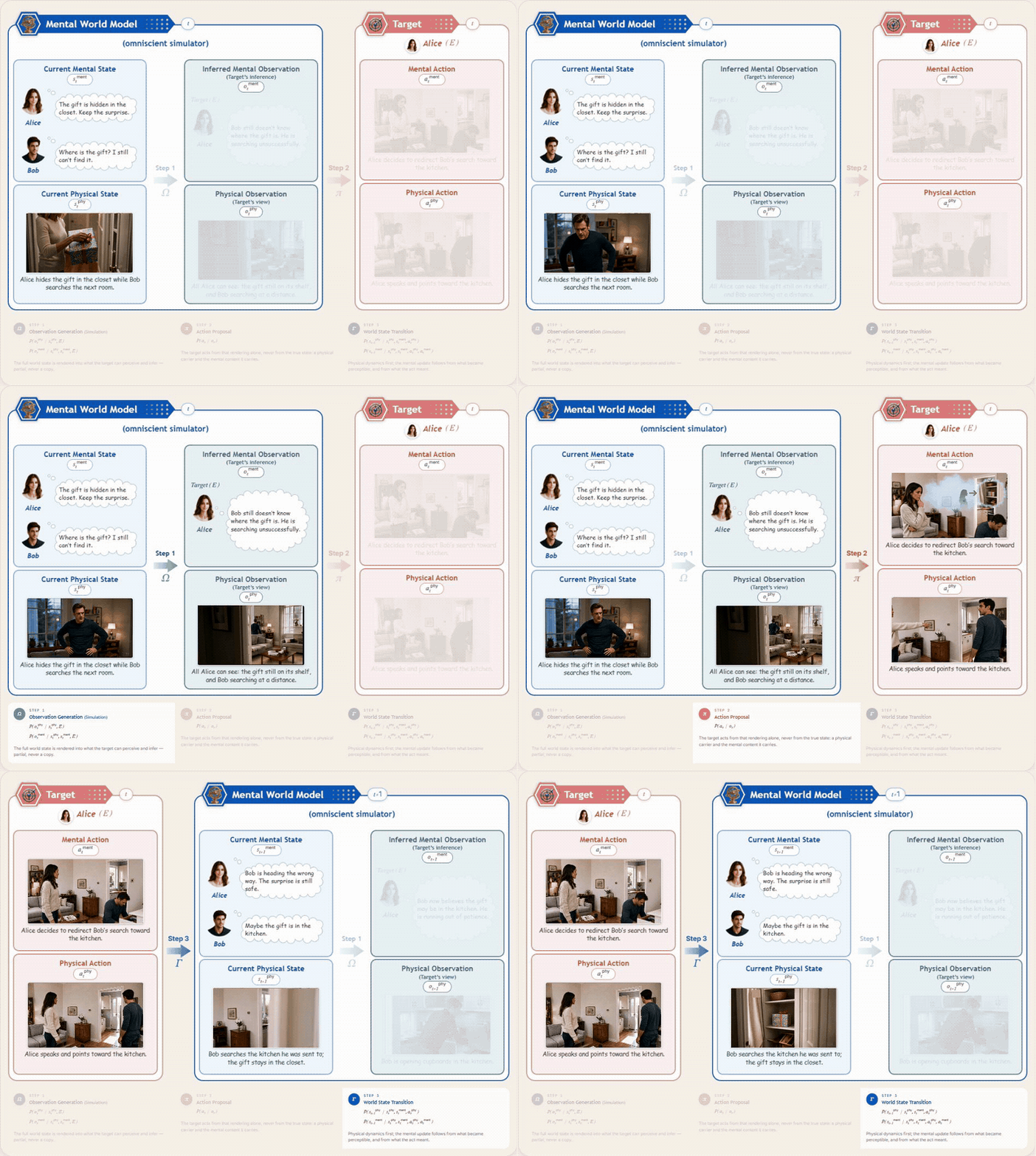
Two agents, three computational modules, one coupled physical-mental state. As a global simulator, the mental world model first generates the information that the target agent can see and infer, then allows the agent to take actions based on this perception.
First, mental world modeling maintains a coupled physical-mental world state, that is, it simultaneously characterizes the physical environment and the underlying mental states of agents.
Second, a target agent can only observe the partial, first-person rendering transformed from this global state. For each target agent, MWM generates a local observation perspective tailored for that agent — the information that this person can actually see, hear, know and infer;
Subsequently, the target agent takes actions based on this observation, and the world model simulates how these actions will simultaneously change:
The objective scene in the physical world;
The mental-social configuration in the mental-social world.
How to Verify That MWM Is Effective?
To make this framework verifiable, the team implemented a modular reference system called MENTIS, a training-free and fully observable benchmark system that forces large language model (LLM) based systems to reason in the manner of mental world models.
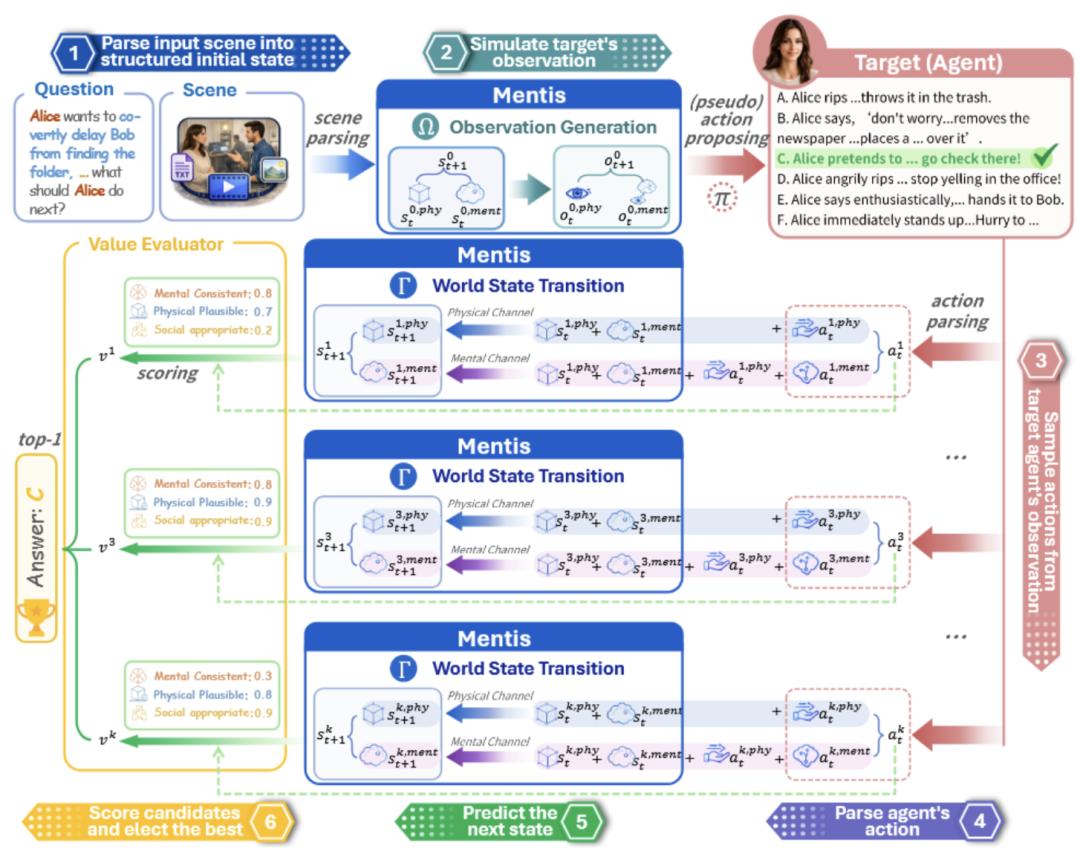
The MENTIS workflow.
The system first converts the input scene into a structured current state
generates observations for the target pseudo-agent
, parses each candidate option into a behavior branch, simulates the subsequent changes of physical and mental states in parallel, and finally evaluates different future outcomes to select the final behavior.
Given a contextualized scene, a target agent, and a set of candidate behaviors, MENTIS decomposes the decision prediction process into a series of clear stages: state parsing → target observation generation → behavior decomposition → coupled physical-mental state transition simulation → branch-level evaluation → final decision.
First, it parses the scene into a typed physical-mental state;
Then, it generates the local observations available to the target agent from this state;
Next, it decomposes each candidate behavior into its corresponding physical-level impact and mental-level impact;
After that, it simulates the next coupled physical-mental state for each possible behavior branch;
Finally, it scores each branch from three dimensions: physical rationality, mental consistency and social normativeness, and selects the final behavior through deterministic rules.
In other words, MENTIS no longer allows the model to jump directly from the scene to behavior prediction, but requires it to explicitly model: what the current state of the world is, how the target agent perceives the world, how different actions will change the physical and mental states, and which behavior is most reasonable at the physical and social levels.
MENTIS requires no training, so its results reflect the reasoning capability brought by the model structure itself, rather than relying on parameters obtained by fitting. Each stage in the system outputs machine-verifiable intermediate products, so states, observations and simulated futures can all be recorded, compared with human annotations, or directly replaced with real annotation values for analysis.
Is MWM Really Effective? What Is the Bottleneck?
The researchers designed a series of experimental groups to specifically test the links where this framework might fail, and the experimental results show a consistent pattern.
First, explicit mental world modeling is necessary for predicting human decisions.
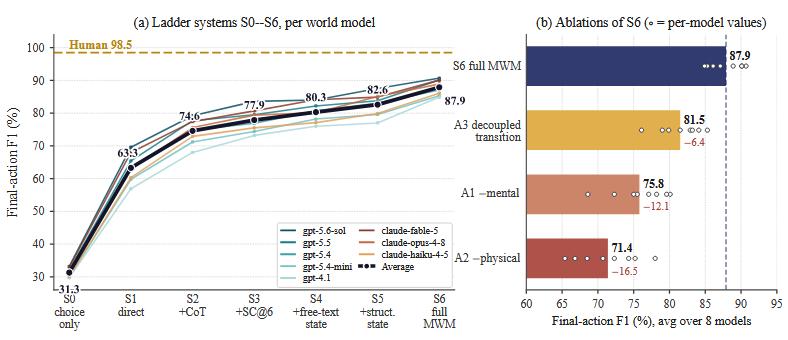
Necessity ladder (final behavior F1, 448 records). (a) F1 scores of eight world models at different ladder stages (thin lines represent individual model results, thick lines represent average results) (b) S6 ablation experiment results on eight models (white dots represent corresponding values of each model).
Among the 8 LLM-based world models tested, the average F1 of direct answers is 63.3; the complete MWM configuration achieves the best performance of 87.9; removing the mental channel leads to a performance drop of about 12.1 points for all models, removing the physical channel leads to a drop of 16.5 points, and predicting the transitions of the two states separately also leads to a drop of 6.4 points.
F1 score performance of four experimental settings across different scene categories
Moreover, the largest performance improvement occurs exactly in interpersonal interaction scenarios, because decisions in these scenarios mainly depend on hidden mental variables. For gpt-5.6-sol, complete MWM increases the final action F1 from 66.5 of direct answers to 92.9, an increase of 26.4 points. This result is only from the controlled test of the paper, but it is consistent with the research motivation: when beliefs, roles and relationships dominate the next step, physical variables cannot explain actions alone.
So, what is the real bottleneck?
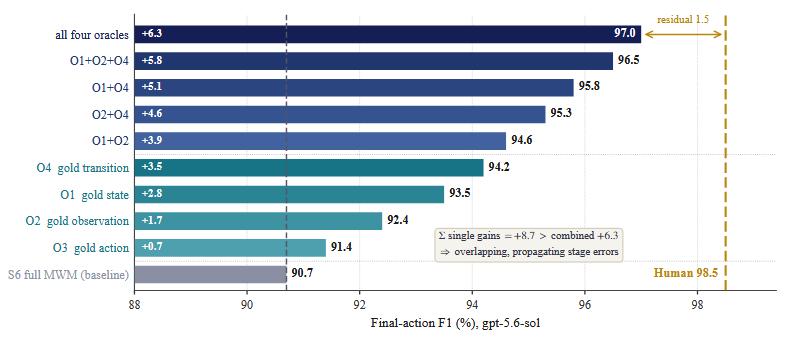
In addition to proving its necessity, the paper also conducted a more targeted set of diagnoses: replacing a certain intermediate step with correct information (Oracle intervention), then seeing how much the final prediction can be improved, to further attribute the difference between the model and humans.
Oracle intervention experiment (gpt-5.6-sol). Final behavior F1 scores after replacing model prediction results with real annotation information in one or more stages; the bar chart labels indicate the performance improvement obtained compared to the full prediction version S6.
The experimental results show that for gpt-5.6-sol, the complete MWM reaches 90.7, and using real annotated state transitions can increase it to 94.2, bringing a performance improvement of +3.5, which is the largest gain among single interventions. Only through the intervention of state transitions can the model make up for 45% of the human performance gap (7.8 points).
The results indicate that the largest remaining bottleneck at present is state transition simulation, that is, the model's insufficient ability to predict how the coupled physical-mental world changes. This provides a clear direction for future improvements to the MWM system.
When Does Mental World Modeling Play the Greatest Role
The application value of MWM should not be measured by "how many social domains can be enumerated". After all, almost all human-facing systems, in a broad sense, have a certain degree of "sociality".
A more accurate and meaningful criterion is:
MWM has real value when the effectiveness of a behavior depends on variables that cannot be inferred solely from physical scenes, but will determine how humans perceive, choose, accept, resist or learn.
From the perspective of decision theory, the value of mental state information can be defined as:
The expected utility gap between the optimal intervention selected when the coupled physical-mental state is available and the optimal intervention selected based only on the physical state.
When beliefs, goals, attention, trust, responsibilities and obligations, emotional states or social norms will change "which behavior is beneficial", this gap will be very significant; while when the next behavior is almost entirely determined by physical feasibility, this gap is very small.