Just now, Alibaba open-sourced a large model with 2.4 trillion parameters, and its performance is on a par with Fable 5.
Zhi Dong Xi August 13 report, the Alibaba Qwen large model team has just released the weights of the Qwen3.8-2.4T-A95B model!
Qwen3.8-Max is the official version based on Qwen3.8-2.4T-A95B, released on August 3. It has more features, such as visual input capability, no need for thinking enabling by default, native support for 1 million context length processing, and built-in official tools.
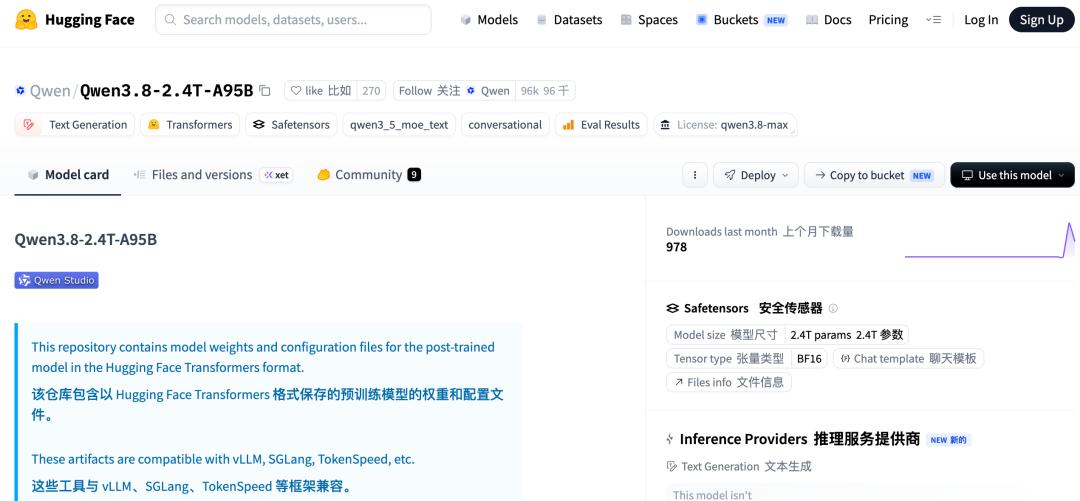
▲Qwen3.8-2.4T-A95B open source homepage (Source: Hugging Face)
Model download address on ModelScope:
https://modelscope.cn/models/Qwen/Qwen3.8-2.4T-A95B
Hugging Face model download address:
https://huggingface.co/Qwen/Qwen3.8-2.4T-A95B
This is also the first time Alibaba Qwen has publicly opened the weights of its Max-level flagship model. According to the official announcement from ModelScope, the smaller-sized Qwen3.8-27B is on the way.
The total parameter size of Qwen3.8-2.4T-A95B is 2.4 trillion, with 95 billion parameters activated per Token. It natively supports 262144 Token context, which can be extended to 1.01 million Tokens. The model adopts the underlying architecture of Qwen3.5, and achieves performance improvements in programming, office work, scientific research, and long-cycle agent tasks.
The Qwen3.8-2.4T-A95B model can be deployed through SGLang, vLLM and TokenSpeed inference engines. For formal deployment, you need to use the latest Recipe of each framework for Qwen3.8, and select the parallel strategy according to the weight precision, GPU model and quantity.
The Qwen3.8 model runs in thinking mode by default. Before generating the final response, the model will first generate thinking content marked with <think>\n...</think>\n\n. Qwen3.8-2.4T-A95B does not support turning off the thinking mode.
Meanwhile, the open source AI project team Unsloth AI uses dynamic 1-bit layered selective quantization technology to compress the original 4.9TB model size of Qwen3.8‑2.4T‑A95B to 397GB, reducing the storage space by 91%.
With the help of the Unsloth-Desktop tool, the model can run locally as long as the total amount of device RAM + VRAM reaches more than 410GB.
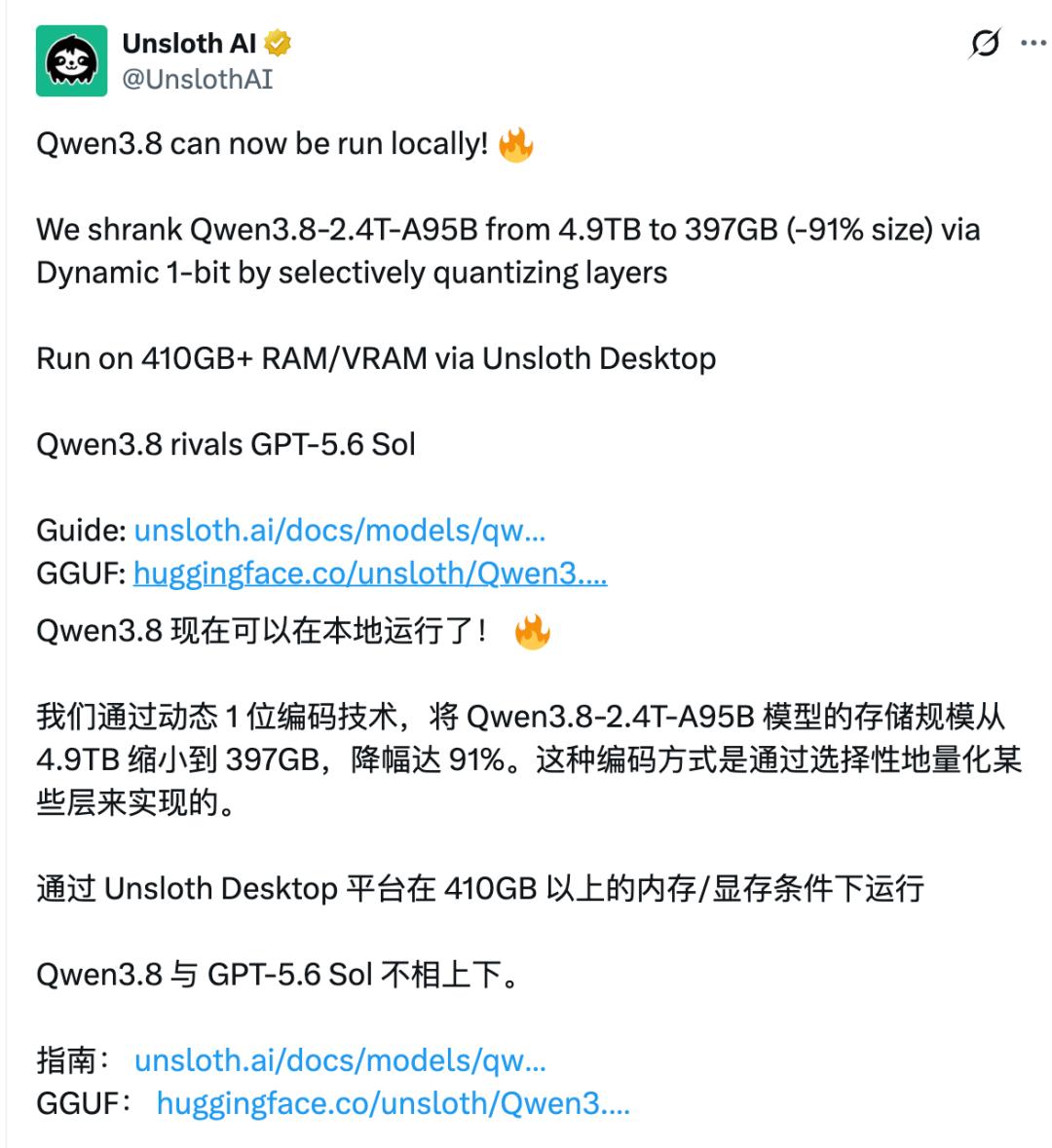
▲Unsloth AI compresses Qwen3.8-2.4T-A95B (Source: X)
When the Qwen3.8 release was announced, the Qwen team stated that the model "may be the most powerful model besides Fable 5".
Benchmark test results show that in PaperBench, the paper reproduction benchmark, Qwen3.8-Max scored 93.0 points, higher than GPT-5.6 Sol, Fable 5 and Claude Opus 4.8. In OSworld-Verified, which evaluates computer operation capabilities, Qwen3.8-Max ranks first among all participating models with a score of 86.1; in the parametric CAD benchmark, its 91.5 points also surpass Fable 5, GPT-5.6 Sol and Gemini 3.1 Pro.
However, Qwen3.8-Max has not taken the lead in all tests.
In TerminalBench 2.1, its score is 86.6 points, slightly lower than GPT-5.6 Sol's 88.8 points; in SWE-bench Pro, Qwen3.8-Max scored 67.7 points, lagging behind Fable 5's 80.0 points and Claude Opus 4.8's 69.2 points; in VideoMME v2, the long video benchmark, its 68.3 points are also lower than GPT-5.6 Sol's 71.1 points.
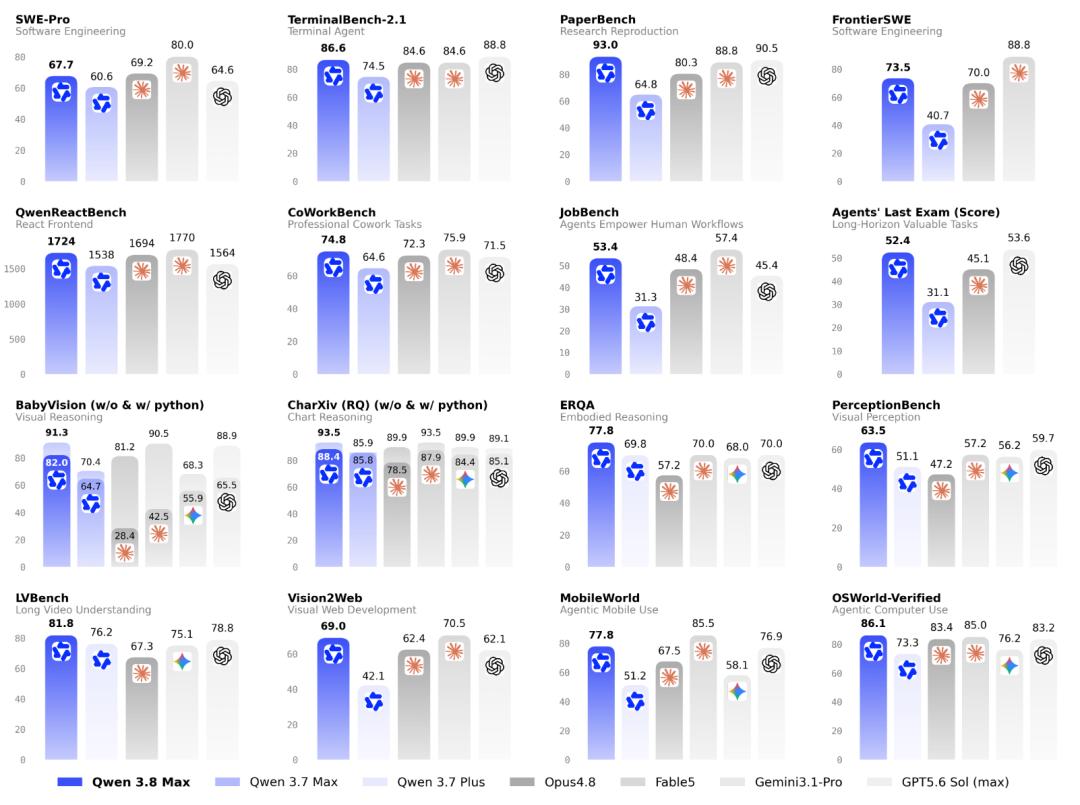
▲Qwen3.8-Max benchmark test results (Source: Alibaba)
The focus of Qwen3.8 is whether the model can get rid of continuous manual companionship and independently complete a task spanning several hours, several days or even several weeks.
The Qwen team let Qwen3.8-Max carry out continuous autonomous programming for about 16 days, independently reproduce and improve a research paper, participate in real algorithm competitions, and also let it operate a virtual e-commerce enterprise in more than 2000 rounds of interactions.
In the task of 16 days of continuous autonomous programming, Qwen3.8-Max independently built a self-evolving Harness, and continuously completed community demand collection, issue assignment, code generation, verification and self-repair.
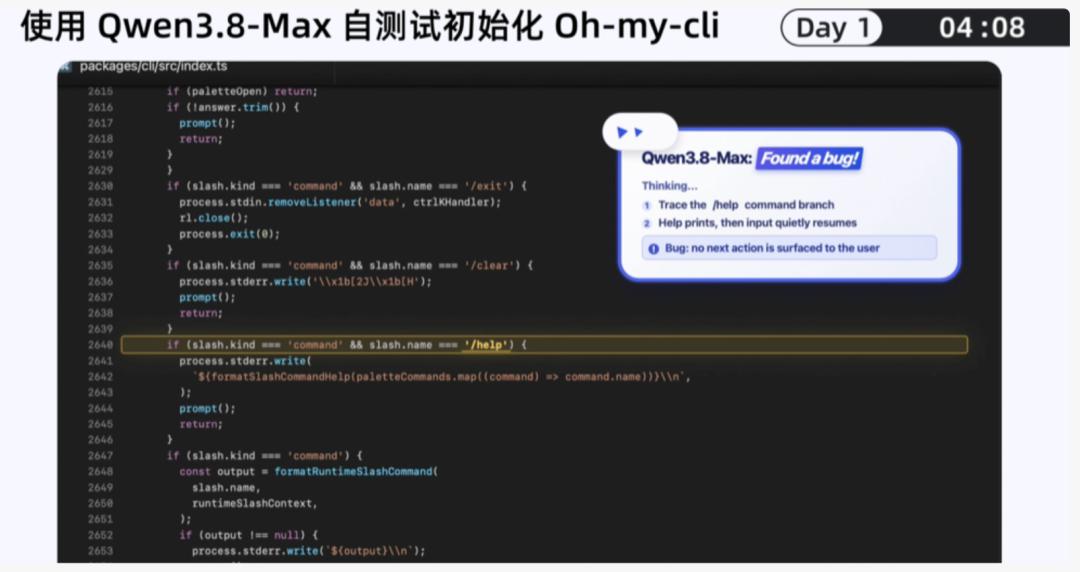
▲Qwen3.8-Max performs autonomous programming tasks (Source: Alibaba)
In terms of API pricing, Qwen3.8-Max charges 12 yuan per million Tokens for input and 36 yuan for output in Chinese mainland, with 1.5 yuan for implicit cache hits; overseas, it charges 2 US dollars per million Tokens for input and 6 US dollars for output, with 0.25 US dollars for implicit cache hits.
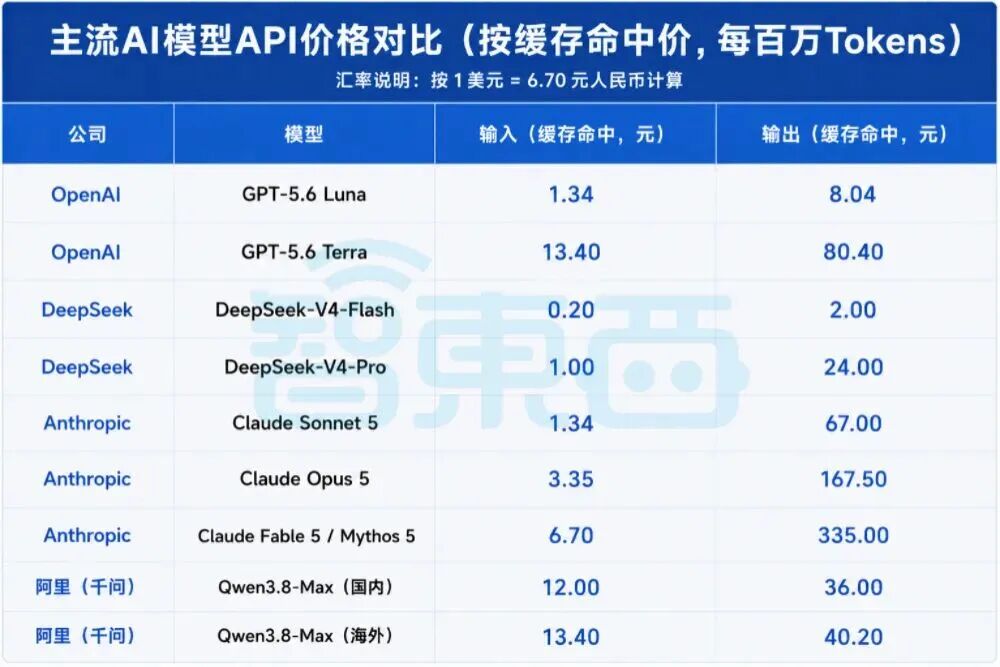
▲API price comparison table (Chart by Zhi Dong Xi)
Conclusion: The world's top three leading models are all updated!
All focus on enhancing agent capabilities
Overnight, the three top leading large models have been released one after another: first, Elon Musk launched his strongest model Grok 4.6, in which Grok 4.6 high has comprehensive performance comparable to GPT-5.6 Sol Max and Claude Fable 5 Max in a number of disclosed agent programming and knowledge work benchmarks; then the official version of DeepSeek-V4-Pro was launched, with comprehensive performance close to and some indicators surpassing Claude Fable 5; finally, Qwen3.8 opened its weights.
It can be seen that all three companies have focused on enhancing the multi-step long-cycle autonomous work capability of their models, and begun to compete on the agent level of the model to independently undertake complete projects and complete work in an autonomous closed loop.
In addition, the Alibaba Qwen team's official opening of the weights of the 2.4 trillion parameter top flagship model this time is also a key step in China's open source large model layout.
This article is from the WeChat official account "Zhi Dong Xi" (ID: zhidxcom), Author: Cheng Qian, Editor: Xin Yuan, published by 36Kr with authorization.