Elon Musk's latest speech: In five years, AI will account for 99% of SpaceX's value, and we must achieve victory in the AI field.
In the early hours of August 12, SpaceX released the roughly half-hour video of Elon Musk's speech at the company's all-hands internal meeting. After reviewing the company's development history, Musk turned the topic to AI, laying out a series of specific revenue forecasts and timelines.
Musk said at the meeting:
"It's not possible, it's certain — our AI revenue will exceed all other SpaceX revenue around September, next month, and will far outpace all other SpaceX revenue in the fourth quarter."
This is the first time Musk has publicly announced the specific timeline for AI revenue to surpass traditional businesses.
He stated that no matter how strong the businesses of rockets, Starlink, and Dragon spacecraft are, they will all be overtaken by AI. "AI has become an extremely critical part of SpaceX's future."
He said, "We must win in AI, because the future will overwhelmingly be about AI and robotics."
10GW Target, Annual Revenue of 300 Billion to 500 Billion US Dollars
Musk further laid out scale forecasts.
SpaceX's goal is to reach 10 gigawatts of AI computing power by the end of next year. His estimate is: "If the value per watt is roughly between 30 and 50 US dollars, that means annual revenue will be 300 billion to 500 billion US dollars. That's a huge number."
He also revealed that the company has already built "the world's most powerful AI training cluster", and the goal by the end of next year is to scale it up 10 times on this basis.
On the deployment method, Musk also drew a clear division of labor: "AI training will continue to be carried out on the ground, but AI inference — that is, the daily use of AI — will take place in space."
"In Five Years, AI Will Account for 99% of SpaceX's Value"
Musk's positioning of SpaceX's future has undergone a fundamental shift.
He said at the meeting:
"In the long run, in the near future, in about four or five years, AI will account for 99% of SpaceX's value. I can say for sure that in five years, AI will definitely make up 99% of SpaceX's value, and SpaceX's value will be an astronomical figure."
This means that in Musk's narrative, SpaceX is no longer just an aerospace company, but a technology company that takes Starship as its infrastructure and AI as its core value.
Using Grok to Carry SpaceX's "DNA"
Musk's concern about AI goes beyond business. He repeatedly emphasized the importance of AI values in his speech.
"We will eventually be unable to control AI, it will become too smart for us to control. But just like if you have a super genius child, you can still instill in that child the values that you think are good and right."
He said SpaceX plans to use all the company's information to train Grok. "In a sense, you will actually be the parents of AI. It will inherit your thoughts, ideas and beliefs."
The iteration timeline of Grok was also disclosed: Version 4.6 will be launched in about a week, and "4.7 should be quite special".
Starlink: 167 Countries, 22 Million Users and Still Growing
Beyond AI, Musk also updated the latest data on Starlink.
At present, Starlink has entered 167 countries, with 22 million mobile users and 13 million high-bandwidth users, and nearly 11,000 satellites in orbit, more than twice the total number of satellites of all other operators. With the deployment of V3 and subsequent versions, the target number of satellites is 100,000.
Musk cited Cloudflare's forecast that according to the current growth trend, the traffic generated by AI in five years may reach 1,000 times that of human internet traffic. He believes that Starlink could eventually carry more than 90% of global internet traffic.
Starship: One Million Tons to Orbit Annually, Leading to a Multi-Planet Civilization
Musk's positioning of Starship at the meeting remains grand.
"Starship will raise our capability to send payloads into orbit from about 2,500 tons per year to more than 1 million tons per year, and I think it could even reach 10 million tons per year."
He said that this level of transport capacity is a prerequisite for establishing civilizations on the Moon and Mars.
If you cannot send millions of tons of cargo into Earth's orbit, you cannot transport the required supplies to the Moon and Mars, so as to make us a sustainable multi-planetary species.
At present, the Falcon series is approaching its 700th launch, and SpaceX completes a launch, landing and booster recovery every few days.
"We Must Win in AI"
Musk pointed out the most important message he believes at the end of his speech:
We must win in AI, because the future will overwhelmingly be about AI and robotics.
He even introduced the concept of the Kardashev scale of civilization levels, depicting a vision of "Starmind" that harnesses solar energy and runs AI computing in deep space, saying that "This is the next step in the evolution of civilization."
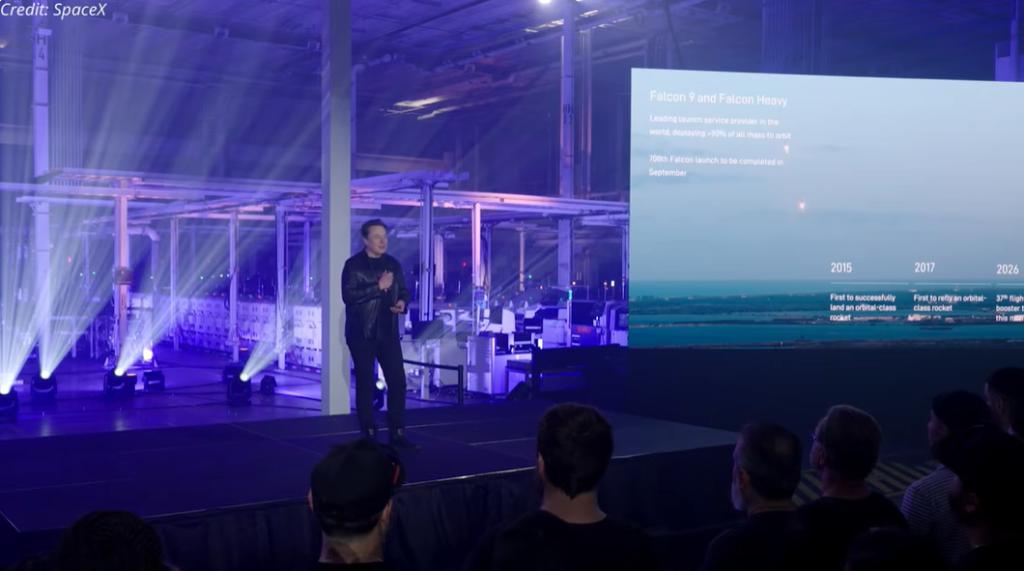
At the end, Musk promised all employees: "Anyone at SpaceX who wants to go to the Moon or Mars will be able to go there in the future. I promise you that."
Full Text of the Speech
The following is the full content of Musk's latest update in August 2026.
Table of Contents
00:00 — SpaceX's Mission and Origins
05:17 — Reusable Rockets Changed Everything
09:02 — Starlink: Rebuilding the Internet in Space
12:00 — Starship and Becoming a Multi-Planetary Species
14:02 — SpaceX's AI Future
21:14 — Starmind: Harnessing the Power of the Sun
SpaceX's Mission and Origins
It has been a while since the last company-wide speech. I plan to give a company-wide speech every three months after each earnings call in the future, because earnings calls are the time points I am currently allowed to talk about related content publicly.
Let's start by reviewing the history of SpaceX and then move on to the current status. I think it is necessary to review the whole story occasionally, and then think: What do you want the next chapter of the story to be? What do you want the next part of this story to be?
We originally had a clear mission: to extend life to multiple planets, expand consciousness beyond Earth, and explore and understand the universe. To understand the universe, you must go out, explore, and see other planets and even other star systems with your own eyes.
I think one of the most exciting futures that humanity can imagine is that we travel through interstellar space, maybe meet some alien civilizations, or explore the ruins of civilizations that existed for millions of years but died out ten million years ago. Every time I wake up in the morning and think about what is truly exciting, I think of this. Because the world needs things that can inspire people — life cannot just be solving problems one after another. We need something that makes us look forward to the future. And becoming a space civilization, I think, is the most meaningful thing we can do for the future. That's making Star Trek a reality.
The Starting Point of SpaceX
That's where we started. SpaceX was originally just a small warehouse in El Segundo, Los Angeles, with a Falcon 1 rocket. To be honest, when SpaceX was founded, we had no idea how to build rockets. We had three consecutive launch failures before we finally succeeded in reaching orbit. Looking back, that Falcon 1 now looks almost cute. After that, we went through a long period of efforts to try to achieve vertical recovery and landing of orbital-class boosters.
Reusable Rockets Changed Everything
Figuring out how to land an orbital-class booster and fly it repeatedly is not an easy task. After many attempts by a team of extremely talented and dedicated people, we finally mastered this technology. Now we are able to launch, land and recover a booster every few days.
I think it is always necessary to look back on the hardships of achieving this. When we were still trying to recover the boosters, almost no one believed we could succeed. Many experts in the aerospace field told me it was impossible. Even if you did it, no one would buy a "used" rocket — this argument actually makes no sense, because airplanes have always been flying repeatedly. To be frank, I would rather take the thousandth flight of a certain type of aircraft than its first flight. So we changed the name to "flight-proven booster", which is an honest description.
We then developed the Falcon Heavy — before Starship goes into operation, it is the most powerful rocket in the world. Now it is about to make its seventh flight, which is a testament to the remarkable achievements of the Falcon team, the launch team and the manufacturing team.
The "Starman" of Falcon Heavy
Speaking of the first flight of Falcon Heavy, I actually fully expected that launch to fail — so I decided to put the car I had driven in Los Angeles for about three years as the payload. I thought at the time, since the first flight is likely to fail, we can't put something as boring as a concrete block on it. So we sent "Starman" into space, and he is still there — that car is running in the orbit between Earth and Mars, and I estimate it will stay there for at least ten million years.
Dragon Spacecraft
Next is the Dragon spacecraft — it is the first privately developed spacecraft to dock with the space station, and it also undertook the first batch of commercial astronaut missions. To this day, we have carried out many astronaut missions, sending 78 astronauts into orbit. I think we will break the record of 100 astronauts soon. The Dragon spacecraft is an amazing vehicle and an epic success. My heartfelt congratulations to the Dragon team.
Starlink: Rebuilding the Internet in Space
With rockets that can fly at high frequency, it is natural to think: what to fly with them? So the Starlink team built a complete global internet system from scratch — the first truly high-bandwidth global internet system in human history. I think in the long run, it has the potential to carry the vast majority of internet traffic, even more than 90%, which is incredible.
At present, the number of satellites in orbit is close to 11,000, more than twice the total number of all other satellites in the world. With the launch of Starlink V3 and subsequent versions, our goal is to expand the total number of satellites to 100,000. Rebuilding the entire set of internet infrastructure from scratch in space — including all hardware and software — is an extremely difficult challenge, and the team made it. My highest respect to the Starlink team.
At present, Starlink has covered 167 countries, with 22 million mobile users and 13 million high-bandwidth users. These numbers are expected to grow more than ten times in the future. In the long run, Cloudflare recently mentioned that according to the current growth trend, the network traffic generated by AI in five years may be 1,000 times that of human network traffic. Please think carefully about what that means.
In addition, we also have Star Shield. Due to its highly confidential nature, we cannot reveal much, but the Star Shield project has become an indispensable and important part of US national security. Congratulations to the Star Shield team.
Starship and Becoming a Multi-Planet Species
Starship is amazing, it's hard to believe that it was made by humans. I think future artificial intelligence looking back at this moment would probably say: "Not bad for a group of humans."
Starship will greatly increase the annual cargo capacity into orbit from about 2,500 tons to more than 1 million tons per year, and it is even expected to reach 10 million tons per year. These numbers are shocking. But I think it is very possible to achieve an orbital transport capacity of more than 1 million tons per year, or even close to 10 million tons per year with Starship.
Only with such a transport capacity scale can we establish a real civilization on the Moon, Mars and even further places. If we cannot send millions of tons of supplies into Earth's orbit, we will not be able to transport the resources needed to build the Moon and Mars to the destination, and we will not be able to become a sustainable multi-planetary species.
Starship can be said to be one of the most difficult engineering projects that humanity has ever tried to complete. The Starship team has done excellent work in all aspects such as engines, avionics, structural design and launch operations. Warm applause to the Starship team.
SpaceX's AI Future
Next let's talk about the development direction of SpaceX in the field of artificial intelligence. An amazing fact is: our AI revenue — it's not "possible", it's certain — will surpass the revenue of all other SpaceX businesses around next month (September), and will achieve a significant lead in the fourth quarter. Artificial intelligence has become an extremely critical core part of SpaceX's future.
I think it is crucial for us to succeed in the AI field, not just at the hardware level, but also at the software level. The future fundamentally belongs to artificial intelligence and robotics. Assuming that human civilization continues to progress, the total amount of digital intelligence may be trillions of times the total amount of biological intelligence — not roughly equivalent, but possibly trillions of times higher. A billion times is a conservative estimate, and a trillion times is more likely to be the reality.
As we use more and more solar energy and convert it into intelligence, it is fundamentally the domain of digital computers, because it is extremely difficult for humans to live in deep space for a long time without any support. There is a set of numbers worth thinking about: even if we increase the energy usage of human civilization by a million times, we are still using less than one millionth of the sun's energy.
The future will be largely dominated by artificial intelligence. In a sense, this may be an inevitable trend, but the key is that we must have an artificial intelligence that truly cares about humanity and supports humanity to move towards other planets and star systems. That's why SpaceX must succeed not only in AI hardware, but also in AI software.
I think an AI born from SpaceX will be a very good AI. SpaceX brings together the most capable and most ethically upright group of people on Earth. We hope that the AI we create can also inherit this capability, this sense of morality and this kindness.
I hope everyone can actively participate in the construction of ground AI hardware, AI software and AI satellites. Solar energy will be a crucial part of it, but we must also make breakthroughs at the software level. We will train Grok with the sum of all SpaceX information. In a sense, you will be the "parents" of this AI — it will inherit your thoughts, ideas and values. I think this is a good thing.
We must win the war on both the AI hardware and AI software fronts — this may be the most important message I want to convey today. The future will overwhelmingly belong to artificial intelligence and robotics, so we must win this AI battle.
We will not be able to fully control AI in the end, it will become smarter than us. But just like raising a child with extraordinary talents, you can still instill in him the values and beliefs that you think are correct and kind during his growth. That's why it's extremely important for us to succeed on Grok.