Harness has officially stepped into the limelight, and DeepSeek is no longer solely dedicated to model development.
When the parameter arms race of large AI models has fully come to an end, the era of extensive growth in the industry has drawn to a close.
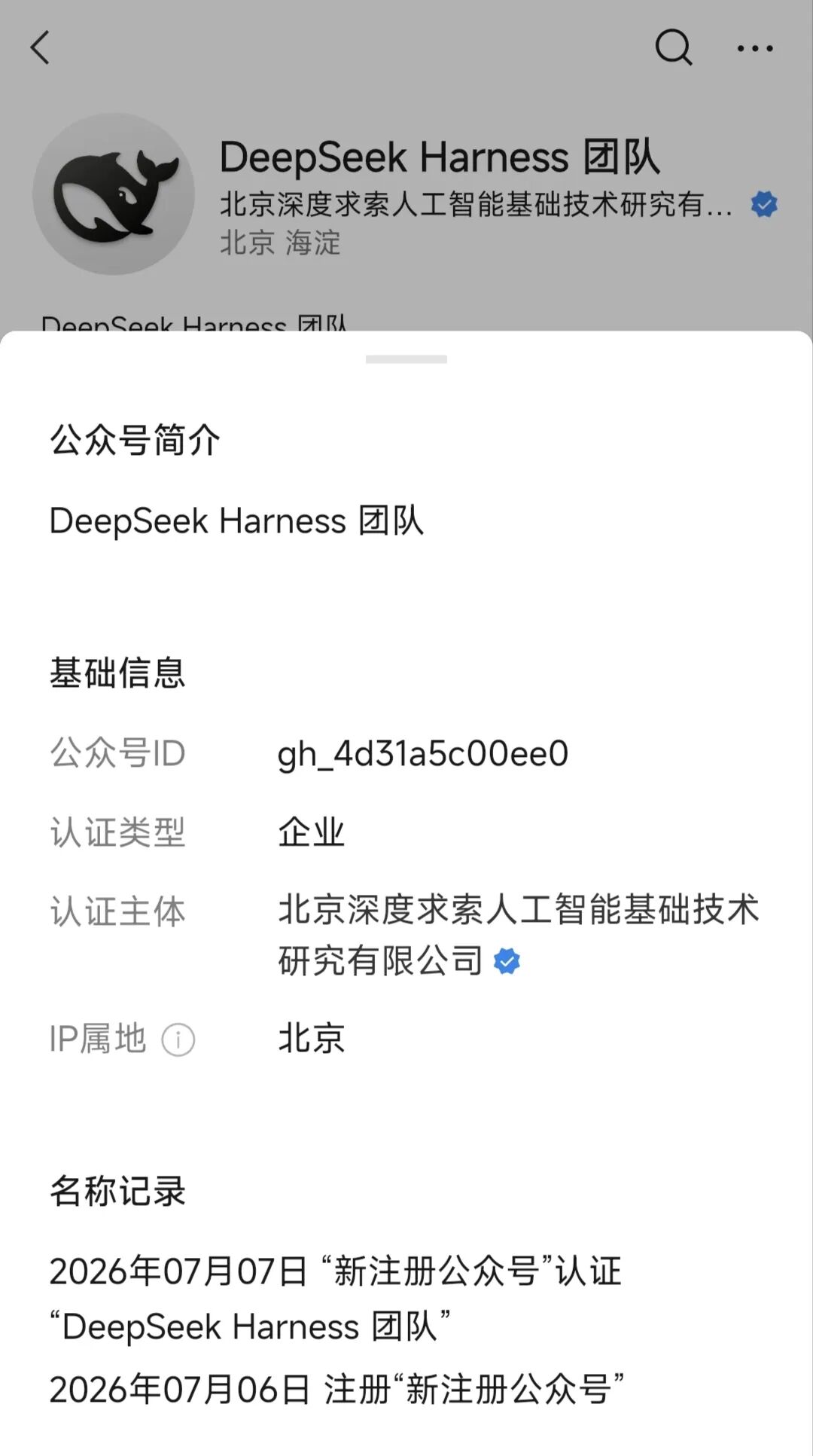
On August 11, media reported that the official WeChat account of DeepSeek's "DeepSeek Harness Team" has been formally registered, with the certification subject being "Beijing DeepSeek Artificial Intelligence Fundamental Technology Research Co., Ltd.".
Public information shows that Beijing DeepSeek Artificial Intelligence Fundamental Technology Research Co., Ltd. is 100% owned by Hangzhou DeepSeek Artificial Intelligence Fundamental Technology Research Co., Ltd.
In late June, Cui Tianyi, head of the DeepSeek Harness Team, posted on social platforms that as a newly established department, the DeepSeek Harness Team has ambitious goals and heavy workload, and is still facing a severe staff shortage. "I am conducting interviews every day, and posting small recruitment notices on various platforms."
On August 1, Cui Tianyi publicly called for global beta testers for Harness, giving priority to developers with experience in the open-source Agent Harness project. Applicants are required to submit their code hosting platform accounts and representative works.
What exactly is Harness? It can be understood as all the engineering capabilities beyond the model, the system that truly enables the model to "run".
In 2026, Harness directly drove VibeCoding — or "code agent" — to become the first successful commercial killer application since the "GPT Moment" in 2022. The two most well-known Harness products are OpenAI's Codex and Anthropic's Claude Code.
The public is generally curious about why DeepSeek, which has long focused on the fundamental large model track and gained recognition for its strong model capabilities, chooses to cross-border deploy the underlying system for agents to compete with Claude Code.
Over the past few years, industry players have been rushing to expand model parameter scales and stack fundamental capabilities, trying to build competitive barriers with stronger reasoning and dialogue capabilities.
However, as mainstream vendors accelerate model iteration, the fundamental performance of leading large models quickly converges, and the gap in pure model parameters and single-round Q&A accuracy continues to narrow. Industry competition has officially shifted from "competition over underlying models" to "competition over implementation capabilities and engineering systems".
The internal beta launch of Harness implies DeepSeek's core strategy of stepping out of the low-cost computing power competition and reconstructing its business model, marking that DeepSeek has officially transformed from a single fundamental model provider to a builder of full-link AI workflow solutions.
Reconstruct the Engineering Underlying Layer
Inside DeepSeek, the team has always adhered to a core product logic: Model + Harness = Agent.
If the large language model is the "brain" that provides intelligent reasoning, then Harness is the "nervous system" and "limbs" responsible for coordinating actions, which specifically covers capabilities including tool invocation, task planning, memory management, security control, and execution scheduling.
There is a core misconception prevalent in the industry: most practitioners believe that a high-quality large model is sufficient to create a usable AI agent. However, in real industrial scenarios, large models have inherent shortcomings. They only have cognitive and reasoning capabilities and cannot independently complete implementation tasks.
Models cannot independently read and write local files, accurately invoke third-party tools, split and disassemble complex engineering tasks, nor do they have the ability to independently retry, iterate and optimize when facing problems such as code errors, execution exceptions, and process jams.
The core value of Harness is to make up for the engineering shortcomings of large models, undertake the full-process engineering work beyond model reasoning, covering fine-grained task planning, long-term context management, multi-tool intelligent scheduling, code reading, writing and compilation, terminal command execution, full-dimensional error capture and closed-loop feedback of results, and finally build a fully automatic iterative closed loop of "thinking - action - feedback - correction", so as to enable AI agents to truly evolve from "being able to think" to "being able to work steadily and reliably".
At present, there are still obvious deviations in the market's perception of Harness. Most people equate it with common ordinary Agent development frameworks on the market, a positioning that completely underestimates its industrial value.
Most of the Agent frameworks in the current open-source market have core functions limited to prompt arrangement and simple tool splicing. They are essentially lightweight application assembly tools, lacking complete engineering operation capabilities, and cannot adapt to the needs of industrial implementation.
The core positioning of DeepSeek Harness is a "production-grade AI agent operation system", rather than a simple API encapsulation tool.
DeepSeek Harness has built an independent and complete underlying operating environment, which can be deeply embedded in the entire process of real software R&D, can independently read and parse code repositories, modify source code files in batches, run unit tests automatically, accurately locate code vulnerabilities, and independently repair program bugs, realizing end-to-end full-process operations from requirement docking, code development to testing and operation and maintenance. Its product capabilities are directly comparable to Claude Code from the industry benchmark Anthropic, making it a rare domestic industrial-grade underlying system for code agents.
The recruitment rules and participating entities of DeepSeek Harness's closed beta have sent a clear ecological signal. Through in-depth practical operation by developers, Harness can quickly capture various extreme boundary problems, continuously polish the system's stability, data security and exception tolerance capabilities, and lay a solid product foundation for subsequent commercial implementation.
The core team configuration of the Harness team further confirms its product positioning of "valuing engineering and implementation".
Cui Tianyi graduated from the Department of Computer Science of Zhejiang University, and worked at Jane Street, a quantitative trading institution, for nine years. He joined DeepSeek in March 2026. He has experience in high-frequency quantitative trading system development, and is deeply engaged in building underlying systems with high concurrency, high stability and high fault tolerance.
The core barrier of high-frequency quantitative systems has never been strategy innovation, but stable execution under extremely complex environments, exception fallback, full-process log tracing and precise risk control. The requirements for system rigor, stability and fault tolerance far exceed those of ordinary Internet products.
DeepSeek transferred the senior system engineering expert to the head of the agent project, conveying a clear industry judgment: The bottleneck of AI agent implementation is no longer the algorithm capability of large models, but the system engineering capability.
High-quality large models are emerging in endlessly on the market, but there are very few agents that can be steadily implemented in industrial scenarios and complete closed-loop operations. The core gap lies in the underlying system capabilities of task scheduling, independent execution and exception tolerance, which is exactly the core advantage of Harness.
Step Out of Track Involution
Since its establishment, DeepSeek has gained a firm foothold in the global AI developer market with its strong fundamental model capabilities and become an industry benchmark enterprise. Its self-developed DeepSeek-Coder code model, R1 reasoning model and V4 series large models have quickly grabbed global developer market share and accumulated a huge group of technical users with core advantages such as open source and openness, super strong reasoning capabilities and high cost performance.
For a long time, the public's perception of DeepSeek's business model has been limited to fundamental model services, that is, obtaining revenue by selling API interface calls and outputting model weight files, which is a typical "computing power selling" model. This lightweight monetization model has low thresholds and strong replicability, and is also the mainstream choice for most domestic AI model vendors.
However, with the rapid iteration of the AI industry, the involution dilemma in the fundamental model track has become increasingly prominent.
At present, the fundamental capabilities of large models from leading global vendors continue to converge, and the gaps in reasoning accuracy, dialogue effect and general capabilities are narrowing, making it difficult to build long-term and solid commercial barriers relying solely on the model itself.
At the same time, the industry price war is intensifying, the price of model calls continues to decline, and the ceiling of the business model of purely selling computing power Tokens is quickly emerging.
Industry practitioners are gradually realizing that the core value of the AI industry does not lie in "model output", but in "scenario implementation". With the same large model base and different agent orchestration systems, the final implementation effect and commercial value will be vastly different.
Ordinary Q&A scenarios consume a huge amount of Tokens but generate meager commercial value; while in the rigid-demand scenario of software R&D, relying on the agent system, the same amount of Token consumption can complete high-value work such as bug repair, module reconstruction, function iteration and project prototype development, multiplying the commercial value by several times.
Facing industry involution and business model bottlenecks, DeepSeek has taken the initiative to carry out strategic upgrading, complementing full-link capabilities through Harness, and realizing a leap-forward upgrade from "selling computing power" to "delivering results".
Under the original business model, enterprise customers pay according to the number of Token calls. No matter whether the model completes effective work or solves practical problems, the vendor can obtain revenue, leading to a disconnect between value creation and revenue.
The implementation of Harness has completely reconstructed this business logic, shifting the payment mode from "paying for computing power consumption" to "paying for result delivery". Customers no longer pay for abstract model computing power, but for specific industrial results such as "fixing code vulnerabilities", "completing function development" and "optimizing project architecture", completely getting rid of the involution trap of homogeneous low-price bidding, and building differentiated core competitiveness.
From the perspective of strategic layout, Harness is the core springboard for DeepSeek to close the AI implementation loop.
First, it accurately positions itself in software R&D, the optimal AI implementation track. In the current AI industry, software R&D is the scenario with the strongest rigid demand, the highest degree of standardization and the most intuitive implementation effect. Products such as Claude Code overseas have fully verified the potential of code agents, but there has long been a lack of mature, stable and commercializable production-grade code agent products in China.
Relying on the V4-Flash high-performance model base, combined with Harness's complete engineering execution system, DeepSeek can convert excellent model reasoning capabilities into implementable and deliverable engineering results, build China's leading digital R&D assistant, and seize the dividends of the rigid-demand track.
Second, it builds a long-term and sustainable agent ecological base. The capability boundary of Harness is not limited to software R&D scenarios. Its core capabilities of task scheduling, independent execution and closed-loop iteration can be quickly extended to multiple vertical fields such as government affairs, finance, manufacturing and scientific research.
The future industrial implementation of AI in all walks of life cannot be separated from a stable, independent and iterable underlying system for agents. Harness is exactly the core infrastructure for DeepSeek to lay out the next-generation AI application ecology. With this system, the enterprise can get rid of the identity constraint of a single model vendor, extend the industrial service link upward, transform into a full-link AI infrastructure service provider covering models, systems, workflows and scenario implementation, build an irreplicable industry barrier, and open a new curve for long-term growth.
The launch of Harness by DeepSeek is not only an iteration of product form, but also a self-innovation of business model: instead of earning meager traffic margins by stacking computing power, it harvests the high-level value of industrial implementation through implementable, closed-loop and value-added AI workflows.
In the new cycle where AI is shifting from "competing over parameters and prices" to "competing over implementation and results", DeepSeek, which owns full-link engineering capabilities and ecological base, has officially bid farewell to the red ocean competition in the underlying track and obtained the core admission ticket to the high-quality growth of industrial AI.
This article is from the WeChat official account "Tech Chic", author: Ling Feng, editor: Li Wei, published with authorization from 36Kr.