Manus suddenly announced its independent operation, returning to the entrepreneurial state overnight.
Out of the blue, the official Manus account just published an open letter titled "A Note to Manus Users". It clearly states: We are resuming operations as an independent company!
The news that Meta acquired Manus for $2 billion at the end of December last year is still fresh in memory, yet unexpectedly, this deal, regarded as Mark Zuckerberg's third-largest acquisition, has suddenly taken a huge turn?
More importantly, Manus officials stated that to comply with regulatory requirements, all data generated after December 29, 2025, the day Meta completed the acquisition, needs to be processed accordingly.
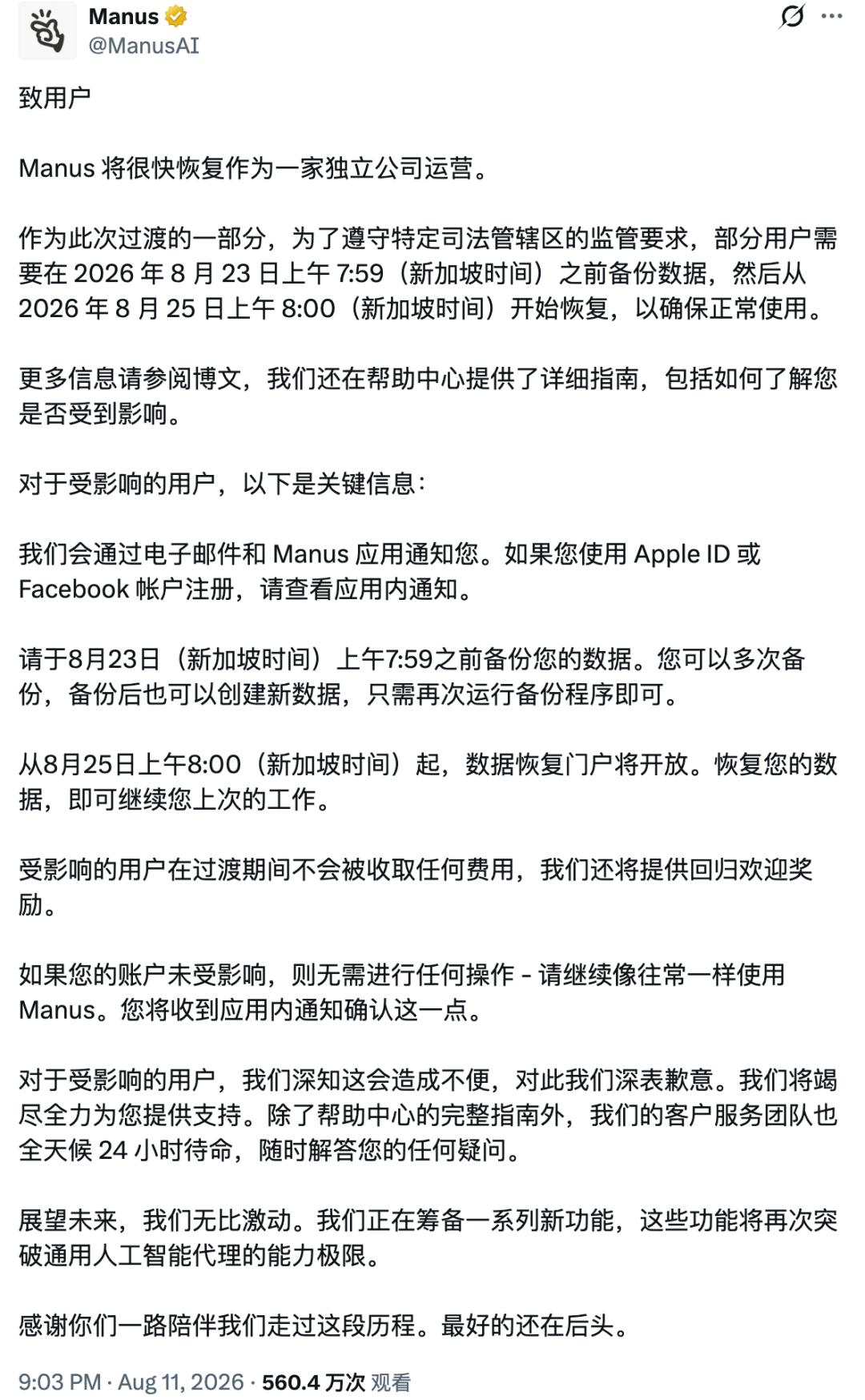
Users are now given a migration window: complete manual backup before 8 a.m. Singapore Time on August 23, then re-upload and restore the data on August 25.
Manus also specifically explained that this data adjustment has nothing to do with hacker attacks or data breaches, and is mainly due to the data migration and compliance arrangements after the company resumes independent operations.
Affected users will also receive compensation.
The official will not only offer free services to users for the next ten days or so, but also distribute a "Return Gift Pack" after the service goes back online, prioritizing calming user sentiment first.
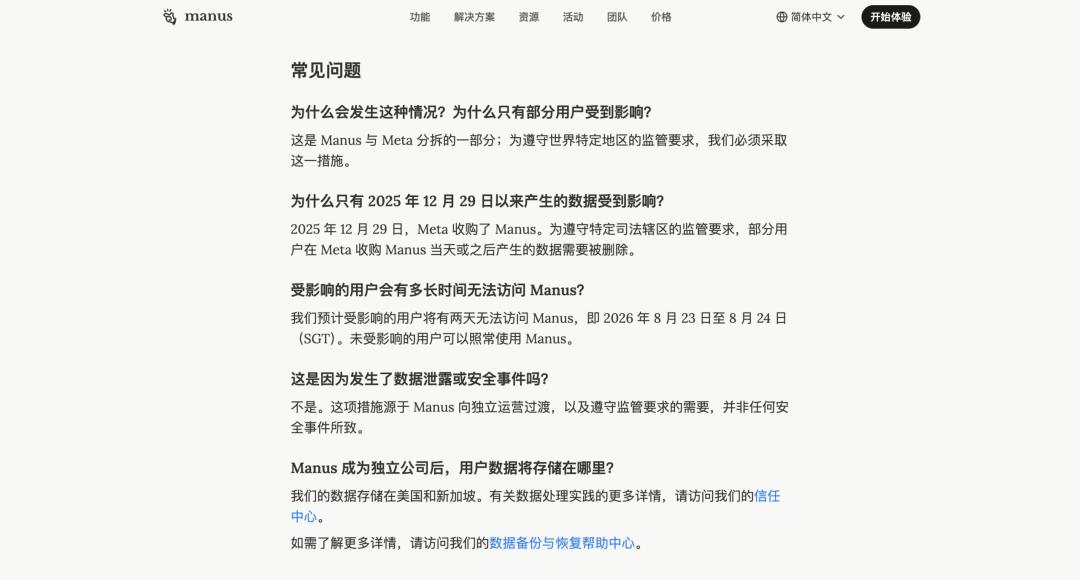
Official blog address: https://manus.im/zh-cn/blog/a-note-to-our-users
From Viral Sensation to $2 Billion Acquisition, Manus Took Only One Year
Looking back a bit, the development speed of Manus over the past two years is truly astonishing.
Its founder Xiao Hong, born in 1992, is a graduate of Huazhong University of Science and Technology and one of the earlier AI entrepreneurs in China.
Starting out by developing WeChat plugins, then launching Monica, an AI plugin with annual recurring revenue of tens of millions of dollars, this team mastered the tricks of commercializing AI products very early on.
Then in March 2025, they launched Manus, dubbed "the world's first general-purpose AI agent".
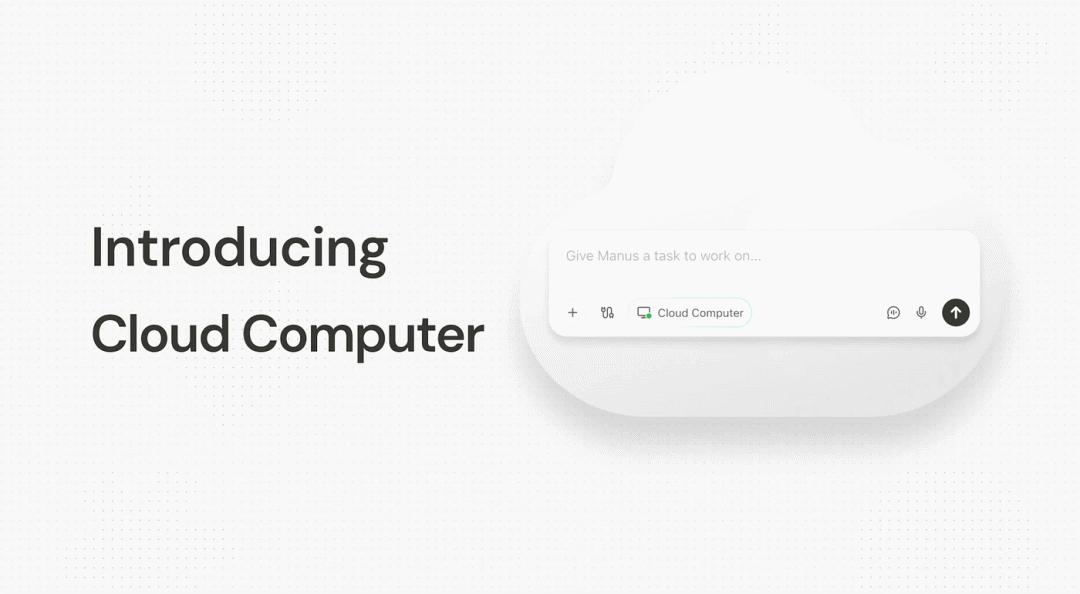
It is not a regular AI assistant that mainly chats with you, but a product that is fully committed to the Agent track. Once you submit a request, it will directly create a virtual machine for you on the cloud, to look up information, write code, and make PPTs on its own.
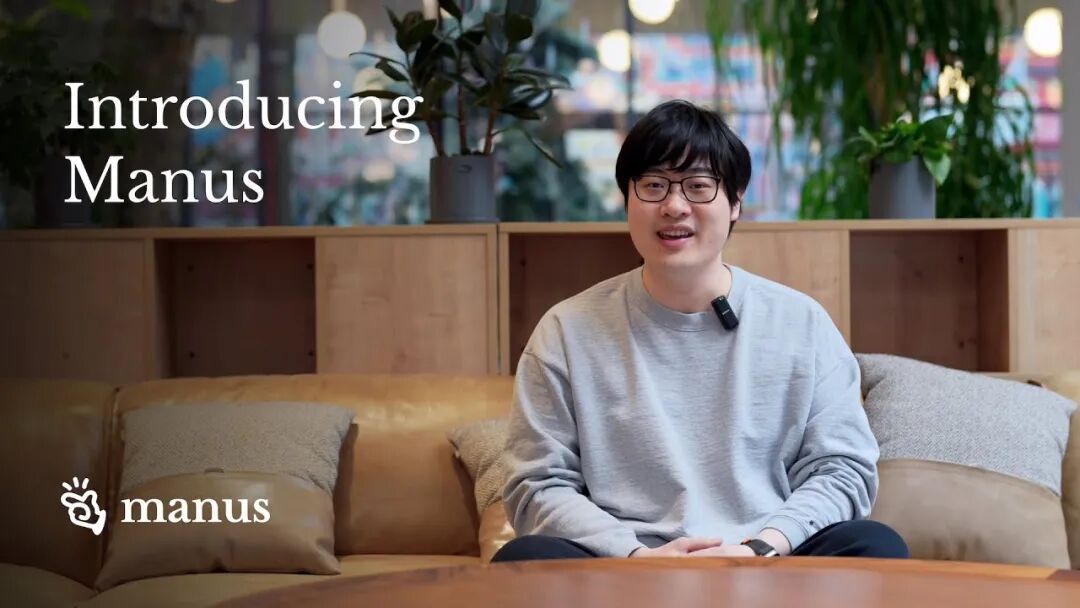
Upon its release on March 6, the number of visits exceeded 10 million in just 4 hours, crashing the official website on the spot. Invitation codes were resold for as high as 50,000 yuan each on Xianyu, is that reasonable?
However, after the initial hype faded, doubts soon emerged.
Shortly after, the tech circle began to discuss how much independent R&D capability the product actually has, and issues like shelling third-party models and the source of model capabilities once became the focus of controversy.
Another more practical issue is cost.
In the early stage, Manus needed to consume a large number of Tokens to perform complex tasks, and the cost per task was not low. For an Agent product targeted at ordinary users, its business model still needs further validation.
After the initial explosive traffic, Manus also experienced a noticeable decline.
Facing the situation where it entered a cooling-off period rapidly after the high-growth start, Xiao Hong's team later made a decision that affected the fate of the company: fully shift to the overseas market.
Manus gradually moved its operational focus to Singapore, and its team, business and service system also began to be rebuilt around the global market.
The effect showed quickly. By December last year, Manus's ARR, that is, Annual Recurring Revenue, had exceeded 100 million US dollars, setting one of the records for the world's fastest-growing startup to hit 100 million US dollars in revenue.
The platform has created a total of 80 million virtual computers and consumed 147 trillion Tokens. From a suddenly viral Agent startup to a company with solid commercial revenue, Manus took less than a year.
It was at this stage that Meta made its move.
On December 30 last year, after only more than ten days of negotiations, Meta spent over 2 billion US dollars to complete the acquisition. For Xiao Hong and the Manus team, this was almost the standard happy ending in AI entrepreneurship stories:
Found a startup, go viral, achieve commercialization, and finally get acquired by a tech giant at a sky-high price.
Xiao Hong himself also joined the Meta system and took a senior executive position as per the arrangement at that time.
After Joining Meta, Why Did Manus Become Independent Again?
Yet the story took a huge unexpected turn in 2026.
Since the first half of this year, this cross-border acquisition has faced new regulatory and compliance variables.
Since Manus previously had R&D and operation bases in China, then moved overseas, and was later fully acquired by a US tech giant, the deal involves a series of complex issues including corporate control, data processing, intellectual property rights and cross-border investment.
For a $2 billion-level AI transaction, none of these issues can be avoided.
As reported by multiple media outlets earlier, starting from April this year, this deal entered a stricter review stage, and the two parties then had to readjust the original transaction and corporate structure.
By June, the relationship between Manus and Meta began to undergo substantial changes.
The business, personnel and data that were originally integrated into the Meta system need to be re-divided; Xiao Hong's position within Meta also changed accordingly.
That's exactly what users have seen in the past two days:
Manus resumes operations as an independent company, and launches large-scale data migration at the same time.
Although it seems that everything has come full circle, Manus is no longer the same company it was half a year ago.
According to data disclosed in relevant reports, in the six months after joining the Meta system, Manus's commercialization speed continued to increase, and its annualized run rate revenue by mid-year was reportedly between 400 million and 500 million US dollars.
When it was sold to Meta last December, that figure was only about 100 million US dollars. In just half a year, its revenue scale has risen to a completely different level.

It can only be said that the plot development speed of this AI startup is as fast as a short web drama.
In just over a year, Manus has experienced product explosion, commercial growth, acquisition by Meta, and now the resumption of independent operations. The corporate status of an AI startup has become more dynamic than ever against the backdrop of the rapidly evolving Agent industry.
For ordinary users around the world, the most practical thing to do right now is to log into their accounts as soon as possible and check if there is any data that needs to be saved.
This article is from the WeChat official account "APPSO", the author is APPSO that discovers tomorrow's products, and is published with authorization from 36Kr.