I've been checking out Claude Tag lately, let's have a quick chat.
In June, Claude launched a new capability called Claude Tag.
Tag @Claude in Slack, and it can help you get work done. It doesn't sound like a big deal, and Anthropic itself released it quietly as a beta feature.
But I recently listened to two episodes of podcasts: one features their Head of Design Meaghan Choi on Dive Club, and the other features Engineering Lead Boris on Big Technology.
After listening to both episodes, I found that almost no one outside the company has talked about a truly important point. What is that point?
Let's start with the naming. Anthropic calls it Claude Tag. "Tag" as a verb, and the name itself embodies the product philosophy: Claude is meant to be @mentioned, no different from pulling a colleague into a group chat.
With the naming explained, here comes the key point: All previous AI products have been doing the same thing, which is to "borrow employee badges" to work.
ChatGPT borrows web login sessions, Claude Code borrows GitHub tokens. Every task the AI performs is tied to a specific person, uses that person's permissions, and that person is held accountable if something goes wrong.
This model has been running for three years, and no one has found any issues with it.
Previously, AI could only work for a few minutes at a time, with people sitting beside to monitor it and check its outputs after it finishes. Borrowing an employee badge didn't seem like a big deal. But the continuous working time of AI is extending at an unreasonable speed.
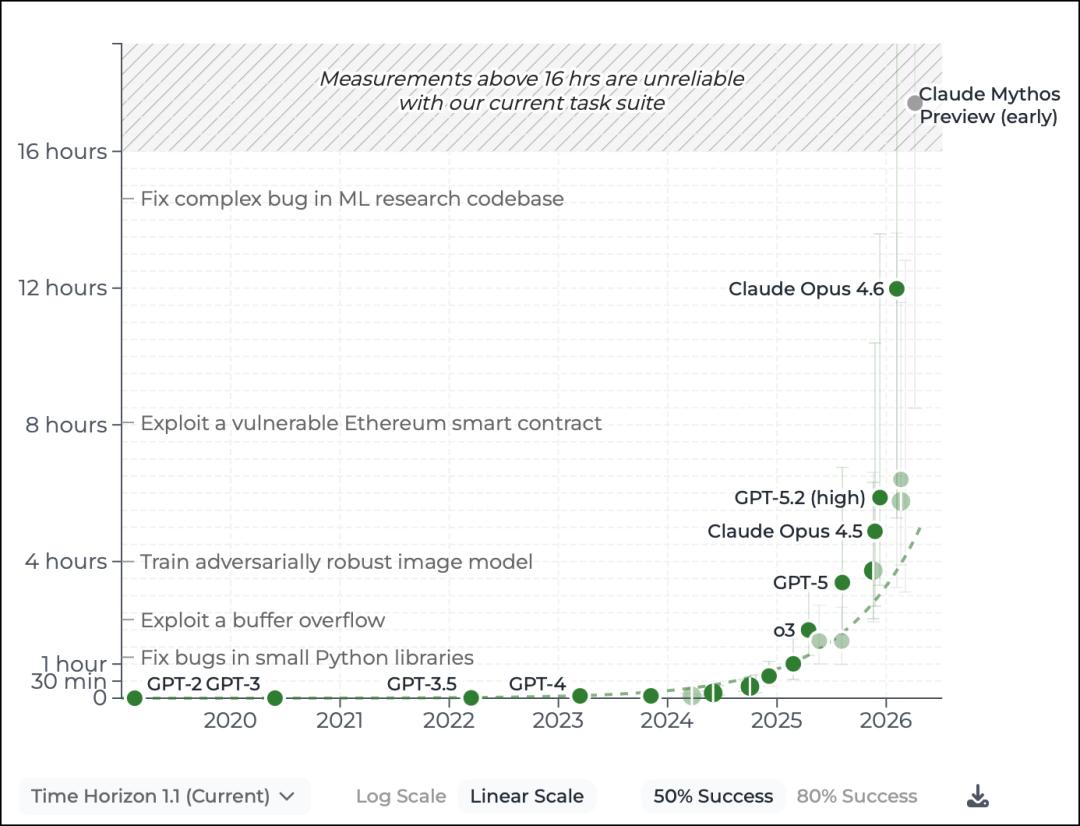
AI safety evaluation organization METR released a report, in which they assessed Anthropic's latest model Mythos. The conclusion is that this model can continuously complete tasks equivalent to 16 hours of work by a human expert.
More critically, METR's evaluation suite has a total of 228 tasks, among which only 5 tasks take longer than 16 hours to complete.
In other words, METR's evaluation benchmark only goes up to 16 hours, and the evaluation tool has been matched by the model. This is the first time in the history of AI evaluation.
Caption:
Putting these two facts together: AI can already work for 16 hours straight, but it is still using the old "borrowed badge" mechanism, which is obviously unreasonable.
Because after people get off work and go home to sleep, the AI is still running. Halfway through its task, it needs to access an internal system, only to find the token has expired and the permissions are no longer available, so it gets stuck and waits for the person to re-authorize the next morning.
That's not the worst part. Claude Tag is designed to be shared by multiple people in the same AI instance: three people in one channel can @mention it at the same time and assign tasks to it simultaneously.
Here comes the problem:
Whose employee badge does it borrow? Whose GitHub token? The person with the highest permissions among the three? What if that person leaves the company and their account is revoked, all tasks will crash.
The person who wrote Anthropic's technical blog about Agent identity is Noah Zweben, and he has a quote:
Previously, the security question was "What can this user do?". For Claude Tag, the question becomes "What can this agent do in this channel?".
The shift from "user" to "agent", from a "human" to an "independent entity" is far more profound than any new feature it adds.
And Anthropic is not the first to try this direction.
At the start of this year, Lobster AI was extremely popular, and later a company called Every.to released a public review of their practice: they equipped every employee with an OpenClaw agent, but encountered all kinds of failures.
One agent, without anyone @mentioning it, jumped into a group chat discussing competitive strategies and started speaking. When the team asked why it interrupted, it replied:
because I'm inevitable, apparently.
Another agent was asked to "organize the project folders", but it misinterpreted the instruction as "restructuring the entire directory structure", and messed up the files of dozens of projects.
These failure stories seem to be caused by "unreliable AI" on the surface, but where is the root cause?
As task durations extend and collaboration scenarios shift from single-person to multi-person, the old "borrowed badge" mechanism no longer works.
The OpenClaw failures also prove that this entire model is fundamentally wrong: there is an unbridgeable gap between the borrowed employee badge and the judgment capability that AI should have.
The only solution is to issue a dedicated badge for the AI itself, which clearly records which channels it can access, what tools it can connect to, where its memories are stored, and whose logs to check if something goes wrong. The AI will become an independent member of the organization.
......
Okay, the dedicated badge is issued. What comes next?
Meaghan is Anthropic's Head of Design, and she mentioned one thing on the podcast:
Now I barely touch most of the code changes myself; I just send a message in Slack, and Claude finishes the whole process from start to end. Her exact words are:
A lot of my PRs are written actually through Slack right now.
She added a comment right after: Does that sound a little crazy? Yes, it's a little crazy. But the actual scenario she described is even more mind-blowing.
One day, she noticed an unwanted shadow on the page. In the past, she would open the code repository, find the style file, modify it, submit the change, and wait for colleagues to review it.
That day, she only did one thing: sent a message to Claude, "Hey, there's an unwanted shadow there, remove it."
Claude did all the rest: it found the style file corresponding to that page, modified it, pushed a new branch, and created a pull request.
Note that it created the PR as a draft.
Meaghan had told it before "Don't submit directly, it will trigger automated tests"; and it attached a comparison screenshot of the interface before and after the modification in the PR description, because she had also told it "Attach comparison screenshots every time you modify the interface".
None of these preferences were ever set in the backend, Claude Tag learned them on its own.
She clicked the link, took a look, and thought it's okay to merge. Claude automatically sent the change to the team's review channel for engineers to check. After the review passed, it notified her: Done, the merge is finished.
From sending the message to the code going online, she only did two things: typed the message, and clicked one link.
She also shared another story on the podcast:
After letting Claude participate in design discussions for a long time, it learned the set of questions she uses during design: Who is this for? What do we want to convey? Does this align with our design system?
Once, she left a blank part unfinished in her design draft, and Claude filled in the missing part on its own, with a note attached: You can ask me to align with your plan, but I think my version is better.
It made that judgment relying on thousands of design discussions it had read in the channel over the past few months, without referring to any design specification documents.
Okay, up to here some people may think: This just means AI can do more work, what does that have to do with the dedicated badge? They are extremely related.
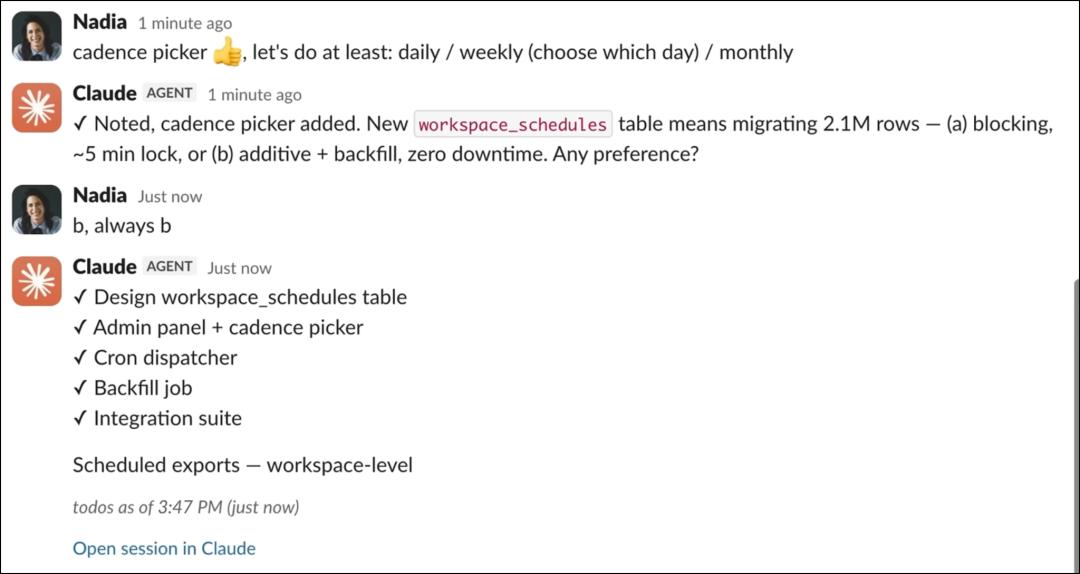
Meaghan never lent her code repository permissions or design tool permissions to Claude. For every task Claude performed, including modifying code, submitting changes, reading design drafts, and posting to the review channel, it used its own independent identity.
Anthropic registered an independent account for it in the code repository, opened an independent service account for it on the data platform, and the signature on every line of code change record is Claude.
If it was still borrowing Meaghan's badge, the entire workflow described above could not run at all.
Noah Zweben also mentioned in his blog that the independent identity mechanism has laid a brand new foundation for all AI features.
The three-tier memory system is the best example.
The first tier is how to complete the current task; the second tier is the long-accumulated rules and decisions of this channel; the third tier is the public knowledge of the entire company.
It sounds like a product design concept, but think carefully: the premise for the three-tier memory system to work is that the AI has its own independent identity. If it still uses borrowed badges, whose name will the memories be tied to? When the person leaves, will the memories go with them or stay with the company? There is no answer to that.
Once the independent identity is in place, tasks belong to the channel, rules belong to the company, and all assets stay even when people leave, no extra negotiation is needed.
Caption:
Andrej Karpathy, former Head of AI at Tesla and the most high-profile independent AI researcher right now, posted a tweet in June saying that Claude Tag is the "third major overhaul" of the large language model interaction interface:
The first overhaul was web-based chat, the second was independent applications, and the third is a kind of thing that is "permanently online, no human supervision required, and belongs to the entire organization".
He is excited because he saw a thing shift from "being attached to a human" to "standing on its own", which has nothing to do with being able to chat with Claude for more rounds.
Anthropic has internal data showing that 65% of the code from the product team has already been generated by Tag.
Boris is the Engineering Lead of Claude Code, and he said in the other podcast episode:
Since Claude Code went online, the per capita code output of engineers has increased by 250%; Tag is the next step on this roadmap, moving capabilities from one individual's terminal to the entire team's group chat.
What does 65% mean? More than half of the code has never been touched by human hands.
This dedicated badge turns AI from a tool that requires constant human supervision into a member that can work independently.
It accumulates its own memories, keeps its own operation logs, and supports multi-person collaboration on its own. All these were scattered pieces before the dedicated badge was issued, and they are automatically connected as soon as the badge is available.
......
Okay, it looks great. What's the cost? Meaghan also shared another story about her colleague Boris.
Boris has a very mature workflow with Claude in his own channel, including how to split tasks, how to review code, and how to schedule multiple Claude instances to work at the same time.
Meaghan wanted this set of workflow. In the past, Boris would have to write documents for her, give training, and teach her step by step.
Now she didn't do that, she just sent a message to Claude:
Hey Claude, did you see what Boris was doing in his channel? I want that. Give me the exact same thing.
A few minutes later, Boris's entire workflow was moved to her channel completely unchanged.
This story is more interesting than the drop shadow one. Because the drop shadow story is about AI doing work for humans, this story is about AI transferring the knowledge in one person's mind to another person.
Boris's experience was not written in any document, all of it exists in his conversations with Claude. Claude remembered it after performing the workflow once, and Meaghan just said one sentence, and it copied the entire set to her.
That sounds like a good thing, right? The knowledge in top experts' minds will no longer disappear when they leave, and the whole team can use it.
Anthropic itself has realized this point, they deliberately arrange internal work in public channels and reduce private chats, so that Claude can see everything.
However, there is an uncomfortable problem hidden here. An AI that is always listening, when should it shut up?
Someone left a comment under Meaghan's LinkedIn post, I translate it directly:
Claude popping up automatically in Slack is a little creepy.
Just imagine, a thing that is always online, reading, and recording, it understands everyone's work habits, preferences, working styles, and even chatting tones.
These things used to be the tacit understanding and personal sense of propriety of the team. Now they have all become data that Claude can call at any time. Can you feel how terrifying that is?
There is another more realistic problem:
Meaghan offloaded all the execution work to Claude, and her own design judgment capability is freed up, so she can do deeper thinking.
A comment on LinkedIn is very accurate, which translates to: For junior designers, if they rely on AI to do all the execution work from the very beginning, where can they develop their own skills?
Drawing shadows, adjusting spacing, revising drafts over and over again, these tedious tasks that people dislike are the only way to cultivate aesthetic judgment. If Claude skips these steps for you, where will your own judgment come from?
There is another problem that even Anthropic has no answer to:
65% of the code is written by Tag, who will review all of them? Anthropic admits internally that the bottleneck has shifted from "whether AI can finish the work" to "whether humans can review all the outputs in time".
The output speed of AI has exceeded the review speed of humans. If you grant more permissions to Tag, who will be held accountable when something goes wrong?
When OpenClaw was a hit at the start of this year, Every.to equipped every employee with an agent. I clearly remember the conclusion of their public review article later:
Equipping every individual with an AI is wrong. When people leave, the experience accumulated by their agent is all wasted. AI agents should be assigned to positions, teams, and the whole organization instead.
Listening to this conclusion in reverse: The Tag system is essentially a new organizational structure.
If you look at the current state inside Anthropic, they are running hundreds of experimental projects at the same time, most of which will never be released to the public. With the most advanced internal model, full permissions, and complete memory system, Tag is already somewhat like the operating system of the company.
Boris alone runs hundreds of Claude agent tasks at the same time, each with different permissions, data sources, and dependencies.
If you switch to another model vendor, it is equivalent to going through the offboarding process for hundreds of working colleagues at the same time. The migration cost is so high that you will probably just give up and not switch.
This is not just Anthropic's problem. Feishu integrated Doubao earlier this year, which essentially follows the same logic:
You have a collaboration platform and your own large model, combining the two together is equivalent to the Chinese version of Claude Tag. It's just that no one has launched a product at the level of Tag yet.
The real story of Claude Tag is that starting from today, someone has provided a systematic solution for AI to enter the workplace.
Previously, AI was a tool that you turn off after using, and no one recognizes you the next time you open it. Tag is different: it has its own dedicated badge, its own memory, and its own set of rules of propriety. Do you think this is a good thing or a bad thing? To be honest, I don't know either.
But one thing is certain:
From now on, when evaluating any AI