Starting at 499 yuan, Xiaomi's power banks are priced so high — is the "new national standard" the source of its confidence?
Just yesterday (August 10), Xiaomi launched a 20000mAh power bank with built-in cable that has passed the 2026 new national standard certification, which comes in two versions of 45W and 67W. What surprises many people is their price:
They are priced at 499 yuan and 599 yuan respectively.
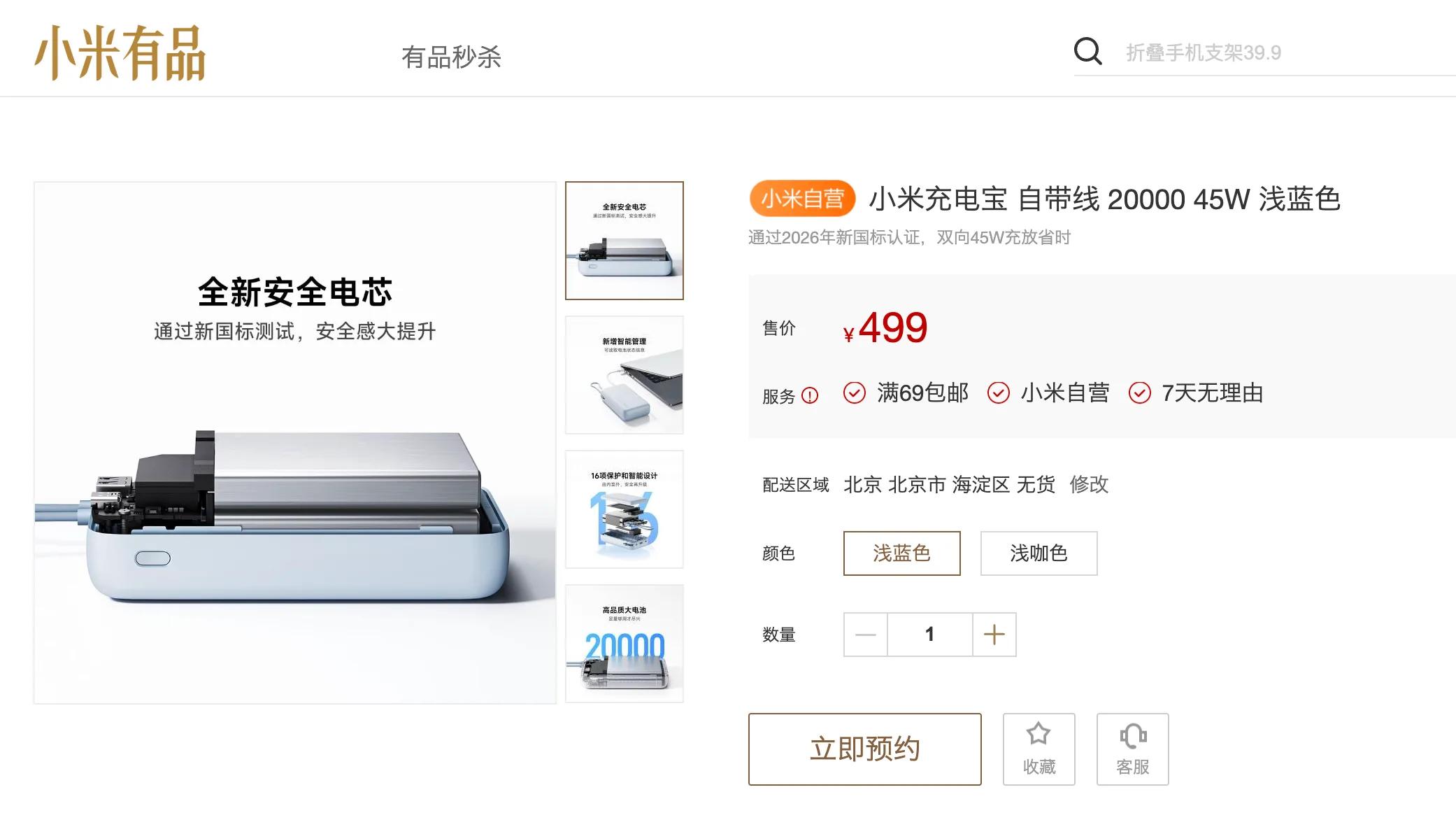
Image source: Xiaomi
With the label of "2026 New National Standard", the price of power banks has suddenly caught up with that of mid-range earphones, and there are naturally countless complaints online: Are power banks that meet the new national standard this expensive?
The gap between specifications and price is too large. Is this still the "price butcher" in the digital field? Of course, there is no need to rush to conclusions. The pricing of Xiaomi's new power bank that meets the new national standard has not been finalized yet, and it is currently only in the reservation stage. The price of 499/599 yuan may be a pre-order anti-shoot price.
For reference, at the launch event of the Zunjie Era flagship MPV and Huawei's full-scenario new products held on August 5, Huawei also launched its first new P0023 smart universal power bank with built-in cable that has passed the 2026 new national standard certification. It has a 12000mAh capacity, 100W bidirectional charging, and is priced at 399 yuan.
The price is consistent with that of the previous generation P0023 (both have 12000mAh capacity and 100W bidirectional charging).
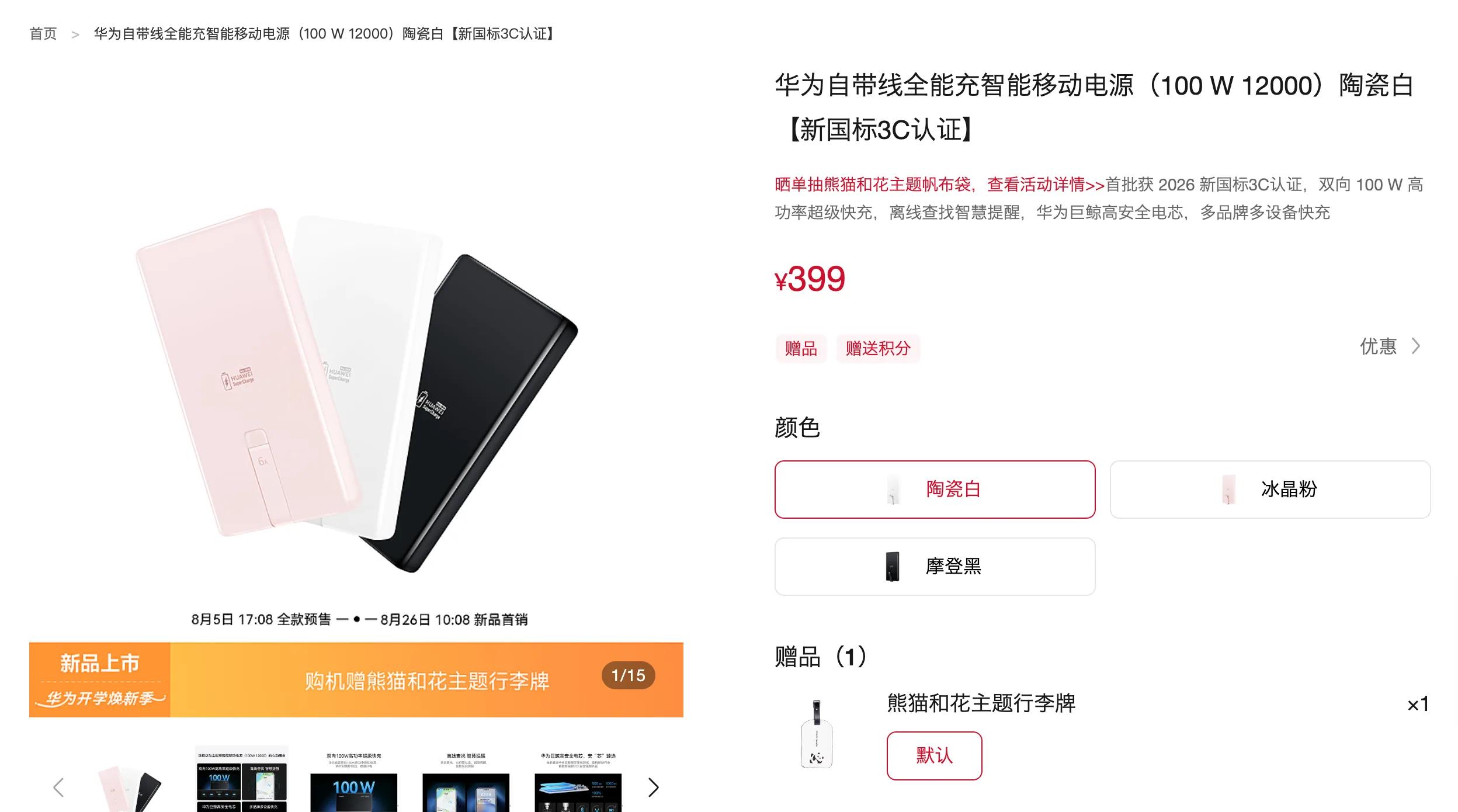
Image source: Huawei
Therefore, we can boldly judge that 499 yuan and 599 yuan will not be the final pricing of Xiaomi's new power bank. However, the concern that the new national standard pushes up product prices cannot be denied. More importantly, at this stage when new national standard products are gradually launched and products under the old and new national standards are in transition, consumers still need to clarify a lot of facts.
(Lei Technology Note: At the REDMI K100 series new product launch conference held on the evening of August 11, Xiaomi officially announced that the pricing of its first new national standard power bank is 229/269 yuan.)
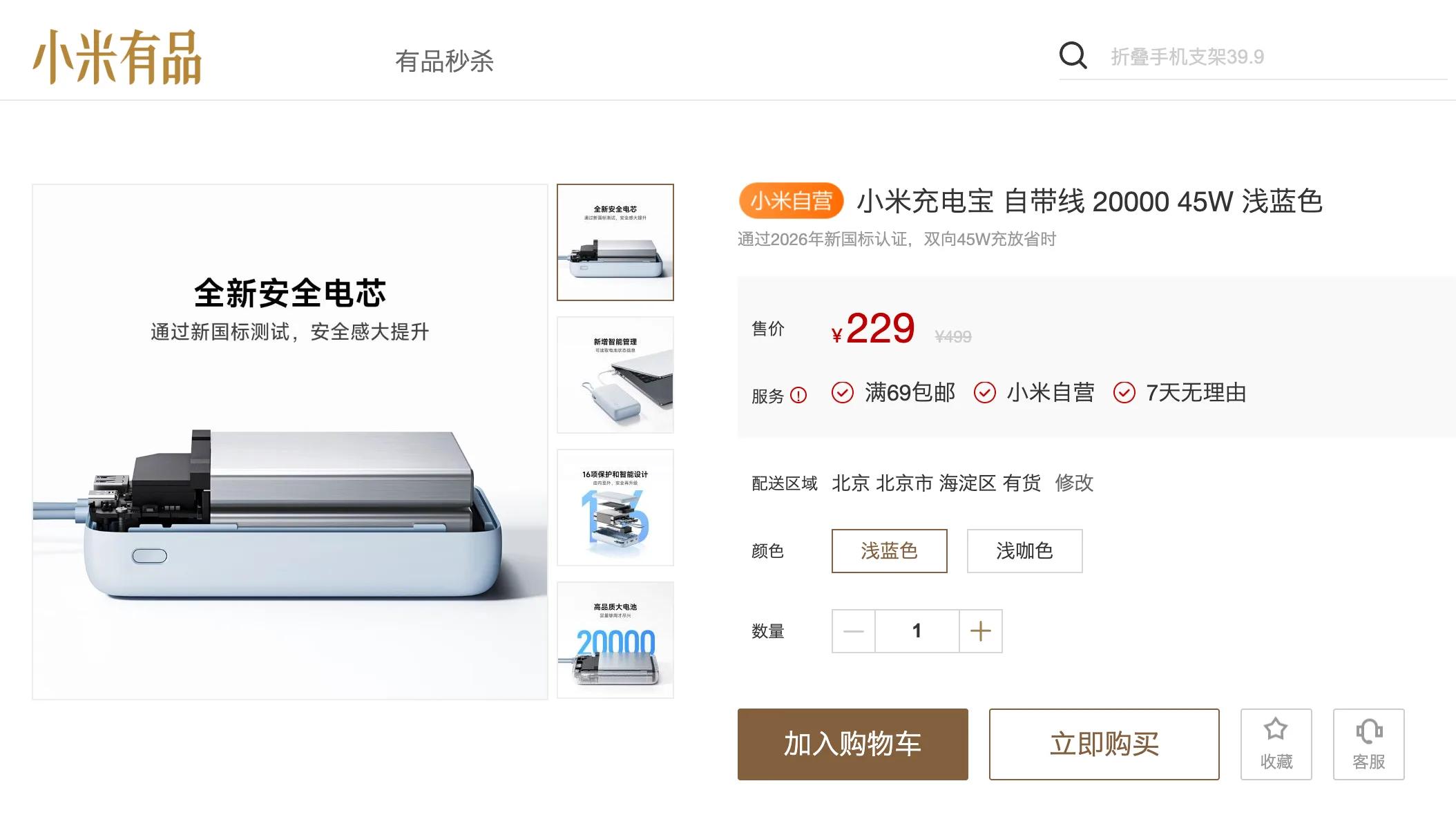
Image source: Xiaomi
However, the core question is, in 2026, how should we ordinary consumers make choices?
Does a power bank also need a dedicated new national standard?
Power banks did not have no safety standards until 2026.
Since August 1, 2024, power banks have been included in the 3C certification scope. Only products that meet GB 4943.1—2022 (governing the overall safety of equipment) and GB 31241—2022 (governing battery safety), obtain the corresponding certificates and mark the 3C logo can leave the factory and be sold.
The problem is that these two are both general standards with a wide coverage. As one of the products, power banks not only need repeated charging and discharging, but also are often put into backpacks and suitcases, subjected to drops, extrusion and high temperatures, and will also be carried into densely populated places such as planes, high-speed rails and hotels. Their actual challenges and safety risks far exceed the design scope of general standards.
In the final analysis, general standards can only be regarded as a basic threshold, and it is difficult for them to take into account factors such as cell aging, material substitution in the supply chain, abnormal records and long-term traceability.
In particular, a series of accidents last year brought this issue to the forefront. Manufacturers such as Romoss and Anker carried out large-scale recalls due to cell risks, and the 3C certificates of multiple products were suspended or revoked. The Civil Aviation Administration of China also banned power banks without 3C logos, with unclear logos, or belonging to recalled models or batches from boarding domestic flights starting from June 28, 2025.
According to the statistics of People's Daily, in 2025, the State Administration for Market Regulation supervised and urged enterprises to recall a total of:
1.3977 million units of problematic power banks.
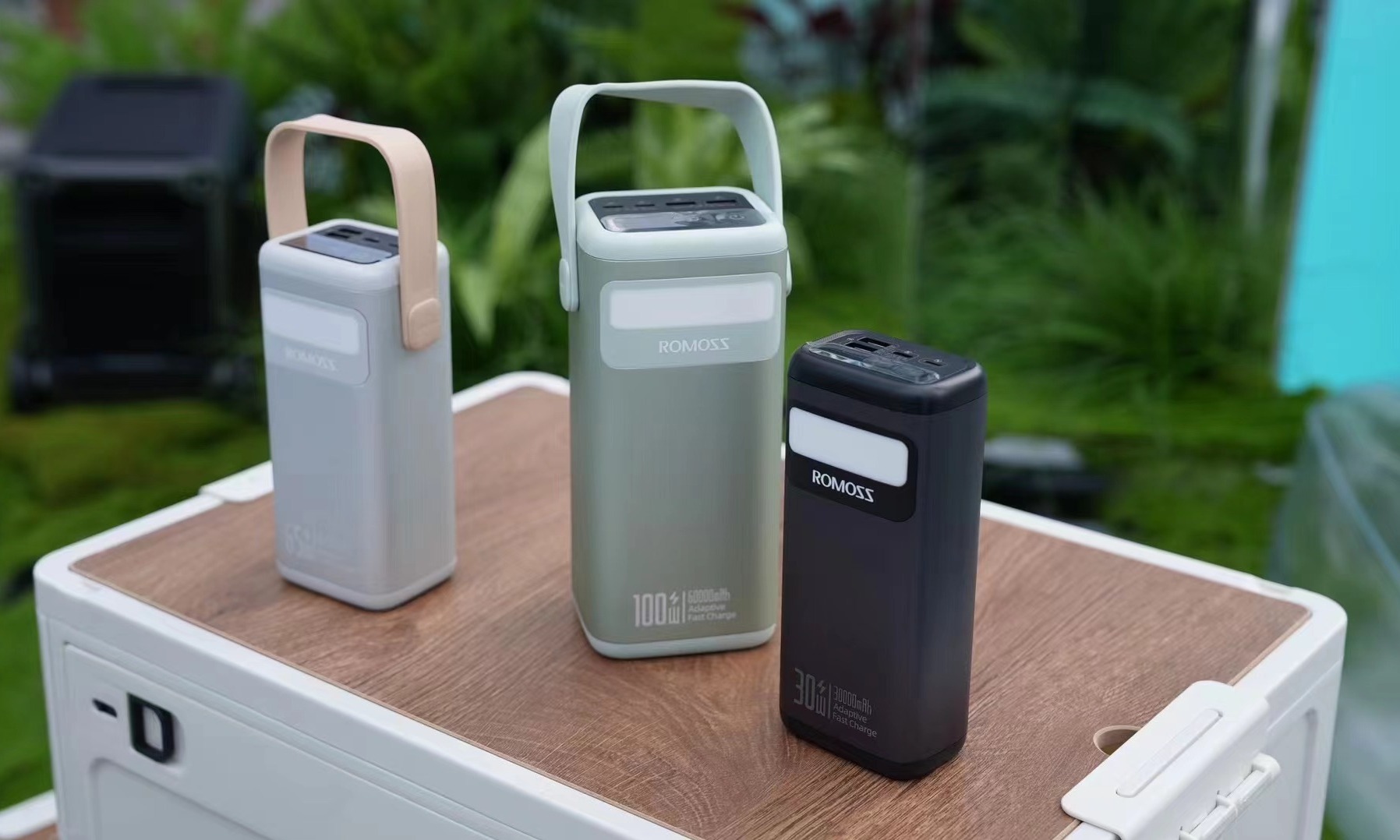
Romoss, Image source: Lei Technology
This is the background for the introduction of GB 47372—2026 "Technical Specification for Safety of Power Banks" (the 2026 New National Standard). It was released on March 31 this year and will be mandatorily implemented on April 1, 2027. It is the first mandatory national standard in China specifically for power banks.
For the new national standard, the most frequently mentioned change we hear may be "no fire and no explosion after needle puncture", but the standards it actually puts forward are far more than that.
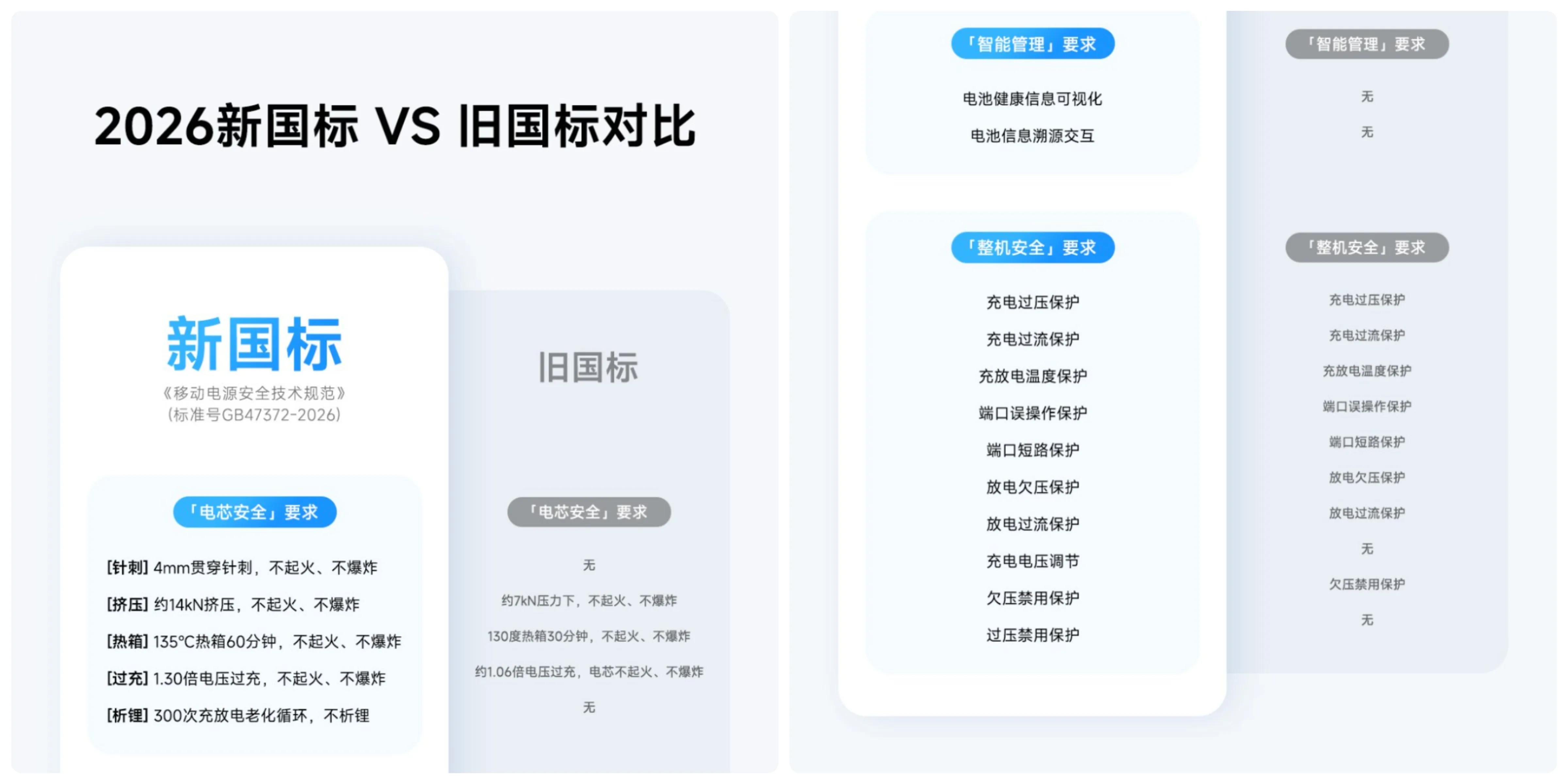
Image source: Xiaomi
On the one hand, aiming at the internal short circuit that may be caused by extrusion and production impurities, the new standard tightens the extrusion conditions, introduces the needle puncture test, and further tightens the thermal abuse test. Aiming at the metal lithium precipitated after long-term use that may pierce the diaphragm, a lithium precipitation test after 300 charge-discharge cycles is added.
The overcharge protection has also been upgraded from single-layer to double-layer, and the test voltage is increased to 1.3 times the charging limit voltage. Once severe overvoltage occurs, the power bank will be directly "locked" to prevent the already faulty battery from continuing to work. If the cell voltage is too low due to long-term idle or internal micro-short circuit, the power bank will also be directly "locked".
In addition, the new national standard also requires the rated energy, recommended safe service life and unique code to be marked on the body, further extending the requirements to the upstream supply chain, and adding raw material incoming inspection, management of key production links and product consistency.
A more intuitive change is the mandatory requirement for BMS intelligent safety management and its visualization. The new national standard requires power banks to continuously monitor the voltage of each series-connected battery, the total voltage of the battery pack, and the temperature at the most unfavorable position of the cell, and also to realize "visualization" — the information can be directly displayed on the screen of the power bank, or only supported to be displayed on the screens of mobile phones, computers and other devices.
Take the first new national standard power banks of Huawei and Xiaomi as examples. Neither of the two power banks is equipped with a screen. Huawei allows users to check the status of the power bank (including power level, status, etc.) through the Huawei Smart Life App, while Xiaomi's product page shows that users can also monitor the information of each battery and the charging process in real time by connecting to a computer via a wired connection.
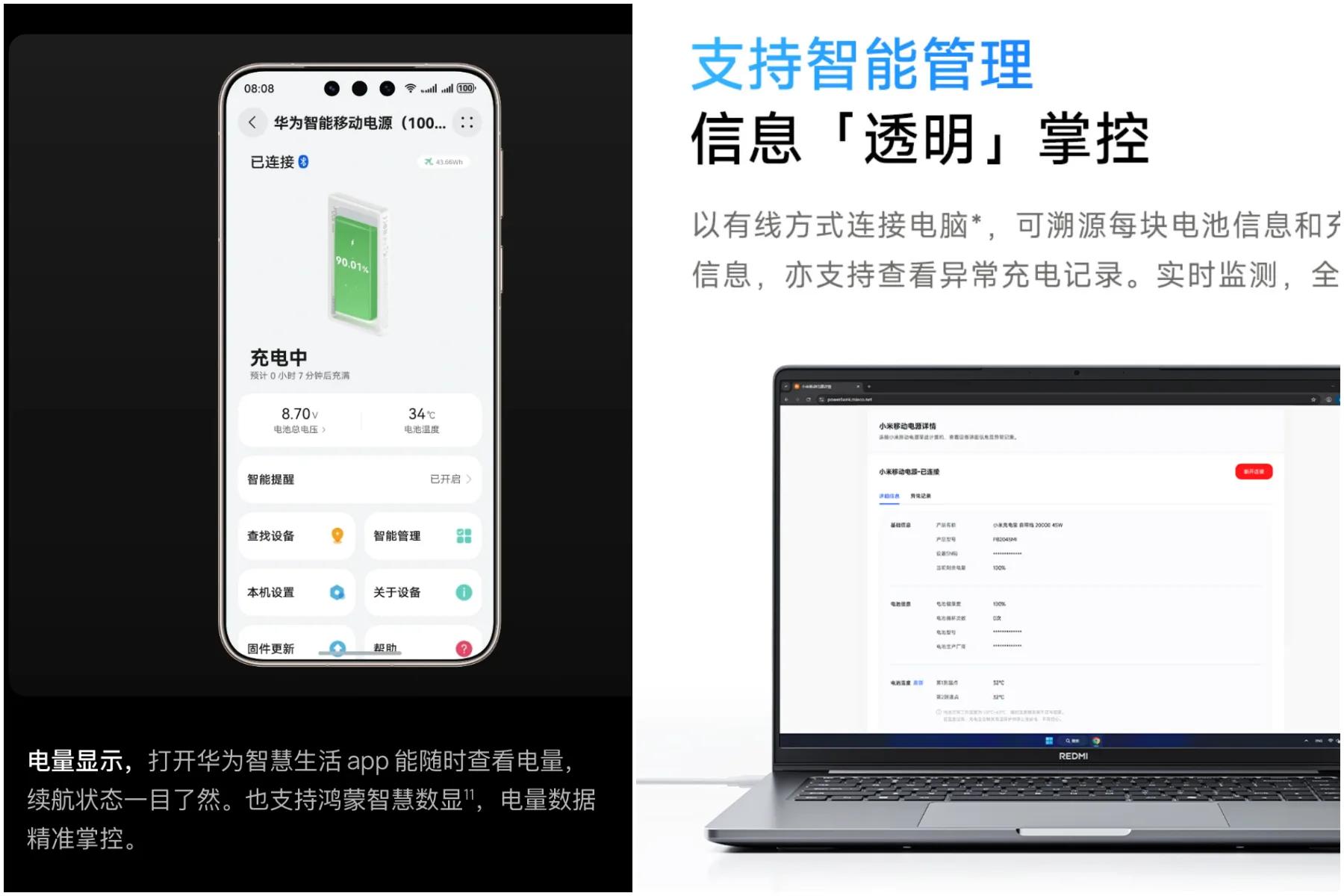
Image source: Huawei, Xiaomi
According to current information, Baseus's 10000mAh card-shaped magnetic Air power bank (E00363), which has passed the new national standard certification and has not yet been launched, supports NFC tap to view information such as power level and battery status.
In short, BMS information must be "visualized", but the visualization entry and interaction methods are diverse.
Note: "Designed in compliance with the standard" is not equal to "Passed the certification"
First of all, it needs to be clarified that the new national standard does not mean that the old national standard power banks we are using that have passed 3C certification need to be scrapped.
According to the version replacement arrangement of China Quality Certification Center, before March 31, 2027, manufacturers can choose to apply for 3C certification according to the old or new version of the rules. Starting from April 1, 2027, power banks must obtain 3C certificates issued in accordance with the new version of the rules and the new standard to continue to be factory-produced, sold and imported. However, power banks with old version 3C certification can continue to be used, including being carried on planes.
Back to the current situation, there are very few first-batch products that have passed the 2026 new national standard certification, but they cover major brands in the market — Huawei, Xiaomi, Baseus, Ugreen, Anker, and even Meituan (shared power banks) and other manufacturers. As one of the drafting units of the new national standard, CUKTECH has not launched such products yet.
But at present, there is actually no new national standard certified power bank that can be publicly "bought and obtained", including the two new national standard power banks of Huawei and Xiaomi mentioned above. Huawei has currently launched full payment pre-orders, and the official first sale time is August 26; Xiaomi is in the reservation stage and has not announced the specific on-sale time.
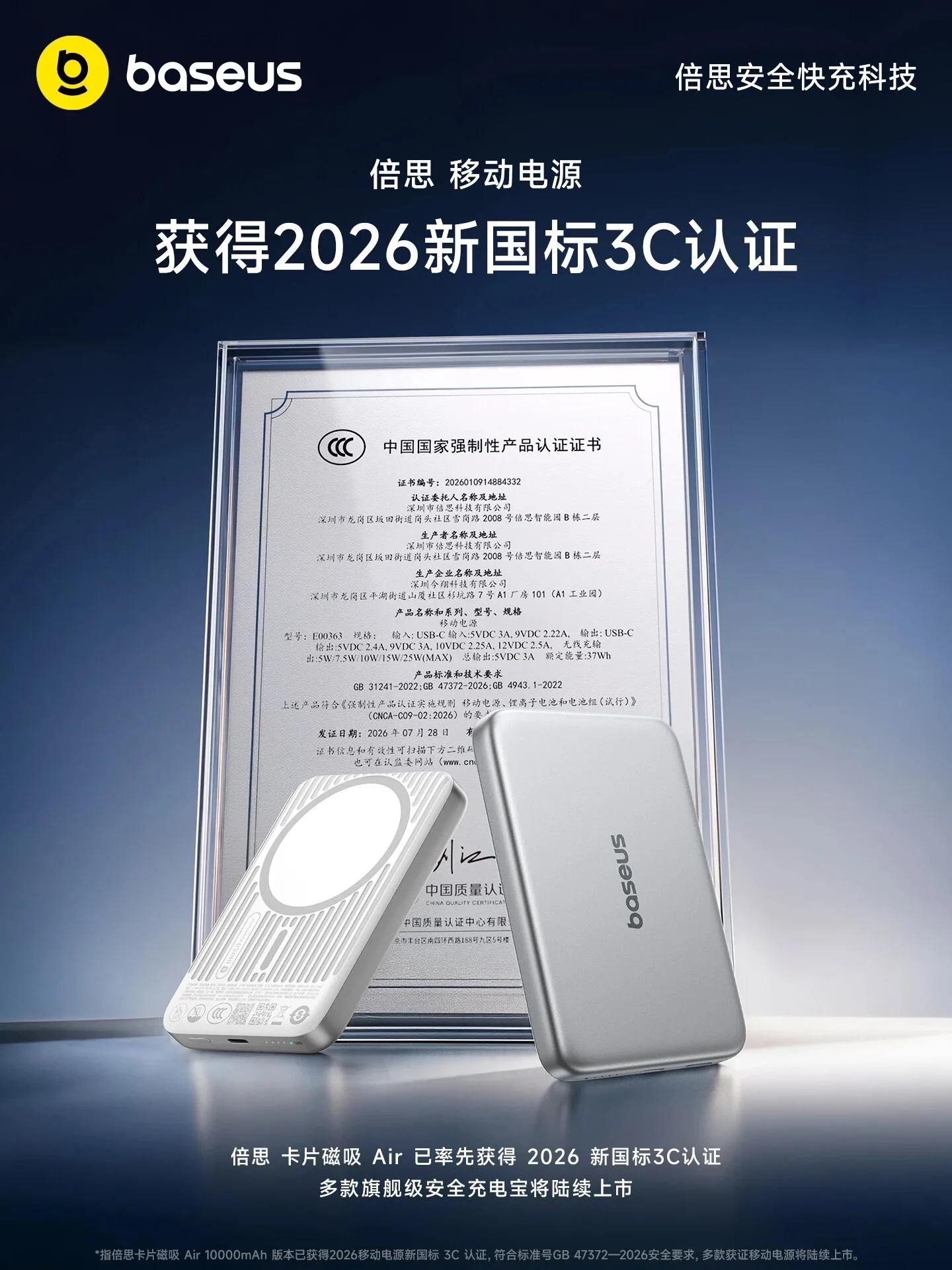
Image source: Baseus
Some "new national standard power banks" you can find and see on e-commerce platforms are actually "designed in accordance with the 2026 new national standard", such as Xiaomi's built-in cable power bank (20000mAh 22.5W) that went on sale some time ago, or various new national standard power banks claimed by mainstream and non-mainstream brands.
Brands that clearly indicate "designed in accordance with the 2026 new national standard" such as Xiaomi and Ugreen are already relatively transparent, and many brands simply blur the boundary between "designed in accordance with the 2026 new national standard" and "2026 new national standard certification".
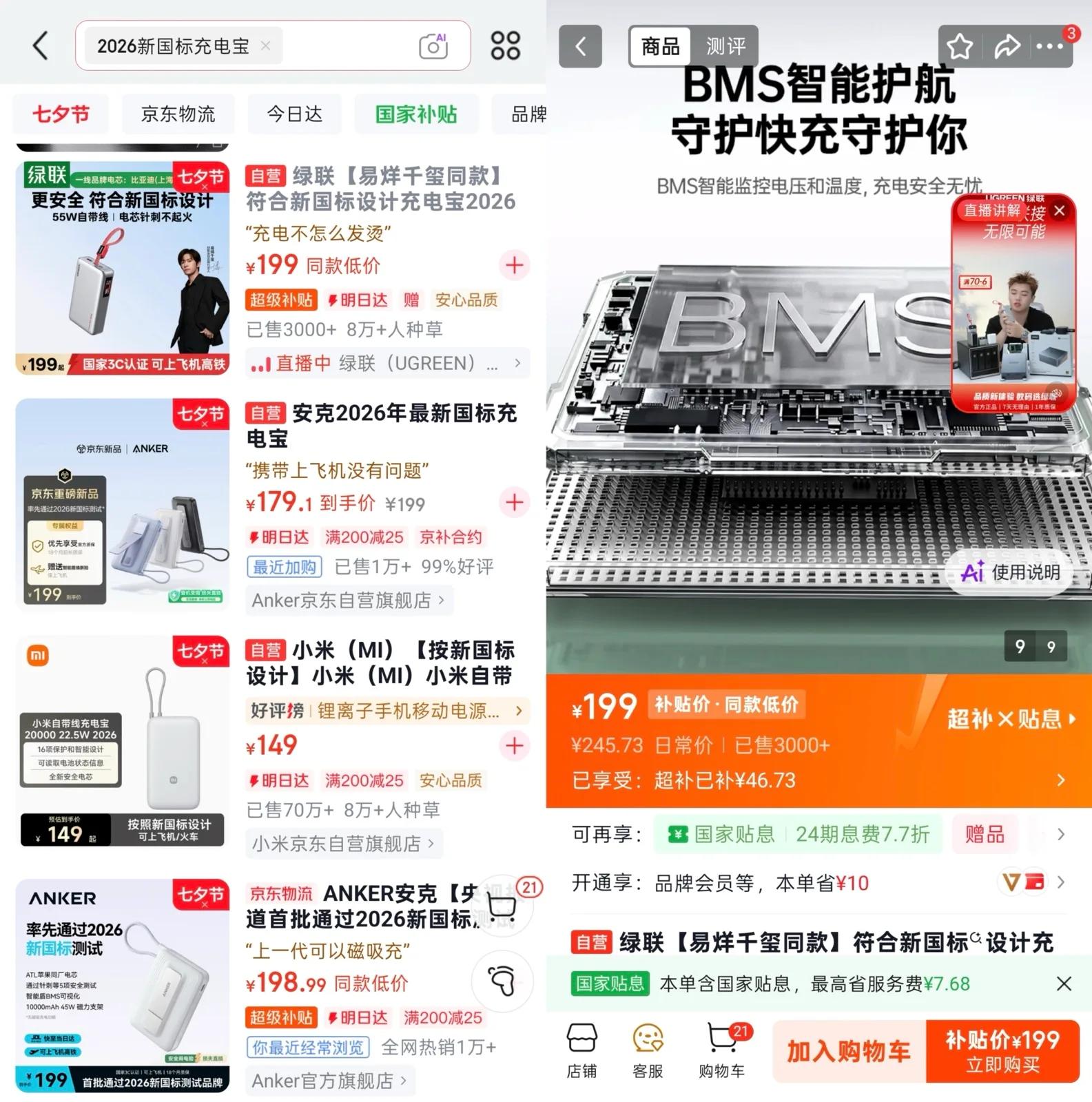
Image source: JD.com
So what exactly does "designed in accordance with the 2026 new national standard" mean? What is the difference between it and "2026 new national standard certification"?
In simple terms, the so-called "designed in accordance with the 2026 new national standard" means that the product is designed and tested according to the requirements of the new national standard. They may indeed use cells that can pass the needle puncture test, add intelligent management and abnormal records, and may also have undergone tests by the manufacturer or a third party. However, as long as there is no GB 47372—2026 in the certification basis of the 3C certificate, it cannot be regarded as having passed the 2026 new national standard certification.
The truth is often that many products have only passed the old version 3C standard certification, but they claim to meet the new national standard.
The difference between the two lies in whether there is official endorsement. The credibility of manufacturer or third-party tests is not sufficient, especially after the trust crisis caused by the Romoss incident last year. For ordinary consumers, national standard certification is the most convenient and fair "endorsement".
The two cannot be confused.
How to choose a power bank now?
As mentioned earlier, power banks with 3C certification (including the old version standard) can be fully used continuously, so there is no need to replace the power bank just for the "new national standard".
But if you just need to replace your power bank and your budget allows, I also give priority to recommending products that have passed GB 47372—2026 certification. The first batch of products will most likely go on sale in the next two to three months. More complete cell testing, abnormal recording and traceability capabilities are still worth choosing for people who often take planes and high-speed rails, or are used to keeping power banks in their bags for a long time.
Products "designed in compliance with the new national standard" can also be considered, on the premise that they come from reliable brands, the old standard 3C certificate is authentic and valid, the product page clearly specifies which new standard designs and tests are adopted, and the price has a sufficient advantage over the new national standard certified model. If the price difference is only tens of yuan, it may not be necessary.
In particular, do not pay extra for the manufacturer's claim of "new national standard design", which cannot replace the complete new national standard certification.
No matter which one you choose, the 3C logo is only the factory entry threshold. If the power bank bulges, has abnormal heating, peculiar smell, shell cracking, or has experienced severe drops and extrusion, you should stop using it immediately. Recalled models should not be used reluctantly just because "they can still be charged". Do not charge the power bank for a long time in pillows, bedding or closed bags, and do not leave the power bank in a car exposed to direct sunlight.
To be fair, the industry reshuffle brought by the 2026 new national standard is real, and the first batch of new products will inevitably be concentrated in mid