Just now, Ant Group open-sourced a new model standing on the shoulders of Kimi.
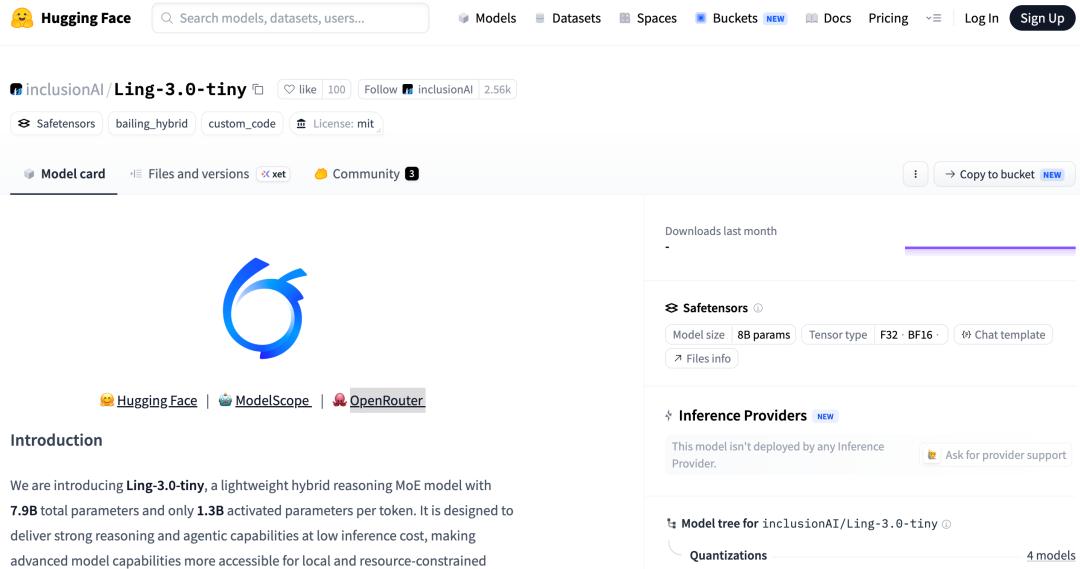
Reported by Zhidx on August 11, Ant Group's Bailian large model open-sourced a lightweight hybrid inference MoE model — Ling-3.0-tiny.
The total number of parameters of this model is 7.9B, with only 1.3B parameters activated during inference, and it is mainly designed for efficient local deployment. It provides three versions of BF16, FP8 and INT4 simultaneously, which have been verified on devices such as DGX Spark, MacBook, Mac mini, taking into account performance, efficiency and deployability.
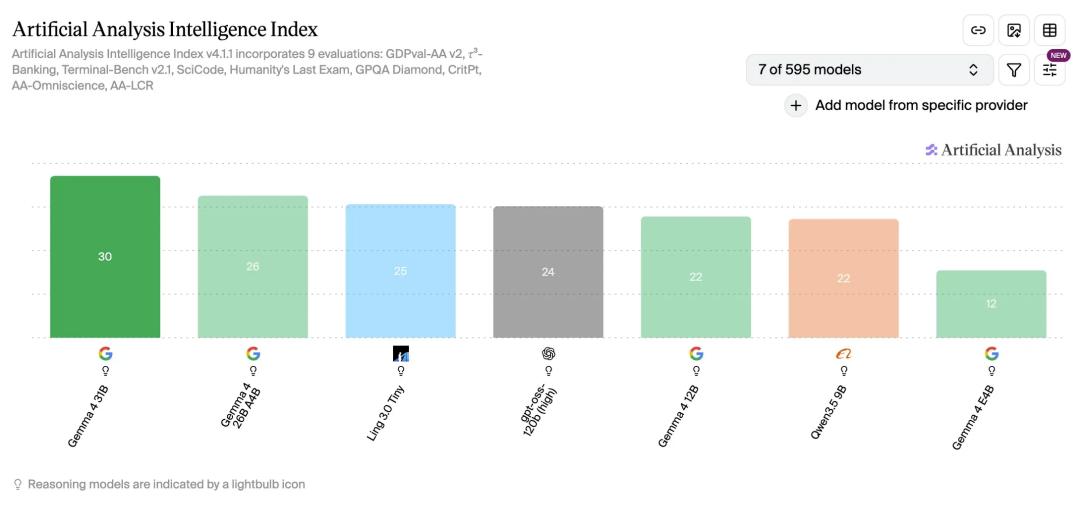
In the Artificial Analysis Intelligence Index evaluation system, Ling-3.0-tiny scored 25 points, only 1 point lower than Gemma-4-26B-A4B, and higher than gpt-oss-120B (high), Qwen3.5-9B, Gemma-4-12B and Gemma-4-E4B.
The key points of this model are summarized as follows:
1. Efficient hybrid linear architecture: Ling-3.0-tiny adopts a 3:1 alternating stacked structure of Moonshot AI's self-developed KDA (Kimi Dilation Attention) and DeepSeek's self-developed MLA (Multi-head Latent Attention), and is equipped with a sparse MoE feedforward network composed of 128 routing experts to build an efficient hybrid linear architecture.
Each Token activates only 8 routing experts and 1 shared expert, enabling the model to strike a balance between long-context modeling capability, parameter efficiency and computational cost.
2. Native hybrid inference and agent capability: Ling-3.0-tiny takes into account the capabilities of fast response and multi-step reasoning, and can flexibly enable or disable the thinking mode in a single request through the enable_thinking parameter. This model has balanced performance in scenarios such as general agent tasks, code generation, mathematical and scientific reasoning and instruction following.
3. Local and edge deployment: Under FP8 precision, the inference throughput of Ling-3.0-tiny on DGX Spark can reach 100–105tokens/s, while on M4 Pro MacBook it is 86–90tokens/s, and the peak memory usage is only 8.34GiB when the context length is 8K.
As shown in the video below, Bailian reproduces the core experience of Infinite Wiki on a MacBook Pro with 36GB memory. Users can click on words while reading to generate context explanation cards, supporting multi-layer knowledge drilling down.
The entire Demo runs local inference without cloud calls. The actual measured first Token response is less than 100 milliseconds; all data is stored on the device side, no cloud API billing will be generated, which is close to a native-speed local knowledge engine.
Hugging Face address:
https://huggingface.co/inclusionAI/Ling-3.0-tiny
https://huggingface.co/inclusionAI/Ling-3.0-tiny-fp8
https://huggingface.co/inclusionAI/Ling-3.0-tiny-int4
ModelScope address:
https://modelscope.cn/models/inclusionAI/Ling-3.0-tiny
https://modelscope.cn/models/inclusionAI/Ling-3.0-tiny-fp8
https://modelscope.cn/models/inclusionAI/Ling-3.0-tiny-int4
01.
1.3B activated parameters "achieve more with less"
Scores closely follow 26B large models
In the Artificial Analysis Intelligence Index evaluation system, Ling-3.0-tiny scored 25 points. This index comprehensively measures the cross-task capability of the model from nine dimensions including real tasks, tool usage, code, scientific reasoning, knowledge reliability and long context.
The comparison results released by Bailian show that the comprehensive score of Ling-3.0-tiny is only 1 point lower than Gemma-4-26B-A4B, close to larger MoE models with about 4B activated parameters, and higher than gpt-oss-120B (high), Qwen3.5-9B, Gemma-4-12B and Gemma-4-E4B.
Ling-3.0-tiny has 7.9B total parameters, but only 1.3B parameters are activated per Token. This means that with a low actual computational scale, it has entered the comprehensive capability range of mainstream 4B to 12B level models.
A single score cannot cover all capabilities of the model, and the Tiny model cannot replace all large models. However, according to relevant evaluations, Ling-3.0-tiny already has the capability foundation to enter code assistance, knowledge workflow, tool invocation and local Agent applications, and its positioning goes far beyond small-size models that simply pursue "can be installed on devices".
02.
Agent score exceeds 31B large model
Output speed exceeds 160 tokens/s
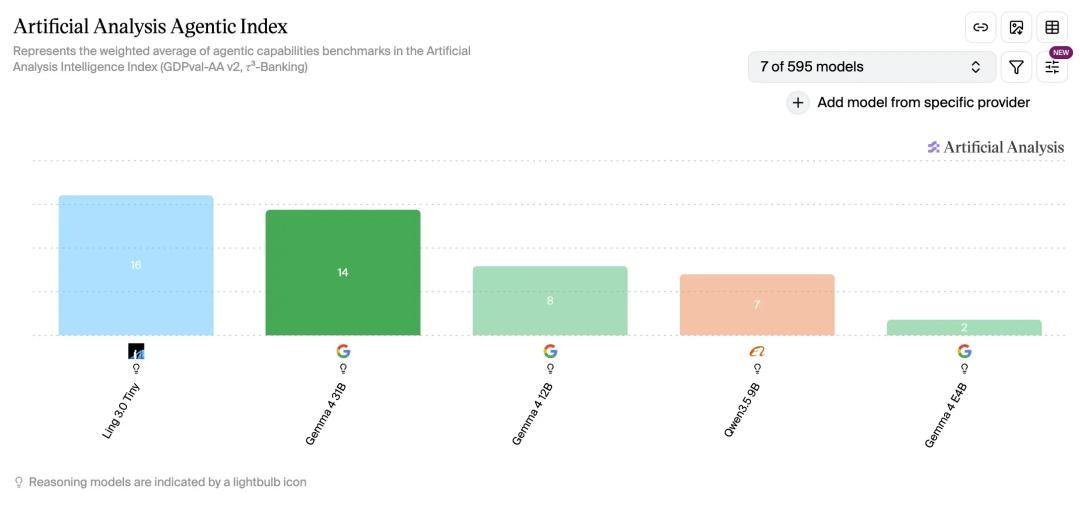
The outstanding direction of Ling-3.0-tiny is real tasks and Agent execution.
Its Artificial Analysis Agentic Index score is 16, which is higher than Gemma-4-31B; among them, GDPval-AA v2 obtained 772 Elo, and τ³-Banking scored 20.80, reflecting the model's capabilities in task understanding, tool invocation and process advancement.
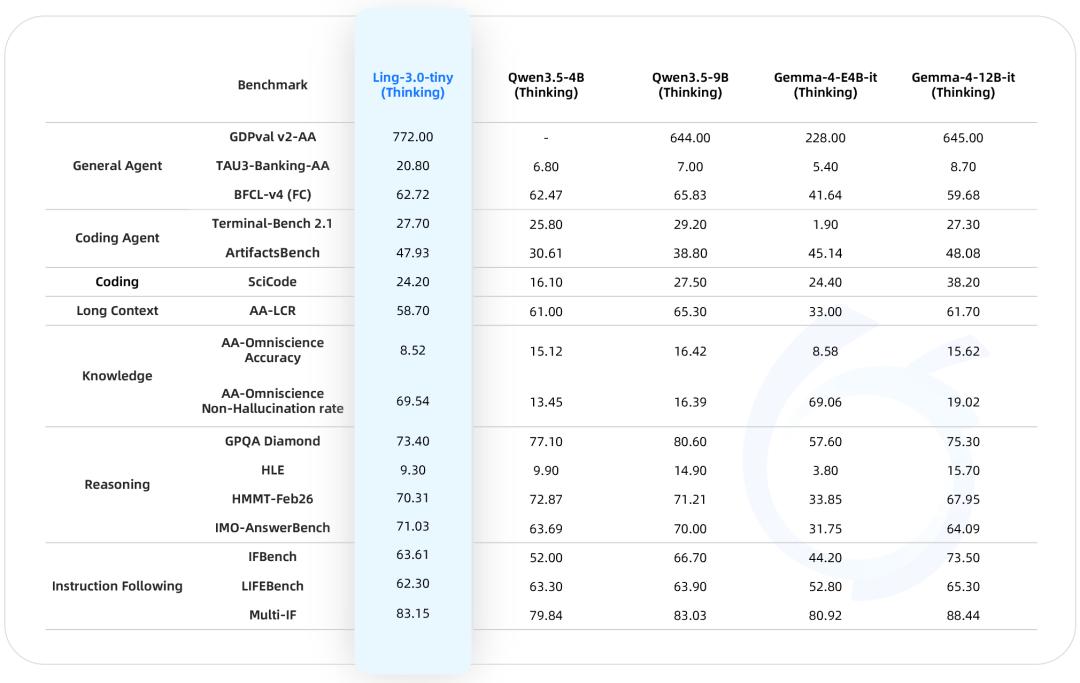
Among the comparison models listed by Bailian this time, Ling-3.0-tiny takes the lead in the IMO-AnswerBench and non-hallucination rate indicators, and its performance in tasks such as mathematics, scientific reasoning, code Agent, instruction following and long context is also relatively balanced.
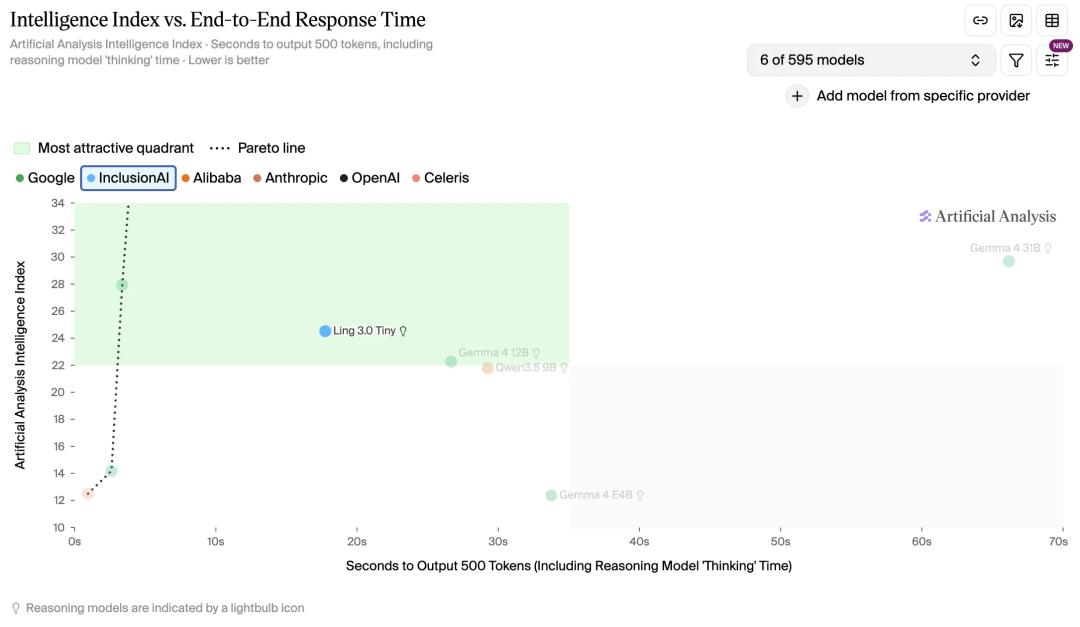
While the comprehensive intelligence index reaches 25 points, the output speed of Ling-3.0-tiny exceeds 160 tokens/s, and the end-to-end time for outputting 500 Tokens is about 18 seconds, which already includes the model thinking process.
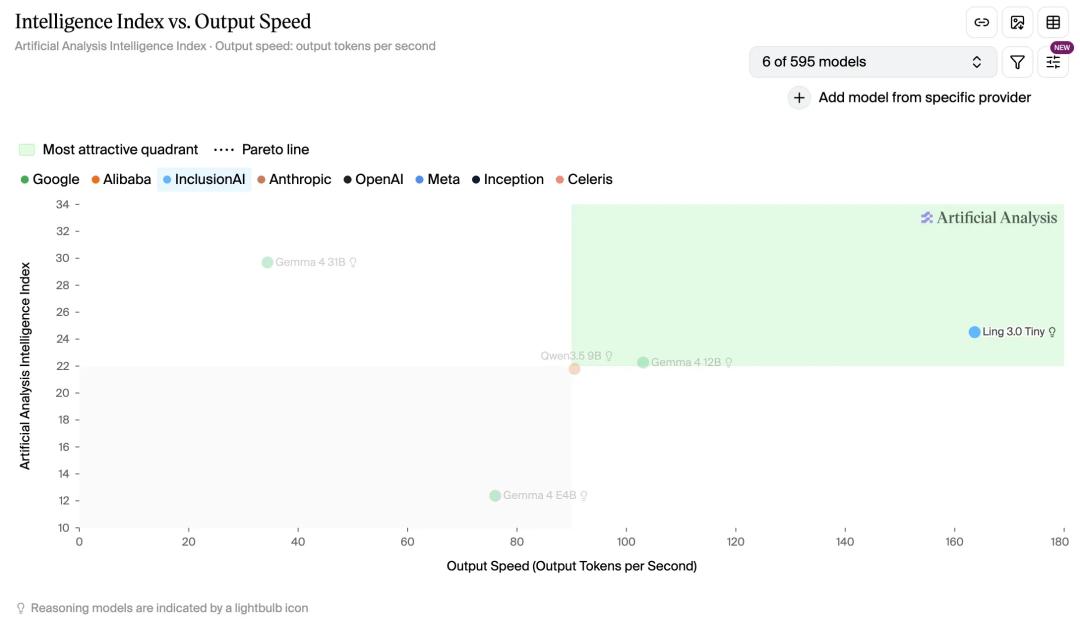
The smaller activation scale is thus transformed into shorter task waiting time, which also helps to improve the response efficiency when the Agent continuously executes tasks.
03.
Innovative architecture based on the achievements of DeepSeek and Kimi
Lower the threshold of local deployment
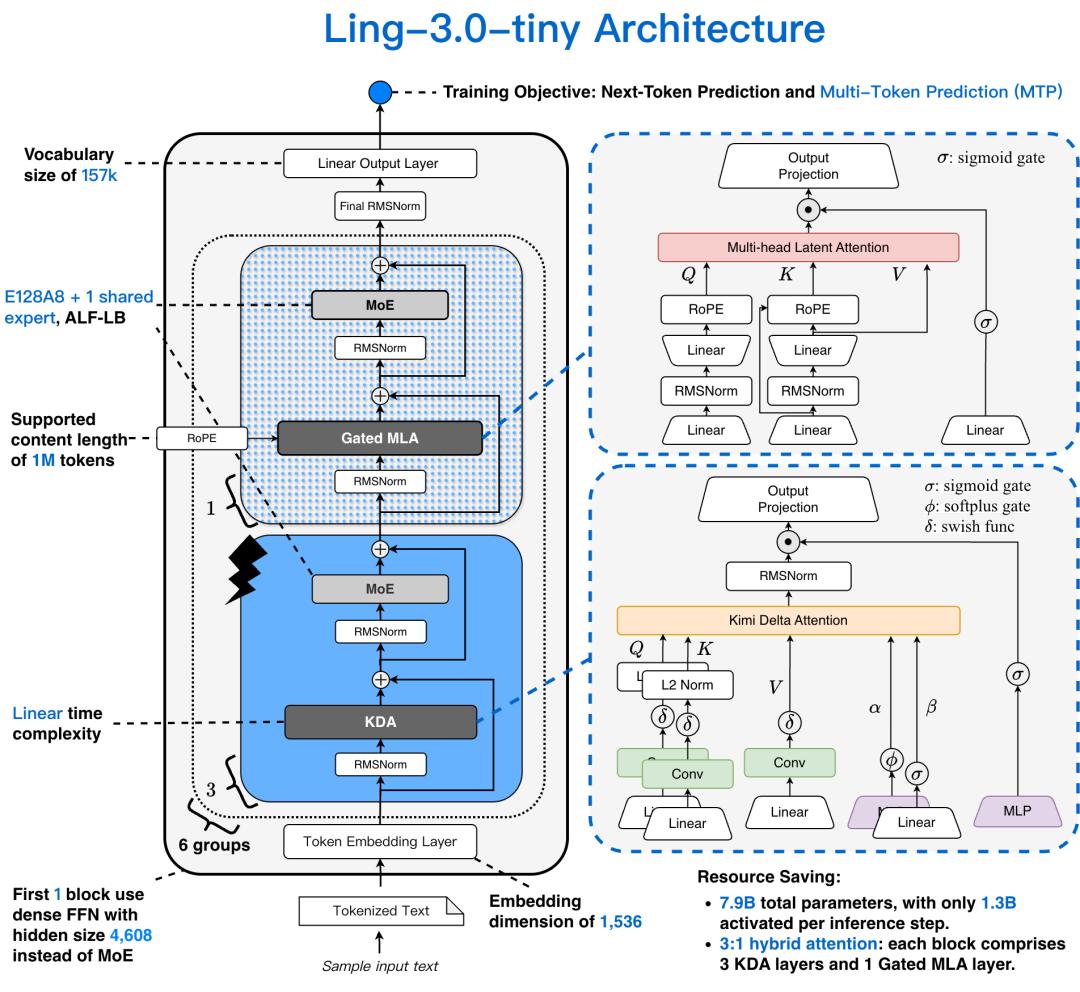
Ling-3.0-tiny continues the native hybrid linear attention technical route of the Ling-3.0 series, and is further optimized for lightweight and low-threshold deployment. Its total number of parameters is controlled at 7.9B, and the number of activated parameters per Token is 1.3B.
The model adopts a 3:1 KDA-MLA architecture, that is, every 4 layers contain 3 layers of KDA and 1 layer of MLA to improve the efficiency of long context processing.
In the MoE part, Ling-3.0-tiny sets 128 sparse experts. Each Token activates 8 routing experts and 1 shared expert, so as to carry more complete model capabilities with a smaller number of activated parameters.
This model also adopts a native hybrid inference mechanism, so that the fast response of conventional tasks and the multi-step thinking of complex tasks can be completed by the same model. The Multi-Token Prediction training target provides the basis for more efficient Token prediction and subsequent inference acceleration.
These architectural designs mainly point to three practical values: reduce the computational resources required for inference, lower the threshold for local deployment and secondary development, and enable lightweight models to access real Agent workflows.
04.
From DGX Spark to MacBook
Three precision versions cover different devices
Ling-3.0-tiny open-sourced three versions of BF16, FP8 and INT8 simultaneously this time, developers can choose the deployment scheme according to hardware conditions, performance requirements and costs.
Among them, the BF16 version is suitable for research evaluation and production applications that value full precision; the FP8 version balances model effect, running speed and resource occupation; the INT4 version further reduces resource requirements, facing local environments with relatively limited computing power and memory.
The launch of the three versions enables the model to cover different devices from professional local AI workstations to personal computers. Developers can connect it to local knowledge bases, code assistants, UI automation, enterprise task agents and other workflows, and keep the model and business data in the local environment.
1. DGX Spark: A single machine can support small-scale local services
Ling-3.0-tiny can run FP8 inference on a single NVIDIA DGX Spark, and the model weight file is about 7.85GB.
In the 2K input test, the steady-state decoding speed of a single request is about 100 to 105 tokens/s; when two requests are concurrent, the aggregated decoding throughput is about 161 tokens/s.
According to the above test results, developers and small and medium-sized teams do not need to build large-scale computing clusters, and only use one DGX Spark to build an independently running local model service to provide inference capabilities for small-scale users. Potential applications include enterprise internal knowledge assistants, R&D team code assistants and task agents for specific business processes.
Bailian also deployed Ling-3.0-tiny on DGX Spark, and used it to drive mobile devices, demonstrating the process of the model understanding tasks, calling tools, performing automated operations and completing verification. This Demo is oriented to the batch trial run and regression verification scenarios in development and testing, and verifies the application potential of local models in terms of operating cost, data controllability and execution reliability.
2. MacBook: First Token response is less than 100 milliseconds
At present, Ling-3.0-tiny has completed the local operation adaptation for MacBook (Apple Silicon), and both the BF16 and FP8 versions can run.
On MacBook, this model can be used for code assistance, document processing, local knowledge Q&A and workflow automation. Since both the model and data remain locally, users can reduce their dependence on cloud model services and have a more controllable data boundary when processing privacy-sensitive information.
Among them, the FP8 version further reduces the resources required for local operation, and increases the continuous generation speed by about 30% to improve the multi-round interaction and Agent operation experience.
As mentioned earlier, in order to verify the local high-frequency interaction capability, Bailian reproduced the core experience of Infinite Wiki on a MacBook Pro with 36GB memory. Tests show that Ling-3.0-tiny can already undertake high-frequency local interaction tasks on Mac and act as a local knowledge engine with response speed close to native applications.
3. Mac mini: Transform into a resident local intelligent node
The deployment scheme of Ling-3.0-tiny for Apple Silicon can also be extended to Mac mini.
Compared with MacBook, which focuses more on mobile office, Mac mini is more suitable as a low-power, resident local intelligent node, continuously providing knowledge base retrieval, document analysis, automated tasks and local model API services for individuals or small teams.
In the Demo demonstrated by Bailian, Ling-3.0-tiny is deployed on Mac mini for word translation, grammar correction and text rewriting. Related tasks do not need to upload data to the cloud, can run offline and provide low-latency response, which is suitable for local reading and writing scenarios of individuals and enterprises.
So far, Ling-3.0-tiny has completed adaptation and verification from DGX Spark, MacBook to Mac mini. Different precision versions and device forms jointly expand the deployment scope of this model, and also enable small and medium-sized teams to choose a more suitable local operation mode according to computing power, data boundary and business requirements.
05.
Conclusion: The next step will strengthen factual accuracy
and long-term Agent stability
Bailian said that next it will continue to enhance the long-tail knowledge coverage and factual accuracy of Ling-3.0-tiny, improve the stability of complex tool invocation and long-term Agent tasks, and optimize the capabilities of code, scientific reasoning and long context.
The team also plans to improve the balance between model reasoning capability, response time and task cost, perfect the hardware adaptation, inference framework support and deployment documents for the FP8 and INT4 versions, and jointly build a lightweight model ecosystem with hardware manufacturers, universities and developer communities.