The next war for DeepSeek and its peers has quietly kicked off in this small fifth-tier city.
After passing through layers of security checks and having anti-peep films pasted on their phone cameras, Ifeng Technology entered this data center located in Ulanqab, Inner Mongolia. The site hosts large-scale intelligent computing businesses for cloud vendors and AI companies, and serves as a microcosm of the Chinese AI industry's competition for computing power infrastructure.
Gone is the dust that many might imagine, replaced by a low hum — the roar of cold airflow in the modular cabins of the intelligent computing center. Huge orange-and-white cabinets are arranged in neat rows, waiting for computing cards to be inserted.
"Today, we can say that not a single card is left idle. Delivery equals productivity, and faster delivery delivers greater value to customers," Wang Zhaoyang, General Manager of Global Data Centers at Alibaba Cloud, told us.
Since the start of this year, as rising AI players including DeepSeek have announced plans to build or co-build their own data centers, the industry has been quietly shifting from the asset-light model of "renting server rooms and purchasing computing power" to deep control over the computing power foundation. The logic for enterprises has also shifted from simply buying cards in the past to hoarding strategic assets, with clusters of 10,000 or even 100,000 cards becoming the minimum threshold for entry.
As a result, Ulanqab has evolved into a key battlefield for AI giants vying for high ground in computing power. From self-developed equipment in self-built server rooms to modular "cabins" that can be delivered in just 100 days in leased spaces, a new "Foxconn model" for the AI era is emerging.
Visiting Ulanqab: What Exactly Is Inside the Intelligent Computing Centers?
Ulanqab is a grassland city in central Inner Mongolia with an average annual temperature of only 4.3 degrees Celsius. In the middle of this year, a recruitment notice from DeepSeek brought it into the spotlight of the AI industry.
In the past, it was known as "China's Potato Hometown". Back in 2013, when the mobile internet was just starting to gain momentum, Ulanqab brought in Huawei to build its first cloud data center, officially kicking off the era of big data. Over the following years, the rise and fall of the internet evolved quietly here in symbols that cannot be directly perceived by humans, with Huawei, Alibaba, Apple, Kuaishou, 21Vianet, and GDS all settling in Ulanqab one after another.
According to data released by the local government, by the end of 2025, Ulanqab had signed 84 data center projects, including 81 intelligent computing centers, with a total investment exceeding 500 billion yuan.
In 2026, a new protagonist steps onto the stage: DeepSeek has started large-scale recruitment for its intelligent computing center in Ulanqab, and plans to build an ultra-large intelligent computing center with a total power capacity of 1 gigawatt (GW) in the city, while recruiting IDC design and planning engineers at the same time.
Following the attention of the entire AI industry, a previously hidden cluster of ultra-large intelligent computing centers on the grasslands has been unveiled, and Ifeng Technology arrived in Ulanqab this August.
"One step west from Beijing is Ulanqab." Stepping out of the high-speed railway station, besides the refreshing cool air, the eye-catching red promotional banners come into view.
Located 350 kilometers from Beijing, reachable in less than two hours by the fastest high-speed train, with a network latency of only 4 milliseconds, a low annual temperature, strong winds, dry climate, and no location in the seismic zone... Most importantly, it is a low-cost zone for electricity prices, with renewable energy accounting for 90% of the total power supply, and electricity prices at 0.32 to 0.35 yuan per kWh. A server room of the same size in Ulanqab can save 5 billion yuan in electricity costs a year compared to neighboring cities.
With all these advantages combined, Ulanqab has become the largest national intelligent computing cluster that outperforms all other East Data West Computing nodes in the intelligent computing era, and a veritable "Capital of Token".
Alibaba Cloud's data center park is also located in Ulanqab. It not only hosts the self-built data center constructed by Alibaba in its early years, but also a 5.0 modular cabin data center that was just built in 100 days — the latter now carries 80% of Alibaba Cloud's intelligent computing business.
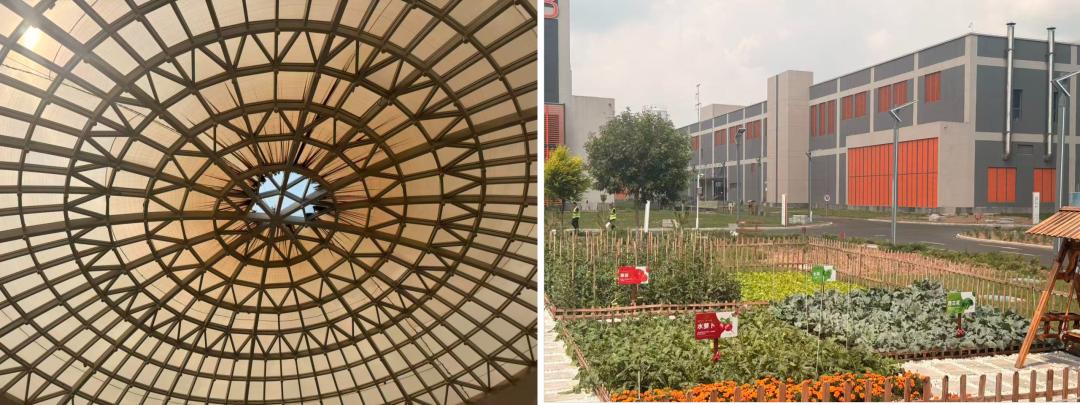
Left: The "yurt" structure added for heat insulation on the roof of Alibaba's data center office building; Right: Exterior view of the data center
Here we found that data center construction is no longer simply following the logic of "building houses", which is why DeepSeek is recruiting IDC design and planning engineers — the field is full of technical nuances. For example, Alibaba's self-built 2.0 architecture server room in Ulanqab represents the peak of the previous generation of technology. To save power, Alibaba tested its self-developed Panama power supply here, which drastically compresses the voltage transformation process; to save water, the server room adopts a closed system, and even uses the heat emitted by servers to heat the equipment rooms in winter.
In the power distribution room, the docent told us, "In traditional server rooms, the entire first floor is for infrastructure, and servers are placed on the second floor. But in our new 5.0 architecture, everything is 'flattened'."
The so-called flattening, "essentially means turning engineering projects into factory production, and replacing on-site engineering with standardized products," Wang Zhaoyang explained. From the 10kV medium-voltage power distribution, to the self-developed Panama power supply, to lithium battery backup power supplies and liquid-cooled IT cabinets, all components are prefabricated in the modular cabins. On site, you only need to lift the cabins into place like assembling Lego blocks and connect the wires to complete the setup.
"In the past, thousands of people worked on site to build a data center. Now we only need a crane team to place the containers in the right position. Our limit for construction from scratch to delivery is four and a half months," the docent revealed. Although currently constrained by the intermittent shortage of upstream raw materials and components caused by surging demand, the ideal "30-day prefabrication" phase in the 100-day delivery cycle sometimes cannot be perfectly met, the assembly process in between has already reached maximum efficiency.
DeepSeek Also Bets Big to Seize Computing Power Infrastructure
In the past few years, large model companies have focused their competition on algorithms, data and model parameters.
But in the era of training with 10,000 or even 100,000 cards, computing power has evolved from a "purchased resource" to a strategic asset that determines the life and death of an enterprise.
DeepSeek's heavy investment is a microcosm of this trend. A harsh reality is facing all players in the AI race: all available computing power server rooms on the market have long been snapped up. The traditional 12-month construction cycle is completely unable to keep up with the exponentially exploding demand for Tokens. Against the backdrop of the AI demand boom, the party that can obtain large-scale, high-density, low-cost dedicated computing power bases faster will secure the ticket to the next round of competition.
What's more, the rise of Agents has led to a blowout in inference demand as well. According to the National Bureau of Statistics of China, the daily average Token call volume across the country exceeded 140 trillion in March 2026. This requires the construction of far more data centers.
The huge demand for Tokens has led to the rapid rise of numerous data centers. Ifeng Technology saw a large number of ongoing construction projects in Ulanqab. In areas including Yiwutang, Bayin Area and Chayouqian Banner, besides internet companies such as Huawei, Kuaishou and Alibaba, third-party data service providers such as 21Vianet and China Data occupy even larger areas.
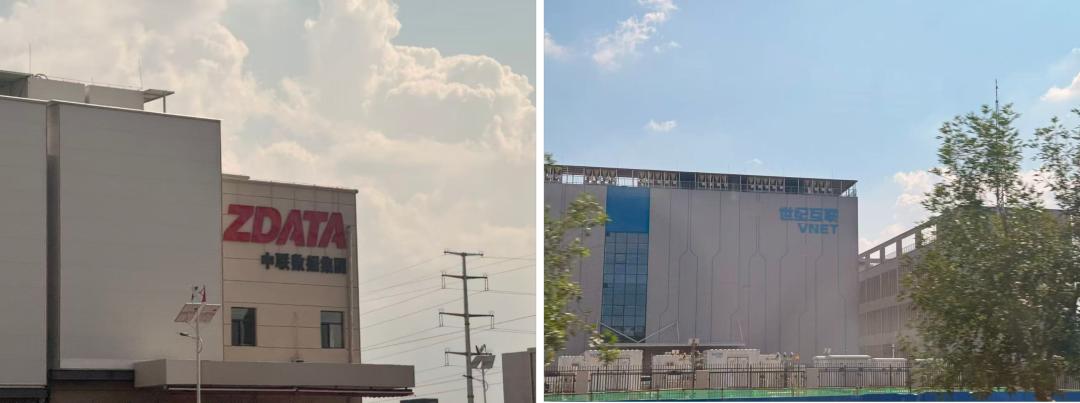
How to make Tokens operate in a more efficient way has also become a new key point of competition in the AI era.
Wang Zhaoyang recalled that when the modular solution was first proposed, there was strong internal opposition over concerns that the cost was too high. "But once the product is iterated and optimized, the cost will definitely come down." When looking for partners, there was still resistance. "One of our partners disagreed, saying the cost was too high. But after checking, they found they had overcalculated the cost per kilowatt by more than one third, and later regretted their miscalculation very much," Wang Zhaoyang said, noting that many partners have now fully accepted the solution.
What made him even more aware of the changing industry trend was the reaction of competitors. "One of our largest competitors spent three months basically learning the whole solution internally. When they heard we were going to develop the next architecture, they got very nervous. Other partners are also asking us when our new standards will be released." Not just domestic players, overseas operators are also following up. In his view, this set of solutions has evolved from Alibaba's own exploration to a path that the whole industry is adopting.
Alibaba Cloud has even bolder plans for data center construction — "to become the Foxconn of this industry". Through the ODM model, the supply chain can carry out large-scale OEM production according to Alibaba's self-developed standards.
Inside the modular cabin, even a single power module is highly standardized. The docent took the on-site air conditioners as an example: "Most air conditioners on the market are AC units, but there is power loss when converting AC to DC. For this architecture, Alibaba specially customized DC air conditioners with small manufacturers." Wang Zhaoyang later added that in this modular solution, "every module has been optimally debugged", and the Chinese supply chain can fully keep up with the pace. "If we want to build in any large base, these manufacturers are all willing to set up factories locally with us."
Wang Zhaoyang emphasized that modularization is useless unless it reaches more than 90% coverage. "If you only achieve 30% or 20% modularization, you only solve partial product problems. First, you cannot solve the overall cost problem, and second, you cannot solve the overall delivery cycle problem." He also admitted that modularization has the practical challenge that "once the internal design is finalized, it is hard to make changes". "Fortunately, we can continue to iterate, and modularization is always backed by version control and standardization."
This capability to turn data centers into "standardized products" may also reshape the landscape of the AI competition between China and the United States. Wang Zhaoyang also mentioned that China's manufacturing capacity is "incredibly strong" — you can easily find several enterprises in Zhejiang to produce this kind of container data center. In overseas markets that generally face a shortage of industrial workers and a delivery cycle of up to 30 months, the modular products supported by the Chinese supply chain will bring an overwhelming advantage. "When our performance catches up with our competitors, our Token cost will definitely be at a level that leaves others far behind."
The End of AI Is Power
The end of computing power is electricity. All the ultimate pursuit of extreme efficiency and cost control points to electricity.
"For the same data center, the annual electricity cost can differ by 5 billion yuan if it is located in Ulanqab versus a neighboring city," Wang Zhaoyang said. When the scale of data centers is more than 10 times that of the past, and the power of a single cabinet often reaches 1000 kilowatts (equivalent to the heat emitted by more than 10,000 people), electricity price has become the only key factor besides chips that people strive to optimize.
However, cheap electricity does not come by waiting. As the AI era of inference demand boom arrives, computing power demand shows a two-way trend: training workloads move westward "three levels in depth" to pursue low-cost renewable power, while inference workloads move eastward "three levels down" to get closer to economic circles.
This hits the biggest pain point at present: the coordination between computing power and power supply. Wang Zhaoyang observed that many of the so-called source-grid-load-storage systems now are essentially designed to absorb new energy, not for real computing power coordination. "Power delivery often takes three to five years, but our computing power delivery has been compressed to 100 days. When Token demand is exploding at a near-exponential rate, planning coordination is of vital importance."
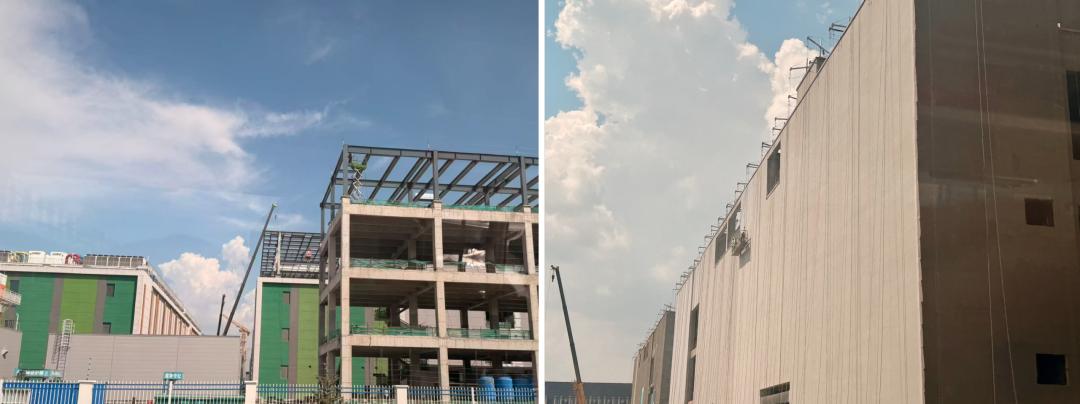
Caption: Construction sites of new buildings can be seen everywhere
He judged that the gap between the current planned scale and actual demand is so large that it is forcing the industry to come up with explosive solutions within two years. "Power companies are very excited now, but they do not know how to participate. In the future, data centers cannot be rigid loads, they must become flexible self-consistent systems that let computing power adapt to power supply to achieve dynamic balance."
To find a balance in water-scarce Inner Mongolia, Alibaba is also making every effort to reduce water consumption. In Ulanqab, all data centers use reclaimed water, and the WUE (Water Usage Effectiveness) of the benchmark project is as low as 0.088, meaning it barely consumes fresh water. Wang Zhaoyang admitted: "Using more water can save power, and the low price of water makes manufacturers prefer to use more water. But when building ultra-large clusters, we must consider the social cost, and find that subtle critical point between optimal cost and environmental friendliness."
From the "Potato Capital" to the "China Computing Power Capital", Ulanqab is witnessing a surge in computing power infrastructure. As players like Alibaba Cloud turn data centers from "civil engineering projects" into "products" that can be mass-produced on factory assembly lines, and as new players like DeepSeek also start to build their own computing power bases along this path, a new paradigm of AI infrastructure supported by Chinese manufacturing is emerging.
In those orange-and-white modular cabins on the grasslands, Tokens are being produced nonstop 24 hours a day. The next chapter of this computing power boom may be the real arrival of AI inclusiveness, when these "Chinese solutions" flow to the rest of the world along the supply chain.
This article is from the WeChat official account "Ifeng Technology", author: Ifeng Technology, published with authorization from 36Kr.