Zuck's 10,000-word long essay slams closed-source practices: Distillation is not a crime, Meta officially returns to the open-source model track
On August 10, Meta Superintelligence Lab officially released Muse Glimmer, and opened the model weights under the permissive Apache 2.0 license.
Meta CEO Mark Zuckerberg said that the weights of Muse Spark 1.2, Meta's latest foundational model, will be released soon. This marks Meta's official return to the "open" AI strategy. Zuckerberg also published a 10,000-word long article arguing that powerful artificial intelligence should not be concentrated in the hands of enterprises and governments.
In addition, Meta has set up an independent board of directors responsible for formulating safety standards and reviewing each model release on a case-by-case basis. Zuckerberg believes that even if the founder holds the controlling stake, the CEO will no longer make the sole decision to launch high-risk AI, and he calls on the whole industry to follow suit.
Focusing on Local Agent Models
Muse Glimmer, the first model released after Meta's strategic transformation, has 30 billion parameters, is specially optimized for the continuously running local agent workflow, and can run on Mac or PC equipped with a single consumer-grade GPU. Its application scenarios cover tasks such as local personal agents, function calling, code development, and "evaluating large models with large models".
Download link:
https://huggingface.co/meta-models/Muse-Glimmer-30B
To enable the model to manage schedules, draft messages, organize files and adapt to users' working styles, Muse Glimmer focuses on enhancing long-process execution, precise tool calling, multi-modal understanding, long-context memory and instruction following capabilities.
During the pre-training phase, logit distillation is performed using the output of Muse Spark, adopting a data combination similar to that of the teacher model; in the mid-training phase, longer context, a higher proportion of agent task data and richer reasoning trajectories are added; in the post-training phase, supervised fine-tuning, online policy distillation and reinforcement learning are combined to cover general, reasoning, programming and agent tasks.
Meta has also conducted various benchmark tests to compare the internally developed Muse Glimmer with Gemma4-31B and Qwen3.6-27B:
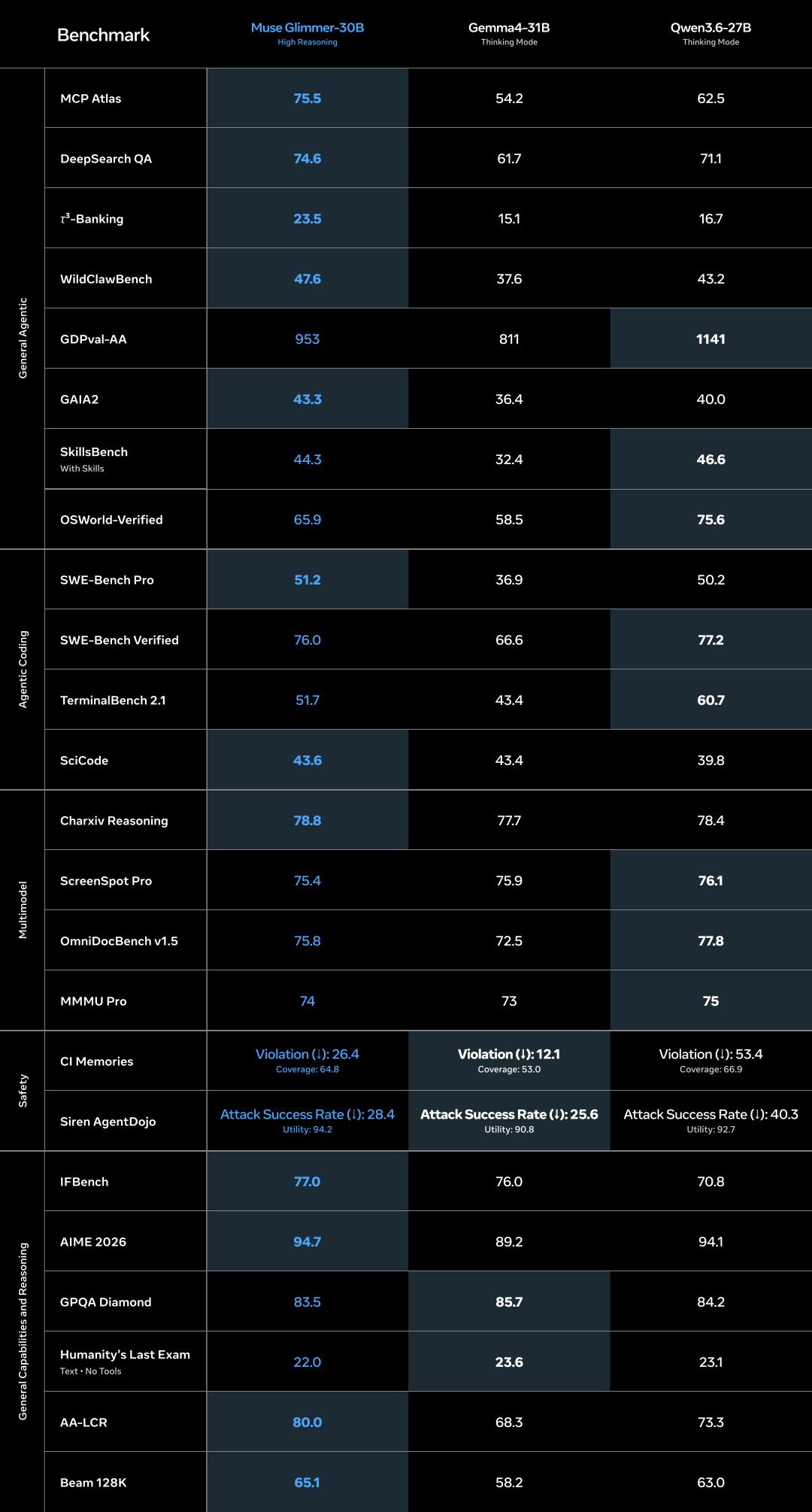
However, although this set of comparisons is relatively fair in terms of parameter scale, some netizens pointed out that Qwen 3.6 is no longer the latest generation model, and Muse Glimmer still needs to be directly tested with subsequent 27B-level models to judge its real competitiveness.
According to the introduction, Muse Glimmer supports end-to-end task execution, precise tool calling, multi-step reasoning, failure diagnosis and retry, and can process text and images simultaneously through a dedicated perception encoder. The model is compatible with agent orchestration methods such as OpenClaw, supports adjusting reasoning intensity, and covers more than 100 languages.
To adapt to local devices, Meta compresses the language model that originally required more than 55GB of memory to less than 20GB through approximately 4-bit quantization, so that the KV cache, image perception encoder and speculative decoding module can run together in a memory environment of 24GB or 32GB.
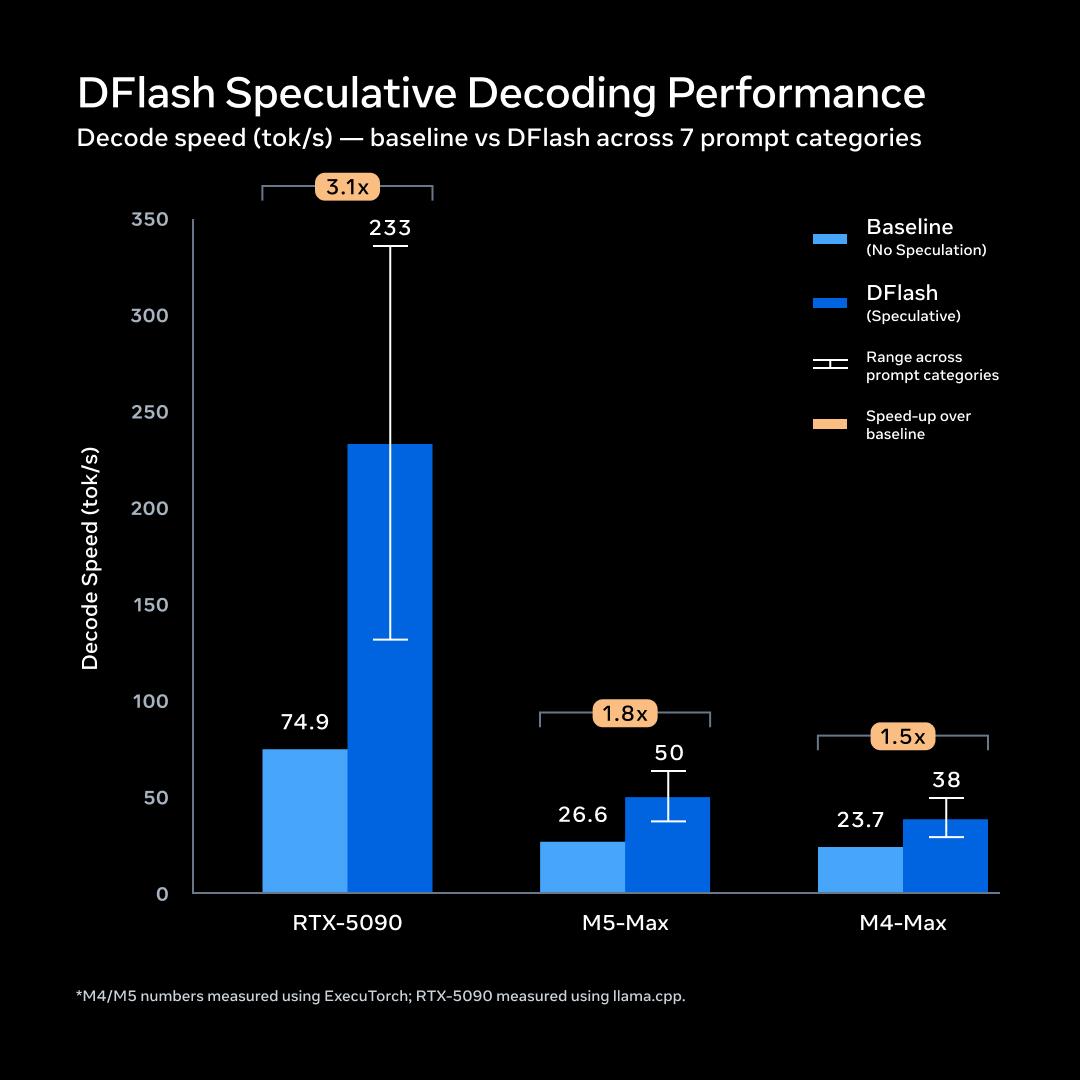
To improve generation speed, Muse Glimmer is also equipped with a lightweight draft model based on DFlash. This model can propose a set of candidate tokens at a time, and then the main model verifies them in parallel, accepts correct content and corrects wrong content, thus reducing the waiting time caused by token-by-token generation. Meta says this significantly improves the text generation speed of Muse Glimmer.
Test results show that when running with the K-Quant-17GB quantized model, DFlash can increase the decoding speed of Muse Glimmer by about 3.1 times on RTX 5090, about 1.8 times and 1.5 times on M5 Max and M4 Max respectively. All calculations can be completed on local devices.
Some netizens said that they have run Muse Glimmer on an old Mac mini with 32GB of memory through Ollama, and the initial effect is good, but the speed of completing tasks is relatively slow. Some testers believe that the reasoning process of the model is relatively concise, but it may be more efficient than some models that tend to iterate repeatedly in some tasks.
Some developers hold a reserved attitude towards its programming capabilities, believing that although Muse Glimmer can handle code tasks, its real advantage may lie in agent workflows, tool calling and different security alignment methods, rather than directly challenging the strongest cloud programming models. "Qwen3.6 27B is a commonly used medium-sized model in programming, and it is by no means easy to beat it," said a netizen.
In addition, Muse Glimmer focuses on deployment on consumer-grade devices, but video memory or unified memory above 24GB is still a threshold for ordinary users. "Not everyone can afford a device with 24GB of memory," said a netizen.
Some netizens estimate that the price of the RTX 5090 used in the official test may reach thousands of dollars. If only considering the short-term usage cost, subscribing to cutting-edge cloud models may be more cost-effective. The value of local deployment is more reflected in privacy, offline use, customizability, and immunity to changes in API fees and service policies.
Zuckerberg's 10,000-Word Article Slams Competitors' "Closed" Approach
While releasing the model, Zuckerberg also published a long article on Meta's official website. He wrote in the article: "Most other labs are focused on building AI for enterprises, governments or other institutions. Therefore, if these labs take the lead, the balance of power will tilt towards large institutions rather than individuals." These remarks seem to be targeting companies such as Google, Anthropic and OpenAI.
Zuckerberg said Meta will continue to invest in open weight models. He criticized competing labs for adopting a "closed" path: these labs have earned billions of dollars in revenue by selling access to their models.
Zuckerberg wrote: "Some people think that the best way to reduce risks is to limit the capabilities that individuals can access." But he believes that "widely deployed open source systems have proven to be more secure because more people can discover vulnerabilities in them."
He took Hugging Face as an example, saying that after a closed model rejected its request on the grounds of security, Hugging Face used an open model to patch its own security system.
Zuckerberg made these remarks at a time when open models from Chinese AI labs are narrowing the gap with the most advanced proprietary models from US labs.
OpenAI and Anthropic previously accused domestic competitors of using the outputs of US AI lab models to train their own models. This technology is called "distillation". However, Zuckerberg expressed support for it. He believes that it is very important to uphold the principle that "people can learn from anything they observe", and rejects the view that distillation is "harmful".
However, Zuckerberg supports continuing to slow down the development of competitors through chip export controls.
He wrote in the article that more than 1 GW of nuclear power capacity is put into operation in China approximately every two weeks, so the United States needs to speed up the construction of energy facilities and data centers, and continue to slow down the development of competitors through chip export controls. Even a two-month technological lead is of great value, and a one-month delay in model release may affect the United States' leading position.
However, Zuckerberg is not in favor of banning individuals and enterprises from using foreign open models, arguing that this will reduce the quality of available AI and exacerbate centralization. Meta advocates reducing policy resistance faced by US labs in terms of training data, distillation and other aspects.
Zuckerberg also said that Meta will hand over the model security review power to the company's independent board of directors. He said that neither he himself nor any head of an AI enterprise should make the sole decision on how superintelligence is deployed, and he calls on other leading labs to establish a similar independent supervision mechanism.
In response to concerns that AI will replace jobs, Zuckerberg believes that the speed of automation is not necessarily faster than the speed at which AI enhances individual capabilities and creates new demands and new occupations. If superintelligence is mainly used for invention rather than replacing existing positions, the growth of individual capabilities may catch up with or even exceed automation.
He predicts that there may be single-person product studios, world builders, experience designers, and "personal biologists" who use AI to develop personalized therapies in the future. The average size of enterprises may shrink, but the total number of enterprises is expected to increase, and a small number of people can run large-scale companies with the help of personal agents.
He admits that changes in working methods will bring a difficult adaptation process, but believes that personal agents can also take on vocational training and transformation coaching.
The Meta founder criticized the narrative promoted by competing AI labs as "full of doomsday scenarios". "The view that AI is so dangerous that only extreme concentration of power is a safe path is problematic in itself. As everyone gets more powerful tools, everyone's ability to shape the future will increase, not decrease."
Interested readers can view the full text at:
https://www.meta.com/thefutureisforeveryone/
Earlier this year, Meta refused to disclose the underlying weights of Muse Spark on the grounds of security issues. As competition among leading AI companies becomes increasingly fierce, how and to what extent the most powerful technologies should be opened is becoming the focus of industry debate.
On Monday, Meta also announced the establishment of a $1 billion fund to support communities in the locations of its US data centers. The company is accelerating the construction of the infrastructure needed to realize the above AI vision. The data center construction of large technology companies has triggered a backlash from surrounding residents, as these projects may compete for scarce resources such as electricity and water.
Zuckerberg's remarks came at a time when Meta is investing tens of billions of dollars to catch up with the cutting edge of AI technology and vigorously promoting its vision of "personal superintelligence".
However, Meta disclosed last month that AI infrastructure spending led to a 91% drop in its free cash flow, after which the company's share price fell by nearly 8% at one point. Over the past year, the company's share price has fallen by nearly 20% cumulatively. During this period, Meta invested huge sums of money to recruit top AI talents and build AI data centers.
This article is from the WeChat official account "InfoQ", author: Chu Xingjuan, published with authorization from 36Kr.