Ant Group leads the investment in a scarce embodied team.
Today (August 11), Daimon Robotics announced the completion of a strategic financing round of several hundred million yuan, led by Ant Group, with over-subscribed follow-on investment from existing shareholders.
The financing move comes at a rapid pace. Just two months ago, Daimon closed its 100-million-yuan Series A financing.
The lineup of investors is even more impressive. With Ant Group joining this round, Daimon has gathered a group of leading industrial capital players including China Merchants Capital, Lenovo Capital and Incubator Group, Inovance Industrial Investment, China Mobile, and China Telecom behind it.
Why are industrial giants all betting on Daimon?
The answer lies in the shifting focus of embodied intelligence competition.
The next stage of competition has moved from "whether robots have tactile capability" to "whether they can truly understand and use tactile sense", and the ability to convert tactile input into tactile intelligence is becoming the decisive winning factor.
Industry research has verified that after introducing tactile data, the success rate of robot contact-related tasks and data utilization efficiency can be significantly improved, pushing Physical AI to move along a Scaling curve far exceeding that of pure vision solutions.
Not long ago, the team of "AI Godmother" Li Fei-Fei proposed in the T-Rex paper that tactile sense is not an accessory to vision, but an independent, high-frequency physical perception channel. Simply splicing tactile signals as additional inputs into existing models cannot fully improve performance, and may even lead to a sharp drop in task success rate.
If T-Rex systematically solves the problem of "how to use tactile sense correctly", Daimon goes a step further and pushes tactile sense from "ex-post feedback" to "ex-ante deduction".
Daimon not only takes the lead in the industry to propose the Vision-Tactile-Language-Action (VTLA) model architecture, enabling tactile sense to natively enter perception, decision-making and action generation; it has also built the world's first "Physical Interaction Brain" that drives dexterous robot operation, and for the first time incorporates physical cognition, deductive decision-making and instantaneous control into a unified model framework.
A tactile intelligence revolution sparked by the "Physical Interaction Brain" is underway, and Daimon is now standing right at the center of the storm of this revolution.
From CMU to HKUST
The World's Rare Full-Stack Tactile Intelligence Team
A "Physical Interaction Brain" that truly drives dexterous robot operation cannot be separated from three underlying supports: mass-producible tactile perception equipment, large-scale physical interaction data infrastructure, and a landing system covering evaluation and deployment.
Daimon has connected these three high-barrier capabilities at the same time, backed by a globally rare full-stack tactile intelligence team spanning robot operation, tactile perception, large model training and engineering implementation.
This technical lineage can be traced back to Carnegie Mellon University (CMU).
CMU is the birthplace of global robotics research. In 1979, Raj Reddy, Turing Award winner and artificial intelligence pioneer, established the world's first Robotics Institute here. Three years later, Professor Matthew T. Mason came to serve as the dean of the Robotics Institute. He is also known as the father of global robotic dexterous manipulation, and his research laid the theoretical foundation for the entire field of robot operation, grasping and contact mechanics.
The academic branch led by Professor Mason has supported almost half of the global robotics industry. From industry giants such as Boston Dynamics, Google DeepMind, Physical Intelligence, NVIDIA, Amazon Robotics to the tactile and operation laboratories of various enterprises, most of the entrepreneurs and researchers active in the center of today's embodied intelligence stage come from this lineage.
Among Mason's students, a Chinese figure stands out — Wang Yu, the first graduated PhD student of Professor Mason. As the inheritor of CMU's orthodox academic lineage, Wang Yu later brought the entire dexterous operation academic system back to China, becoming the guide of this Chinese tactile entrepreneurship story.
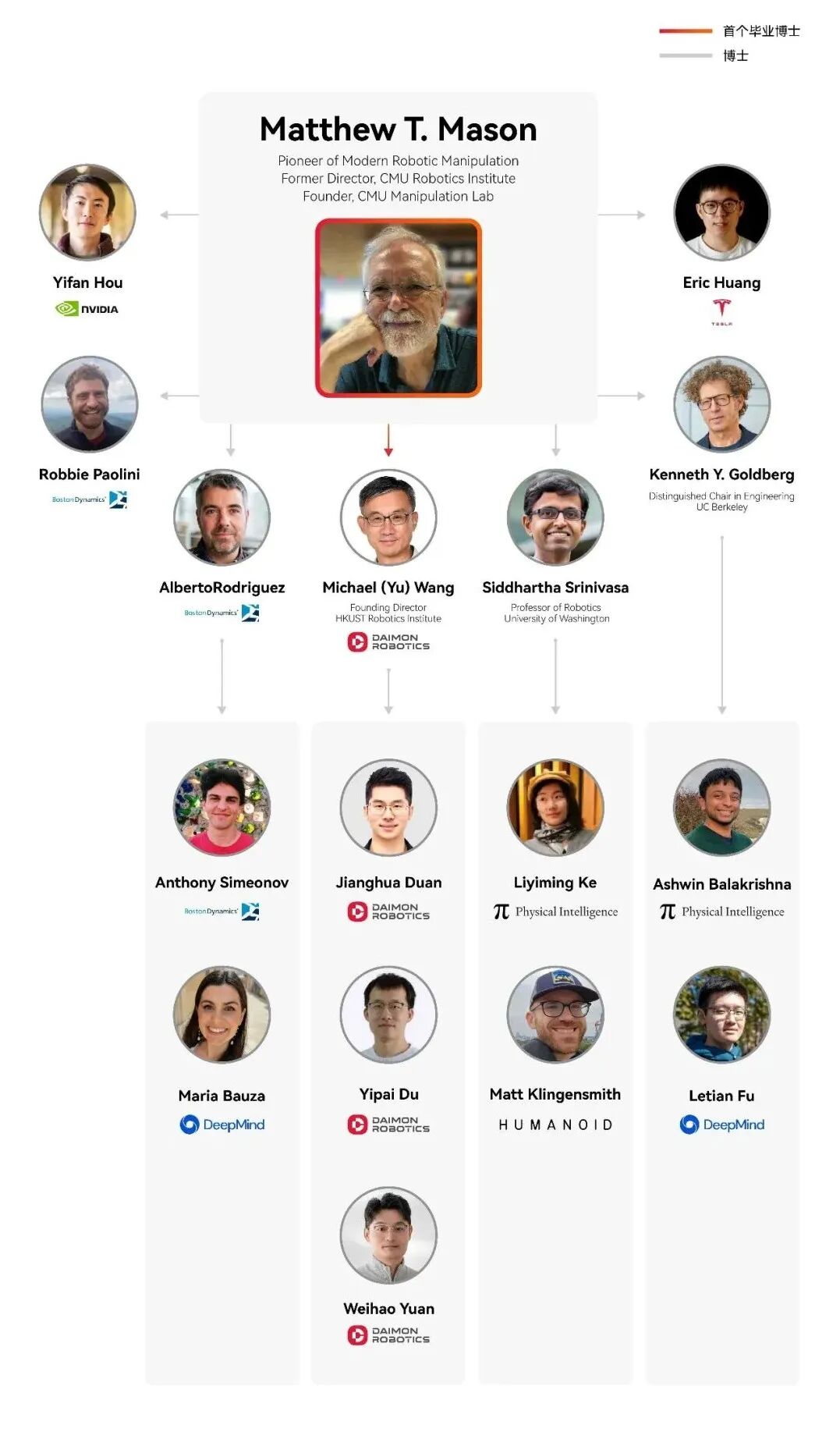
Academic pedigree of Mason and his two generations of students
The robotics operation school represented by Mason has a core judgment: The dexterity of the hand mainly depends on the "brain", not the hand itself. This also leads to a more essential question: if the key to dexterous operation lies in the "brain", what does this "brain" rely on to learn?
Language models have books for learning, video models have the Internet, while data such as contact, force, deformation and slip can only be created and accumulated in real operations. Therefore, the first step towards physical intelligence is not to directly build a "brain", but to first establish a data entry for it that can perceive and record real contact.
In 2015, Wang Yu co-founded the Robotics Institute of the Hong Kong University of Science and Technology (HKUST) with Li Zexiang and served as its founding dean. It was also during this period that Wang Yu began to lead the HKUST research team to tackle high-resolution vision-tactile perception technology.
In the long-term research that followed, Wang Yu gradually cultivated a team of young scientists covering robot operation, multimodal large models and tactile perception.
At the end of 2023, Daimon Robotics officially launched large-scale operations in Shenzhen. Professor Wang Yu serves as co-founder and Chief Scientist, and together with three post-90s PhD students he trained, they form the core strength of the team.

Yuan Weihao, Wang Yu, Duan Jianghua, Du Yipai
Duan Jianghua, PhD from Chinese Academy of Sciences, postdoctoral fellow of HKUST, selected into MIT AI100 Young Scientists, serves as Founder and CEO, and is the core figure promoting the industrialization of vision-tactile technology; Yuan Weihao, former multimodal research expert of Alibaba Tongyi Lab with experience in both large models and robot physical operation, serves as Chief AI Scientist; Du Yipai, core disciple of Professor Wang Yu in the direction of tactile sensing and chief architect of Daimon's monochromatic light vision-tactile sensor, serves as Head of R&D and Tactile Business.
From Mason's robotic operation theory to Wang Yu's tactile technology route, and then to Duan Jianghua, Yuan Weihao and Du Yipai who promote industrialization, model and product engineering respectively, this team has spent ten years turning a scientific proposition about robot dexterity into a commercially operating system at scale.
The World's First "Physical Interaction Brain"
Reshaping the Embodied Scaling Curve
Continuing to climb along the technical path of "first establishing data entry, then moving towards physical intelligence", Daimon recently officially launched the world's first Tactile-grounded World Model Daimon-TWM, which uses native tactile sense to run through understanding, reasoning, prediction and verification, thus building a "tactile nervous system" from fingertip perception to brain reasoning and then back to the action control end, pushing embodied intelligence to move from "seeing the world" to "understanding the world" and "interacting with the world".
Based on the world's largest multimodal physical world dataset containing tactile data launched by Daimon, the model demonstrates operation stability and generalization ability in complex scenarios, and shows a continuous scaling trend and cross-scenario, cross-robot application potential.
In the task of cleaning up broken glass, transparent reflection and irregular edges make it difficult for vision to stably identify the glass edge; the glass is slippery and fragile, so it is easy to slip if grasped too lightly, and slight deviation in clamping force and handling posture may even lead to secondary breakage; the fragments are close to the tablecloth, and direct lifting may also bring the tablecloth up together.
Daimon's "Physical Interaction Brain" Daimon-TWM confirms whether the glass is firmly grasped through contact, deduces the consequences of different grasping angles, lifting directions and placement methods; when judging that direct lifting may bring the tablecloth along, it actively adjusts the glass to a vertical posture before lifting, and continuously corrects the force and trajectory according to real-time tactile feedback, finally safely placing the fragments into the desktop trash can.
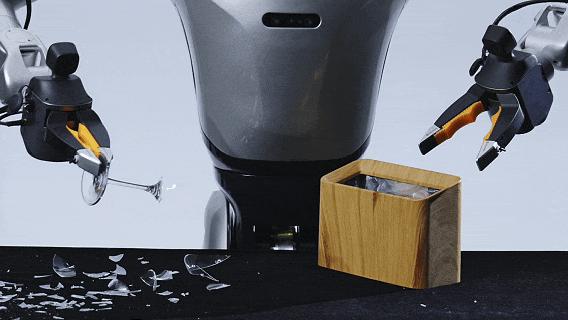
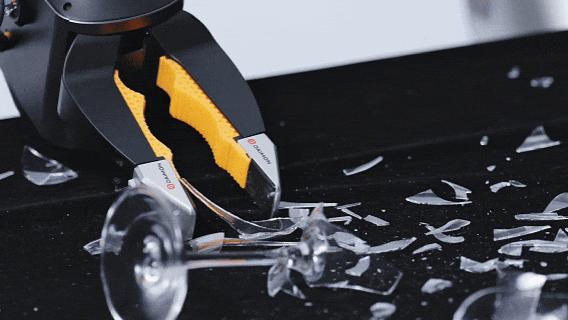
Daimon-TWM autonomously completes the task of cleaning up broken glass
Daimon-TWM works in coordination with a three-layer architecture to form physical intelligence with physical cognition as the base and "slow planning - fast correction" as the operation closed loop:
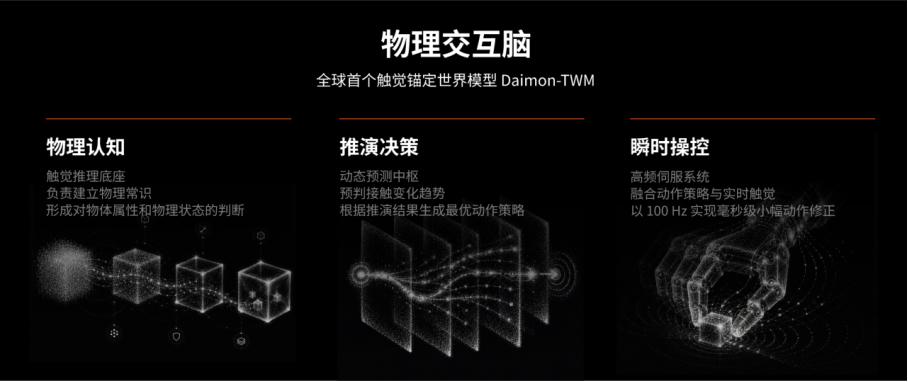
Daimon-TWM three-layer architecture
Physical Cognition Module: A tactile reasoning base based on reinforcement learning, responsible for building physical common sense, understanding key features such as contact state, force and deformation, and material properties, forming cognitive judgment of the current physical state.
Deductive Decision Module: A dynamic prediction center based on the world model, responsible for forward-looking prediction, deducing the evolution trend of contact state and potential failure risks, and generating action strategies according to the deduction results.
Instant Control Module: A high-frequency servo system based on tactile feedback, responsible for instant action correction, continuously integrating decision instructions and real-time tactile feedback to achieve millisecond-level small corrections at a high frequency of 100Hz.
Daimon-TWM has a parameter scale of 10B level, which can perform real-time reasoning on the NVIDIA RTX 5090 platform, and has the deployment potential across different robot bodies and different robotic arms. The model introduces learnable unified tactile tokens, extracts contact-related information from multimodal observations, and builds a unified tactile latent space for tactile understanding and prediction.
Daimon-TWM runs through all stages of the model with tactile sense, endowing the model with significant advantages in physical understanding, predictive planning and operation generalization: Daimon-TWM has achieved comprehensive advantages in physical cognition evaluation, and demonstrated excellent autonomous operation ability in contact-intensive operation tasks. The average success rate under undisturbed conditions is twice that of π0.5, and the improvement under disturbed conditions is up to ten times.
Building the Self-Evolution Loop of Physical Intelligence
In this fierce competition led by the "Physical Interaction Brain", Daimon not only built a first-mover advantage in intelligence, but also took the lead in running through the complete loop of "perception generates data, data refines intelligence, evaluation verifies capability, deployment promotes iteration", pushing for the "Cambrian explosion" of physical intelligence.
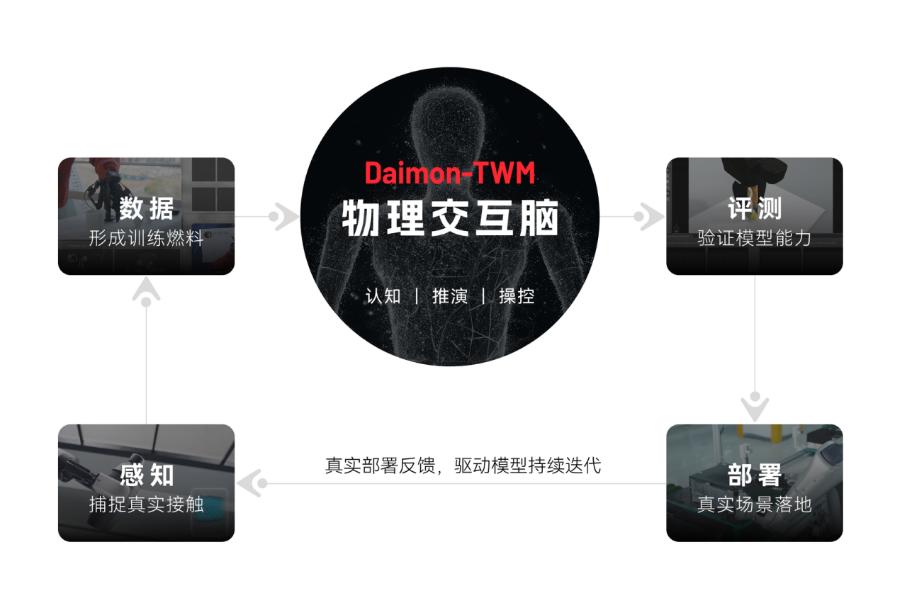
Daimon-TWM evolution loop
Based on the large-scale deployed tactile perception equipment and collection system, Daimon has built Daimon-Infinity, the world's largest multimodal physical world dataset containing tactile data, forming a complete data pyramid covering "simulation data - no-robot data - teleoperation data". It has accumulated hundreds of thousands of hours of multimodal physical world operation data containing tactile data, and the data scale is planned to expand to millions of hours within the year, becoming an important foundation for the model to learn real operation rules and build interaction capabilities.
After the first 10,000 hours of data of Daimon-Infinity was open sourced, it received nearly 5 million downloads on Alibaba's ModelScope community, ranking first among all embodied datasets.
In the data collection link, Daimon also co-built the "data collection into households" external distribution collection network with China Mobile, and landed the world's first "Embodied Data Collection 5S Store" in Chenzhou, Hunan. The first phase of the project plans to deploy 1000 sets of equipment, which is expected to generate 1 million hours of real operation data per year after reaching full production capacity.
This means that Daimon is transforming the data collection that used to be highly dependent on engineers and fixed sites into a standardized and flexible production network that can break through time and space constraints.
Daimon has also built RobOmni, the industry's first multimodal evaluation benchmark containing tactile data for physical interaction capabilities, providing a unified standard for model training and optimization.
In every link from perception, data, evaluation to deployment, Daimon has received support from industrial parties and partners. In the perception link, Lenovo provides industrial mass production capabilities; in the data link, it co-builds an external distribution data collection network with China Mobile; in the evaluation link, NVIDIA provides ecological support; in the deployment link, Inovance connects industrial automation and precision manufacturing, and China Merchants connects port and logistics scenarios.
From mass production scale to market share, and then to data and model capabilities, Daimon has achieved "global No.1" in 8 key indicators:
The first to realize 10,000-piece-level shipment of vision-tactile perception equipment;
The first to achieve 80% vision-tactile coverage of dexterous hand manufacturers;
The world's No.1 shipment volume of vision-tactile perception equipment;
The world's No.1 revenue scale in the vision-tactile track;
The world's No.1 download volume of embodied datasets containing tactile data;
Building the world's first large-scale external distribution data collection system;
Launching the world's first multimodal evaluation benchmark RobOmni containing tactile data for physical interaction capabilities;
Launching the world's first "Physical Interaction Brain" Daimon-TWM that supports cross-body and cross-configuration deployment.
With comprehensive leading advantages in mass production yield, unit cost and delivery stability, Daimon has served more than 200 customers around the world, including more than 50 overseas customers, and has completed deliveries to global leading enterprises and institutions such as OpenAI, Figure, Physical Intelligence, Skild AI, Meta, BMW, Google DeepMind. At the same time, it is advancing a number of model deployment and POC cooperation, and has entered the supply chain of leading industrial automation and robot industry players such as Inovance and Tesla's supplier enterprises.
