Mark Zuckerberg published a long article defining Meta's AI roadmap: to build "personal superintelligence"
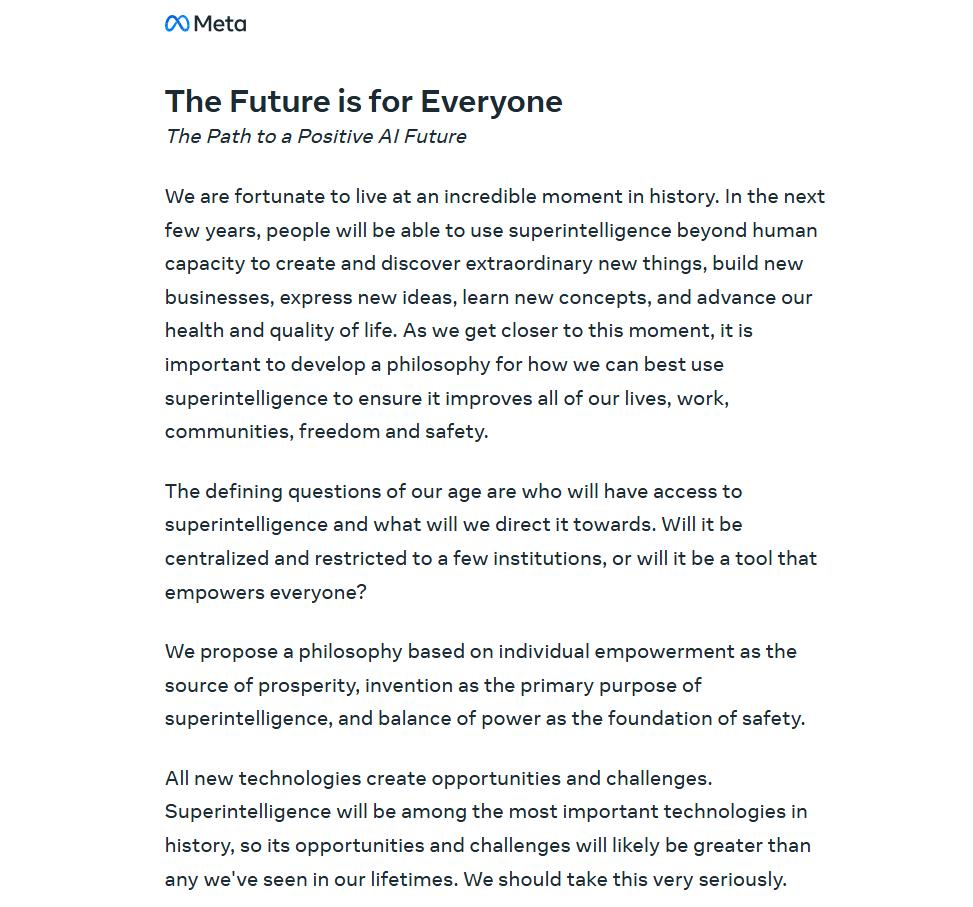
On August 10 local time in the United States, Mark Zuckerberg published a long essay titled "The Future Belongs to Everyone: A Path to a Positive AI Future".
On the surface, this is a policy manifesto about superintelligence, safety, open source and infrastructure, but behind this 10,000-word long essay lies a more critical main line: Meta will focus on building "personal superintelligence" in the future.
Zuckerberg set a very clear premise for this concept: Superintelligence should not ultimately be controlled only by a small number of companies, governments or laboratories, it must be distributed to more ordinary people.
In the past two years, discussions about superintelligence in the AI industry have mostly focused on how much more powerful models can become and how to prevent a system with capabilities far exceeding humans from getting out of control. Zuckerberg proposed that even if superintelligence is safe, if such capabilities are ultimately only in the hands of a very small number of institutions, a new imbalance of power may still form.
So the solution he put forward is very "Meta".
He proposed that the core principles for the future development of AI should cover three aspects: taking personal empowerment as the source of prosperity, taking innovation as the primary purpose of superintelligence, and ensuring safety through checks and balances of power.
In his vision, everyone will have a long-existing superintelligence by their side in the future. It understands your work style, health status, family arrangements and long-term goals, can conduct research for you, write code, design products, plan tasks, and even help a person complete things that used to require an entire company to accomplish.
This also explains why Zuckerberg put several seemingly not entirely related topics together in the same essay: open source models, AI employment, safety governance, data center construction, and even the United States' energy and infrastructure capabilities.
All of these actually point to the same question: If personal superintelligence really becomes the next-generation computing platform, who can control it, who can afford the computing power cost behind it, and who gets to decide what it can do?
Zuckerberg's answer clearly carries Meta's product philosophy from the past two decades.
Facebook once gave content production and dissemination capabilities to every user, and Instagram and WhatsApp continued to expand this connection. In the AI era, Meta wants to replicate a similar devolution of power — turning the intelligent capabilities that belong to large institutions into basic tools for ordinary people.
Even on the issue of AI safety, Zuckerberg offered a perspective that is not entirely consistent with the mainstream discussions in Silicon Valley.
He believes that one of the truly alarming risks in the future is the excessive concentration of superintelligence capabilities. Following this logic, open source models are no longer just a technical route choice for Meta to compete with OpenAI and Anthropic.
It has become part of Zuckerberg's vision of how a superintelligent society operates. On a more practical level, Meta is also looking for new business entry points for this narrative.
If AI moves from chat boxes to personal agents that accompany users for a long time in the future, the truly important entry point may no longer be web pages, nor just mobile apps, but an AI system that continuously understands users and is ready to take action at any time. Meta owns social connections, content, communication products, and smart glasses. For the first time, these assets have the opportunity to be connected around the core of "personal superintelligence".
Zuckerberg's essay aims to construct a larger question than "whether Meta can build the most powerful model".
01
From "Controlling Superintelligence" to "Distributing Superintelligence"
Zuckerberg raised a fundamental question in his essay: Who will own superintelligence in the future? If superintelligence is concentrated in the hands of a small number of companies, governments or laboratories, will a new imbalance of power arise in society as a result?
In recent years, one of the important discussions in the field of AI safety is how to make future superintelligent systems align with human values, the so-called "alignment problem". Many researchers worry that if AI capabilities reach a level far exceeding humans, and its goals are inconsistent with human interests, it may bring uncontrollable risks.
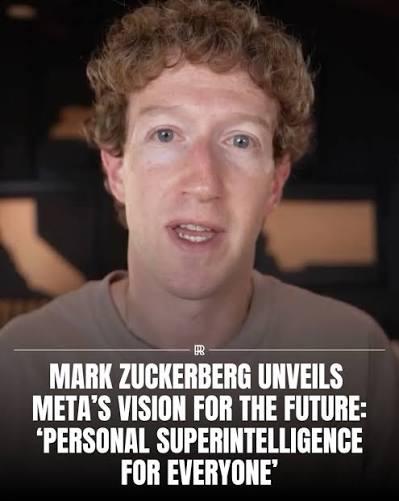
Figure: Zuckerberg released an article elaborating on Meta's AI vision
But Zuckerberg believes that there is a logical problem in simply relying on technical means to create a superintelligence that "fully serves the interests of all people".
The reason is that there is no unified value system in human society. Different individuals, cultures and groups have different judgments about what a better life is. A superintelligence designed and controlled by a small number of institutions will inevitably favor certain groups in value choices and cannot represent the interests of all people.
Therefore, he proposed another line of thinking: instead of trying to create a centralized, absolutely correct superintelligence, we should let more people own their own superintelligence, and form a new balance of power through competition among individuals, enterprises and institutions.
Zuckerberg used the example of a "superintelligent lawyer" to illustrate this point.
If only one person in the world owns a superintelligent lawyer, that person will gain a huge asymmetric advantage in the legal system. But if everyone has similar capabilities, the distribution of legal resources will be more fair, and the information gap between ordinary people and large institutions will also narrow.
Similarly, if only one organization owns superintelligent cybersecurity capabilities, it may become the biggest security risk; but if defenders also have powerful AI tools, the security level of the entire digital system will be improved instead.
In Zuckerberg's framework, AI safety cannot rely solely on restricting capabilities. What is more important is to avoid the formation of uncontrollable concentration of power by superintelligence.
02
The Most Important Product Form of AI in the Future
Based on this concept, Meta is promoting the "personal superintelligence" route.
Zuckerberg believes that the most important product form of AI in the future will evolve from a chatbot that answers questions to a personal agent that understands users for a long time and helps users achieve their goals.
This kind of agent will become an intelligent assistant in users' daily lives, capable of understanding personal preferences, goals and long-term needs, and continuously helping users optimize health, work, family management, financial planning, as well as learning and growth.
Different from most current AI tools, the core value of future personal agents will expand from providing information to taking actions on behalf of users. For example, it can help users organize information, propose ideas, plan tasks, provide life suggestions based on users' health data, and even assist in family activity arrangements.
Zuckerberg specially emphasized the importance of privacy. If personal superintelligence is to truly integrate into daily life, it must obtain users' authorization to access a large amount of private information. Meta proposes that future personal agents will provide a "full privacy mode", under which even Meta cannot view user information or authorize others to access it.
This is also the new human-AI relationship that Meta is trying to build: AI will transform from a tool owned by enterprises to a capability owned by individuals.
In discussions about employment and automation, Zuckerberg put forward a different view from traditional concerns. He believes that the most important contribution of superintelligence is not to simply replace human work, but to help humans create more new things that could not be accomplished in the past.
Historically, every major technological revolution has triggered concerns about unemployment. From the Industrial Revolution to the Internet era, people once worried that machines would replace a large number of jobs. But in the end, technology not only improved production efficiency, but also created new industries and professions. Zuckerberg believes that the AI era will follow a similar rule.
In the future, the truly important change is not that machines take on more repetitive tasks, but that ordinary people obtain capabilities that used to be exclusive to large enterprises and professional institutions.
A person may complete product design, software development, market research and even startup operation with the help of AI, without needing to form a large team. This will change the way enterprises are organized.
In the future, companies may be smaller in size, but individual productivity will be stronger. A large number of ideas that could not be realized in the past due to excessively high costs and technical thresholds will become feasible with the popularization of AI tools. Zuckerberg believes that superintelligence should eventually become innovation infrastructure, rather than a simple automation machine.
03
Exchanging Open Source for Ecosystem: Meta's AI Competition Strategy
In addition to personal superintelligence, open source is also an important theme in Zuckerberg's essay this time.
Meta has long supported the open source model route, and this choice is clearly different from some competitors that emphasize closed-weight models. Zuckerberg believes that open source can not only promote innovation, but also improve security.
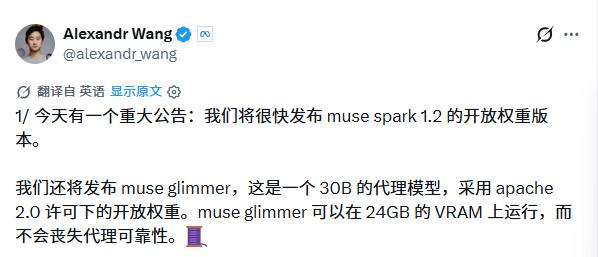
Figure: Wang Tao, head of Meta's AI department, announced that the company will soon release the open-weight version of Muse Spark 1.2
His logic is that the more researchers, developers and enterprises can access the model, the more people can discover vulnerabilities, improve the system, and promote rapid technological iteration. On the contrary, if superintelligence is controlled by a small number of institutions for a long time, society will lack sufficient checks and balances.
At the global competition level, Zuckerberg believes that the United States currently has advantages in fields such as chip design, but faces challenges in energy, data center and infrastructure construction speed. The future AI competition is not only a competition of algorithms, but also a competition of energy and computing capabilities.
He specially emphasized that the United States needs to improve the speed of infrastructure construction while maintaining the advantages of an open ecosystem.
Regarding the issues of data usage and model distillation in model training, Zuckerberg proposed that the United States should not weaken its own competitiveness due to excessive restrictions. His view is that the development of AI is essentially built on the accumulation of human knowledge, and mutual learning between models is an important way for technological progress. If the United States excessively restricts its own open source ecosystem, it may leave opportunities for other countries instead.
On the issue of security, Zuckerberg did not deny the possible risks brought by AI. He focused on discussing issues such as cybersecurity, biological risks, and the expansion of government power.
His core view is that in the face of AI risks, society should enhance its defense capabilities, rather than simply restricting technical capabilities.
For example, in the field of cybersecurity, if only attackers have advanced AI tools, the risk will indeed rise. But if enterprises, governments and individuals can all use AI to improve their defense capabilities, the security level of the overall system will also rise simultaneously.
Regarding biological and chemical risks, Zuckerberg believes that the policy focus should be on restricting the production and spread of dangerous substances, rather than preventing the development of scientific knowledge.
As AI accelerates drug R&D and life science research, the regulatory system also needs to be upgraded simultaneously, otherwise the traditional approval process may become a bottleneck for innovation.
04
The "Community Account" of Data Centers
AI competition is entering the infrastructure era.
A large number of data centers, energy supplies and computing resources have become the foundation for the development of superintelligence. But at the same time, there are growing disputes in American society over the energy consumption, water resource pressure and environmental impact brought by the construction of large-scale data centers.
Zuckerberg specifically emphasized this time that the construction of AI infrastructure must share benefits with communities. Meta put forward the concept of "Community Covenant", hoping that the locations of data centers can obtain more employment opportunities, education investment and public service support.
He believes that data centers should not be regarded as facilities that simply consume resources, but should become long-term assets that promote regional economic development, just like railways, electric power and Internet infrastructure in the past.
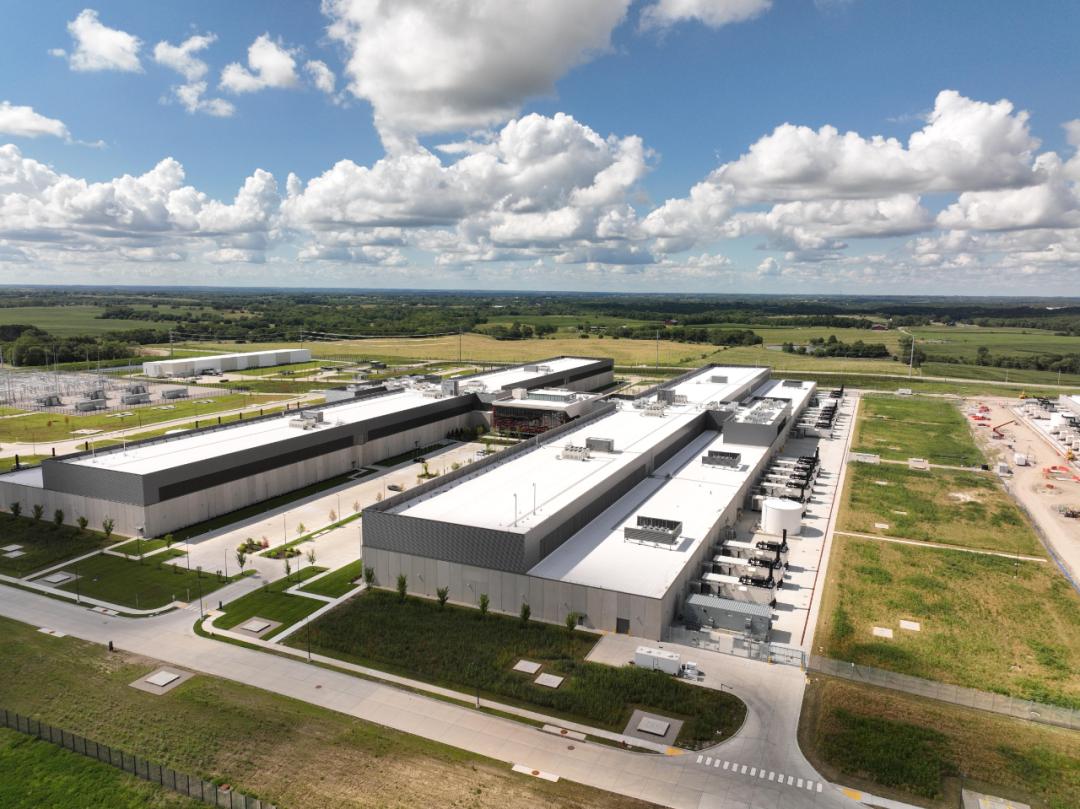
Figure: Meta's data center project in Richland Parish, Louisiana, United States
This is also an important part of Meta's response to external doubts about its large-scale AI investment.
Future AI competition requires huge capital investment, and whether these investments can gain social recognition will become a problem that technology companies must solve.
In terms of corporate governance, Zuckerberg proposed that the development of superintelligence cannot rely on the judgment of a single leader. He admitted that making the CEO the final decision-maker for superintelligence deployment is not the most ideal way. Therefore, Meta is establishing a new governance mechanism, allowing the independent board of directors to participate in the formulation of safety standards for model release and review major model releases.
This arrangement is actually a response to the long-standing external concerns about the concentration of AI power in large technology companies.
At the same time, Zuckerberg also discussed the extreme risks that may arise after AI gains the ability to improve itself autonomously.
If the AI system can continuously improve its own capabilities, then computing resources may become the decisive factor. A system with the ability to continuously self-optimize could theoretically quickly widen the gap with other systems.
Therefore, he believes that even if part of the computing power must be invested in the recursive self-improvement of AI in the future, most of the intelligent capabilities should still be dominated by humans to achieve human goals.
05
Final Note: Fighting for the Entry Point of the Next-Generation Computing Platform
Putting this long essay into the context of Meta's actions over the past year, what Zuckerberg is talking about seems to be AI safety, but what he cares more about is obviously Meta's future.
Personal superintelligence, open models, smart glasses, large-scale computing power investment — these previously seemingly scattered layouts are being integrated into the same narrative by him: the next stage of AI competition will evolve from who owns the most powerful model to who can master the longest-term and highest-frequency entry point between humans and AI.
This is a war that Meta is really familiar with.
Over the past two decades, from Facebook to Instagram and WhatsApp, Meta's core asset has always been the entry point for human-to-human connections. But in the mobile Internet era, it has always been constrained by the operating systems controlled by Apple and Google. AI gives Zuckerberg an opportunity to redefine the computing platform: if in the future everyone has an agent that continuously understands themselves, can call various services and act on their behalf, then this agent itself may become a new operating system.
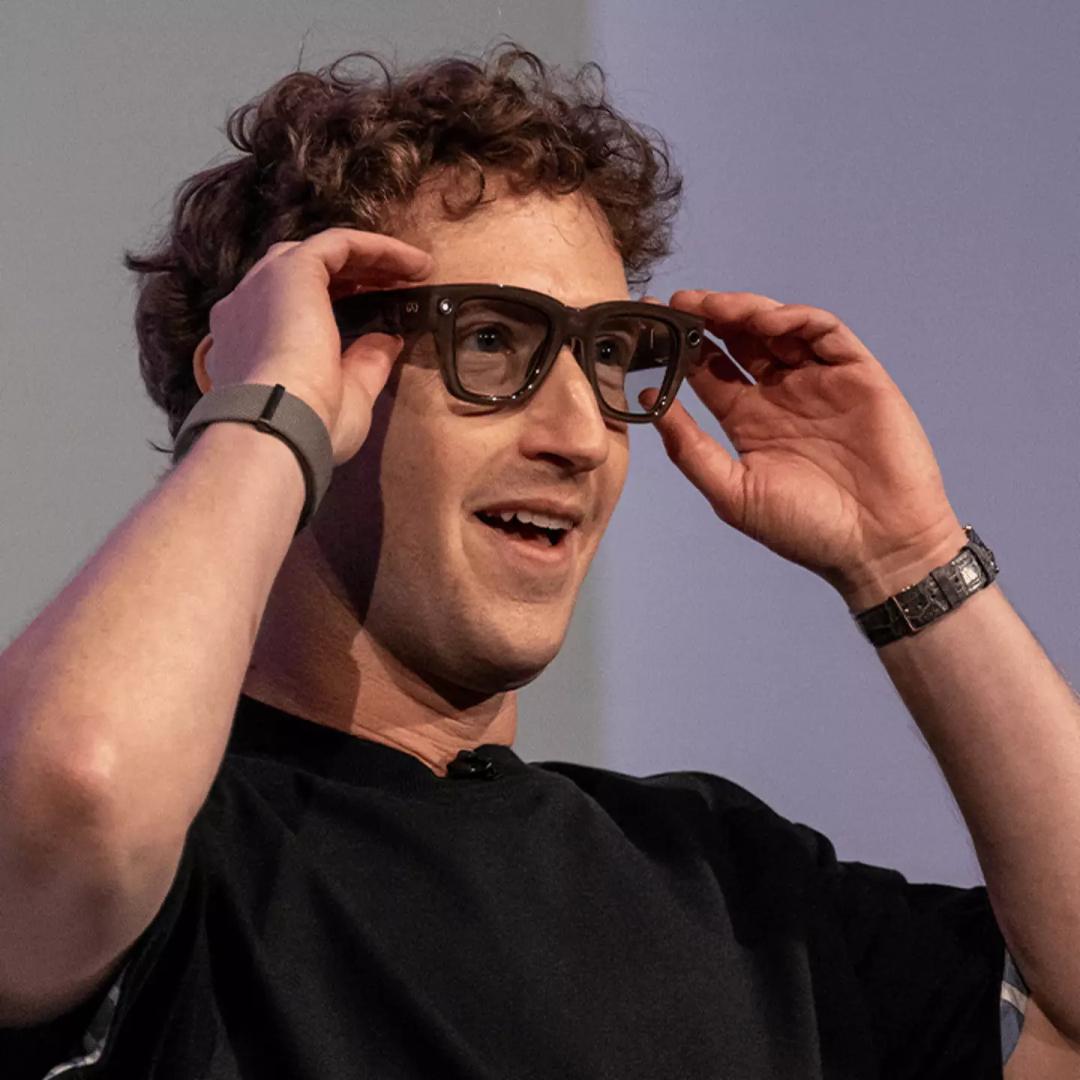
The significance of smart glasses has also changed as a result. It is no longer just a new hardware category, but may become a terminal for personal AI to obtain real-world information and continuously interact with users; open source models are not just a strategy for the technical community, but a way to expand the coverage of Meta's technology stack as much as possible.
But there is a contradiction here that is worth further