Chinese engineers are injecting carbon dioxide deep into the ground with great force, unlocking an inexhaustible super power bank.
New energy has been a red-hot sector in recent years.
Photovoltaic panels are mounted on rooftops, wind turbines stand alongside roads, and both are regulars in news headlines. Geothermal energy is the odd one out in this lineup, with almost zero public presence.
The only contact most people have with geothermal energy is soaking in hot springs, letting the Earth heat a tub of water for a nice, relaxing bath.
But using geothermal energy only for hot springs is a huge waste of its potential. It would be far more valuable if it could be used for heating or even power generation. No matter how robust wind power and photovoltaic systems are, they stop working at night or when there is no wind. Geothermal energy, by contrast, operates 24 hours a day nonstop, unaffected by cloudy weather, calm conditions or darkness.
It sounds ideal, but there is a very obvious bottleneck: the geothermal heat is stored deep underground, out of human reach.
While the heat inside the Earth has persisted for billions of years and will not run out anytime soon, traditional hydrothermal geothermal systems rely heavily on natural underground hot water, meaning development is only possible in areas where hot water is available. High-temperature geothermal power generation to this day is still concentrated in a small number of regions near volcanoes and tectonically active zones.
But in May 2026, engineers from China Huaneng tried a new approach in Zhengzhou.
They drilled a 2500-meter-deep well, and injected carbon dioxide underground instead of water. The carbon dioxide is cold when it goes down, and comes back up fully warmed up, to extract geothermal heat in this way.
This is also China's first commissioned supercritical carbon dioxide closed-loop geothermal heat extraction demonstration project.
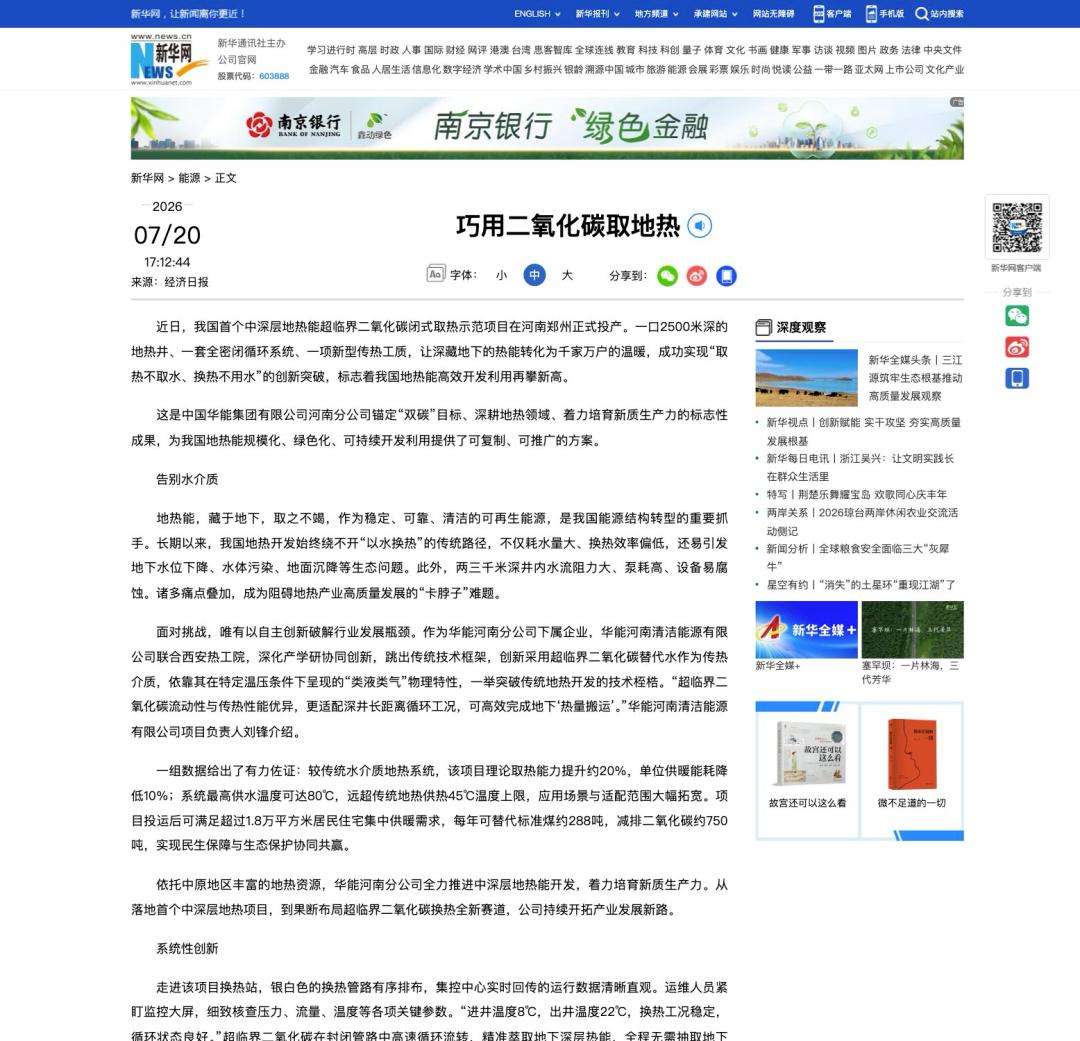
Caption: Xinhua News Agency republished the Economic Daily's report on the supercritical CO₂ closed-loop geothermal project in Zhengzhou. Source: Xinhua News Agency, original content from Economic Daily
If this method proves viable, it will be far more than just a heating solution. If we can extract heat from thousands of meters underground, we will have countless ways to convert it into electricity, treating the Earth as a huge power bank, which is an extremely promising prospect.
I. Heat is right under our feet, but we cannot bring it to the surface
The ground beneath our feet is naturally warm.
And the deeper you dig, the hotter it gets. In ordinary areas, the temperature rises by an average of roughly 2.5 to 3℃ for every 100 meters of depth, with significant variations across different regions. In areas with favorable geothermal conditions, the rock temperature two to three kilometers underground can exceed 100℃.
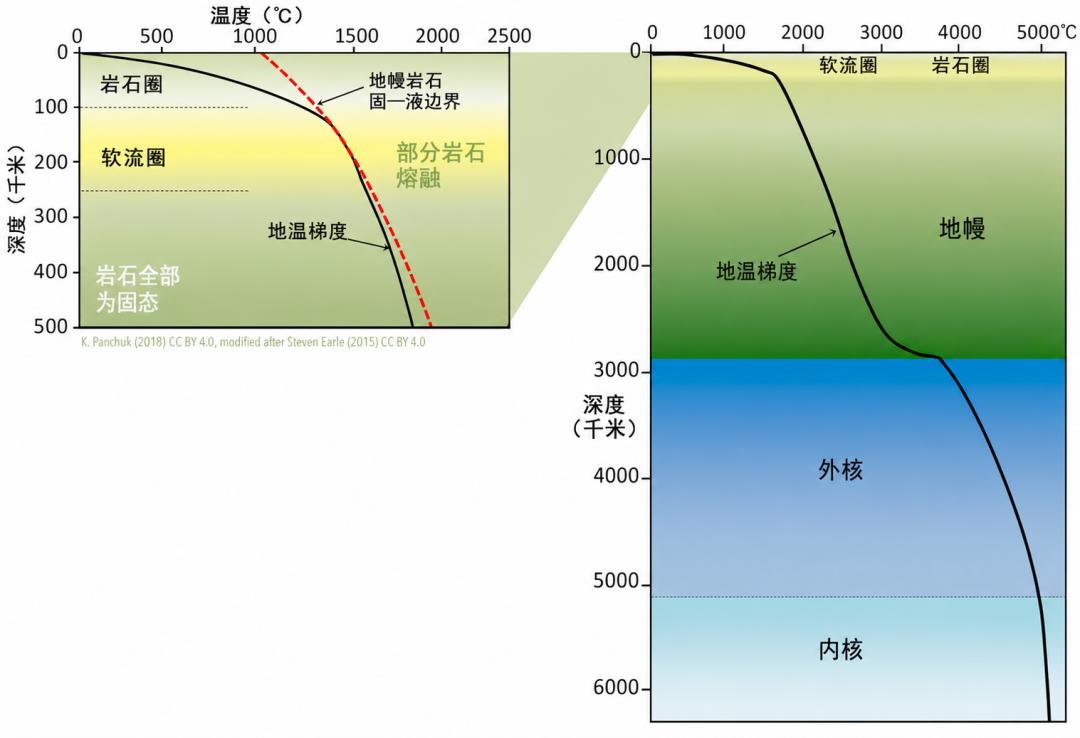
Caption: Geothermal temperature generally rises with depth; the actual gradient in shallow layers varies depending on local geological conditions. Source: Wikimedia Commons
Where does this heat come from?
There are two main sources.
The first is the primordial heat left over from the Earth's formation 4.6 billion years ago: the entire planet has been slowly cooling down from a mass of hot material, and has not fully cooled to this day. The second source comes from radioactive elements including uranium-238, thorium-232 and potassium-40 in crustal rocks. Their unstable atomic nuclei spontaneously decay to generate heat, and decay products collide with surrounding atoms to produce even more heat with each impact. The heat released from a single decay is negligible, but the sheer number of atoms and the long span of time add up to a huge total.
These two sources of heat have sustained for 4.6 billion years, and will continue to do so for billions of years more.
The problem is how to extract this heat to the surface.
Heat is intangible and cannot be moved directly, so we need a carrier to bring it up. The most convenient carrier is hot water: geothermal energy heats up groundwater, and the hot water can then be pumped up for use.
Icelanders have taken this approach to the extreme, and even integrated it into their daily lifestyle.
They have a traditional method for baking bread: knead the rye dough, put it in an iron pot, bury the pot in the soil of a geothermal area, and dig it out the next day without using an oven or gas to get a fully baked loaf.
This practice has lasted for hundreds of years, and is still used by some restaurants today.
What is even more impressive is their heating system: around 90% of the energy used for residential heating in Iceland now comes from geothermal energy. Geothermal snow-melting pipelines are laid under the streets of Reykjavik, so snow melts immediately when it falls in winter. This island nation near the Arctic Circle has basically eliminated its reliance on fossil fuels for residential heating using the heat under its feet.
Impressive as it is, this model cannot be directly replicated elsewhere.
This is because Iceland is a volcanic island with uniquely favorable natural underground hot water conditions.
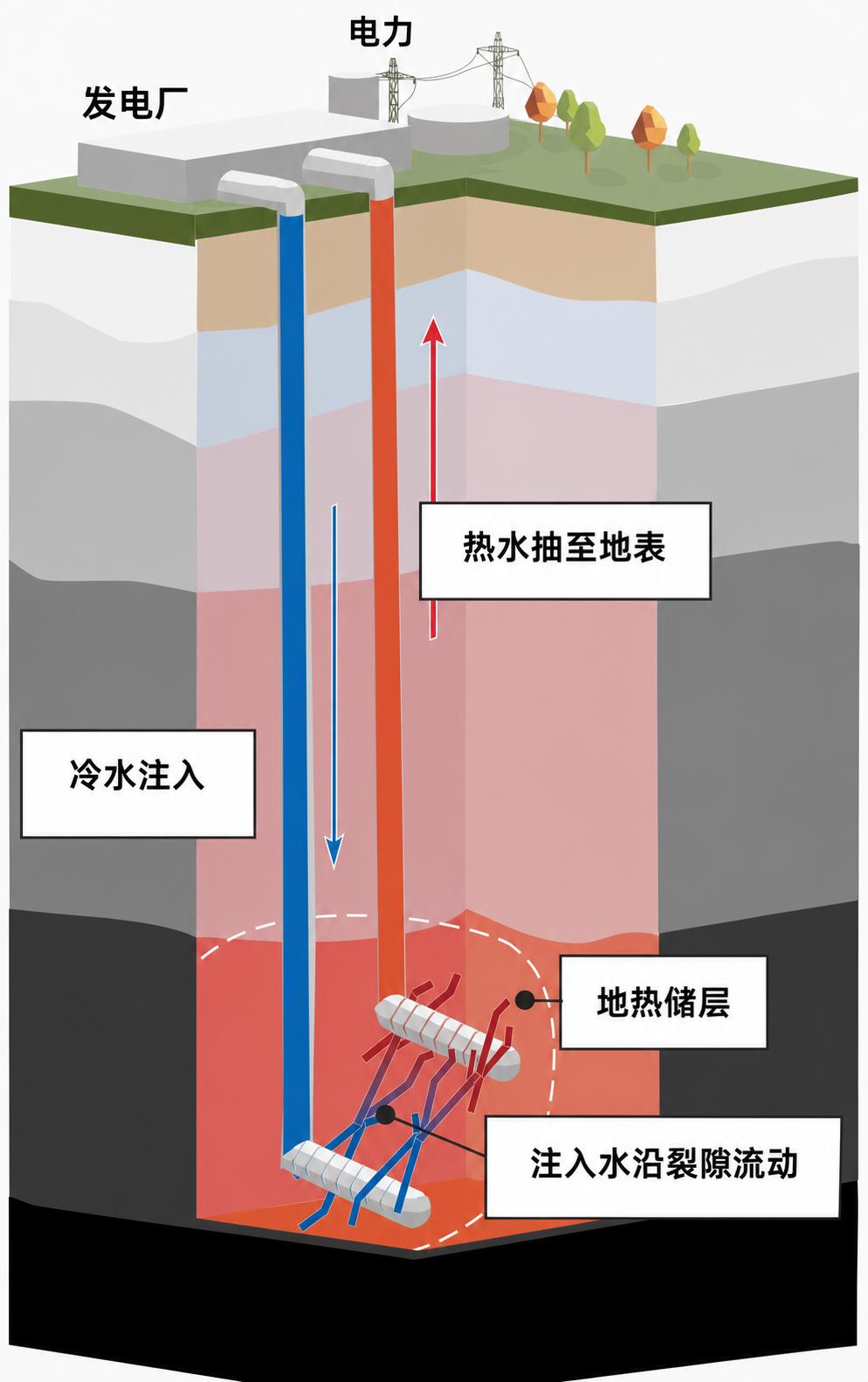
Caption: Traditional hydrothermal or enhanced geothermal systems rely on underground fluids and permeable reservoir channels for fluid flow. Source: USGS, Public Domain
The geological conditions in China are far more complex than those in Iceland. High-temperature geothermal resources are concentrated in southern Tibet, western Yunnan and western Sichuan, which have great power generation potential but are located far away from energy consumption centers. There are plenty of medium and low-temperature underground hot water resources in North China and Northeast China, where heating demand is also concentrated, but traditional pumping-based heat extraction will encounter a series of problems once deployed on site.
For example, reinjection.
The water pumped up through pipes carries a large amount of minerals. When it is injected back underground, it will gradually block the pores of the rock formation and clog the water injection port.
In some other areas, the flow rate is insufficient. After drilling a well, spending a lot of money and getting water out, the heating capacity is not even enough to support several buildings.
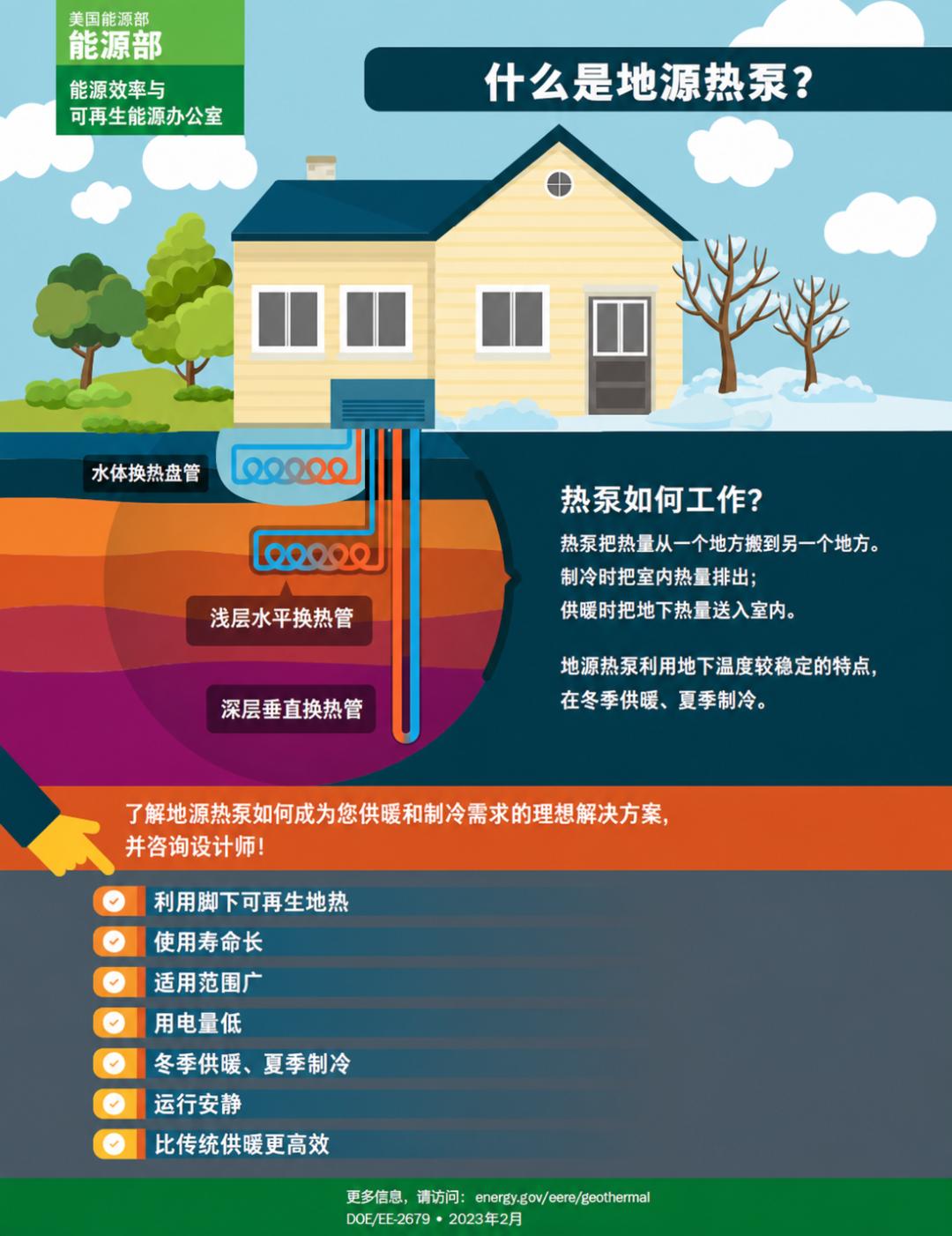
Caption: Shallow ground source heat pumps use the stable temperature near the surface for heating or cooling, which is not comparable to medium and deep geothermal heat extraction thousands of meters underground. Source: U.S. Department of Energy (DOE)
There is also land subsidence.
There is a common misconception here: pumping groundwater does not create a huge underground cavity that suddenly collapses one day. The more common mechanism is that after the water level and pore pressure drop, the fine-grained aquifer that was previously supported by water gradually compacts, and this compaction is often irreversible. The manifestation on the surface is that the ground sinks little by little.
Pipelines also bring extra troubles. Mineral scaling will narrow the flow channel over time, reducing the heat exchange efficiency. Reinjection and fluid injection also need to adapt to local fault and pressure conditions; inadequate design and monitoring may lead to geological risks.
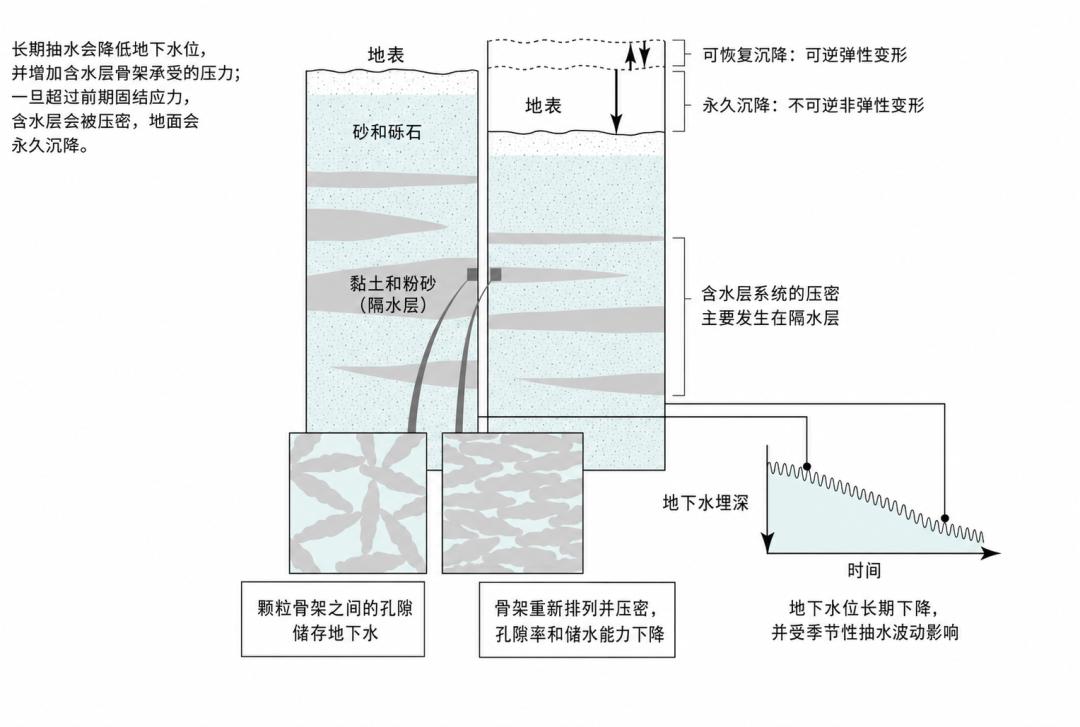
Caption: Long-term water pumping will lower the groundwater level, causing irreversible compaction of fine-grained aquifers, which eventually leads to land subsidence. Source: USGS, Public Domain
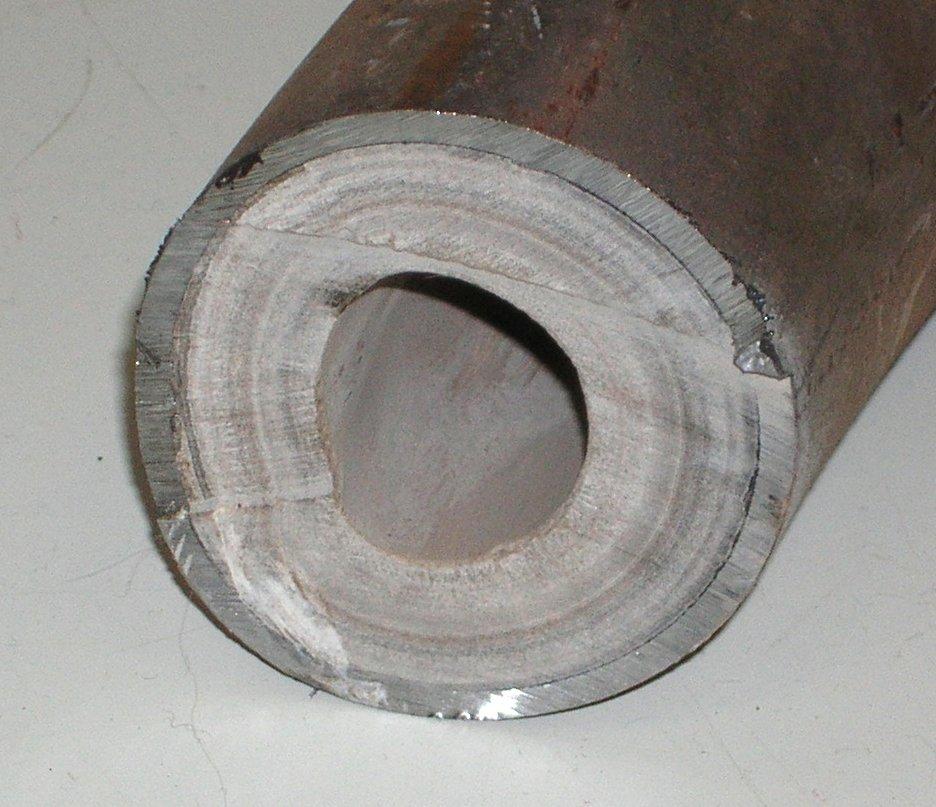
Caption: Cross-section of general heat exchange tube scaling, which visually shows how mineral deposits narrow the flow channel. Source: Wikimedia Commons, Public Domain
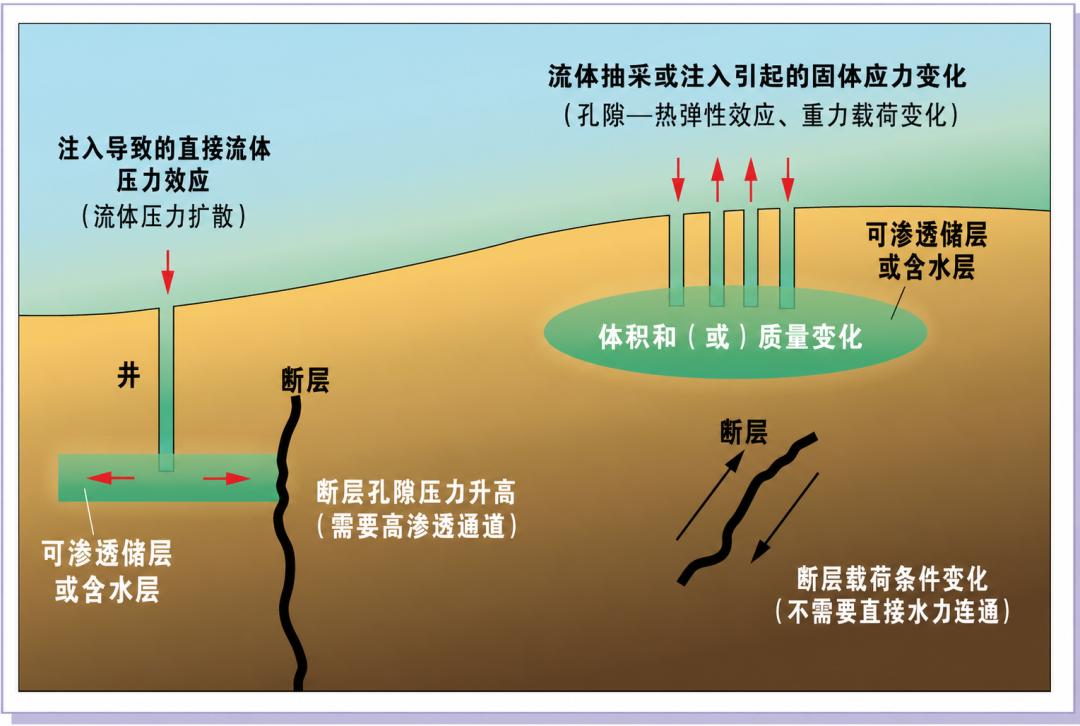
Caption: Fluid injection may change the pore pressure and stress state near faults. This is a schematic diagram of the general mechanism, not targeted at a specific geothermal project. Source: Public Domain
To put it simply, it is very difficult to implement.
II. Inject carbon dioxide underground, bring heat back up
Since natural hot water is so hard to work with, we can abandon this approach entirely.
Engineers came up with a new idea: drill a sealed pipe underground, inject a fluid into it, let it circulate down, get warmed up, and then bring the heat back to the surface.
The fluid absorbs heat through the pipe wall, releases the heat on the surface, is cooled down and then injected back, circulating in the sealed system like a bus running routes, without making any contact with groundwater.
This is "closed-loop geothermal system", which no longer requires the presence of hot water, as long as the underground rock is hot enough. The site selection range is much wider than that of traditional systems.
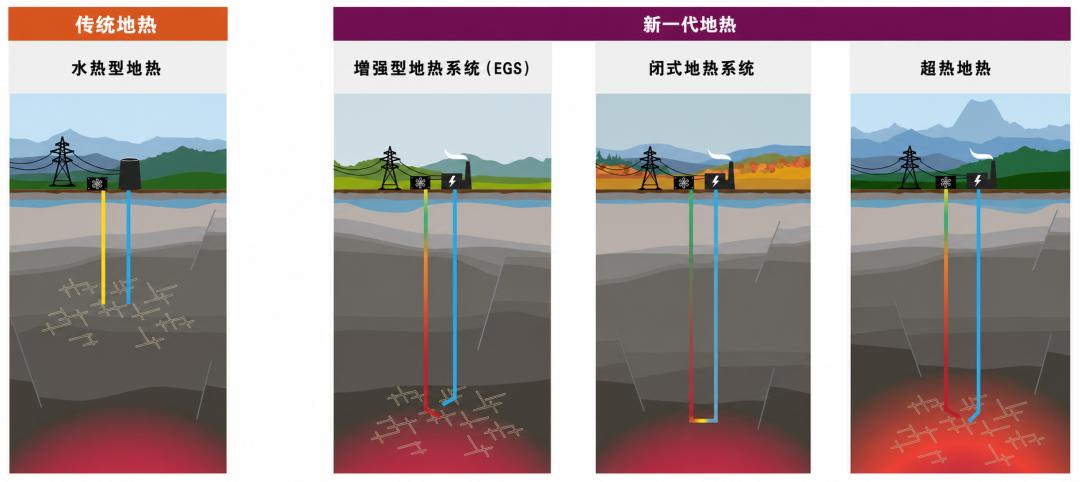
Caption: From left to right: traditional hydrothermal, enhanced geothermal, closed-loop geothermal and superhot geothermal systems. The working fluid in the closed-loop system always circulates inside the pipeline, and does not rely on groundwater or fracture networks. Source: U.S. Department of Energy (DOE)
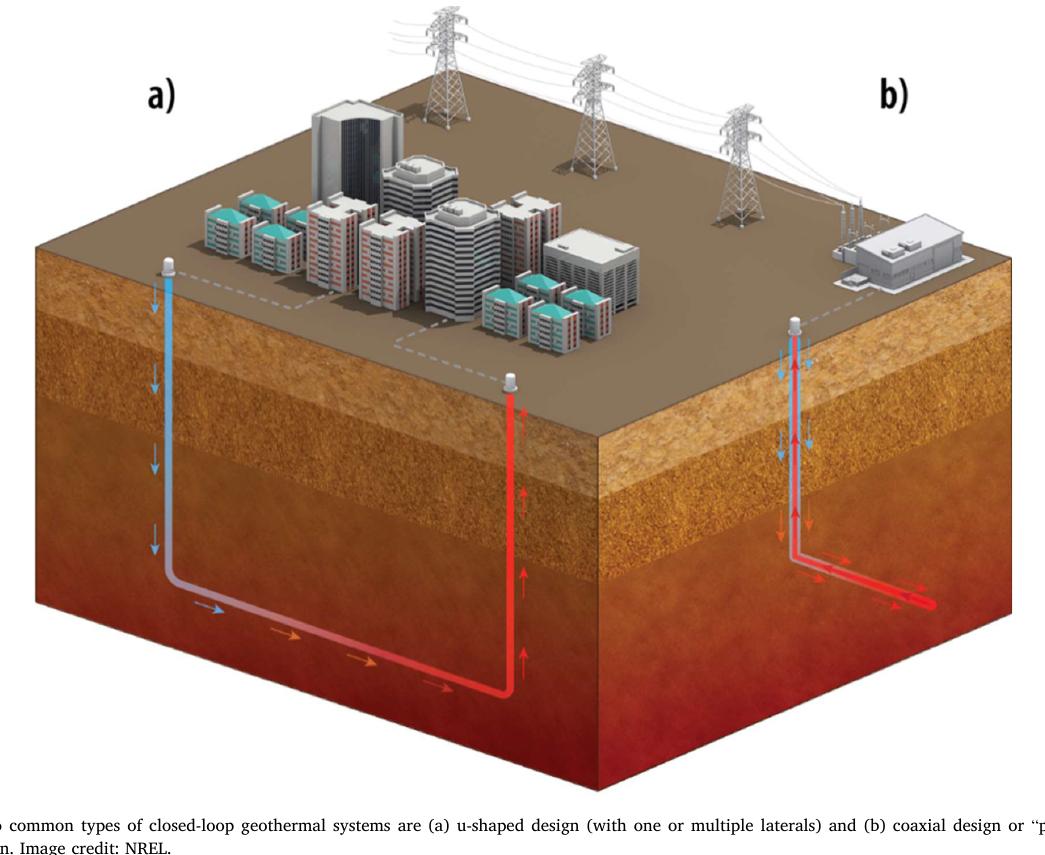
Caption: Two common well types for closed-loop geothermal systems: the left one is U-shaped or multi-branch loop, the right one is coaxial "tube-in-tube" structure. Source: Geothermics journal paper
What fluid runs inside the pipe? It can be water, or other types of fluid.
The Zhengzhou project selected a very common yet interesting substance: carbon dioxide.
Carbon dioxide has a very special physical state.
If you heat liquid carbon dioxide in a high-pressure transparent container, you can clearly see the liquid level at first, with gas above and liquid below. As you continue heating, when the temperature approaches 31.1℃ and the pressure exceeds 73 atmospheres, the liquid level starts to flicker and then suddenly disappears. The entire container is filled with a uniform transparent fluid, and you cannot tell whether it is liquid or gas.
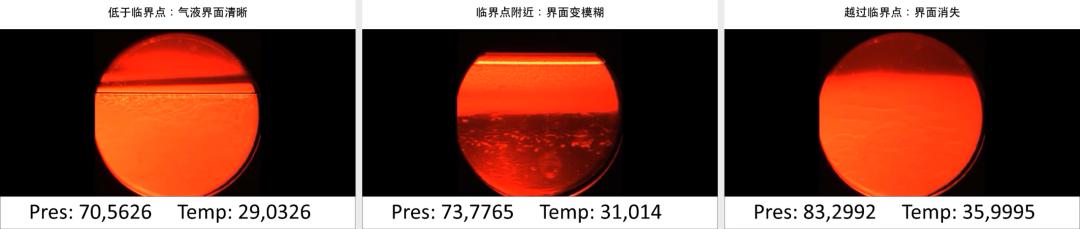
Caption: Visual window experiment from left to right: the gas-liquid interface is clear at 29.03℃, critical opalescence appears near 31.01℃, and the interface disappears at 36.00℃. The footage is captured from the IKE experimental video of University of Stuttgart. Source: IKE, University of Stuttgart
This state is called "supercritical state".
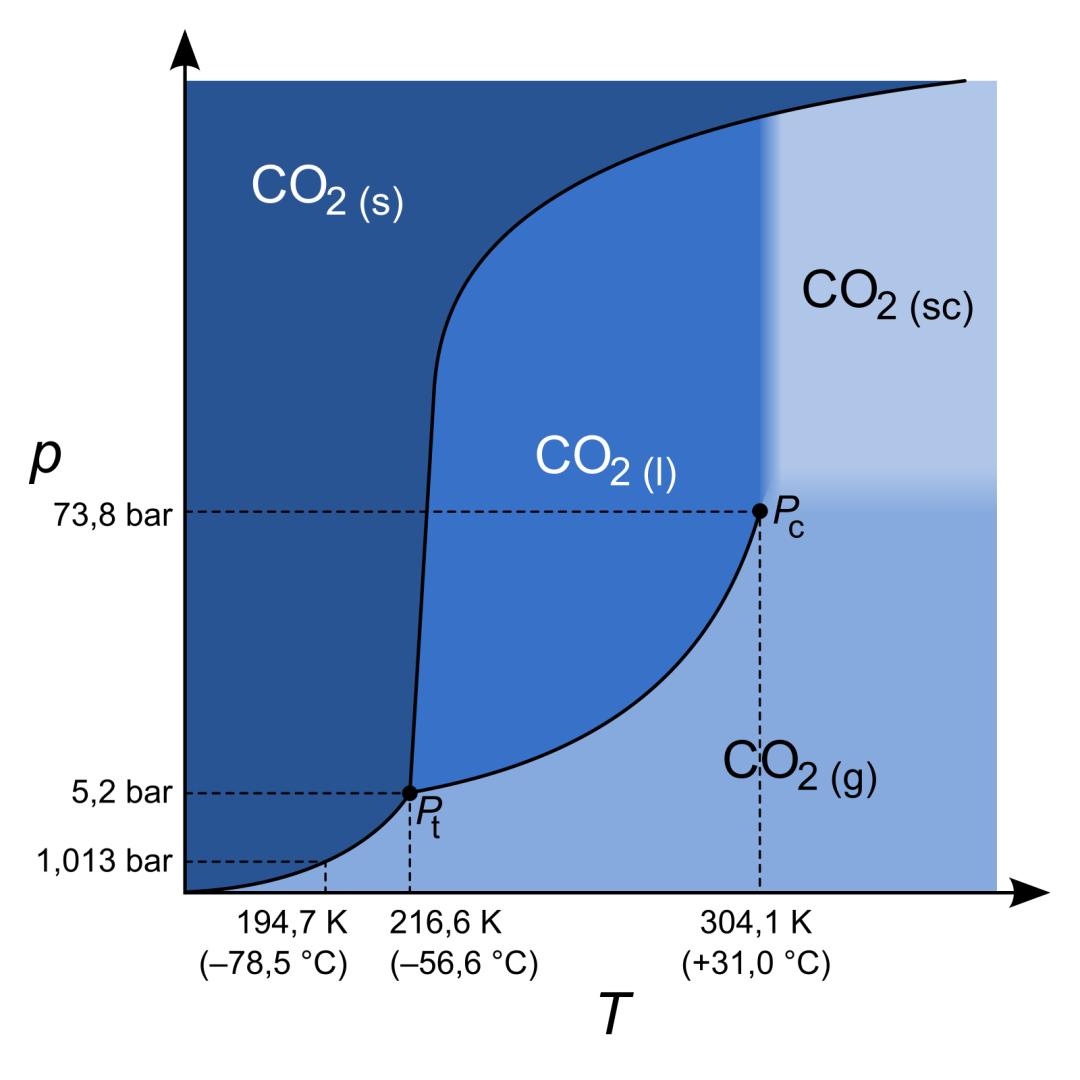
Caption: Carbon dioxide enters the supercritical zone after exceeding the critical point of approximately 31.0℃ and 73.8 bar; this is a schematic diagram and not drawn to scale. Source: Wikimedia Commons, Public Domain
Why is it suitable for transporting heat underground?
First, supercritical carbon dioxide has low viscosity, and under appropriate working conditions, the circulation resistance inside the pipe can be lower than that of water.
Second, its density decreases when heated. Cold and dense carbon dioxide tends to flow downward, while hot and light carbon dioxide tends to rise upward. The difference in temperature and density creates a natural circulation on its own. In other words, it can flow almost without pumping, forming a self-driven cycle.
