NVIDIA is facing an acute HBM shortage that restricts the development of its next-generation GPUs, while this hard drive has stolen the show.
When encryption, compression, indexing, memory and context services are placed close to the media, the value boundaries of SSD, DRAM, HBM and HBF will be redrawn
AI Agent is transforming computers from a system that "completes one model call after receiving a request" into an operating system that continuously observes, reasons, calls tools, modifies the environment and retains states.
A single task may continuously access models, memory, vector indexes, business databases, object storage and network services, and continuously write back tool results, execution traces, user preferences, temporary contexts and audit records. The longer the Agent runs, the more its value depends on whether data can be safely stored, correctly retrieved, updated in time and reused at low cost [1].
This means that storage is no longer just the final landing endpoint for Agent to finish its work, but will gradually enter the perception, memory and decision-making loop of Agent. AI SSD has already demonstrated the first batch of directions: storing models and Adapters, undertaking the KV Cache evicted from memory, shortening cold start, and expanding the capacity of deployable models. Taking one step further, SSD may also perform encryption, compression, deduplication, tagging, indexing, version maintenance and lifecycle management when data is landed on disk, and provide long-term capacity for Agent Memory.
This change does not appear out of thin air. Self-encrypting drives can already transparently complete data encryption and decryption within the controller; computational storage standards list compression, encryption, regular filtering and erasure codes as functions that can be executed on the storage side; products such as Samsung SmartSSD have also offloaded database scanning and video processing to the disk side [4][5][7]. The new idea of the Agent era is that these capabilities no longer only serve general-purpose data processing, but begin to reorganize around agent identity, context, memory, tool traces and Token costs.
In the future market, there may be different names such as "Secure SSD", "Compression SSD", "Retrieval SSD", "Memory SSD" or "Context SSD", or they may not form fragmented hardware categories, but converge into programmable functional SSD: the basic form is still compatible with standard storage, and upper-layer software discovers and invokes device functions according to scenarios.
NVMe has already formed command sets such as Computational Programs and Subsystem Local Memory, providing a standardized path for device-side program discovery, configuration and execution [6]. The real industrial problem is not just whether a processor can be placed inside the disk, but who will define data semantics, functional boundaries and end-to-end results.
Agent is not a single call
But a continuously written data chain
The main persistent object of traditional chatbots is conversation records, while Agent will generate more complex data graphs. It needs to save observation results, tool outputs, plans and reflections, intermediate task states, user portraits, environment snapshots, retrieval evidence and execution logs; the model side will also generate KV Cache, Prefix Cache, Adapter, expert weights and Checkpoint. Different objects have different update timelines, reuse scopes and security levels, but they jointly determine whether subsequent reasoning can continue.
Agent Memory is not equivalent to stuffing all historical conversations into a vector database. Recent systematic research on Agent Memory from the perspective of data management splits it into four modules: representation and storage, information extraction, retrieval and routing, and maintenance, and points out that no single architecture can perform optimally on all workloads [9].
Systems such as Mem0 also emphasize converting original conversations into more compact and reusable long-term memory to reduce the input Token and retrieval burden in long sessions [10]. This means that the storage layer in the future will not only store content, but also preserve how content is organized, updated and forgotten.
Therefore, Agent data landing on disk requires richer contracts than "write successfully". A memory object should carry user or Agent identity, tenant, source, time, version, permission, credibility, retention period and deletability; model context also needs to be bound to model version, Tokenizer, position encoding and Adapter. Only when the namespace and lifecycle are clearly defined, subsequent compression, indexing, caching and sharing will not break the semantic boundary.
The reasonable role of functional SSD in this data chain is not to judge by itself whether a piece of experience is worth remembering, but to perform deterministic work close to the data after the Runtime has given the objects and strategies. For example, selecting keys by tenant, placing data by lifecycle, compressing and deduplicating reducible objects, maintaining index pages and metadata, prioritizing the reload that will be used for reasoning soon, and feeding back tail latency, write amplification and media health to the upper layer. Semantic decisions remain in Agent and Runtime, and data execution is as close to the media as possible.
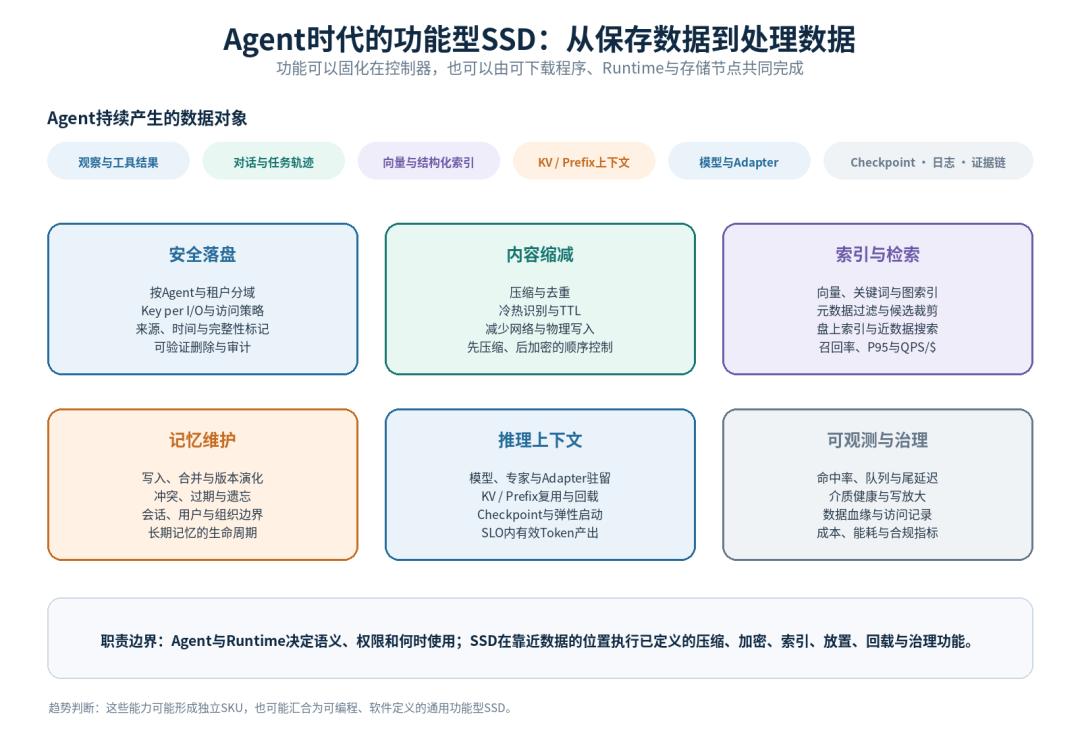
Figure 1 The capability spectrum of functional SSD in the Agent era. Security, content reduction, indexing, memory, reasoning context and governance functions can be solidified in the device, or completed by downloadable programs, Runtime and storage nodes together. This figure is an industrial mechanism deduction, and the capability boundaries of computational storage and security refer to SNIA and NVMe specifications [4][5][6].
Core judgment: The SSD upgrade in the Agent era is not simply increasing the computing power inside the disk, but combining standard block devices, discoverable near-data functions, object semantics and lifecycle management. Functions closer to the media should be more deterministic, auditable and isolatable; decisions closer to the model need to remain in the Runtime.
Automatic encryption already exists, and the change is that strategies begin to follow Agent
"Automatic encryption of data when landed on disk" is not a future concept. Self-encrypting drives will use dedicated hardware in the controller to encrypt written data and decrypt read data, and realize transparent static data protection through key management and policy control [5].
For Agent systems, the new requirement is that the encryption granularity is further refined from the entire disk or a single namespace to users, Agents, tasks and objects: personal memory and application cache on the same end-side device cannot overstep each other's permissions, and the shared context of multi-tenant Agents on the cloud side must also clearly define which parts can be reused and which parts can only be read within one permission domain.
The NVMe specification has introduced more fine-grained capabilities such as host-managed keys and Key Per I/O [6], providing a basis for carrying different security contexts for each I/O. Future secure SSD may also combine data sources, timestamps, access records, integrity verification and trusted deletion, so that Agent can not only answer "what do I remember", but also answer "where does this memory come from, whether it has been modified, who has read it, and when it must be deleted". For finance, healthcare, enterprise knowledge bases and personal AI, the evidence chain may be as important as retrieval speed.
Encryption will also change the order of other near-data functions. The encrypted byte stream is usually difficult to compress and deduplicate effectively, so content reduction should generally precede encryption [5]; indexing needs to distinguish the boundaries of plaintext features, protected metadata and searchable ciphertext. The competitiveness of functional SSD is not only how many functions it has, but whether it can organize compression, indexing, encryption, landing and deletion correctly with a verifiable pipeline, while avoiding that any link expands the attack surface.
Compression, indexing and memory maintenance may become the next batch of SSD functions
Compression is one of the functions most likely to form a commercial closed loop. Agent will repeatedly write text, JSON, logs, vectors, Checkpoint and multimedia intermediate results, a considerable part of which has structural repetition. If compression is completed before data enters the network or NAND, it can reduce transmission, physical writing and capacity occupation, and indirectly reduce energy consumption and media wear. However, compression ratio, extra latency, CPU saving and write amplification must be measured together; for model weights that have been quantized or highly compressed, further compression may have limited benefits.
The indexing function has a more direct relationship with Agent, because memory is valuable only when it is recalled correctly. KIOXIA AiSAQ places vectors and index structures on SSD, uses SSD-friendly clustering and graph search to reduce DRAM occupation, and has demonstrated vector retrieval at the scale of billions on a single server [8]. It needs to be strictly distinguished that AiSAQ is first a set of software technologies with SSD as the main index carrier, which does not mean that ordinary SSD will automatically generate Embedding or understand semantics. A more possible industrial path is that GPU, NPU or CPU is responsible for generating representations, and SSD and near-data programs are responsible for organizing indexes, filtering candidates and returning smaller result sets.
Memory maintenance is more complex than indexing. Long-term Agent Memory will experience addition, merging, conflict, revision, weight reduction, expiration and forgetting; the same fact may also have original records, summaries, vectors and knowledge graph representations at the same time [9]. Future "Memory SSD" can provide atomic updates, logs, TTL, hot and cold placement and secure deletion for these versions, but cannot determine what is real memory solely based on similarity. Memory quality still depends on upper-layer extraction, routing, conflict handling and evaluation.
From a product perspective, these functions do not necessarily require each disk to run complex models. Compression, encryption, hashing, filtering, index page maintenance and object lifecycle are all suitable for deterministic dedicated circuits or lightweight programs; Embedding, reordering, summarization and memory merging may be completed by the host or independent accelerator.
The key to functional SSD is to connect the two types of work with a unified object ID and observable interface, so as to move less data, instead of stuffing all AI computing into the disk.
End side: SSD may become the long-term state layer of personal Agent
End-side Agent will continuously access personal documents, photos, emails, schedules, application states, browsing records and device sensor data. Unified memory is only suitable for retaining the current working set, while SSD can store a larger local model library, Adapters, vector indexes, personal memory and tool traces. As long as it maintains the standard NVMe form, the functional SSD can first be directly installed as an ordinary system disk by AI PCs and workstations, and then gradually enable security, indexing and context capabilities through drivers, Runtime and firmware.
Its value to consumers is not that "the hard drive can think", but that local AI can remember longer, continue to work under weak networks, and reduce the original data and input Token uploaded to the cloud for each task. The meeting Agent can retain audio, summaries and task states, the programming Agent can maintain warehouse indexes and modification history, and the home Agent can share authorized photos, documents and device states across devices. SSD keeps these states near the device, and the Router then decides to process locally or call the cloud according to quality, privacy, power consumption and network.
The end-side market may also expand from a single disk to a small storage node. AI PCs, home servers or store edge boxes can provide local model mirrors, personal memory, vector libraries and encrypted archives for mobile phones, tablets, robots and cameras, avoiding repeated storage of the same set of data on each device. The business model will extend from capacity upgrades to AI PC premium, local Agent subscription, model and skill package management, as well as private AI nodes for families and small enterprises.
Local storage does not automatically equal privacy. If applications can read memory arbitrarily, indexes cannot delete old versions, and keys are disconnected from device identities, more functions will mean a larger attack surface. End-side functional SSD must take application isolation, user consent, retention period, verifiable deletion and key revocation after device loss as product capabilities, rather than just treating privacy as a marketing slogan.
Cloud side: SSD will evolve from devices to Agent storage nodes
The state scale of cloud-side Agent is larger, and sharing is more necessary. A complex request will concatenate multiple model calls, tool execution, memory access and network transmission; multi-Agent collaboration will also generate shared plans, messages, evidence and execution logs [1]. Node local SSD can store models, Checkpoint and high-frequency indexes, the rack or POD-level Flash layer can undertake KV, Prefix, Adapter and shared memory reused across GPUs, and general object storage will continue to store cold data and long-term fact sources.
Mooncake has organized CPU, DRAM, SSD and RDMA/NIC into a distributed KV Cache pool, and allows the scheduler to determine the request path according to cache location, TTFT and TBT targets [3]. NVIDIA CMX establishes a POD-level Flash context layer for KV Cache between HBM, host memory and general shared storage, putting shared storage nodes into the inference data path [2]. The end-to-end benefits of these systems cannot be attributed to a single SSD, but they indicate that "storage nodes participating in Token production" is moving from concept to infrastructure products.
The next-generation Agent storage node may provide context, memory and governance services at the same time. It can maintain shared Prefix and KV directories, preheat models and Adapters, store vectors and graph indexes, compress and encrypt data by tenant, record tool calls and evidence chains, and expose hit rate, P99, write amplification, energy consumption and media health to the scheduler. Customers will not only purchase disk capacity and bandwidth, but also GPU utilization, SLO goodput, Token/$, Token/W, QPS/TB and audit response speed.
This will also change the business model. Single disks can still be sold by capacity, durability and performance; storage nodes may generate combined revenue in the form of multi-disk Appliance, control plane, Runtime authorization, long-term support and SLA; at a higher level, services billed by effective context capacity, number of memory objects, retrieval throughput or effective Token may also appear. Once functional SSD is responsible for end-to-end results, its value boundary will expand from semiconductor devices to data infrastructure.
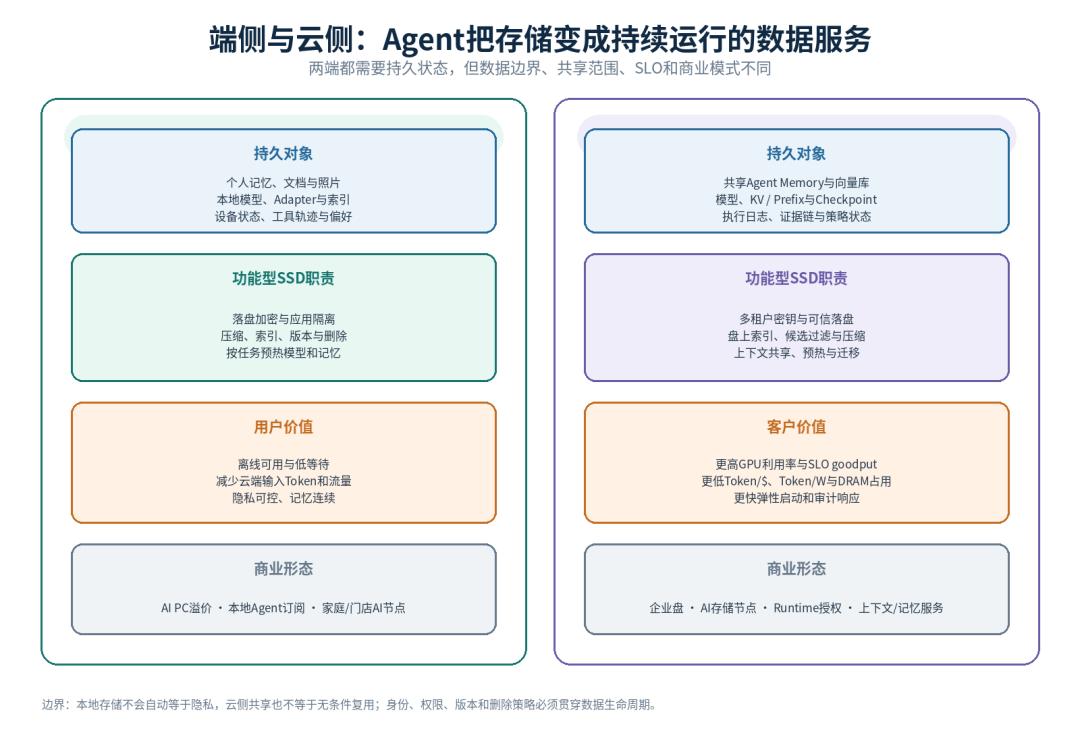
Figure 2 Typical division of labor for end-side and cloud-side Agent storage. The end side emphasizes personal data, local models, offline capabilities and privacy control; the cloud side emphasizes shared context, multi-tenant governance, GPU utilization and Token economics. This figure is a product form deduction, and the cluster side refers to Mooncake and CMX [2][3].
The value boundaries of HBM, HBF, DRAM and SSD will be redrawn
The storage reconstruction brought by Agent should not be understood as SSD replacing memory. The Tiered Memory idea proposed by SK hynix at FMS 2026 is to connect HBM, DRAM, NAND/HBF and SSD according to speed, capacity and cost, focusing on reducing data movement [11]. This exactly corresponds to the reality of Agent systems: data that must be used for the current Token, data that will be used in the next few milliseconds, data that may be reused across sessions, and long-term archived data need to be carried by different media.
HBM is still the core layer closest to GPU computing, carrying current weights, activations, hot KV and operator intermediate states, with indicators of Token/s, bandwidth and computing utilization. Agent adds long context and multi-model collaboration, which will further push up HBM demand rather than weaken its value. The constraints of HBM are capacity cost and supply, so the system needs to move data that does not need immediate access to a lower cost layer and preheat it accurately before use.
HBF, namely High Bandwidth Flash, is a new layer that has taken shape rapidly since 2025. The first batch of open specifications announced by SK hynix and Sandisk in August 2026 covers a maximum capacity of 512GB, with bandwidth divided into three levels from about 0.4TB/s to 3.0TB/s, and uses UCIe to connect to the processor [12]. HBF uses NAND to obtain larger capacity than HBM, aiming to undertake read-intensive large-scale inference working sets between HBM and SSD. It is still in the early stage of standardization and productization, and the official specifications do not equal mass-produced performance in a broad sense, nor can it eliminate the limitations of NAND in latency, write endurance and variable state access.
The H3 study gives a clearer division of labor: place read-only data in HBF and keep other data in HBM to build a hybrid inference system with the advantages of both [13]. For Agent, HBF is more suitable for model weights, MoE experts and large working sets dominated by reading; frequently updated KV, activations and running states are still more suitable for HBM or DRAM. If HBF matures, it may reduce the demand for adding GPU/HBM for capacity reasons, but it is more likely to be a supplement rather than a replacement.
DRAM and CXL are in the middle ground between variable states and shared capacity. Host KV, index hot sets, prefetch buffers and Agent running states require low latency and frequent modification; CXL expansion, pooling and sharing can reduce memory islands and provide more flexible capacity for multiple hosts [14]. SK hynix also demonstrated CXL pooled memory and DRAM-SSD hybrid solutions for KV sharing, prediction and prefetching at FMS 2026, but these are specific demonstration results that need to be verified on more platforms [11].
Functional SSD undertakes larger, more persistent and more