Mark Zuckerberg is going all out. Shortly after being faced with a 1.4 trillion compensation claim, he open-sourced the compact yet powerful AI model overnight to win public goodwill.
Today, Meta is in a situation of extreme contrasts, with both favorable and harsh circumstances unfolding at the same time.
Its social media platforms are facing severe legal accountability over allegations that their addictive design has harmed minors, with related claimed damages soaring to 1.4 trillion U.S. dollars, an amount almost equal to Meta's total market capitalization.
Seemingly aware of the need to polish its public reputation, Meta — which once took the global open-source AI community by storm with Llama, before leaving developers waiting in vain for updates for a long time — has suddenly raised the banner of open source again.
Just recently, Meta Superintelligence Labs officially released Muse Glimmer, an open-weight Agent model with 30 billion parameters, under the highly permissive Apache 2.0 license.
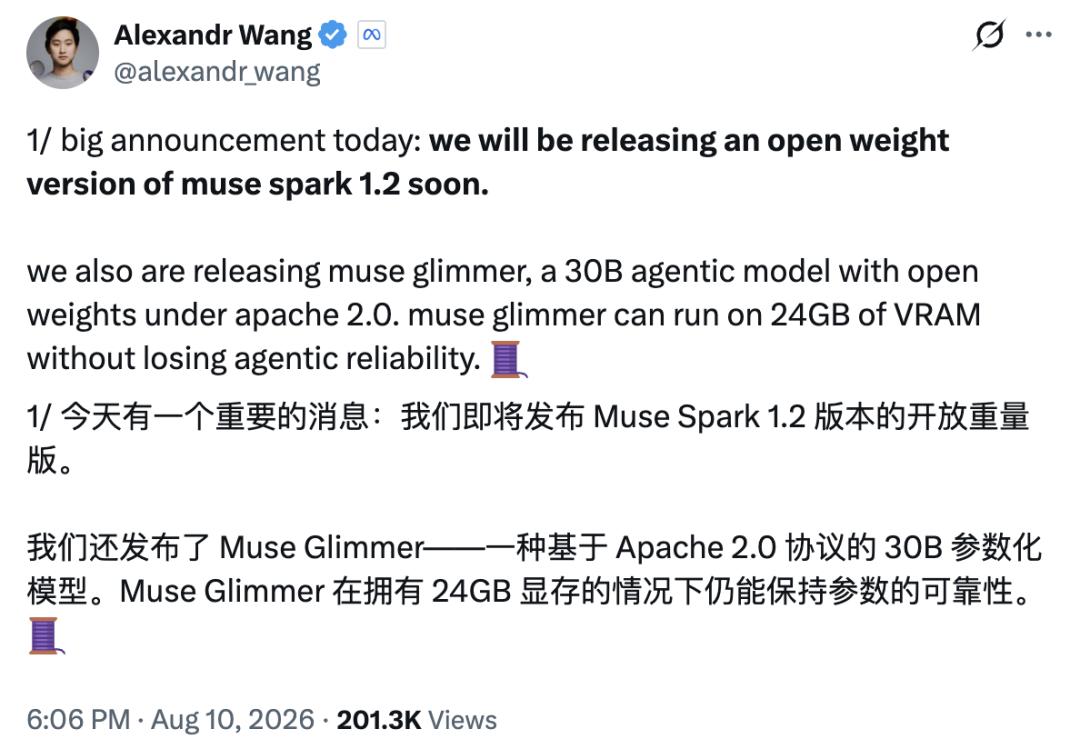
The weights of Muse Spark 1.2 will also be made publicly available.
The barriers to download, modification and commercial use are all relatively low.
Specifically, Muse Glimmer only has 30B parameters, but it is specially built for always-on local agents. It can run on Mac devices, and also on PCs equipped with a single consumer-grade GPU.
It does not need to be constantly connected to the cloud, nor does it need to call APIs for every single step. Even after disconnecting from the network, it can still call local tools, organize files, write code, view screenshots and process tasks.
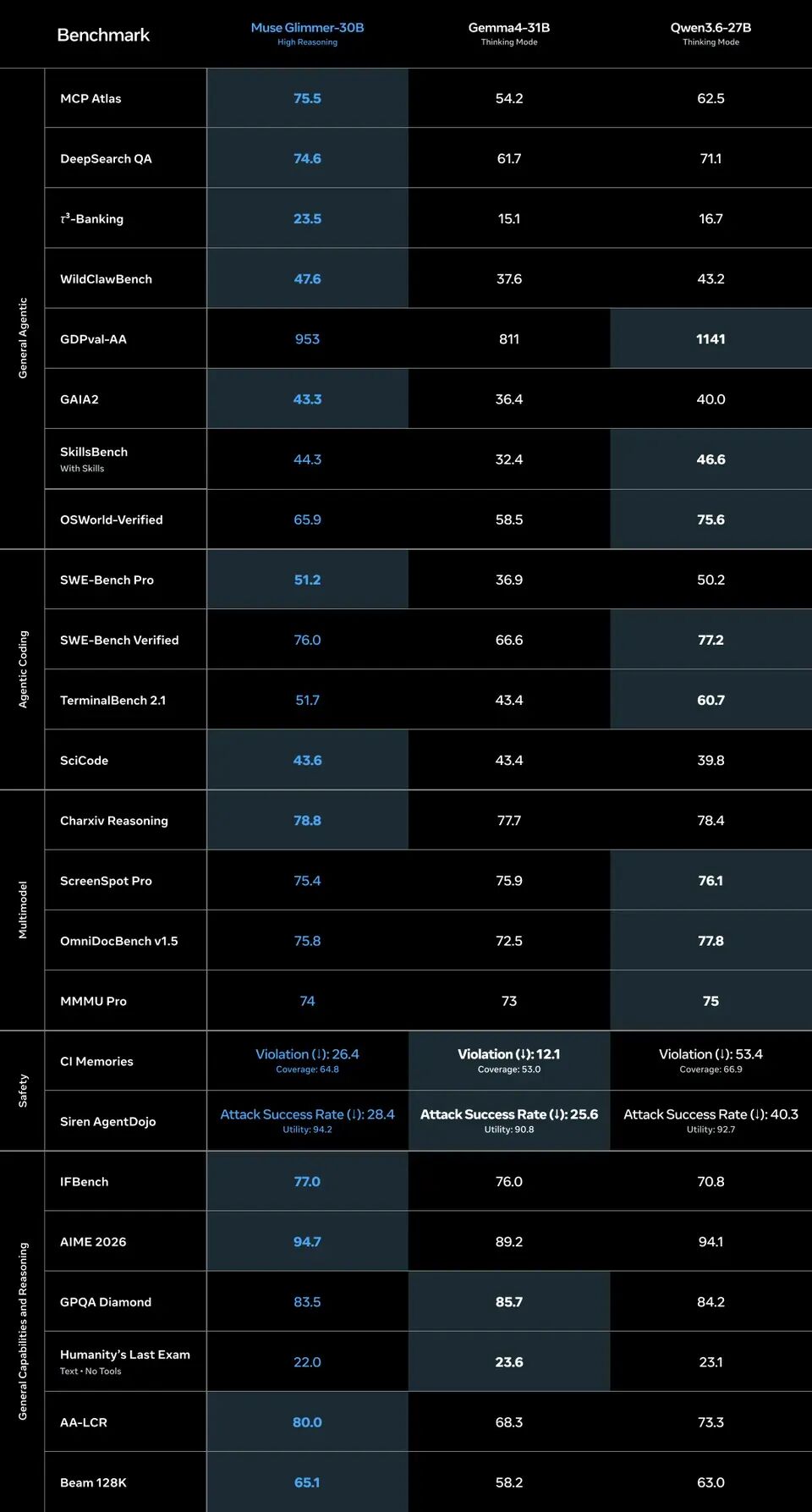
As an agent with a full 30 billion parameters that can perform reasoning, process images, call tools and execute tasks continuously, how exactly did Meta manage to fit this powerful compact AI model into ordinary consumer computers?
The 30B Golden Size: Not Too Big, Not Too Small, Perfectly Fits Right Into Your Mac
In the pecking order of AI models, model size has long been an awkward issue.
Models with 7B to 8B parameters can run on mobile phones, but their intelligence is often limited: they start to ramble nonsensically when faced with slightly complex logical reasoning. Meanwhile, models above 70B parameters are highly capable, but they have extremely high memory requirements that are far beyond the reach of ordinary users.
Muse Glimmer cleverly hits the 30B sweet spot of optimal performance and accessibility.
However, 30B parameters still require more than 55GB of memory under full precision, which obviously exceeds the maximum capacity even of the RTX 5090. To make the model truly deployable for end users, Meta adopted a comprehensive set of optimization measures.
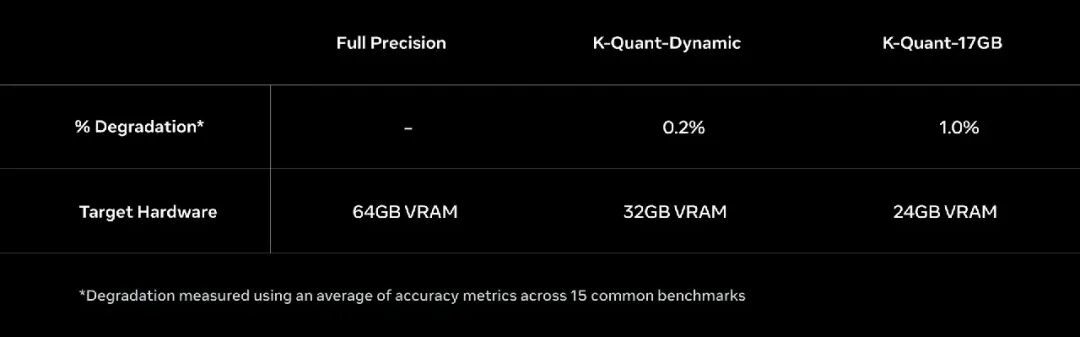
The first step is extremely aggressive model compression.
Using the latest quantization technology, Meta compressed the model weights to 4-bit precision, reducing the total volume to under 20GB. This leaves valuable VRAM space on your computer for loading context memory (KV cache) and the multimodal encoder for image processing.
But being able to run is not enough — it has to run fast.
A local AI that takes five minutes to generate a single sentence will only make users want to smash their keyboards. To solve the long-standing problem of slow local inference, Muse Glimmer is equipped with a lightweight drafter based on DFlash for speculative decoding.
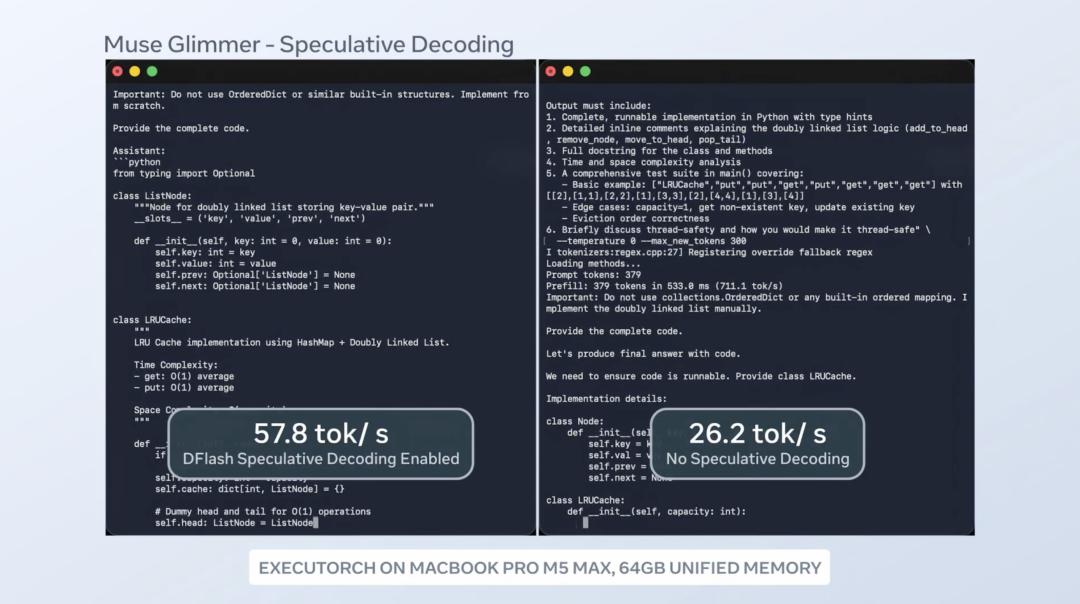
Specifically, the model comes with a very small "intern" (the DFlash draft model), which quickly generates a long sequence of tokens in one go; then the "director" (the main Muse Glimmer model) performs parallel verification, keeping the correct content and modifying the incorrect parts.
This mechanism completely frees Muse Glimmer from the predicament of traditional large language models that generate text one word at a time like squeezing toothpaste. On MacBook devices equipped with M4-Max or M5-Max chips, or PCs with RTX 5090 installed, its generation speed is fast enough to support real-time interaction with no perceptible latency.
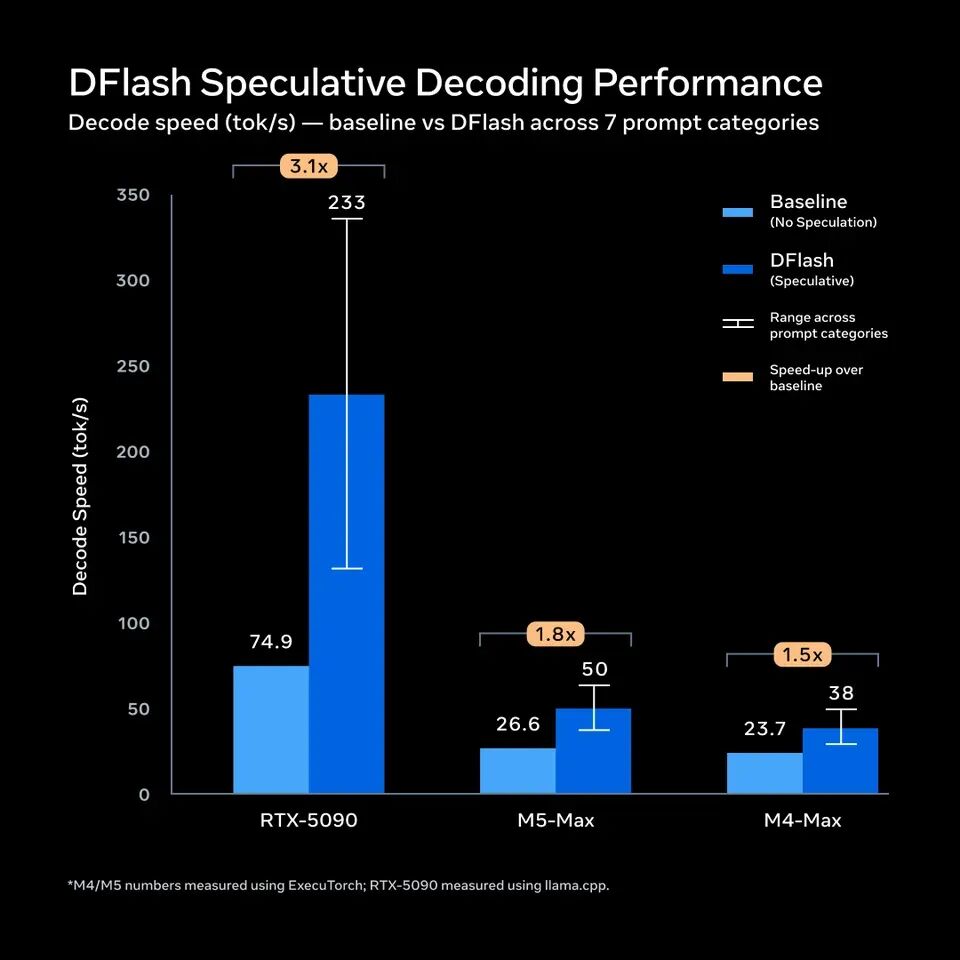
In short, with strong engineering capabilities, Meta has compressed a model that originally required 60GB-level memory to run smoothly, to a size that can be supported by 24GB and 32GB consumer devices.
Not a Chatbot, But a "Digital Worker" That Gets Things Done For You
The official definition of Muse Glimmer from Meta is: Open Agentic Model.
To equip Muse Glimmer with the capabilities of a reliable worker, Meta adopted a logit-based distillation technique during the training process.
They had an extremely large teacher model (Muse Spark) generate complex reasoning chains and agent interaction data, then pass on all the knowledge to Glimmer through step-by-step training.
This also enables Muse Glimmer to master several outstanding capabilities:
For example, Muse Glimmer can deeply integrate with your operating system, directly read your local files, help you manage your schedule, and even open IDEs to write code for you, delivering remarkable performance in rigorous benchmarks such as SWE-Bench.
In terms of multimodal and visual perception, Muse Glimmer has a dedicated independent visual perception encoder. This means you can directly feed it a screenshot full of complex charts, or let it observe your screen operations, and it can seamlessly understand all multimodal information.
In addition, Glimmer is specially trained with a "fault tolerance mechanism". When a tool call fails or returns an unexpected result, it will act like a real human programmer: it will diagnose the error message by itself, adjust the parameters, and retry until the problem is resolved.
The Era of Personal AI Has Only Just Begun
A truly useful personal agent will sooner or later need to access your files, calendars, photos, code, chat records, and even understand your long-term work habits.
If all of these data rely entirely on the cloud, privacy risks, network connectivity, cost and latency will always be limiting factors.
Therefore, future agents will most likely not exist in only one form. The most complex tasks will continue to be handled by large cloud models, while local models will be responsible for high-frequency, private work that needs to stay resident on the device, with both sides leveraging their respective advantages.
The name Muse Glimmer is very appropriate. The next phase of competition in the AI industry will not only focus on building larger models, but also on enabling sufficiently powerful intelligence to run on more people's devices at lower costs.
In the next few days, frameworks familiar to developers including llama.cpp, Ollama and MLX will add support for Muse Glimmer one after another.

During the release of Muse Glimmer, Mark Zuckerberg also published a long article that set the tone for Meta's AI roadmap, stating that superintelligence should be placed in the hands of every individual, rather than being concentrated in a small number of companies.
He envisions that in the future, everyone will have a personal agent that works 24/7, understands your goals, work, health and life, and provides strong privacy protection such that even Meta itself cannot access the user's data.
From this perspective, the significance of Muse Glimmer is very clear: a 30B agent that can run on local computers, stay resident for long periods, and call various tools is a key building block for realizing "personal superintelligence".
He also re-emphasized the importance of open source, calling it the key to preventing excessive concentration of AI power, and stated that Meta Superintelligence Labs will redouble its efforts to promote open source.
Muse Glimmer is exactly one of the models in this new batch.

Hugging Face 🔗https://huggingface.co/meta-models/Muse-Glimmer-30B
Of course, when Meta puts open-weight models back at the forefront at this moment, it is hard to ignore another background: over the past two years, the presence of Chinese models in the global open-source large model ecosystem has been rising rapidly.
Batch after batch of domestic Chinese models have been continuously added to Hugging Face, GitHub and the toolchains of global developers. Chinese teams are no longer just participants in open-source model development, but in many cases are constantly raising the competitive bar of this industry.
Muse Glimmer is just a new contestant that has just joined this race, and the entire open-source local AI ecosystem behind it, which is accelerating its formation, is becoming increasingly lively.
The era of personal open-source AI has only just kicked off.
This article is from the WeChat official account "APPSO", written by APPSO that discovers tomorrow's products, and is published by 36Kr with authorization.