Apple's highly anticipated annual tech event (widely dubbed "tech Spring Gala" in Chinese tech communities) has been officially scheduled, multiple new Apple products have been leaked, and the new generation of iPhones is set to see a significant price hike.
The annual Apple autumn launch event is approaching once again.
Recently, well-known leaker Mark Gurman, a journalist at Bloomberg, has released several posts revealing information related to Apple's new autumn products. He stated that Apple's autumn launch event this year will most likely be held on September 9. That means there is less than a month to go before the official release of highly anticipated new products such as the iPhone 18 Pro and iPhone Ultra.
In fact, there have been numerous leaks about Apple's new autumn products, and it is time to sort all of them out to get a preview of what highlights these new products will bring.
New Products Unveiled One After Another, Old Product Lines Make a "Comeback"
Apple will launch a wide range of products at this autumn launch event. According to leaks from various sources, the following models are at least confirmed to be released: iPhone 18 Pro and iPhone 18 Pro Max, iPhone Ultra, Apple Watch Series 12, Apple Watch Ultra 4, HomePod mini 2, and the new Apple TV.
Foldable Screen Takes the Lead, 18 Pro Serves as the Main Shipping Force
First and foremost, the most important new products are of course smartphones. Two new iPhones will be unveiled at this year's autumn event, namely the iPhone 18 Pro series and the iPhone Ultra. We have previously introduced the foldable-screen iPhone Ultra in detail in a dedicated article. To put it simply, as Apple's first foldable device, Apple has made extensive preparations for it, including stocking 10 million units and sourcing panel solutions from Samsung. However, although the iPhone Ultra will be released as scheduled on September 9, its launch will be postponed to the fourth quarter due to production scheduling issues.
There is no doubt that the iPhone Ultra will steal the show from the iPhone 18 Pro, but the latter remains the key model that undertakes the heavy responsibility of being the main shipping force. Since the standard iPhone 18 and iPhone Air 2 are both delayed to be released in early next year, the 18 Pro series has become the most critical role among Apple's new products.
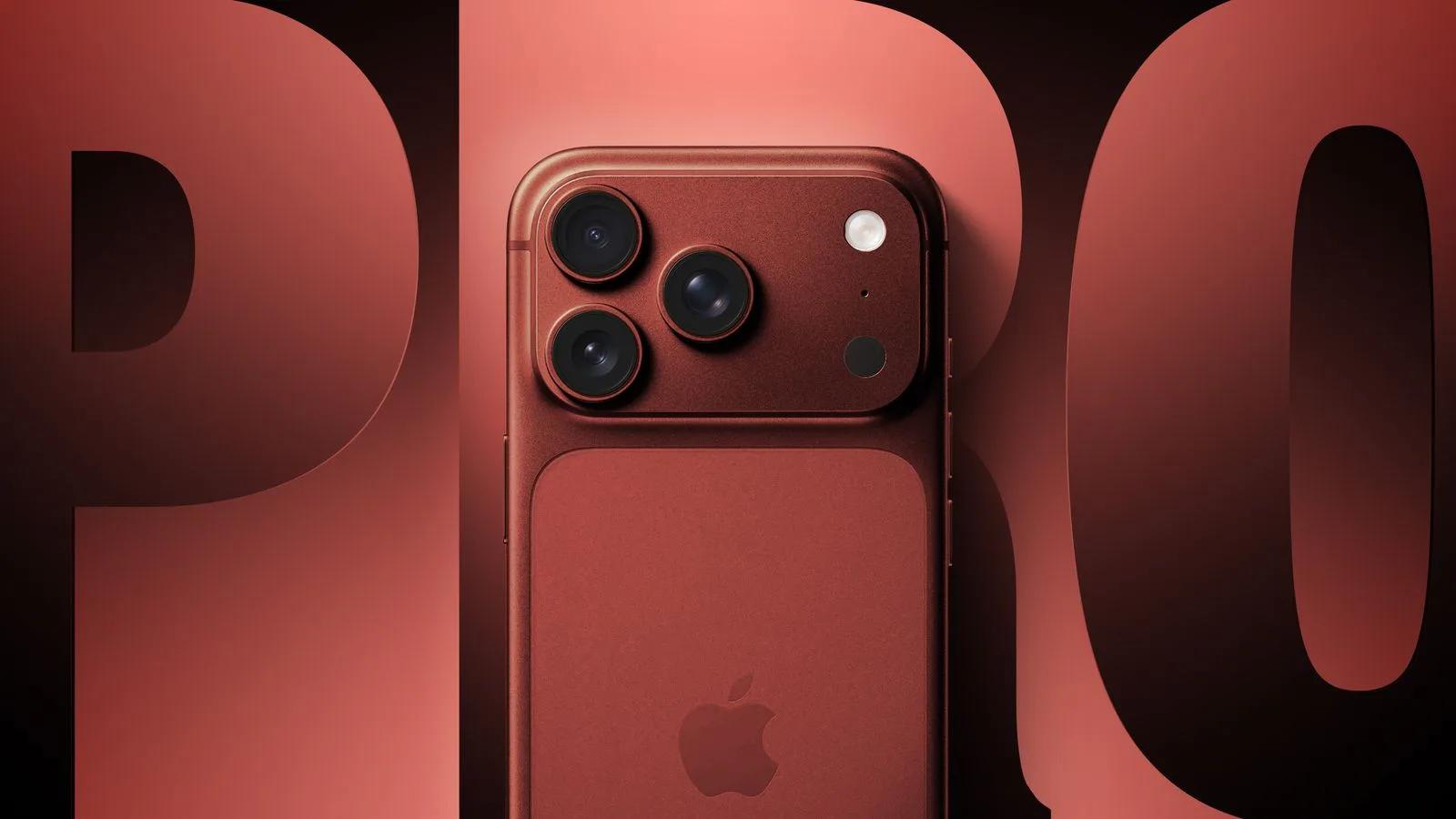
With a large number of leaked information, plus the massive leak from Tata Electronics, Apple's Indian factory, the iPhone 18 Pro series hardly has any secrets left. From the exposed real-device videos and images, the design of the back of the iPhone 18 Pro has not changed much: it still adopts an integrated triple-camera module with a glass + metal spliced design, only the color options are replaced with light blue, silver and deep cherry red.
(Image source: Macworld)
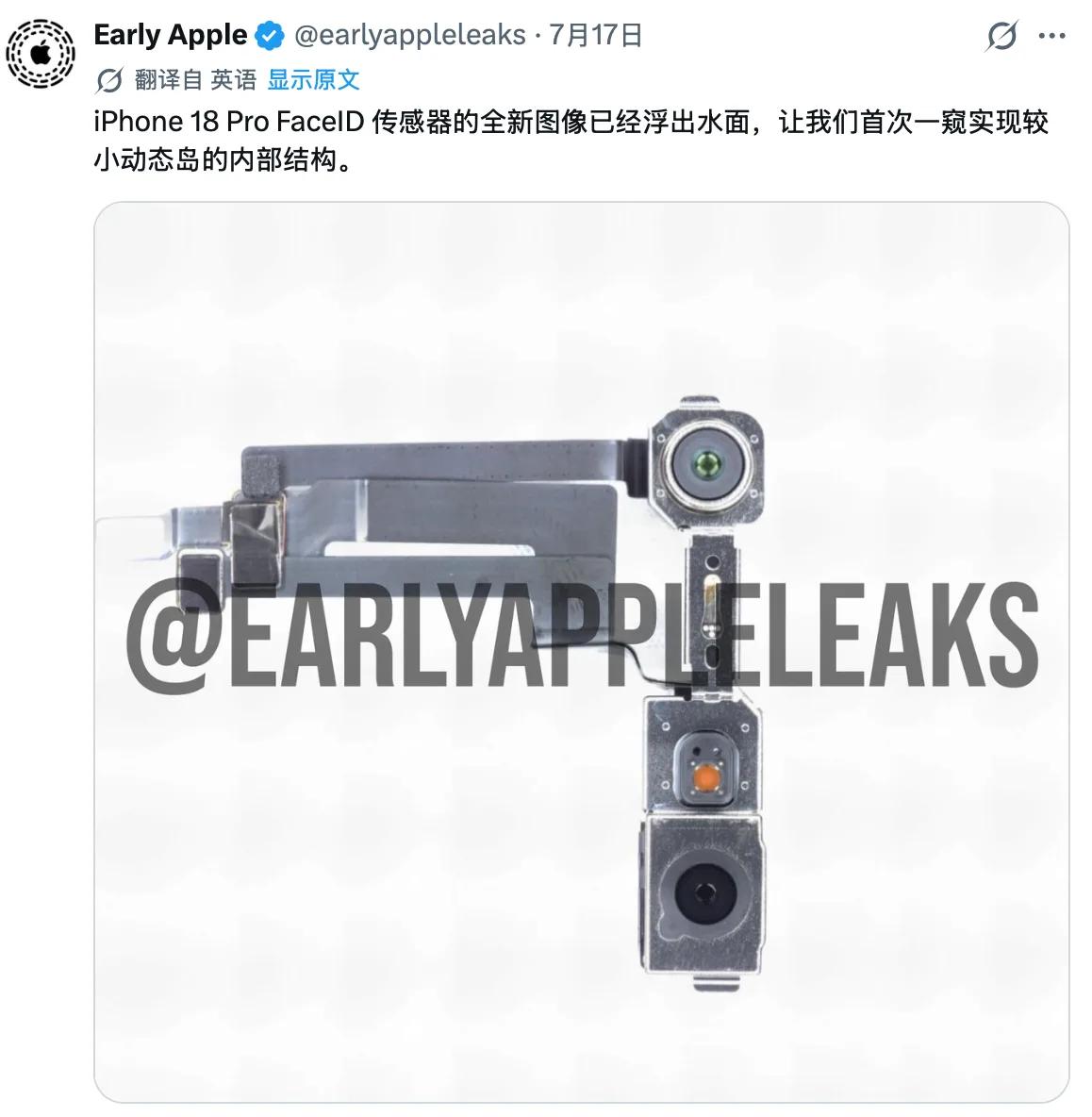
However, changes can be seen on its front: the area of the Dynamic Island has been reduced by 35%. This is achieved mainly by placing the flood illuminator component of Face ID under the screen, thus shrinking the size of the punch hole.
(Image source: X)
In terms of imaging, the main camera CMOS of the iPhone 18 Pro is upgraded to the new Sony IMX905. Its biggest change is the support for a variable aperture, which allows the phone to better adjust the physical light intake and depth of field to improve shooting performance. However, its telephoto and ultra-wide-angle cameras have barely changed, and the overall imaging upgrade is not significant.
In terms of performance, the 18 Pro will be equipped with the A20 Pro chip, built on TSMC's 2nm process, with an expected 15% performance improvement and 30% energy efficiency improvement. The A20 Pro integrates 12GB of RAM, which is considered sufficient for a Pro-model iPhone.
For the battery, the Chinese mainland version of the iPhone 18 Pro has a battery capacity of 4056mAh, while the 18 Pro Max reaches 5391mAh, which is still a noticeable gap compared to Android flagship models. It seems that Apple still has not introduced silicon-anode batteries in this generation of products.
The screen of the 18 Pro has also been upgraded. According to leaks, its panel suppliers are still Samsung and LG. This screen uses Samsung's M16 luminescent material, with a 12% higher luminous efficiency than the previous generation; its global and peak brightness remain unchanged, but its energy efficiency is improved, so the screen power consumption can be reduced by 15%-20% at the same brightness. For now, the iPhone 18 Pro does not downgrade the screen quality, but the screen luminescent material of the standard 18 model next year will be downgraded from M14 to M12, and the configuration difference between the standard version and the Pro version will be further widened.
Overall, the iPhone 18 Pro is a model that follows the routine of regular incremental upgrades. It does not have particularly outstanding product highlights, nor obvious shortcomings. However, as it has to undertake the main shipping task alone without the support of the standard model, its final performance may not be as good as the previous generation.
Smartwatch Communication Function Upgraded, Ceramic Version Returns
Apple's Apple Watch series has been iterated for many years. As the product is already very mature overall, and the scenarios that can be supported on the watch are limited, Apple's smartwatches in recent years have only made very gradual upgrades. This autumn, Apple will release two watches: Apple Watch Series 12 and Watch Ultra 4.
The Apple Watch Series 12 has almost no major updates, mainly a chip upgrade, which is estimated to adapt to the latest AI functions, plus an upgraded hypertension warning feature and extended battery life. There is also a leak saying that this product will have a ceramic version to enhance differentiated selling points, but the price is expected to be relatively high.
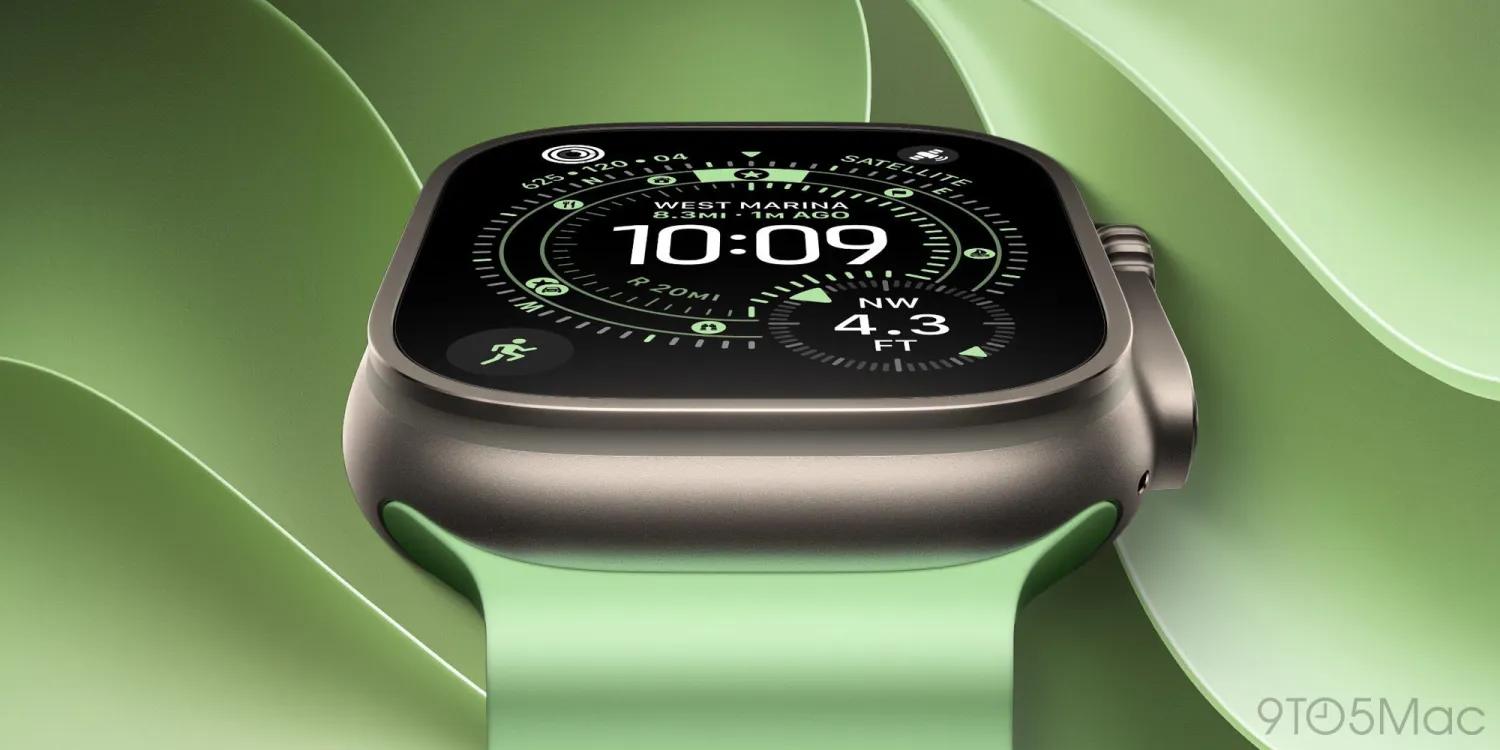
The Apple Watch Ultra 4 has more significant changes: its screen is upgraded to a 2.0-inch LTPO3 OLED display with a peak brightness of up to 3200 nits, and it also supports a minimum brightness of 1 nit. Its chip will also be upgraded to the S12 built on the 3nm process. The new titanium metal case makes the body 15% thinner. Thanks to the reduced power consumption of the chip and screen, the battery life under normal usage scenarios is expected to increase to 36-48 hours.
(Image source: 9To5Mac)
The communication function of this watch has also been upgraded: the cellular version supports 5G RedCap, which specifically enables low-power 5G communication. At the same time, its satellite function is enhanced to support two-way satellite messaging. However, this feature is still not expected to appear in the Chinese mainland version. In addition, its charging speed is also upgraded, which can reach 80% charge in half an hour.
At present, the higher-positioned and higher-priced Ultra series has basically monopolized some specific functions, while the upgrades of the regular digital Apple Watch series have become increasingly unremarkable.
Old Product Lines Revived and Updated, All for AI?
At this year's autumn launch event, Apple will also update a batch of long-neglected old product lines. Among them, the HomePod mini 2 will be released, six years after the launch of the first-generation HomePod mini. It is understood that the core upgrade of the HomePod mini 2 will be the chip, to adapt to the latest Siri AI functions. Barring any unexpected issues, the HomePod mini 2 powered by the new chip will have certain on-device AI computing power, to better integrate into the Apple Intelligence system and serve as the control hub of the entire Apple hardware ecosystem.
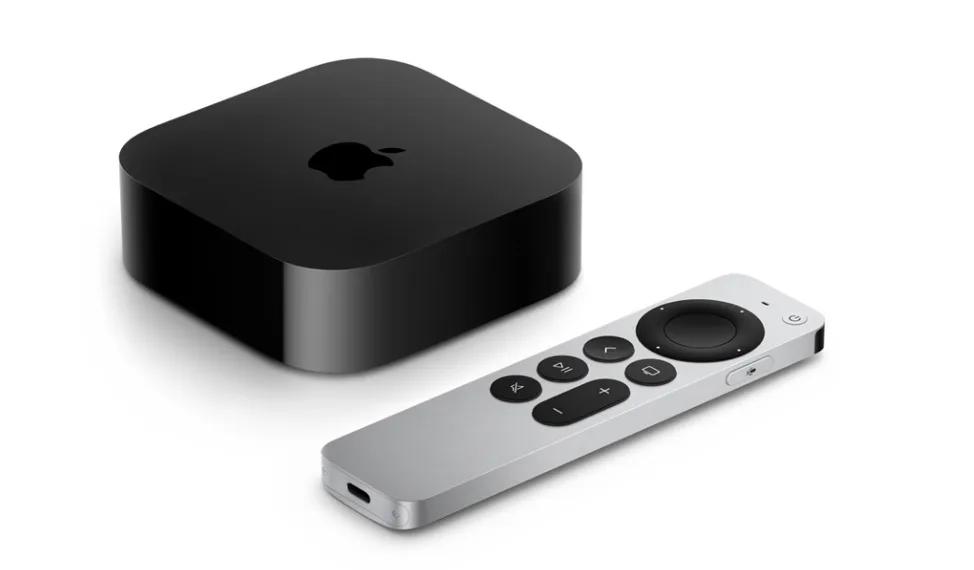
Similarly, Apple TV will also receive an update after nearly four years of no new releases. According to Gurman's leak, the Apple TV 4K (4th generation) will be released this autumn. The core upgrade of this TV box is still the chip, which will be updated from A15 to A17 Pro. This chip was previously used on the iPhone 15 Pro, and is the earliest Apple chip that supports Apple's AI functions. With its support, the new Apple TV will also support AI features. In addition, for users, the 8GB RAM integrated on the A17 Pro greatly helps improve the smoothness and playability of the TV box.
(Image source: Apple)
For now, the updates of the HomePod mini and Apple TV product lines are mostly aimed at adapting to Apple's newly built AI ecosystem, and there are not many functional highlights in other aspects besides the chip upgrade.
In addition, the previously exposed "HomePod with a screen" may also be released. Its form factor is more similar to an IoT central control screen. The latest leak says it will also support functions such as Face ID, positioned as the control hub of Apple's smart home system, playing a role similar to that of the HomePod, except that it adds the interactive capability of touch control.
Intense Competition in the September New Product Season, Apple Faces Considerable Pressure
Apple's autumn launch event is known as the "Spring Gala of the Tech Industry" and has attracted widespread attention. At the same time, September is also the peak season for other brands to release new products in clusters. Apart from facing competition from rivals, Apple is also facing new problems such as rising storage component prices this year.
As mentioned earlier, as Apple's first foldable device, Apple has high confidence in the market performance of the iPhone Ultra, with an initial stock of 10 million units. However, it also faces considerable competitive pressure. After years of development, foldable products have become mature. Samsung and Huawei have recently launched high-end large foldable new products that directly compete with the iPhone Ultra, and some other new products will be released in September, with more competitive price advantages.
As for the iPhone 18 Pro series, there is still the old problem: without the support of the standard model, and with unobvious product power upgrades, it is very difficult to maintain the same strong performance as the same period last year. The pressure of rising storage prices has been fully transmitted to Apple. Some time ago, supply chain sources said that ChangXin refused Apple's request for price cuts, making its memory price equal to that of Samsung and SK Hynix. The latest news shows that Apple has already tested ChangXin's memory on iPhone and MacBook. It seems that even when the new devices are about to be released, Apple still has strong anxiety about memory supply.
A few days ago, market research institution TrendForce stated that the rise in prices of components represented by storage has increased the overall cost of the iPhone 18 Pro by nearly 40%. According to TrendForce's forecast, in the third quarter of this year, the proportion of storage cost in the total hardware BOM cost of the iPhone 18 Pro has increased from 10% in the same period last year to 34%; while the cost proportion of the new chip using a more expensive manufacturing process has barely changed.
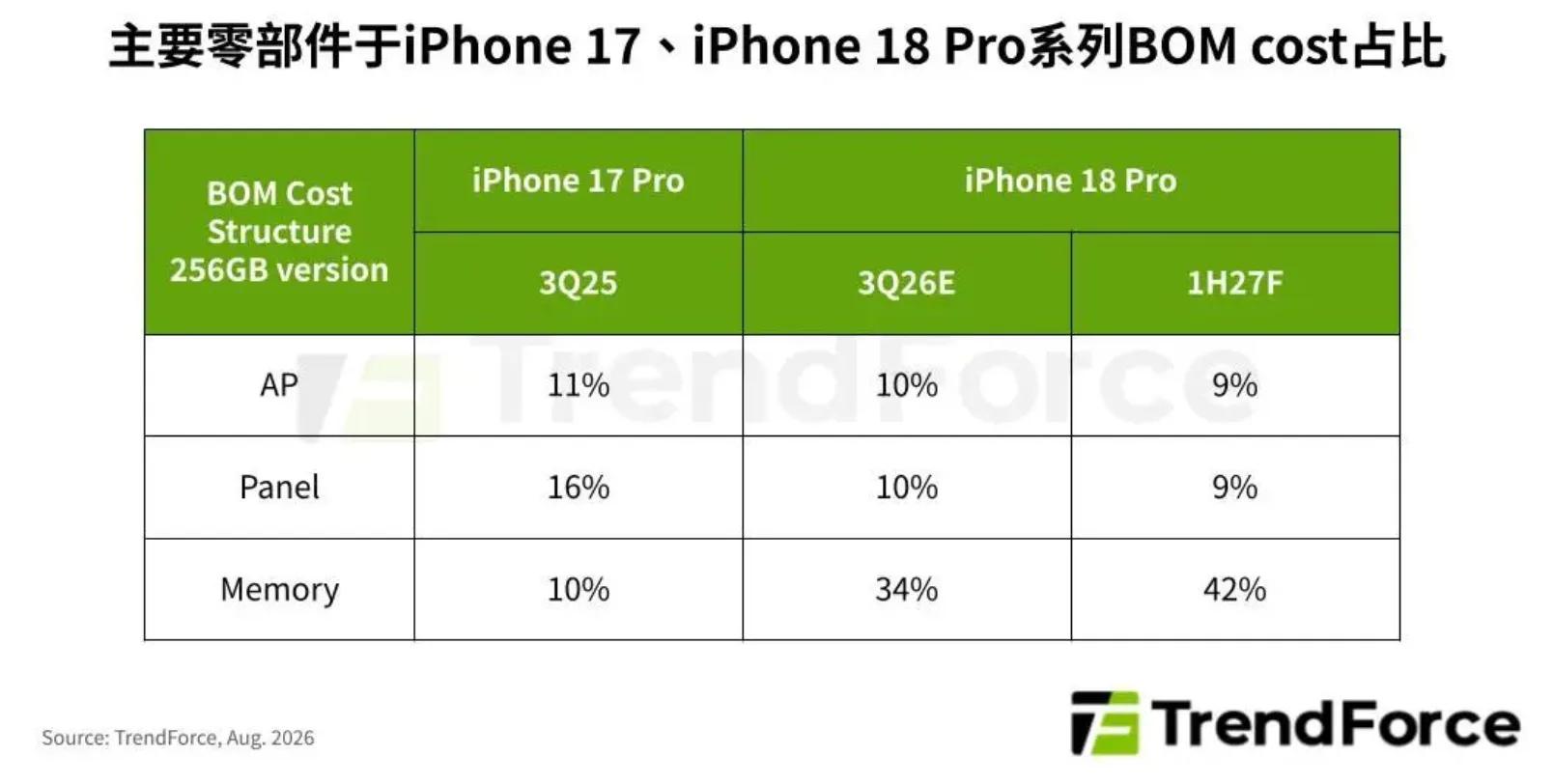
(Image source: TrendForce)
From this point of view, a price increase for the iPhone 18 Pro is almost inevitable. The currently exposed US version pricing of the iPhone 18 Pro is $1399, an increase of $300 over the iPhone 17 Pro. The previous starting price of the iPhone 17 Pro in the Chinese mainland was 8999 RMB, which is much higher than the US version. Considering the strong negative impact brought by price increases, Leikeji (ID: leitech) speculates that the starting price of the iPhone 18 Pro in the Chinese mainland will be set at 9999 RMB, a 1000 RMB increase.
In fact, the Android camp is also under great cost pressure at present. Previous leaks show that the price of the next-generation Android flagship chip has risen sharply. Combined with the rising prices of RAM and storage, the total cost of the three core components (chip, RAM, flash storage) has reached $600, equivalent to more than 4000 RMB. Nowadays, new Android flagship models are generally raising prices. If the iPhone 18 Pro only raises the price by 1000 RMB, it will be quite competitive.
To put it simply, the entire mobile phone industry is bearing the pressure of storage costs. Relatively speaking, Apple, which has larger cash flow and higher profit margins, faces less pressure than its Android rivals. Apple has no anxiety about losses, and only worries that the storage cost will eat into its profits.
New CEO Takes Office, Will Apple's Product Strategy Be Overhauled?
This year's autumn launch event will be the first event hosted by the new CEO after he takes office. However, considering that Tim Cook has just stepped down, the new products at this event are ultimately led by Cook. In other words, the specific performance of the new products at this launch event has little to do with Ternus. As he has a background in the hardware department, the outside world has high hopes for Apple's hardware innovation in the future.
Recent leaks from sources such as Gurman also seem to show that some of Apple's hardware will undergo major changes. Take Apple Watch as an example: Apple plans to enrich its product lines, including adding versions with larger screens, smaller screens, and even no screens. Ternus has also considered launching Apple smartwatches with round screens. The central control screen product mentioned earlier will also be a key product built by Ternus. In addition, there were previous leaks that Ternus will launch Apple's version of AI glasses.
Ternus joined Apple in 2001, worked in the hardware department for a long time, participated in the R&D of many Apple products, and was in charge of multiple product lines including iPad, Mac, AirPods, Watch, and iPhone. Now that Ternus is at the helm, he has stronger decision-making power over products, and theoretically can develop more new product lines.
Compared with Cook, Ternus has a more technical background, and is regarded as the key figure leading Apple's transition from a marketing-driven to a technology-driven company. However, during the more than ten years when Cook served as Apple's CEO, despite some controversies, his overall performance was extremely outstanding. What's more, although the iPhone has been repeatedly criticized for lacking innovation, Cook has brought many innovative products. Categories such as AirPods, Watch, and HomePod were all born during his tenure, and AirPods has even become a phenomenal product category that directly opened up a brand new niche market.
For Ternus, while it is important to bring more innovative hardware products, the top priority is probably to help Apple make breakthroughs in the AI field. It is an indisputable fact that Apple lags behind in AI. Adopting the Gemini solution can solve the urgent need, but it means giving up the dominant position at the technical level. Ternus and Apple are clearly aware of this, and are also accelerating the AI transformation process of other products.