The AI company that has raised another 100 million US dollars claims that AlphaFold is not the ceiling of the biological world.
Text by HU Xiangyun
Edited by HAI Ruojing
By August 2026, if a company only uses AI to "cut costs and boost efficiency", it will be difficult to capture the maximum dividends brought by AI.
This view, put forward by ZHAO Wei'an, founder of Aureka, is somewhat counterintuitive. After all, "cost reduction and efficiency improvement" has been the most familiar development path for AI pharmaceutical companies in the past few years. He admitted that at the current stage, AI is actually a "cost-increasing and efficiency-reducing" game: AI talents, computing power and experimental verification are very expensive; in traditional large pharmaceutical companies, granting higher decision-making authority to AI may also generate additional organizational friction.
However, AI capabilities have become sufficiently strong today, and the Scaling Law demonstrated by biological foundation models has allowed the industry to see the possibility of raising the upper limit of intelligence through scientific discovery. "The capability of AI in macromolecular design has improved tremendously, far beyond human imagination, but we have not yet unlocked the full potential of the models."
The development of foundation models and the reconstruction of R&D platforms may produce differentiated molecules in batches in the future. If the value of these assets can cover the early investment, it means that the new round of AI4S (AI for Science) game rules will be rewritten.
In 2026, capital is pouring into AI4S again. In this new wave, Aureka is a "young player" favored by capital.
Waves has exclusively learned that Aureka has recently closed a Series B financing with a total amount of 100 million US dollars. The first tranche was exclusively invested by Granite Asia (formerly the GGV Capital Asia business), the subsequent tranches were led by well-known industrial investors, followed by HLC Fund, with additional investment from existing shareholders including Qiming Venture Partners, Matrix Partners China and New Alliance Capital. It has only been more than 3 months since the company announced its $35 million Series A+ financing.
ZHAO Wei'an once completed his postdoctoral research at Harvard Medical School, then joined the University of California, Irvine as a tenured full professor, and he is also a serial entrepreneur.
After founding Aureka in 2023, ZHAO Wei'an and his co-founder in charge of AI built a generative AI platform and a high-throughput digital biology platform, forming a closed loop connecting AI design and wet experimental verification. According to introductions, this system has generated tens of millions of dollars in revenue, and has also precipitated a number of candidate drug pipelines.
But he is not satisfied with defining the company as an "AI biotech".
At the end of last year, Aureka invested in kilocalorie-scale computing power to develop the biological foundation model AuraIDE. In July this year, it open-sourced the OpenDDE biological structure modeling capability. ZHAO Wei'an calls this open source move an "identity verification", aiming to enter the global competition arena of biological foundation models.
How will this 100 million US dollars be spent? Can AI evolve from an auxiliary tool to a key decision-maker in R&D? How to identify truly AI-native new drug companies?
Taking advantage of this financing, we talked with ZHAO Wei'an about the new values and old stories he observed. The following is the edited conversation:
AI4S will first deliver results in the new drug track
Waves: Over the past 6 or 7 years, AI pharmaceuticals and AI new materials have experienced at least two boom cycles, with hot money coming and going. This year, AI4S has become a small hotspot in China's primary market investment. What is the reason for the renewed warming of this track?
ZHAO Wei'an: The core reason is the breakthrough of AI capabilities, there are no other factors.
On the technical side, whether in the United States or China, AI large models are the core investment main line of the market. However, the threshold for investing in general large models is getting higher and higher, and investment institutions are bound to lay out other opportunities in the AI industrial chain. AI4S is a high-quality application scenario that can be implemented, and breakthroughs in science itself will also push up the intelligence upper limit of AI foundation models. These two reasons make AI4S the best investment direction at the moment.
Pharmaceutical R&D is a special application in AI4S. The pipeline transactions between multinational pharmaceutical companies and biotechs, as well as the asset listing model are very mature, which can be priced according to "R&D milestones" without waiting for an overly long cycle. In 2025, the wave of BD licensing transactions for innovative drug pipelines allowed investment institutions to see the opportunity to form a commercial closed loop and achieve capital exit in the AI pharmaceutical sector.
Waves: The breakthrough of AI technology makes large pharmaceutical companies more willing to cooperate with AI-native companies?
ZHAO Wei'an: Since the end of 2025, the global pharmaceutical industry's perception of AI technology has undergone great changes.
Previously, we felt that pharmaceutical companies were very cautious about in-depth cooperation with AI companies, but over the past year, the industry has increasingly recognized the Scaling Law demonstrated by biological foundation models: the stronger the model capability, the better the performance in structural prediction accuracy and the differentiation of generated candidate molecules. Companies including Isomorphic Labs and Chai Discovery have continuously reached cooperation with multinational pharmaceutical companies, which also proves this point.
Waves: Large pharmaceutical companies were very cautious when applying AI in the past, what are their main concerns?
ZHAO Wei'an: In our observation, large pharmaceutical companies have always had strong anxiety about AI implementation, and they want to know how to use AI to change the industry. However, they do not want this change to cost too much effort. If AI implementation will affect the organizational structure of the enterprise and change the existing R&D process, there will be great resistance.
In previous years, some large pharmaceutical companies did not have good AI application experience, because they viewed AI with the mentality of "reducing costs and increasing efficiency". In fact, the R&D cost control of domestic pharmaceutical companies has already reached a very high level.
For example, the minimum cost of a certain link is 2 million US dollars, and the large pharmaceutical company has already controlled it at 2.2 million US dollars, so the "redundancy" of the whole process is only 200,000 US dollars. If what the AI company does for the pharmaceutical company is only to compress the 200,000 dollars to 100,000 dollars, its value to the pharmaceutical company is very limited. In the current context where AI talents and computing power are very expensive, it also cannot meet the revenue expectation of AI companies.
Essentially, AI is not a game of "reducing costs and increasing efficiency". In the short term, it will even "increase costs and reduce efficiency". The key lies in whether AI can continuously produce high-value assets that are difficult to generate through the traditional R&D system, and use long-term returns to cover the incremental costs in the early stage. That is the core of the game.
Waves: The short-term "cost-increasing and efficiency-reducing" situation will stop many companies from engaging in AI. What do the new game rules mean?
ZHAO Wei'an: It means that we need production relations that are more in line with the requirements of AI productivity. New organizational operation methods, new business models based on model licensing and joint product development, and so on.
Waves: How to judge the AI-native degree of a company?
ZHAO Wei'an: At least in the early R&D stage, we can look at "the weight of AI in key decision-making".
The small-molecule drug R&D chain is long, involving the collaboration of AI teams, medicinal chemists and biologists. The molecules designed by AI need to be synthesized by medicinal chemists before entering the verification process, with many intermediate links. The coordination cost of the three parties is high, and it is difficult for the AI team to dominate decision-making.
Macromolecules such as antibodies are relatively easier to handle, as there is no chemical synthesis link, and the core chain can be simplified into two parts: AI molecular design and wet experimental verification. AI can more easily form a closed loop with wet experiments, and it is also more suitable to build an AI-led R&D architecture.
A straightforward observation indicator is patent authorship. In traditional pharmaceutical companies, the top authors of drug patents are from biology and chemistry teams; but for AI companies like us, AI algorithm engineers are directly listed as the first and second inventors in core drug patents.
Taking AI design as the starting point and matching it with an appropriate wet experiment system and R&D architecture is very important. If we do not form the production relations corresponding to AI, and still only focus on "reducing costs and increasing efficiency" for traditional R&D, the industry may fall back to a downturn in the future.
Open source foundation model: get a seat at the table
Waves: Aureka was founded in 2023, and the antibody molecules developed by its AI have been licensed to generate tens of millions of dollars in revenue. You have already got your AI pharmaceutical platform running smoothly, why did you invest in kilocalorie-scale computing power at the end of last year to develop a biological foundation model?
ZHAO Wei'an: After the closed loop of the generative model and the high-throughput digital biology platform was put into operation, we began to ask: what is the ceiling of this R&D process closed loop?
If we compare this to car manufacturing, our previous work was like building an automobile production line, and now we are trying to draw a better car design blueprint.
In the past two years, we have connected AI design with wet experimental verification, forming a closed loop covering target analysis, molecular design and multiple rounds of experimental verification. This system has precipitated a number of drug assets; the antibody drug development cooperation reached with European and American pharmaceutical companies has also generated tens of millions of dollars in revenue, proving that this "production line" can operate smoothly.
But what the production line can manufacture depends on the "design blueprint" provided by the model. Since biological foundation models also follow the Scaling Law, continuously improving model capabilities will raise the upper limit of the entire R&D system. Based on this logic, we invested in kilocalorie cluster resources, independently developed the biological foundation model AuraIDE based on proprietary protein co-evolution data, and released the open source version OpenDDE in July.
Waves: Commercial companies usually tend to keep their models closed source, why did you choose to open source OpenDDE?
ZHAO Wei'an: In the AI4S field, if you release a reproducible model that can withstand public evaluation, the industry trust and influence you build will be completely different.
For Aureka, open source is also an identity verification. In the past, the outside world tended to regard us as an AI biotech company, because we took drug R&D and pipeline licensing as our core business model.
But now we want to send a signal to the industry: Aureka is seriously developing foundation models, and is ready to take a seat at the global competition table of biological foundation models.
Therefore, we open sourced OpenDDE which is trained based on open source data. Its training data set and data division rules are consistent with those of biological computing models such as AlphaFold3 and Boltz, and we achieved performance improvement through innovative algorithm architecture and computing power scheduling. For example, in terms of antigen and antibody structure prediction, the overall prediction accuracy of OpenDDE is about 1.5 times higher than that of AlphaFold3.
The open sourced OpenDDE only covers biological structure modeling, which is a single link in the complete drug R&D chain. Even if the full content is open sourced, it will not impact the company's core competitiveness. From the demand side, the supply of biological foundation models in the current open source community is scarce. Since the release of AlphaFold3 in 2024, there have been only 1 or 2 open source models worldwide that have achieved significant performance improvement. So it does no harm to open source it and share part of our capabilities with the community.
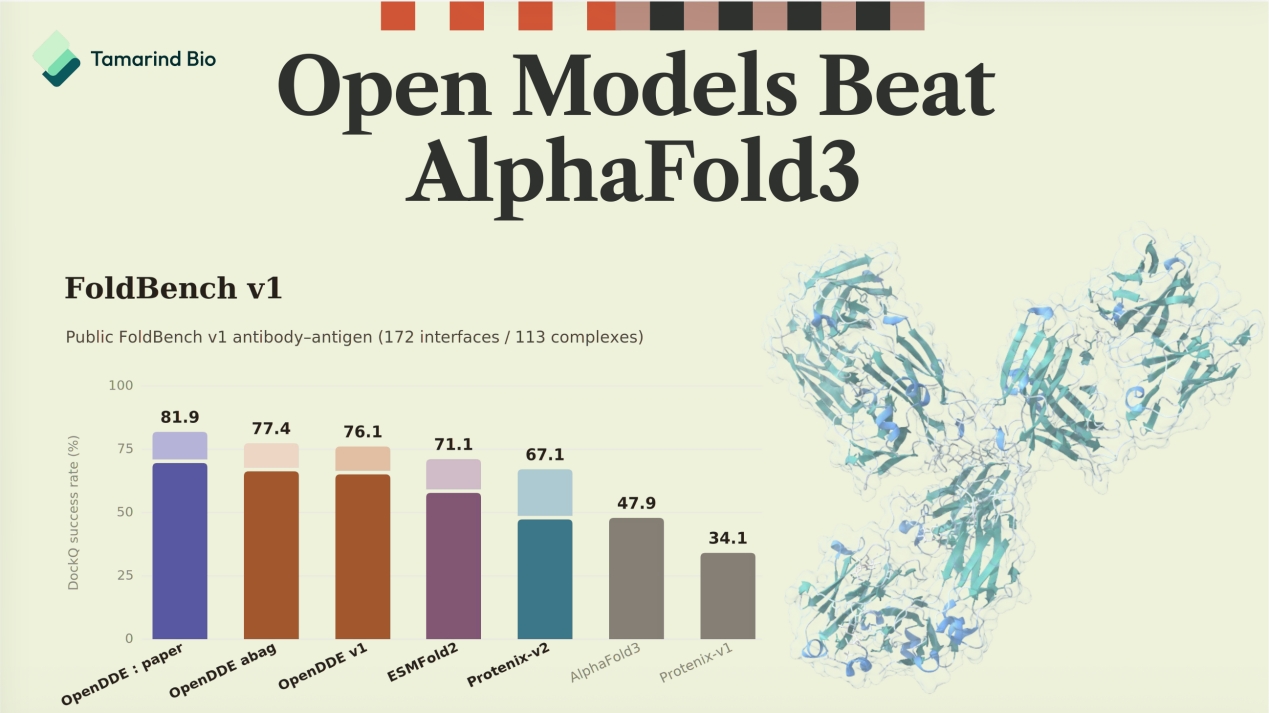
Third-party evaluation performance of OpenDDE on the public antibody-antigen structure prediction benchmark FoldBench v1 (Source: Tamarind Bio)
Waves: Are there any specific target discovery or antibody drug R&D cases that can prove the better performance of OpenDDE?
ZHAO Wei'an: Take an autoimmune disease target as an example, it is characterized by shallowly buried antigen epitopes, so it is very difficult to screen high-activity binding antibodies through traditional animal immunization and library screening.
From 2023 to 2024, when we used the AF open source model and our internal model to design drugs for this target, we usually only got 5 or 6 active sequences out of 50 designed sequences. After integrating OpenDDE into our design process this year, more than 30 out of 50 designed sequences showed high biological activity, and the hit rate increased to 60%.
This shows us that after the model performance is improved, the probability of generating high-quality candidate molecules is also greatly increased. Similar results have appeared on multiple targets, making it more feasible for AI to tackle traditionally undruggable targets.
Waves: Although the model is open sourced, the technical report shows that the computing power consumption is very large. Can ordinary pharmaceutical companies and scientific research institutions afford to use it?
ZHAO Wei'an: We have a dedicated team responsible for developing lightweight inference branches, and plan to officially release the lightweight version within the next six months. At the same time, we are also jointly developing a special acceleration scheme for molecular inference with NVIDIA. The model will be deployed to a dedicated computing power acceleration cluster, providing pharmaceutical companies and scientific research institutions with inference services with lower access thresholds.
Differentiated molecules become the core of competition
Waves: After OpenDDE was open sourced, what is the actual feedback from large pharmaceutical companies?
ZHAO Wei'an: Many third-party institutions have reproduced the capabilities of OpenDDE, and many senior scientists and VP-level management of large pharmaceutical companies have taken the initiative to contact us, expressing their interest in this model.
The open source of OpenDDE also has a positive effect on our future business expansion. Recently, we have set up a full-time BD team, hoping to translate the market's attention to OpenDDE into practical cooperation based on the closed loop of models, data and wet experiments.
Waves: Can you talk more about how these cooperations are carried out?
ZHAO Wei'an: Nowadays, the cooperation between large pharmaceutical companies and AI4S enterprises is integrating two modes: new drug pipeline BD licensing, and AI model & application sales.
At the current stage, large pharmaceutical companies are locking in pipelines at an increasingly early stage. For targets with high verification potential and stable transformation success rate, they are willing to get involved at a much earlier time.
Pharmaceutical companies will provide several targets that cannot be achieved through traditional animal immunization and library screening methods, and require AI companies to design candidate drug molecules that meet the requirements under specified conditions and within a specified time. The preliminary verification after the molecules are delivered can be completed by the AI company in its own dry-wet closed-loop laboratory, or independently evaluated by the pharmaceutical company/CRO.
This model has a low entry threshold. Pharmaceutical companies can use a specific project to quickly and lightly verify the capabilities of AI companies, and even compare two or three companies at the same time. If the candidate molecules meet the requirements, the two parties will promote subsequent development through pipeline licensing, joint R&D and other methods. AI companies can also break away from the limitation of traditional software charging, and share the long-term high value of drug assets.
Waves: In this new trend, what is Aureka's advantage?
ZHAO Wei'an: Our core advantage is the continuous and large-scale output of novel and differentiated molecules.
For a long time, the industry has no shortage of methods to accelerate or produce antibody molecules in batches. What is truly scarce is the differentiated customized design that centers on clinical needs.
Take our self-developed bispecific antibody pipeline as an example. This drug is used for cardiovascular and metabolic diseases. Although there are similar products on the market, due to the large dosage, they can only be administered by intravenous injection, leading to poor patient compliance. With the assistance of the AI model, the high-activity molecules we designed in a targeted manner only need 1/6 of the dosage of similar products, and it is expected to achieve subcutaneous injection in the future, improving the medical convenience and acceptance of patients.
At present, we have produced more than ten candidate pipelines in three major