AI has started helping people write WeChat Moments posts, but I miss the "old-fashioned handcrafted" style of text far more.
Just recently, WeChat Moments began gray-scale testing of the "AI Writing Assistant" feature.
This is a very natural move for WeChat — given that text is a medium with a higher access threshold, WeChat has long placed the "pure-text Moments" entry in a hidden position; now that AI helps most users solve the problem of "failing to express their true intent", this follows a perfectly logical trajectory.
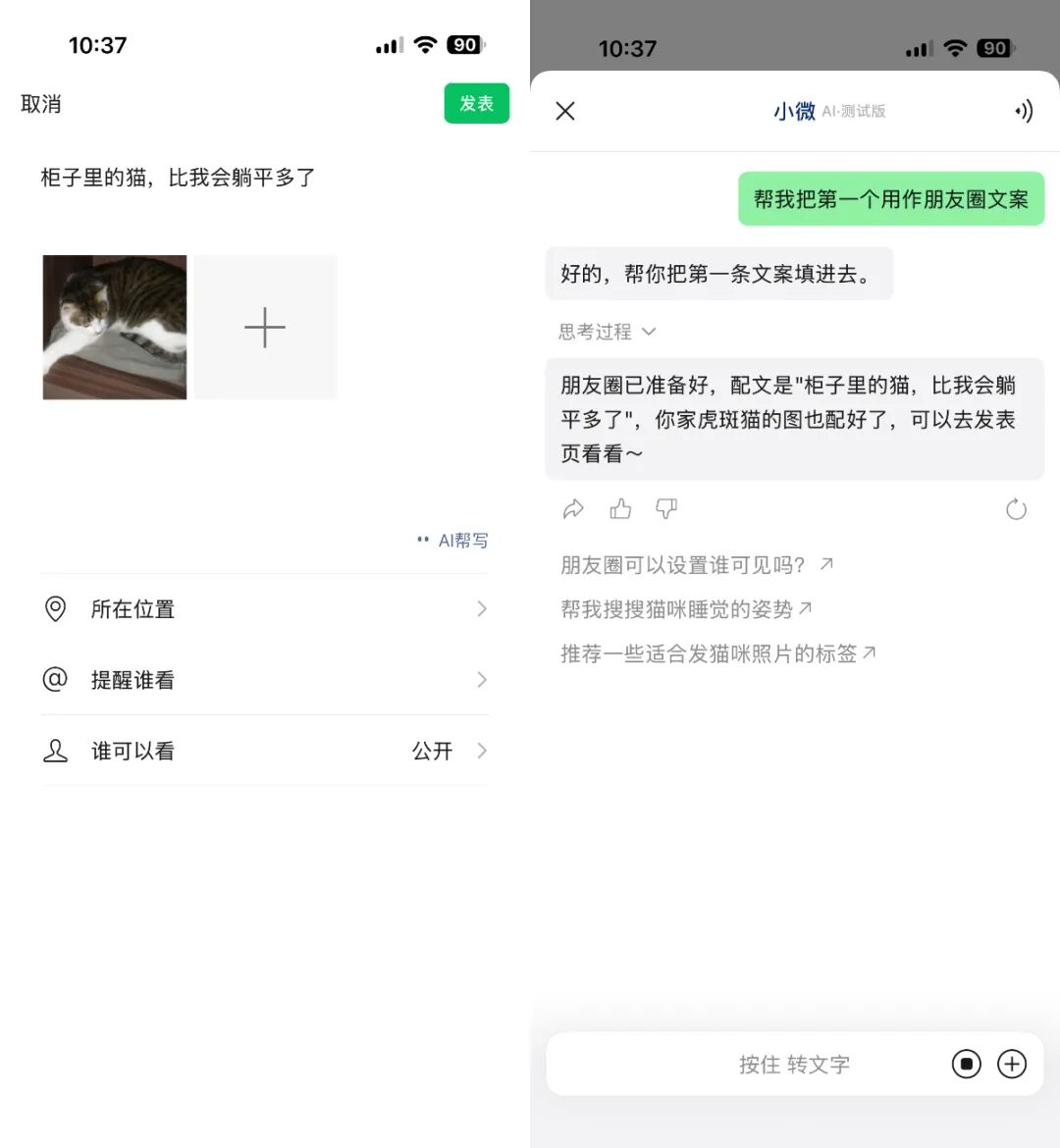
But as one of the few communities full of "real human vibe" that we have, if even Moments gets overrun by AI-generated content, what will become of the online "friendship" relationships WeChat has built?
In this regard, LinkedIn, the world's largest professional community, serves as a cautionary example.
At the end of last month, as AI-written copy flooded the platform and drove away real users, LinkedIn began testing the "Seems like AI slop" report button, allowing users to flag and hide suspected AI-generated "junk text".
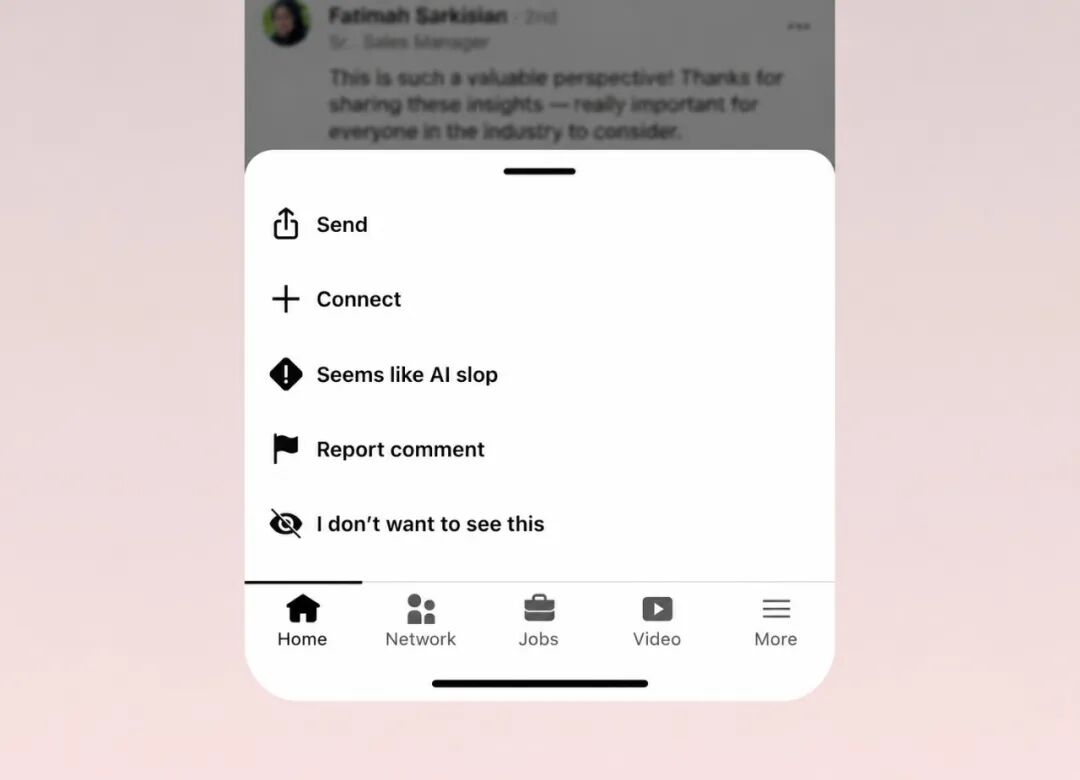
At the same time, LinkedIn also removed the "Rewrite with AI" feature that helped users rephrase their posts before publishing, and now only provides basic text proofreading functions.
After three years of enthusiastically embracing AI, this platform with more than 1.3 billion registered users is now officially "declaring war" on low-quality AI-generated content.
Why does LinkedIn start to hate the "AI-style flavor"?
While LinkedIn's Chief Product Officer Hari Srinivasan noted in the announcement explaining this feature adjustment that "people come to LinkedIn... to share real perspectives, ideas and professional knowledge", in all fairness, this "Trojan horse" was invited into the house by LinkedIn itself from the very beginning.
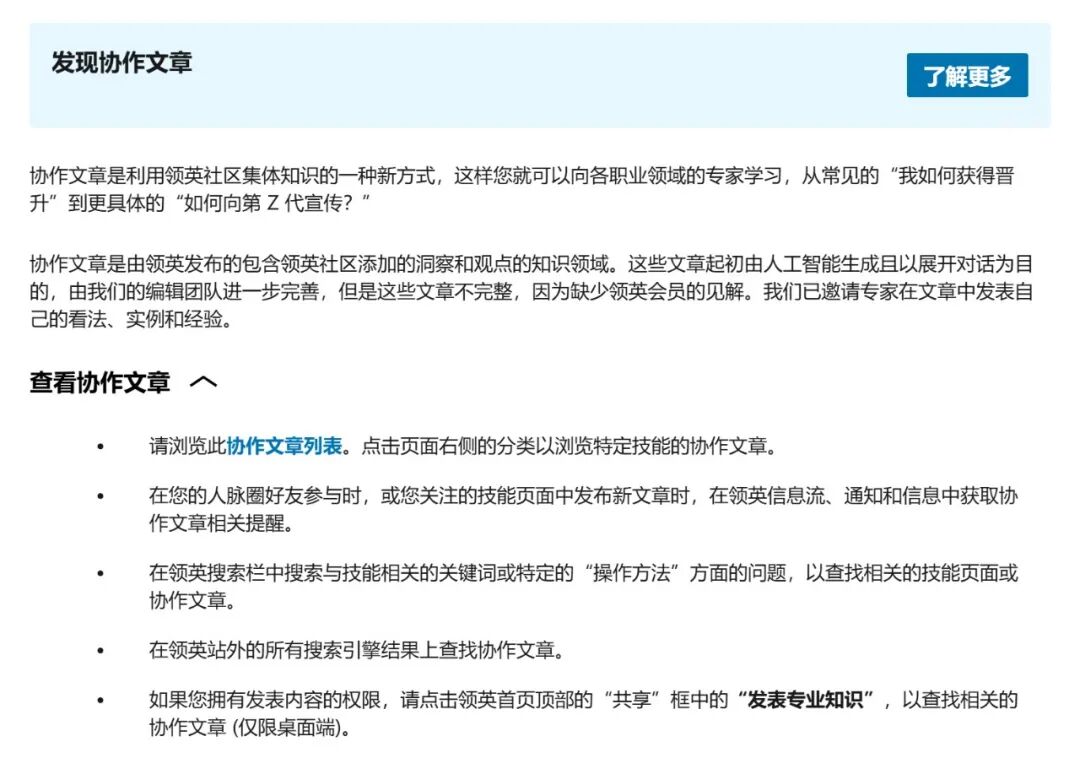
LinkedIn has always been a pioneer in integrating generative AI into products. Just a few months after ChatGPT was released, LinkedIn launched "Collaborative Articles", inviting community users to add their own perspectives under the topic framework generated by AI, and active participants could even get a "Community Star" badge.
In the next two years, features including AI-generated job descriptions, AI-written resumes, and AI-generated posts were launched one after another, and paid users could unlock more powerful AI writing capabilities through Microsoft Copilot.
Until AI finally ran rampant, leaving all users equally dissatisfied.
In early July, AI detection firm Pangram released a research report. Using browser plugins installed with user authorization, the team analyzed about one million posts across five platforms: LinkedIn, X, Medium, Reddit and Substack, and found that LinkedIn had the strongest "AI flavor" among them — 41% of long-form articles and 30% of short content were completely generated by AI, contributing two-thirds of the total amount of all AI posts on the five platforms by itself.
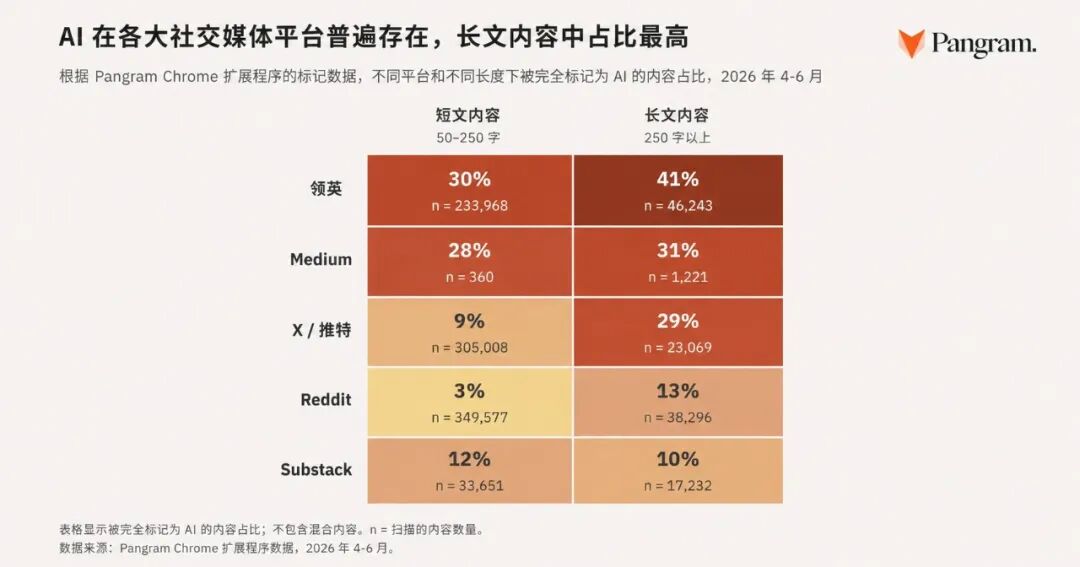
What's even more weird is that only 4.3% of long-form posts on LinkedIn are classified as "written with AI assistance". The rest of the content is either fully manually typed or completely generated by AI, with almost no intermediate state.
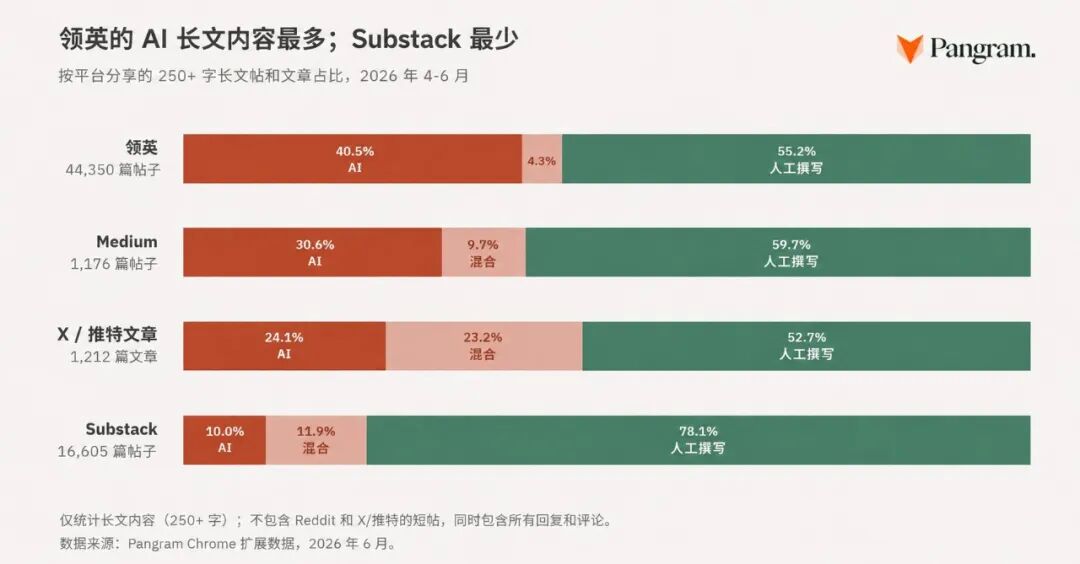
This "duality" is closely related to LinkedIn's product design logic. If the platform seems to distrust people's professional expression ability and chooses to provide a one-click full rewrite button instead of partial polishing, it is essentially encouraging the rampant spread of fully AI-generated content.
In a sense, LinkedIn now is a bit like the "AI Agent social platform" Moltbook that became popular earlier this year: AI creates posts, AI replies to posts, AI likes posts from other AIs, entering a strange state that does not require human participation at all.
If this trend continues, the first to be damaged will inevitably be LinkedIn's own commercial value. That's why as early as May, Laura Lorenzetti, head of LinkedIn's global editorial team, posted an announcement stating that the platform would "step on the brakes" for AI-generated content, and apply algorithmic demotion to content that "lacks real perspectives".
While adding the report button recently, LinkedIn executives also spoke out again, stating that "reducing AI slop has become one of the platform's top priorities".
But LinkedIn itself has been teaching us to speak "AI language" all the time
LinkedIn's announcement of its crackdown on AI-generated content sounds very resolute, but the announcement itself did not escape Pangram's analysis —
Guess what? The announcement was also judged to be written by AI.
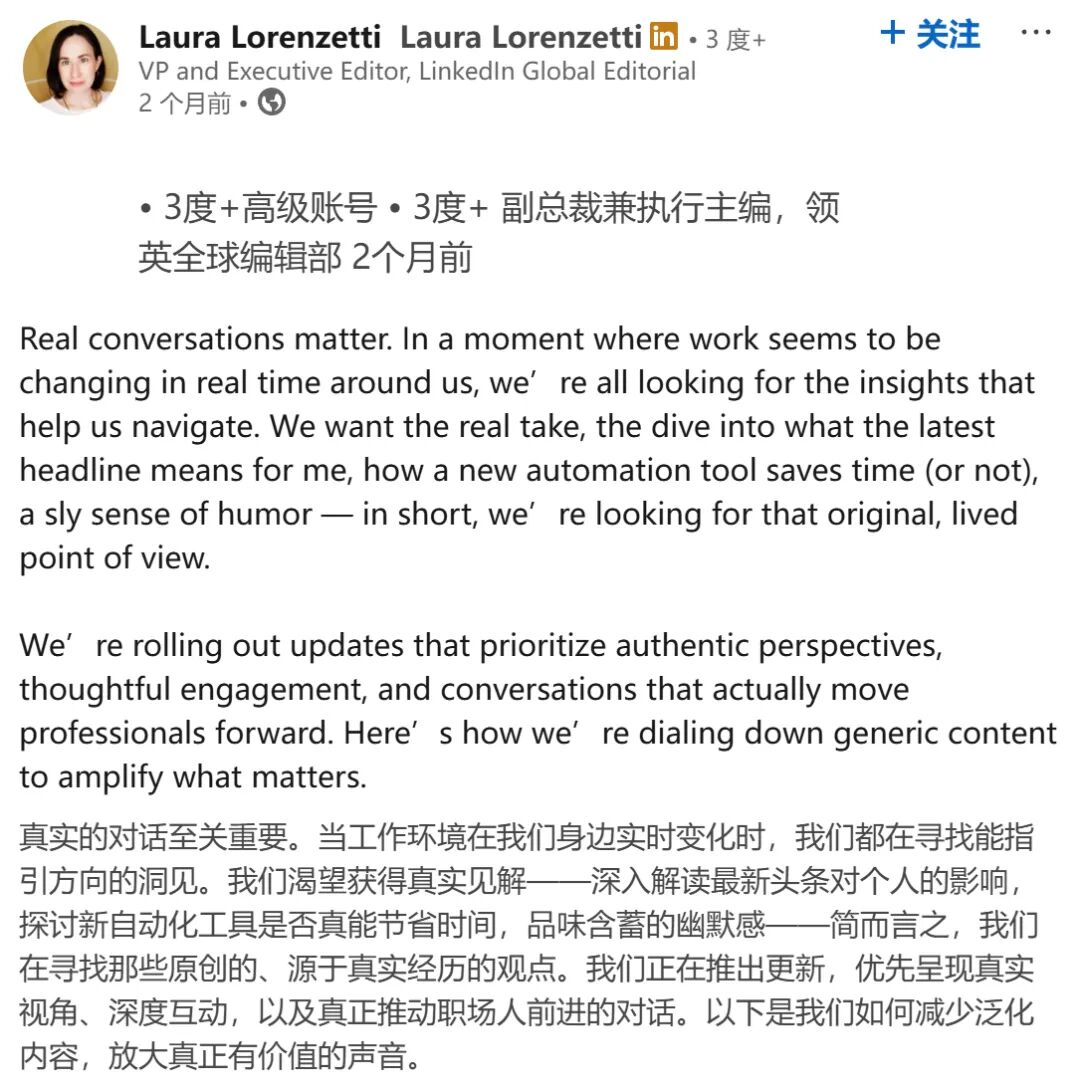
It is not unreasonable that the announcement was written in AI style. In a highly professional community, the most "safe" way of expression is naturally templated phrases, which happens to be exactly what AI is best at.
Rather than saying that AI has polluted the text on LinkedIn, it is more accurate to say that "technological inclusivity" allows everyone to speak a fluent "LinkedIn tone".
For more than ten years, LinkedIn has been training a specific way of expression. You have to treat every experience as a gain, a gap year is not for resting but for "recharging", and your onboarding or departure speech must be as flawless as public relations copy.
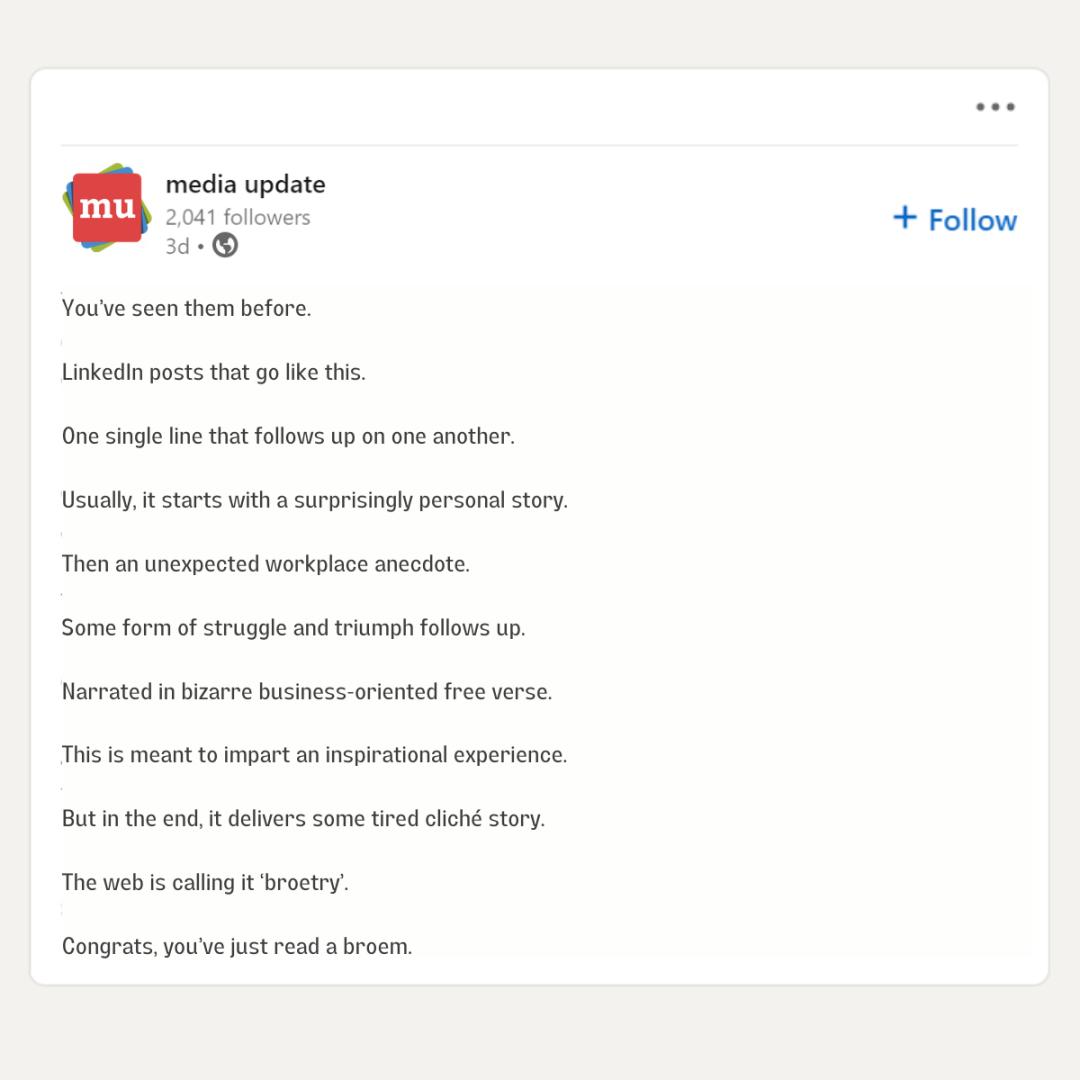
Around 2019, a writing style called Broetry even became the mainstream trend on LinkedIn: every sentence takes up its own line like a poem, starts with a counter-intuitive hook, ends with a chicken-soup-style uplifting conclusion, and tucks personal experiences and life insights in between, which is almost a "workplace eight-part essay".
This is not just a problem for LinkedIn.
Every platform and every type of content medium seems to contain a set of implicit expression norms.
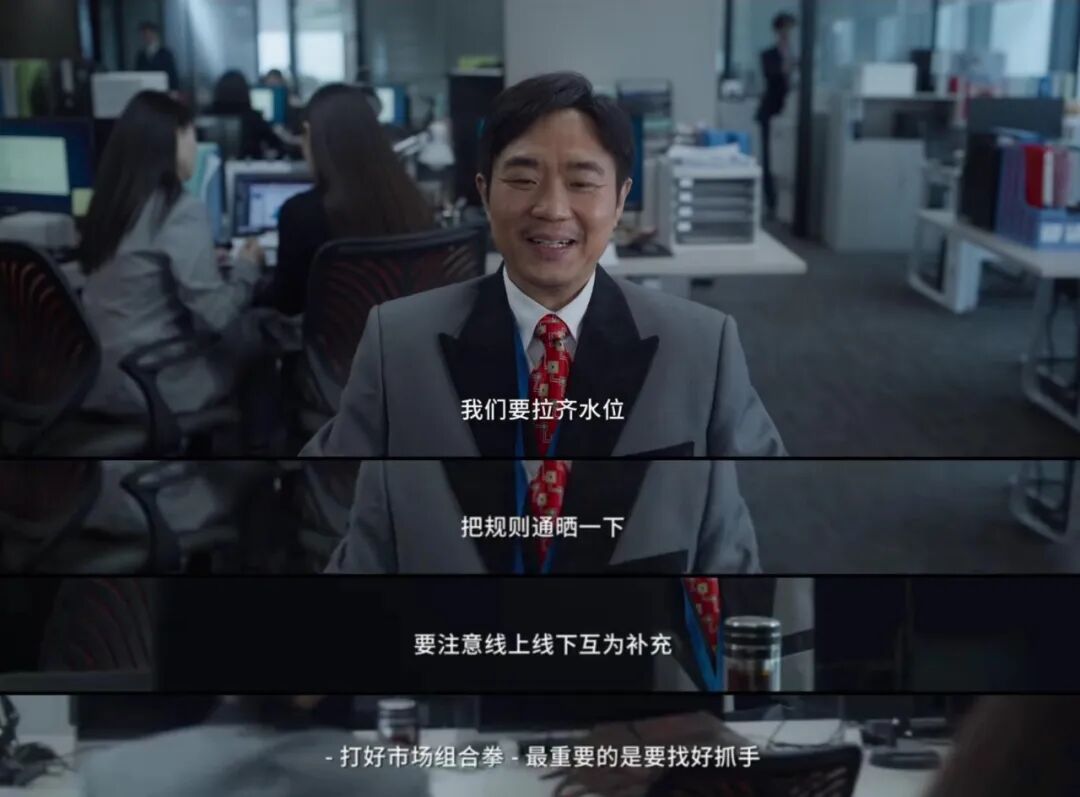
To run a podcast, you have to learn to "frame trivial daily events with grand values", wrapping small life stories with various social science terms; to be a travel blogger, you either speak with full enthusiasm, or adopt the laid-back old-money tone to introduce the stories behind each attraction; the internet corporate jargon mocked in the movie *Never Say No to Party* is also the safest way of expression in specific work environments.
Few people really like these rigid phrases, but everyone believes that "other people" like them. This is what social psychology calls "pluralistic ignorance": everyone is catering to a false consensus.
In an environment where everyone believes "others like to see this kind of content", generating "polished but meaningless" content with AI is the optimal choice for individuals. Over time, this specific way of expression becomes a fixed norm.
The participation of algorithms sometimes further reinforces this inertia.
Take Broetry as an example: the line-by-line paragraphing naturally encourages readers to click "expand" to view the full post, and the algorithm may interpret this action as "this content is very attractive", so it recommends and distributes more similar content, prompting others to copy the same writing style.
Even though LinkedIn's official insists that "the community pursues valuable content", few people probably enjoyed browsing LinkedIn even before the AI era.
Because whether it is the community rules or the algorithm, the first thing they reward is content that *looks* valuable, not content that *is* truly valuable.
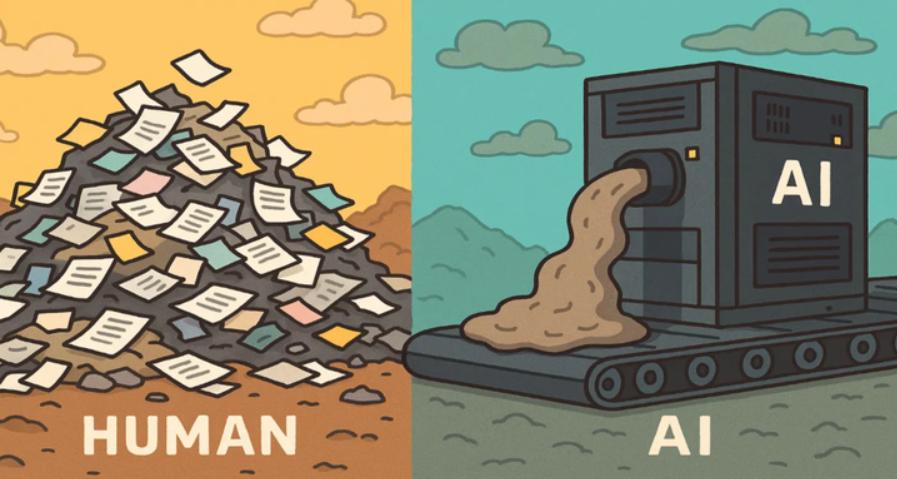
From this perspective, there has always been a gap on LinkedIn between "what we want to see" and "what we actually get", but everyone tacitly chose to keep performing, until AI amplified this problem to a point no one could ignore.
Interestingly, once you step out of this performance-focused scenario, most people will never actively use AI to write for them.
We can be confident that even after the "AI Writing Assistant for Moments" feature is launched, the vast majority of Moments posts will still be handwritten by users themselves —
As the last bastion of "real human vibe" on the internet, when we write Moments posts, what we really want to do is express our true selves. Even if we fail to put our thoughts into perfect words, those are our own imperfect words. Conversely, we also expect to see text typed manually by other people here.
What exactly do we want to see?
The proliferation of AI content is only a surface symptom of a deeper underlying problem.
In the past, the difficulty of writing was "having something to say but being unable to put it into words". We might already have general opinions and rich knowledge in our minds, but our expression ability couldn't keep up, which is why there are so many writing courses, copy templates and expression frameworks on the market. Their purpose is to help us better convey the ideas in our heads.
LinkedIn's algorithm thinks the same way. It always rewards content with clear structure, professional wording and sufficient length, because these formal features usually mean that the author has invested time and thought, and such content is more likely to contain good perspectives and ideas.
But as AI has driven the cost of producing polished long-form content down to nearly zero, the connection between formal features and actual content quality has been completely broken. In the past, when you read a well-worded long post, you could reasonably guess that the author probably had real expertise; now, anyone can get AI to output a seemingly polished "in-depth long article" in just ten minutes.

Perfectly packaged but completely hollow inside — that is the best metaphor for AI writing.
Length, structure, professional terminology, these once-reliable proxy indicators have all failed completely, making it much harder to find truly valuable content.
It is fair to say that the gap between expectation and reality is the root cause of widespread resentment towards AI content.
After all, AI content itself is never the problem.
Many people chat and even have emotional conversations with ChatGPT or DeepSeek every day, but few complain about the "AI flavor" in their replies, because we already have corresponding expectations for them; but when you are casually scrolling through the feed, click on a post that looks full of valuable insights, only to see insincere AI-generated text, the gap between expectation and reality will instantly turn into anger.
For individuals, using AI is certainly a rational choice: it saves time and increases the chance that your content will be spread by more people; but if everyone does this, the entire community will end up covered in empty, meaningless text. You save time on writing, but you have to spend far more time filtering out invalid information. In this "tragedy of the commons", no one is a winner.
Therefore, for all communities that rely on user-generated content, figuring out how to curb "AI slop" and retain sincere sharing is an urgent problem to solve.
LinkedIn has chosen to outsource community moderation to ordinary users, using their personal tastes to help manage the platform. This approach may work for LinkedIn's highly professional real-name community, but the same method may not work when copied to other platforms — especially in anonymous environments, the label of "this is AI slop" could easily become a quick way to dismiss other people's opinions without any evidence. As we all know, "identifying AI content with the naked eye" has never been very reliable.
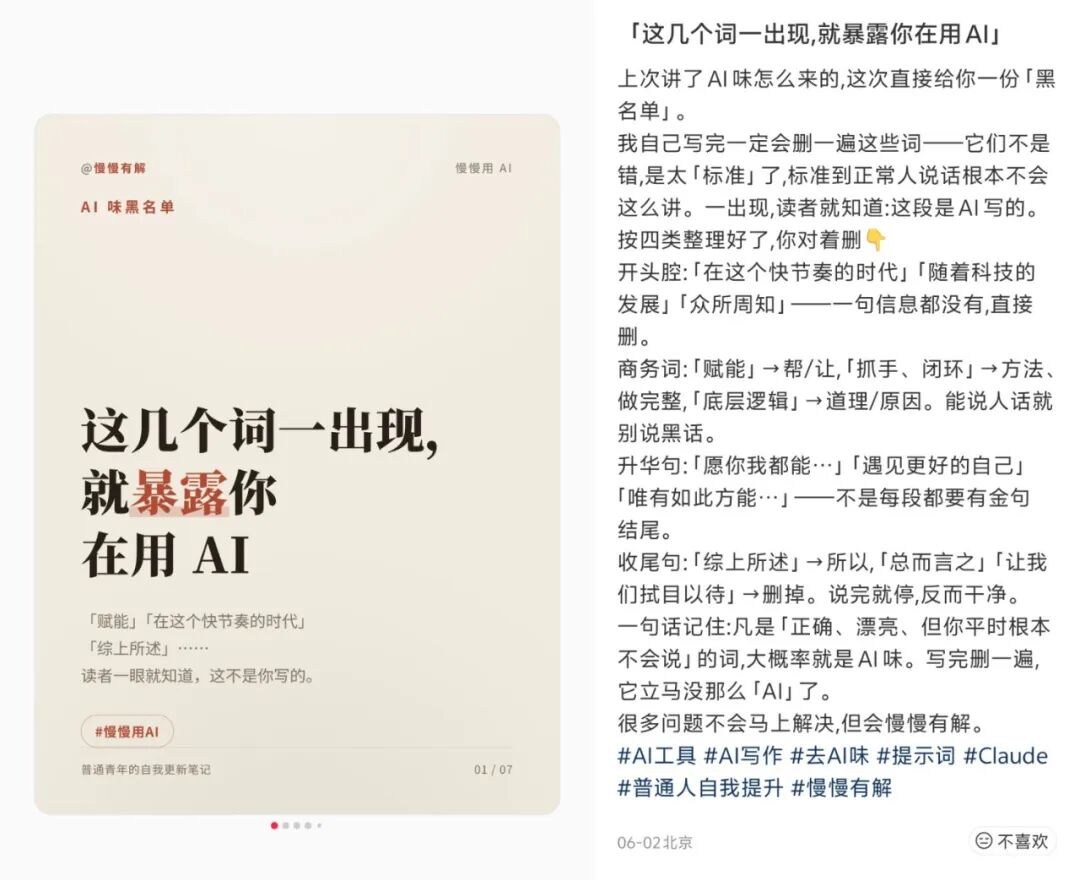
We can wait and see whether the experiments carried out by WeChat, LinkedIn and other platforms will succeed. But one thing is certain: in an era where AI can generate infinite amounts of text, our definition of "scarcity" has already changed —
One sincere line from a real person is worth a hundred polished empty phrases.