The 30th city with a GDP exceeding 1 trillion yuan is just around the corner.
2026 will yet again be a major year of economic advancement for Chinese cities.
Judging from the H1 data released by various cities, it is almost certain that Shenzhen will exceed the 4 trillion yuan GDP mark by the end of the year, Nanjing will cross the 2 trillion yuan threshold, and Shanghai is highly likely to hit 6 trillion yuan with little uncertainty.
At the same time, Xuzhou is 100% set to join the 1-trillion-yuan GDP city club. By then, mainland China will have its 30th trillion-yuan GDP city, and Jiangsu Province will be home to 6 such cities.
Interestingly, many people expected Xuzhou to join the trillion-yuan club alongside Dalian and Wenzhou last year. But Xuzhou did not force the number to hit the mark for the sake of hitting it: its full-year 2022 GDP stood at 995.722 billion yuan, only 4.278 billion yuan short of the 1 trillion target. In the first half of this year alone, Xuzhou's GDP increment has reached 33.762 billion yuan. Even with zero growth in the second half of the year, Xuzhou can easily secure its spot in the trillion-yuan GDP club.
Xuzhou Bureau of Statistics disclosed that according to the unified accounting results of regional gross domestic product, the city's GDP reached 484.692 billion yuan in the first half of the year, representing a 5.2% year-on-year increase at constant prices.
The 5.2% growth rate is 0.5 percentage points higher than the national average. This figure is not exceptionally eye-catching, but it is already a very solid performance for Xuzhou, which maintains steady, well-rounded development across all sectors.
From a data perspective, industry and the service sector have played a prominent driving role.
In the first half of the year, the city's value-added of industries above designated size rose by 6.1% year on year. Among the 38 major industrial categories under statistical tracking, sectors including general-purpose equipment manufacturing, special-purpose equipment manufacturing, and automobile manufacturing recorded relatively fast growth.
In H1, the city's value-added of the service sector increased by 6.3% year on year. Industrial development continued to move toward higher value and greater quality: the value-added of modern service sectors including information transmission, software and information technology services, leasing and business services, and the financial industry grew by 15.2%, 15.1% and 10.8% respectively.
Of course, in line with the trend seen in most cities, investment declined notably. Fixed asset investment in Xuzhou dropped by 32.9% in the first half of the year.
01
Both dubbed "Capital of Construction Machinery", why is Xuzhou outpacing Changsha
At this point, a question naturally arises: as two cities both hailed as the capital of construction machinery, why has Xuzhou maintained a relatively stable industrial growth rate, outperforming the overall national economic growth for most of the past few years and delivering a far better performance than Changsha?
Over the past five years, Changsha only outpaced the national average growth rate in one single year, while Xuzhou consistently beat the overall market level.
In 2021, Changsha's GDP grew by 7.5%, Xuzhou by 8.7%, and the national average by 8.1%. In 2022, Changsha's growth hit 4.5%, Xuzhou 3.2%, and the national average 3%. In 2023, Changsha recorded 4.8% growth, Xuzhou 7.1%, and the national average 5.2%. In 2024, Changsha grew by 5%, Xuzhou by 6.4%, and the national average by 5%. In 2025, Changsha posted 4% growth, Xuzhou 5.8%, and the national average 5%.
The fundamental reason lies in their differing industrial layouts.
On Changsha's industrial map, the construction machinery cluster once accounted for roughly one third of the national market at its peak, hosting five global top 50 enterprises: Sany Heavy Industry, Zoomlion, CRCC Heavy Industry, Sunward Intelligent, and XCMG Intelligent.
However, under the 41 major industrial categories defined by the Ministry of Industry and Information Technology, Changsha only has one single industry with revenue exceeding 100 billion yuan: tobacco manufacturing, with most other industries sitting at the 10-billion-yuan level. When the industry downturn hit in 2022, the total revenue of China's construction machinery sector dropped from over 900 billion yuan to 850 billion yuan. Sany Heavy Industry saw its revenue plummet by 24.37%, Sunward Intelligent posted a net loss of 1.138 billion yuan, and the total output value of Changsha's construction machinery cluster crashed from 280 billion yuan to 199 billion yuan. When one big tree falls, the entire forest feels the tremor.
Xuzhou's situation is completely different.
Back in 2022, Xuzhou systematically rolled out the "343" innovative industrial cluster strategy: three leading advantageous clusters covering construction machinery, green and low-carbon energy, and new materials; four emerging clusters including the digital economy, integrated circuits and ICT, pharmaceutical healthcare, and safety and emergency response; three characteristic clusters consisting of high-quality steel, high-end textiles, and food and agricultural byproduct processing.
In 2024, when the construction machinery sector was still struggling to recover, the output value of high-end textiles rose by 21.9%, integrated circuits and ICT by 14.4%, and new materials by 9.6%.
Four of its industrial clusters have exceeded the 100-billion-yuan mark. When one tree sways, nine others stand firm to support growth. By 2025, the total scale of Xuzhou's "343" clusters exceeded 800 billion yuan. While the "No.1 pillar industry" of construction machinery grew by 19%, the green and low-carbon energy sector, digital economy, and food processing sector all secured their footing above the 100-billion-yuan threshold.
Additionally, an article titled "Is Xuzhou Set to Become the Leader?" published by China Newsweek in 2024 noted that Xuzhou ranked 22nd among the nation's top 100 advanced manufacturing cities in 2023, and its construction machinery industry was selected as one of the first batch of national advanced manufacturing clusters. Furthermore, Xuzhou has completed restoration and treatment of 72.9% of its total coal mining subsidence areas, and its forest coverage rate has ranked second in Jiangsu Province for five consecutive years.
The 2024 statistical communiqué released by Xuzhou states that the city rose to 21st place in the national top 100 advanced manufacturing cities ranking in 2024, up one spot from the previous year. Throughout the year, 56 new provincial-level and above smart manufacturing demonstration factories and workshops, 2 provincial-level industrial internet benchmark factories, and 719 star-rated cloud-connected enterprises were added, alongside 12 new national-level "little giant" enterprises specializing in niche, sophisticated, unique and innovative fields. Four of the city's enterprises made the list of China's top 500 manufacturing enterprises, up by 2 from the previous year.
In 2024, the total scale of Xuzhou's "343" industrial clusters hit 780 billion yuan, with four 100-billion-yuan level industrial clusters covering construction machinery, digital economy, green and low-carbon energy, and food and agricultural byproduct processing becoming the core driving force of Xuzhou's industrial development.
Construction machinery is Xuzhou's "No.1 industry", home to a group of Fortune 500 enterprises including XCMG Group, Caterpillar, and Liebherr, with a total industrial scale exceeding 200 billion yuan and a national market share of over 20%. The green and low-carbon energy industry has gathered three leading photovoltaic giants: the GCL group, the Zhongrun group, and the Hongyuan group, realizing comprehensive development across the wind power, photovoltaic, energy storage, and hydrogen energy industrial chains.
This is not luck, but forward-looking strategic planning.
Xuzhou's fixed asset investment grew by 7.7% in 2024, of which industrial investment increased by 13.6% and manufacturing investment by 12.2%. More notably, private investment rose by 11.7%, accounting for as high as 81% of total investment.
Enterprises have voted with real money. The city signed 605 new projects with a total investment of over 100 million yuan each, the investment completion rate for provincial and municipal major projects exceeded 120%, and equipment upgrading drove a total of 59 billion yuan in new investment.
Changsha's fixed asset investment dropped by 6.8% in 2023, with real estate investment falling by 13.4%. It only posted a 2.3% full-year growth in 2024, and in H1 2026, its fixed asset investment plummeted by 17.9% year on year. The local government openly acknowledged: "The marginal effect of the traditional investment-driven model is weakening, and new projects and new growth drivers need to be accelerated to form a continuous support system."
Investment determines production capacity for tomorrow. The sustained gap in investment will lead to continued divergence in growth momentum.
The divergence between Changsha and Xuzhou is essentially a classic case of industrial concentration risk. Xuzhou spent ten years completing one core task: fostering second, third, and fourth growth pillars beyond the construction machinery sector. When the cyclical downturn hits, only one single industrial segment is affected, rather than the entire economic foundation of the city.
Changsha is not unaware of this problem: its computer, communication and electronic equipment manufacturing sector grew by 26.4% in 2024, the national advanced manufacturing innovation center for high-end construction machinery co-built with Xuzhou was approved in 2026, and the strategy to build a global R&D center city is also steadily advancing.
However, there is still a long period of transition and pain to go through before the city can truly translate its "strong scientific research capabilities but weak industrial support" status into new, robust growth pillars.
The simple common sense of "do not put all your eggs in one basket", when applied to the scale of urban economy, often comes at the cost of a gap of an entire economic cycle.
02
Can Xuzhou return to the top 10 non-provincial capital prefecture-level cities ranking?
The comparison between Xuzhou and Changsha is mainly based on the fact that the two cities share the same "Capital of Construction Machinery" title.
But in terms of overall urban tier and administrative status, Xuzhou is not in the same league as Changsha. Xuzhou's benchmark competitor is not Changsha, but Wenzhou.
This is because Wenzhou not only joined the trillion-yuan GDP club earlier than Xuzhou, but also pushed Xuzhou out of the top 10 non-provincial capital prefecture-level cities ranking. In 2024, Wenzhou's GDP overtook that of Xuzhou, taking Xuzhou's spot in the top 10 non-provincial capital prefecture-level cities. In 2025, Wenzhou officially became a trillion-yuan GDP city.
On the surface, Wenzhou overtaking Xuzhou was attributed to the GDP incremental adjustment from the fifth national economic census.
The pre-adjustment data shows that at the end of 2023, Wenzhou's GDP was 873.06 billion yuan, while Xuzhou's was 890.04 billion yuan. After the revision, Wenzhou's GDP was adjusted up to 922.06 billion yuan, an increment of 49 billion yuan, and Xuzhou's was revised to 901.24 billion yuan, an increment of 11.2 billion yuan.
Wenzhou's total adjustment amount was 37.8 billion yuan higher than that of Xuzhou, which allowed it to overtake Xuzhou smoothly. But the underlying logic is that Wenzhou launched its industrial adjustment and upgrading far earlier than Xuzhou, as far back as the previous round of real estate bubble adjustment period.
In 2016, Zhejiang Province fully launched the traditional manufacturing transformation and upgrading initiative, and Wenzhou took the lead in promoting intelligent and digital upgrading of its traditional sectors including electrical equipment, pumps and valves, footwear and leather, and auto and motorcycle parts, gradually transforming from a "small, scattered and low-end" industrial base to high-end manufacturing.
After the "Yangtze River Delta Regional Integrated Development Planning Outline" was released in 2019, Wenzhou deeply integrated into the Yangtze River Delta industrial division system, and accelerated the development of new energy vehicle parts, new energy, and intelligent equipment sectors.
Since 2022, Wenzhou has proposed to build a "5+5+N" modern industrial system, accelerating the high-end transformation of traditional industries and the large-scale development of emerging industries. Its industrial upgrading has entered a harvest period, which ultimately supported it to overtake Xuzhou in 2024 and break the 1 trillion yuan GDP mark in 2025.
In addition to starting far earlier, Wenzhou's industrial transformation and upgrading efficiency is also higher.
Over 95% of market entities in Wenzhou are private enterprises. Most of its industrial adjustments are driven spontaneously by the market, and local enterprises respond faster to industry changes, enabling them to quickly enter new tracks such as new energy, automotive parts, intelligent manufacturing, and cross-border e-commerce.
At the same time, Wenzhou has formed an "industrial forest" consisting of a large number of niche industrial segments, rather than relying on one single pillar industry. This makes its risk resistance capacity and industrial resilience significantly stronger than Xuzhou, whose core industry is construction machinery. This is also a key reason why Wenzhou's economic growth has consistently outpaced Xuzhou's in recent years.
Earlier and more efficient industrial transformation and upgrading brings multiple outcomes. Overtaking in GDP is only one of them. More importantly, a gap in overall industrial strength has emerged between the two cities.
According to the 2025 statistical yearbook data released by the two cities, Wenzhou outperforms Xuzhou in both the operating revenue of industries above designated size and the number of 100-billion-yuan level industries. In 2024, the operating revenue of industries above designated size in Xuzhou was 668.56 billion yuan, while that of Wenzhou was 823.42 billion yuan.
In terms of the number of 100-billion-yuan level manufacturing industries, Xuzhou does not have any yet. Wenzhou already has one: the electrical machinery and equipment manufacturing industry has posted 188 billion yuan in operating revenue, and the general-purpose equipment manufacturing industry is also on track to hit the 100-billion-yuan mark.
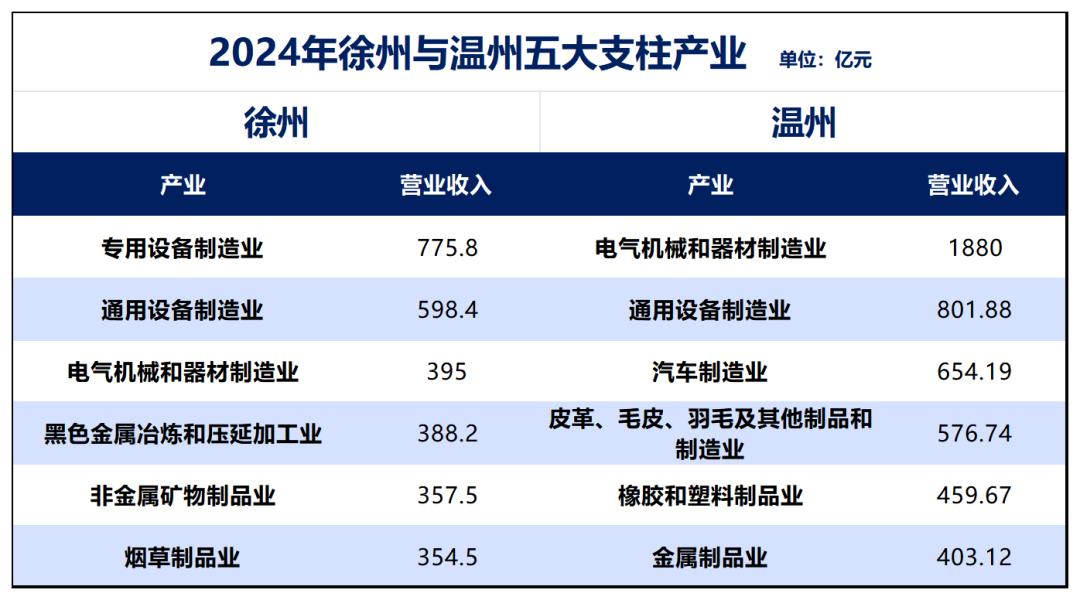
Graphic by City Finance; Data source: Xuzhou Municipal Bureau of Statistics, Wenzhou Municipal Bureau of Statistics
The ultimate competition between cities boils down to industrial competition, as industry is the strongest foundation that underpins a city's economic performance, employment, tax revenue, and population growth.
Thus, we can see that the gap in industrial strength has created a fundamental difference in the population competitiveness of the two cities.
In the past five years, Xuzhou's permanent resident population has continued to decline, falling below 9 million last year. Meanwhile, Wenzhou's permanent resident population is still growing rapidly, and is expected to exceed 10 million in two years.
With this momentum, Xuzhou will find it increasingly difficult to catch up with Wenzhou.
The comparisons with Changsha and Wenzhou are made to emphasize three points: first, on the path of industrial development, we should learn from the strengths of others, and reflect on our own shortcomings when seeing underperformance elsewhere. Second, even when Xuzhou's GDP crosses the trillion-yuan mark by the end of the year, there should be no slack at all, as the trillion-yuan GDP threshold only marks Xuzhou's entry into a new stage of urban competition. Third, there can be no relaxation in urban competition. It is like rowing upstream: if you do not advance, you will fall back, and even if you advance too slowly, you are essentially falling behind.