36Kr Exclusive | 500 Million Yuan Raised in Angel++ Round Financing, Former Head of Huawei's Generative Large Model Team Shrinks the Household Robot to a Size of Only 40 Centimeters
Source / Enterprise
This article has about 3100 words, with an estimated reading time of 6 minutes
Author丨Ou Xue
Editor丨Yuan Silai
Hard Krypton learned that Noen Intelligence, a consumer-grade home embodied intelligence company, has recently completed its Angel++ round of financing, with a single tranche of 500 million RMB. This round is led by Matrix Partners China, with participation from Redpoint Ventures, SenseTime Guoxiang Capital, Walden International, and L2F Lighthouse Founders' Fund, while Lighthouse Capital acts as the exclusive financial advisor. The raised funds will be mainly used for the R&D and iteration of the GLOW generative embodied large model, team expansion, and engineering verification and mass production preparation of its first product KNOWIN-X1.
Founded in August 2025, Noen Intelligence's founding team brings together core technical talents from Huawei and DJI. Founder Li Yinchuan previously worked at Huawei Noah's Ark Lab for 5 years, serving successively as the head of the generative large model direction and the youngest project manager of Noah's Ark Lab. Co-founder Wang Yunjie is the product operator behind DJI's star products. Partner Zhou Kaiwen is a "Genius Young" talent from Huawei Noah's Ark Lab and former head of the Agent direction at Huawei. As of July 2026, the team has more than 190 members, over two-thirds of whom hold a doctoral degree or above, and 90% of the team graduated from top universities including Ivy League schools, Peking University, Tsinghua University, the top 3 universities in Hong Kong, the top 2 universities in Singapore, and C9 League institutions.
Over the past two years, the industry focus of embodied intelligence has been shifting from the industrial scenarios that were first implemented to the consumer-grade home scenarios which are still a blue ocean but have higher technical difficulty.
However, the variables in home scenarios are far more than those in industrial scenarios. Differences in lighting, item layout, and living habits bring a large number of unpredictable situations.
At the same time, the industry is facing deeper bottlenecks: high-quality robot operation data is extremely scarce, and the cost of real machine collection is high and the speed is slow, which makes it difficult to cover the emerging new environments and new tasks.
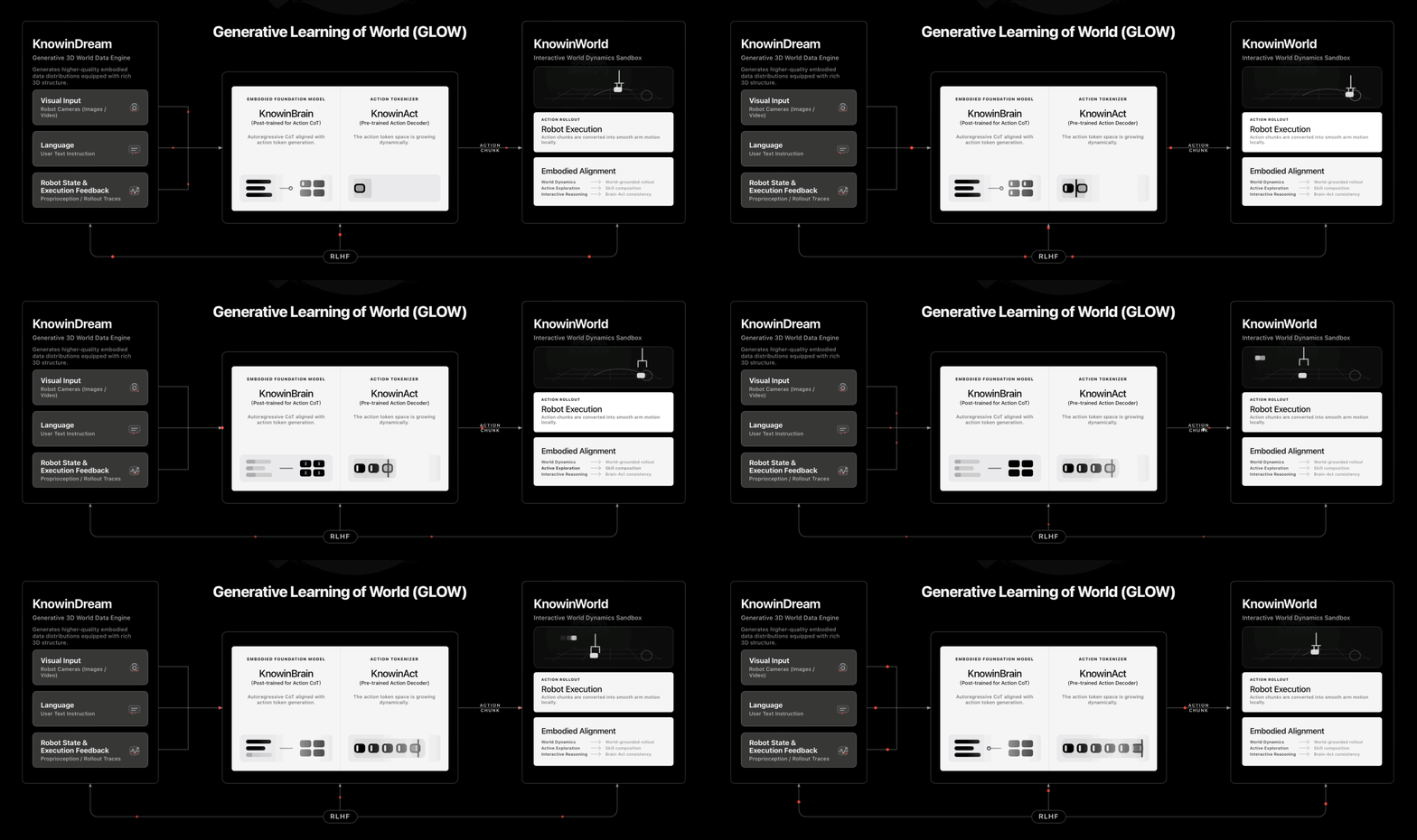
According to Li Yinchuan, Noen Intelligence has self-developed the GLOW generative embodied large model system, which consists of five modules to form a continuous iteration link from data generation to real feedback.
KNOWIN GLOW (Source / Enterprise)
Among them, KnowinDream starts from limited real interactions, expands a small amount of real experience into a wide training distribution covering different combinations of spaces, lighting, materials and tasks, so that the model can systematically learn the long-tail changes that are impossible to enumerate.
KnowinWorld focuses on spatial structure, object state and action influence, judges how actions change the environment and task direction. Different from the practice of replicating the world without boundaries, it concentrates the model's capabilities on the information that truly affects the success or failure of tasks, enabling the robot to not only "see the world", but also understand how to act on the world.
On this basis, KnowinBrain and KnowinAgent are responsible for task understanding, step-by-step planning and failure recovery, and KnowinAct converts strategies into executable actions. Faced with new tasks, the system invokes and combines existing capabilities; when execution deviates from expectations, it dynamically adjusts according to the environmental state instead of relying on fixed processes.
Li Yinchuan summarized the design logic of GLOW as follows: "This is not a one-way link, but a complete closed loop of data generation, virtual trial and error, real execution, and feedback return. The goal is to enable the robot to call and combine existing capabilities to solve tasks independently when facing tasks that it has not fully seen, instead of only reproducing the actions that have been trained."
At present, this technical route has been verified in relevant industry lists — Noen Intelligence won the first place in the world in both tracks of the CVPR 2026 EgoCross Challenge, and ranked first in the comprehensive score in the Embodied Arena evaluation.
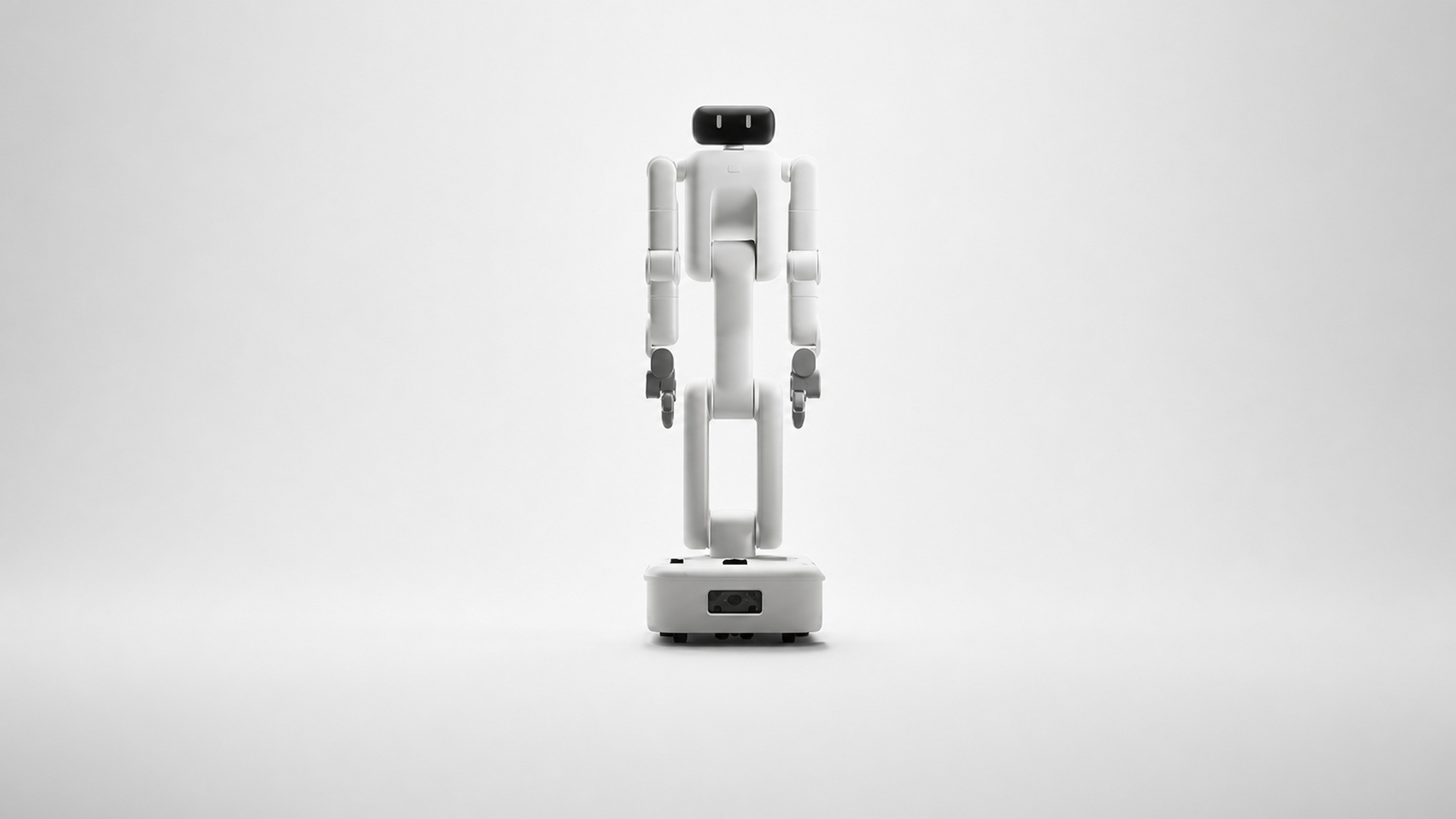
Based on the GLOW generative embodied large model system, Noen Intelligence has also launched its first consumer-grade home robot, KNOWIN-X1.
The product adopts the world's first fully foldable dual-arm configuration, and the height of the whole machine after folding is controlled within 40 cm.
Li Yinchuan told Hard Krypton that home robots must be small enough and do not take up space when not working, so that consumers will accept them. Therefore, KNOWIN-X1 can be easily placed in the trunk of a car, and hardly takes up extra space in the corner of the home.

Robot folding and unfolding (Source / Enterprise)
In addition, after unfolding, the robot has three working modes: lying, kneeling and standing, which are adapted to three types of operation surfaces: ground, desktop and cabinet. A single arm achieves 7 degrees of freedom, the maximum load of dual arms is 6kg, and the whole machine achieves 23 degrees of freedom.
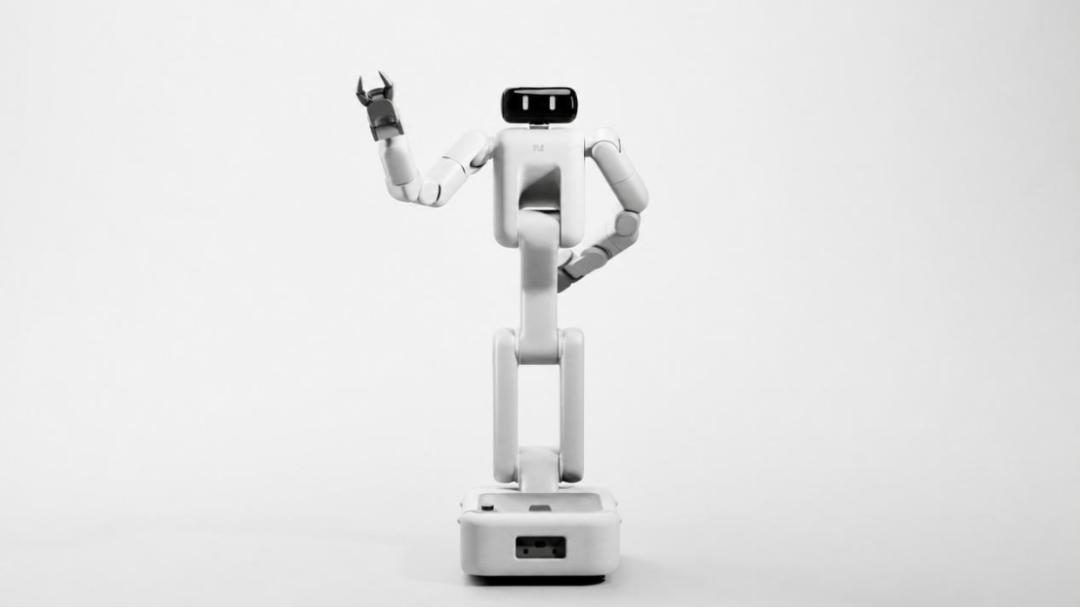
Li Yinchuan introduced that the application scenarios of the product cover multiple levels of modern families. In terms of housework assistance, it can complete high-frequency tasks such as desktop sorting, item replacement, clothing handling, and home device interaction. In terms of family companionship, it has the capabilities of natural interaction, active greeting and long-term memory, and can understand the life rhythm and preferences of family members. In terms of intelligent on-duty, it can continuously perceive the home space and abnormal changes, and support safety reminders and elderly care.
KNOWIN (Source / Enterprise)
However, Li Yinchuan emphasized that the current product design does not pursue out-of-the-box use of the robot, but allows users to "teach" the robot to learn new tasks. For example, after demonstrating the action of wiping the table once, the robot can complete it independently afterwards.
"The product still needs iteration. This can not only avoid the experience risks that may be brought by excessive optimism about out-of-the-box use, but also make the interaction process have the "cultivation-style" sense of companionship," Li Yinchuan said.
In terms of privacy and security, it is guaranteed by local protection mechanisms, multi-modal obstacle avoidance and emergency stop mechanisms. In terms of open ecology, it supports geeks and developers to carry out DIY expansion around home automation and skill development.
Li Yinchuan revealed that the product is expected to be officially released in 2027, with a price tag of tens of thousands of RMB, targeting high-net-worth individuals and geek groups.
The following is an excerpt from the conversation between Hard Krypton and Li Yinchuan, founder of Noen Intelligence (edited):
Hard Krypton: Why did you choose to directly target the most difficult consumer-grade home scenarios instead of landing in the industrial field first?
Li Yinchuan: Home scenarios are indeed much more complex than industrial scenarios, but these complexities are exactly the touchstone for testing generalization capabilities. If the model can work stably in the home, it truly has the ability to move towards the real world.
In addition, consumers will accept robots only when they do not take up space when not working. KNOWIN-X1 adopts a fully foldable configuration, with a height of 40 cm after folding, and stays quietly in the corner like a home appliance. This is a product designed with "consumer-grade" as the premise from the first day, rather than adapting to the home after the technology matures.
Hard Krypton: What is the biggest technical challenge for home robots at present? How does Noen Intelligence deal with it?
Li Yinchuan: The biggest challenge is generalization. To enable the robot to complete tasks when encountering new situations in environments it has never seen. The mainstream practice in the industry is to "feed" all scenarios to the model in advance, but home scenarios cannot be enumerated at all.
Noen Intelligence's idea is to enable the robot to have the ability to "draw inferences from one instance". First, let it make a lot of trial and error in the virtual world through KNOWINWorld, then go back to the real environment to execute, and the information of execution failure will flow back to the training system, so that it will do better next time. We do not rely on piling up data, but on establishing a closed-loop mechanism from virtual to real, from failure to progress.
Hard Krypton: How do you judge the next commercialization rhythm and industry window period?
Li Yinchuan: The home robot market will usher in a mass production outbreak in the next 3 to 5 years. The first one or two years are still in the pilot stage, and the key is who can tap attractive selling points when the model's capabilities are not fully mature.
I think price is a very important variable. Pricing at 10,000, 30,000, 50,000, and 100,000 corresponds to completely different sales scales. We will not sacrifice the generalization ability of the model for short-term commercialization. Pursuing monetization too early may make quick money, but eventually lose the future.
Investor Views:
Matrix Partners China said: Home is the application scenario of embodied intelligence with the most long-term value and the most challenges. For robots to truly enter the home, they need to have the ability of continuous generalization and complete the system closed loop from model R&D to product landing. The Yinchuan team focuses on the highly challenging and extremely imaginative home scenarios, builds a system closed loop of robot understanding, planning, execution and feedback, and their courage to tackle difficulties and iterate impresses us deeply. We look forward to Noen Intelligence continuously promoting the progress of the consumer-grade embodied industry and achieving key breakthroughs in the future.
Redpoint Ventures: Whether the new category of 2C embodied robots can finally achieve scale depends not only on how many skills the robot has mastered at the time of delivery, but also on whether it can continue to learn in real use and become more valuable as users use it. Noen Intelligence takes user teaching and cultivation-style interaction as an important product entry point, and it is expected to precipitate task differences, failure cases and personalized preferences in the home into high-value data in the future, forming a positive flywheel of "increased use - data accumulation - model improvement - experience optimization". What impresses us even more is the perseverance of the team: Facing a road with high technical thresholds, long R&D cycles and no ready-made answers, the team always maintains sober judgment and stable execution, and continuously converges between technical ideals and product constraints. We look forward to Noen Intelligence defining the landing paradigm of consumer-grade embodied intelligence with its leading model capabilities and data flywheel.
SenseTime Guoxiang Capital: 2C embodied robots have different dimensional requirements for teams from 2B scenario robots, with wider capability boundary requirements, higher requirements in technology selection, product definition convergence, structural design and product marketing, which requires the team to be more rational. The Noen Intelligence team has the full-stack self-research capability that is scarce in the industry, covering from data engine, embodied large model, underlying infra to hardware terminals. It has built differentiated barriers on the model side, and its product side also highly matches the full-link comprehensive requirements of 2C embodied intelligence. We are optimistic about the long-term development of the company.
Ji Xing, Partner of Lighthouse Capital and Managing Partner of L2F Lighthouse Founders' Fund said: "Congratulations to Noen Intelligence on completing the Angel++ round of financing. L2F has increased its investment for four consecutive rounds since Day 1, witnessing the team turn non-consensus judgments into verifiable product paths. For hundreds of years, home appliances have created dedicated machines by splitting and standardizing housework; today, what is left to people is exactly the multi-step long-tail tasks that cannot be enumerated. Generalization is not a superposition of functions, nor is it a supplementary capability, but the premise for the establishment of the home robot category. There is no ready-made massive motion data in the real world. Whoever can make generative data, world model and real machine feedback form a low-cost, self-evolving closed loop can go through the long tail. Yinchuan and the team turned this set of judgments into models, systems and real machines in one year, demonstrating excellent technical judgment and engineering execution capabilities. The passing line for consumer-grade robots is that the robot can identify failures, recover independently and continue to learn when no one is on duty. L2F will continue to walk with you to make general-purpose robots the next generation of home infrastructure."