Behind the explosive popularity of ByteDance's Seedance lies a $5 billion unicorn.
Previously, overseas models were imported into China, but now the tables have turned.
"Sign up immediately, and you will get 7 days of unlimited full access once Seedance 2.5 goes live on Higgsfield."
This is a recent advertising slogan from Higgsfield, an American AI video generation startup. Higgsfield does not develop its own models, and only provides scheduling services for video generation models including Google Veo, Kling, and Seedance.
It is worth noting that Higgsfield has a team of only 150 people, with around 60 core engineers and product team members, plus more than 70 film and television practitioners with advertising shooting experience. Just 15 months after its platform went online, it achieved an annualized revenue of 500 million U.S. dollars, with clients mainly being B-side advertising agencies.
Higgsfield is undoubtedly one of the companies that have reaped dividends from the boom of video generation models. At the beginning of this year, Higgsfield was valued at 1.3 billion U.S. dollars during its financing. Half a year later, its valuation in the latest financing has nearly quadrupled, reaching 5 billion U.S. dollars.
Another narrative in this half year is that after ByteDance's Seedance 2.0 exploded, it accounted for more than 40% of the total Token consumption of Volcano Engine, and calls from overseas markets kept growing, accounting for nearly 50%. Now, Seedance 2.5 has started to land in overseas markets, kicking off a new round of growth.
Chinese-made large video generation models fill the Higgsfield platform. The Seedance model is the most eye-catching one on the Higgsfield platform, ranking at the top. Alongside it are Kling 3.0, MiniMax H3, Alibaba JoyMa, and Wan 2.7, etc. The combined strength of Chinese AI has driven the skyrocketing valuation of Higgsfield, helping it become an American AI unicorn enterprise.
In the past, overseas models were imported into China, but now Chinese large video models are supplying the global film and television advertising industry in reverse. When To B becomes the most certain direction in the AI industry, and AI video generation is the independent track with the highest commercial certainty, the development of Higgsfield has proved two certainties:
On the production side, model capabilities will be caught up with or replaced, while the cloud collaboration network is the real moat, and the assets accumulated by users have the characteristic of the strong getting stronger. In terms of commercial closed loop, build an end-to-end commercial link connected to advertising platforms, and finally charge based on value results, using agents to help brand owners improve product sales conversion.
1
An Open Source Project Worth 500,000 U.S. Dollars
Not long ago, Higgsfield open-sourced the production cheats of an AI film.
Hell Grind is a 95-minute AI feature film, with every frame generated by AI. It was produced by Higgsfield at a cost of 500,000 U.S. dollars, 400,000 of which was for computing power. This film is also a representative work generated by Seedance 2.0, and it was screened at the Cannes Film Festival Market this year together with Volcano Engine.
The open source materials displayed by Higgsfield include 115,446 generation records, more than 100 material folders numbered by scene, some video prompts can be up to 3,000 words in length, plus three methodological documents stating work rules. The number of views has exceeded 300,000 so far.
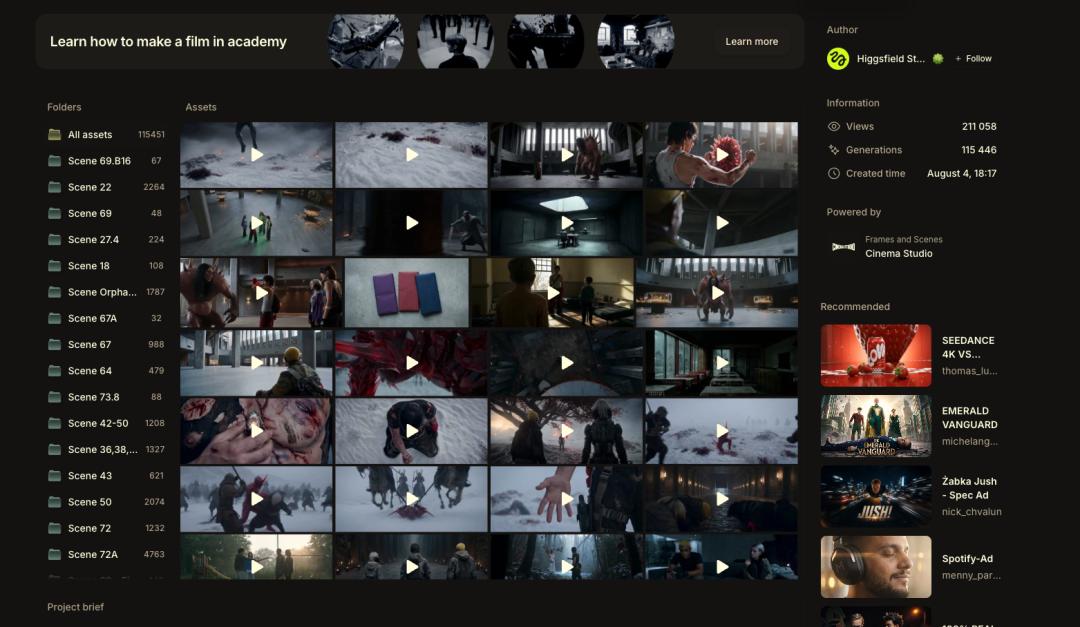
This open source project solves a systematic industry problem: the video generation model itself has no memory. As long as the description of the protagonist in a certain prompt is not complete enough, in the next shot, the protagonist will have a different face and wear a different coat. This open source project is a complete working system that solves the above problems point by point. The released tool skill named CINEDANCE can automatically write video prompts according to all the above rules.
Converted at the computing power cost of 400,000 U.S. dollars, the average cost of each AI generation of this Cannes-featured AI film is 3.5 U.S. dollars. For AI film and television practitioners, this open source project is equivalent to getting 500,000 U.S. dollars worth of training for free.
For example, to overcome the problem that the model has no memory, the character card needs to consist of three pictures: close-up of the face, full front view, and full back view. Before each asset is locked, it needs to pass a stress test: 10 generations with different postures and different lighting, and it can only pass if the character can be recognized correctly in all 10 results.
For another example, to schedule AI to perform emotions, emotional words such as "sadness" and "anger" are not allowed in the prompts, only the muscle movements are described: the jaw clenches and then releases, blood from the nose flows to the lips without wiping, a slow blink followed by a quick double blink. Lines can only appear in the audio block, and no words are allowed in the action block, otherwise the model will arbitrarily add other actions or chuckles.
In addition, the AI model will not remember who stood in which position in the previous shot, and accurate marking is required when the shot switches. The team's solution is to write a plain-text floor plan for each scene, marking landmarks, left-right relationships, camera positions, and the line that must never be crossed. Write it once for each scene, and then paste the original text for each subsequent shot. At the beginning of each scene, leave a one-second panorama without lines and actions, so that the model can first "take a photo" of the standing positions.
Most importantly, there is a special folder in the material library for storing rework records, with a total of 14,593 entries, accounting for about 13% of the total.
The heavy action scene in the middle of the film consumed four to five thousand generations for a single scene. For a series of scenes numbered 73.x in the later part, the same team only used ten to twenty generations for one scene. The production briefing explained this very directly: the working formula was not formed until near the end of production, and this open source report is that formula, the version the team wished they had from day one.
This means that behind the seemingly perfect AI film production, there is a complex production process and huge computing power consumption. The team wrote in the production briefing: every rule in this briefing comes from a failed shot.
For the AI film and television industry, this batch of open source assets may be more valuable than the film itself.
2
Not a Model Manufacturer, But a Large-scale Wholesaler
Higgsfield took some detours in the early days of its entrepreneurship.
At the beginning of its founding, Alex Mashrabov, CEO of Higgsfield AI, and Yerzat Dulat, CTO, the former had working experience in Snap's generative AI department, and the latter came from Kazakhstan. The two initially developed video generation models on their own, taking the path of challenging Sora, and later transformed into an AI video platform that aggregates multiple models.
Mashrabov later talked about why they transformed: new video models are released almost every week in the industry, no laboratory can win all scenarios, and binding any single one is a wrong choice.
So for startups, "selling shovels" is easier to survive than "digging for gold".
Mashrabov then put Google Veo, Kuaishou Kling, and ByteDance Seedance all on the shelves, and began to act as a wholesaler. Users can send the same instruction to multiple models at the same time, and select the best result as the delivery. In response to external doubts about being just a "shell wrapper", he responded that almost all software companies in the future will run on models they do not own, and this argument itself is meaningless.
The real moat is not the model, the model is a general capability that can be bought with money. Everyone in the industry can get the same Seedance interface, but they cannot get your project files, team collaboration processes, and massive accumulated film and television assets. Therefore, the key lies in the collaborative experience that allows multiple people to use it together and makes it more and more user-friendly, as well as the network effect generated thereby.
For ByteDance, it needs wholesalers like Higgsfield to promote its large models, and it also needs exhibits like Hell Grind that can be sent to Cannes. For American startups like Higgsfield, it needs to obtain special cooperation permissions for Seedance, and it also needs to open source Hell Grind to the industry to attract investors.
On the Higgsfield platform, you can see the exclusive cooperation version Seedance 2.0 Enhanced Fast, and the platform has also launched Seedance 2.5.
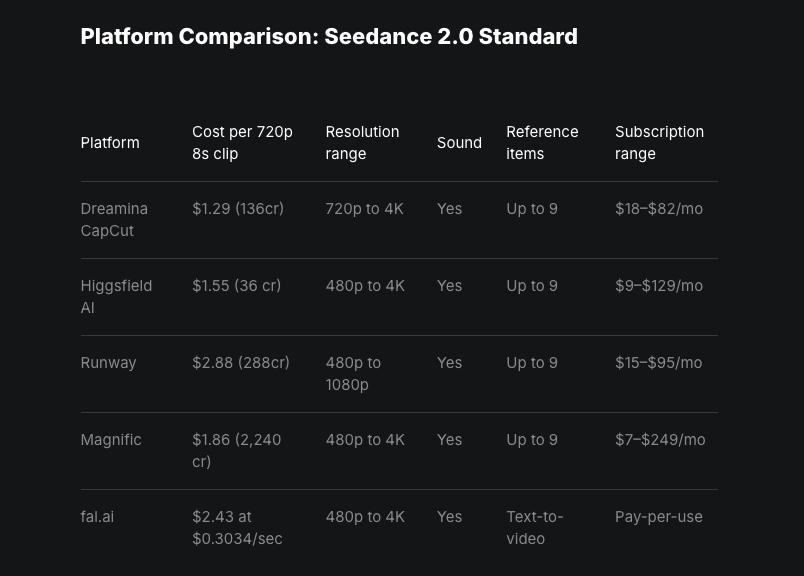
Comparing the prices, for American users who generate videos occasionally in small quantities, the official Dreamina (CapCut) is the most cost-effective for single use. But if you subscribe monthly for long-term use and create in batches with high frequency, Higgsfield AI has the highest overall cost performance and is the most cost-effective. The entry subscription is only 9 U.S. dollars per month, which has the lowest entry threshold among the four mainstream AI video subscription platforms.
This is a typical pricing strategy for drainage products: model calls are sold at near-cost, and profits are made at the upper layer.
According to the report from Sacra, about 40% of Higgsfield's usage has been run on workflow products such as Cinema Studio and Marketing Studio. The average annual consumption per user is about 1,000 U.S. dollars, five times that of Canva, and the annual consumption of enterprise customers can reach more than 200,000 U.S. dollars.
More importantly, Higgsfield has sold model products from tools to full workflows.
Seventy percent of its revenue comes from advertising agencies, which is the deterministic income of To B. In the past, an American advertising creative director needed a film crew, equipment and venues to shoot an advertisement, but now it can be completed in one day. Changing actors, adjusting lighting, and producing ten variants are all process operations in the software, allowing users to modify characters and objects in videos more easily.
Riding on the east wind of the development of Chinese AI models, Higgsfield's valuation has been rising steadily.
In January this year, Higgsfield completed 80 million U.S. dollars in financing led by Accel, with a valuation of 1.3 billion U.S. dollars and an annualized revenue of 230 million U.S. dollars. A month later, Seedance 2.0 went online, only three days apart from the release of Kling 3.0, and Higgsfield immediately obtained exclusive cooperation.
In June this year, Higgsfield's revenue exceeded 500 million U.S. dollars, and it raised 300 to 500 million U.S. dollars with a pre-money valuation of 5 billion U.S. dollars. This round of valuation increase from 1.3 billion U.S. dollars to 5 billion U.S. dollars, nearly 4 times, occurred in the four-month window after Seedance 2.0 went online and before Seedance 2.5 was released.
3
Chinese AI Behind the 5 Billion U.S. Dollar Valuation
On July 31, ByteDance released Seedance 2.5, extending the single generation duration from 15 seconds to 30 seconds. A few days later, MiniMax released H3 and announced the open source of model weights, with an API price of 0.8 RMB per second, about 1/12 of that of Seedance 2.5. After its release, it topped the popularity list of Hugging Face.
Now, the two most popular domestic models are on the shelves of Higgsfield. Seedance 2.5 has been announced to be launched soon, and H3 has also entered its model list. In terms of entering overseas markets, H3 is faster than Seedance 2.5.
Multimodal large video model is a track with high entry barriers and high profits. Even if there are differences in analysis calibers, "LatePost" once reported that the gross profit margin of the Seedance model reached 70%, and 36Kr also disclosed from the industry practitioners that the gross profit margin of Seedance 2.0 reached 90%.
But at the same time, the growth of Chinese video models is indeed increasingly dependent on overseas markets. Kling is the most extreme example: 70% to 75% of its revenue comes from overseas markets, especially North America, and its annualized revenue is hitting 1 billion U.S. dollars. Kuaishou has planned to spin it off and raise 2 billion U.S. dollars in financing.
The same is true for ByteDance. As of the end of June, the proportion of overseas calls to Seedance 2.0 has increased from 1/3 to 1/2. This is also the ongoing transformation: in the past, overseas models were imported into China, but now Chinese large video models are supplying the global film and television advertising industry in reverse.
Distribution platforms like Higgsfield are one of the forces driving this growth. In addition, a number of overseas AI video SaaS, advertising agencies, and AI manhua drama platforms have successively accessed the models through official BytePlus cooperation, and the demand for B-side mass production overseas has exploded.
Especially driven by video models, in the AI short drama industry, data released by companies including Google shows that the overseas short drama market size in 2026 will exceed 6 billion U.S. dollars, with a year-on-year growth rate of more than 60%.
Which is stronger, Seedance 2.5 or the open source MiniMax H3? This is a question that varies from person to person.
On overseas technology forums, users have started evaluation tests. Some people think that Seedance 2.5 is more suitable for projects that take longer time, have many reference materials and require frequent modifications, but its price is relatively high. While MiniMax H3 is good at processing short prompts with clear goals, especially suitable for scenarios where the video only needs to convey a clear core idea and does not require a lot of repeated modifications.
But the two adopt completely different technical routes: H3 seizes the developer ecosystem with an open base model, further lowering the threshold for obtaining a video generation base, while Seedance 2.5 adheres to the closed-source API route.
Behind the fierce competition between Seedance 2.5 and MiniMax H3, the biggest beneficiary may still be aggregation platforms like Higgsfield. Because what it sells is never AI video, but certainty: the models are changing every week, no matter it is Seedance 2.5 or MiniMax H3, the customer's workflow does not need to be changed, and the commercial closed loop of advertising delivery that has been connected will not change.
This article is from the WeChat Official Account "Blue Hole Business" (ID: value_creation), written by ZHAO Weiwei, and republished with authorization from 36Kr.