The "fake takeaway" product has gone viral, and this AI wealth management app that roasts users for ordering takeout randomly generates an annual revenue of more than 100 million US dollars.
Last month, a dopamine-driven website named "FoodNeverComes" became popular among young people in South Korea. It offers a "food delivery experience with no real outcome": users can browse menus, place orders and wait for delivery just like ordering takeout in real life, but no actual consumption will be generated, nor will they receive any real food.

The "fake takeout ordering" website that went viral among Generation Z in South Korea
On August 7, Douyin also followed the trend and launched the mini-game "Greedy Cat Takeout". By simulating the process of ordering takeout, the amount users "pay" on the order page will be deposited into the "Greedy Cat Piggy Bank", and can be withdrawn at any time. Relying on its own payment system, Douyin connects the entertaining gameplay of "fake takeout" with the financial management function of "real money saving", further upgrading this model.
The current explosive popularity of the "fake takeout" model, to a certain extent, reflects the long-standing user pain points in the traditional financial management tools track. Looking at the current market of personal financial management and bookkeeping apps, mainstream products mainly follow two development paths.
The first type is tool-based journaling bookkeeping apps, which rely on users to actively and manually enter detailed accounts. Although such products have a low threshold for use, they highly depend on users' self-discipline, with a long bookkeeping process, and are not suitable for all users.
The second type is data coordination apps represented by products such as YNAB, which automatically aggregate income and expenditure records by binding bank cards and provide visual chart displays. Such products solve the efficiency problem of manual bookkeeping, but do not fundamentally address the way young consumer groups review and adjust their behavior when facing impulsive consumption.
Following this line of thinking, we noticed a product ranked Top 10 in the finance category of the US Google Play Store — Cleo AI: Cash Advance & Budget (hereinafter referred to as "Cleo AI").
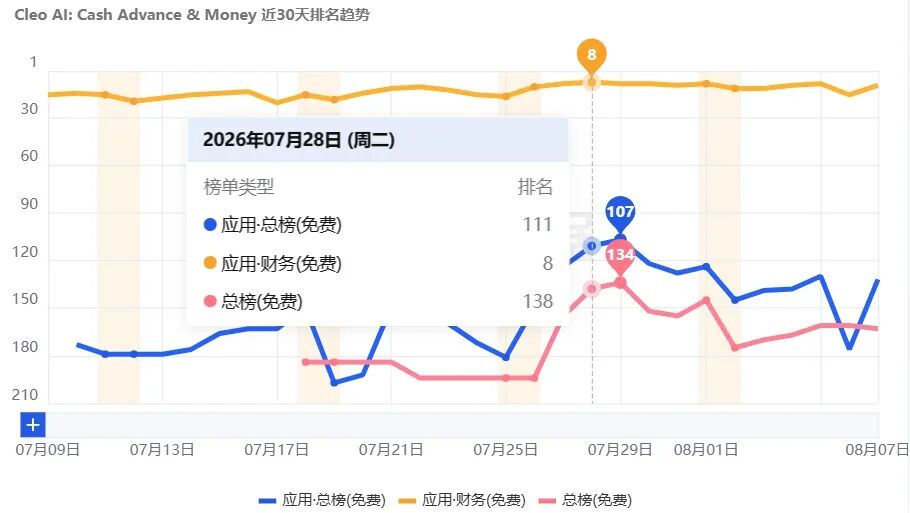
Cleo AI's ranking trend in the US Google Play Store in the past 30 days. Source: Diandian Data
AI Assistant That Understands Finance
Cleo AI is positioned as an AI financial coach, with whom users can ask questions at any time and communicate to learn financial management knowledge.

Users can communicate directly with the AI financial coach. Source: Cleo AI official website
After users bind their bank accounts, Cleo AI will help analyze: how much money they spent on takeout consumption (a specific field) in the past month, what the proportion is, and how much it has increased/decreased month-on-month.
Beyond text and data, Cleo AI tends to turn the entire financial management process into a chat experience. It can even activate the "roast mode" or "praise mode" according to users' actual financial management situation.
When a user overspends, the "roast" mechanism will be triggered in the chat between the user and the AI, and the AI will use sarcastic, sharp remarks to directly hit the user's consumption pain points. It is reported that the official once stated that multiple comedians participated in writing most of the replies. This dramatic feedback precisely hits the self-deprecating psychology of young groups when facing financial anxiety.

Dramatic conversations between users and the AI. Source: Cleo AI
On the contrary, when a user reaches the budget target or completes consecutive savings, the AI may switch to the "praise mode" and provide high-density positive incentives. Under this flexibly switched dialogue mechanism, the originally counter-intuitive and boring financial management is shaped into a certain kind of companionship experience.
In addition, Cleo AI further provides practical execution tools. In addition to conventional money-saving mechanisms such as "piggy bank", the product also introduces the designs of "round-up spare change" and "fine jar". "Round-up spare change" is mainly fragmented saving: after the user binds the bank card, every time they make a daily consumption, the system will automatically "round up" the bill amount to the nearest whole US dollar, and automatically transfer the extra "spare change" to the user's savings account.
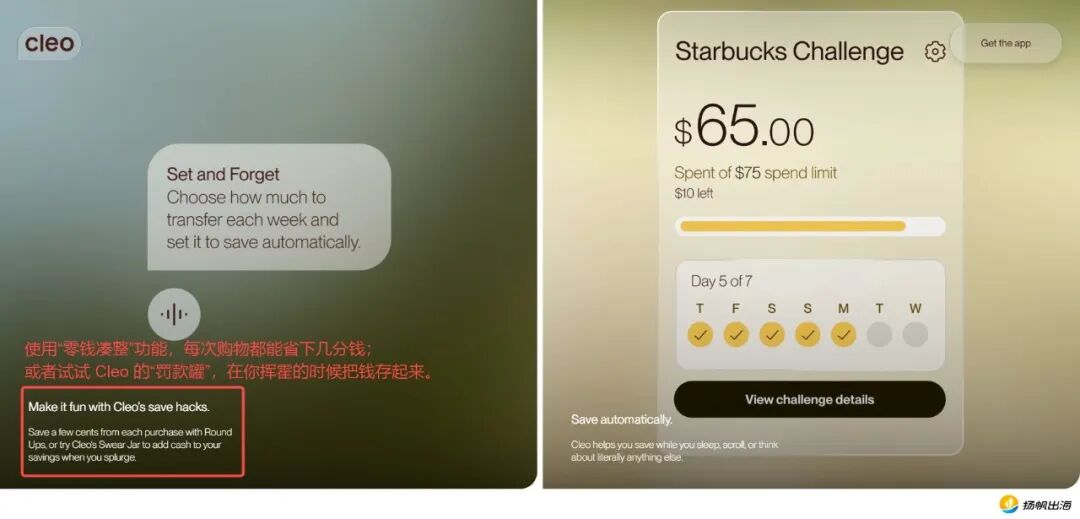
Multiple money-saving functions. Source: Cleo AI official website
In comparison, the "fine jar" design is more gamified. Users can set their own "sinful consumption areas" in the app. Once Cleo AI detects consumption at these "blacklist" merchants or the preset budget is exceeded, it will deduct a fixed amount (such as 1 USD or 5 USD) from the user's consumption account and transfer it to the savings account as a "fine".
More importantly, the trust built on account data and high-frequency conversations paves the way for its commercialization closed loop. For young users who lack traditional credit records or often face short-term capital pressure before payday, Cleo AI has launched credit score and cash advance services. Qualified users can get a maximum cash advance limit of 250-500 USD to solve temporary funding gaps, and this service does not charge interest.
At the same time, Cleo AI completes commercialization conversion through a tiered subscription model. The basic Cleo Plus subscription service (5.99 USD/month) provides users with cash advance, credit support and score monitoring, as well as a personalized debt reset plan; Cleo Pro subscription (8.99 USD/month) further adds advanced AI coaches and higher-yield savings on the basis of Plus; the highest-level Cleo Credit Builder subscription (14.99 USD/month) packages all privileges, including savings goals, money-saving tips, challenges, more powerful credit functions, more advanced cash advances and a full set of financial tools.
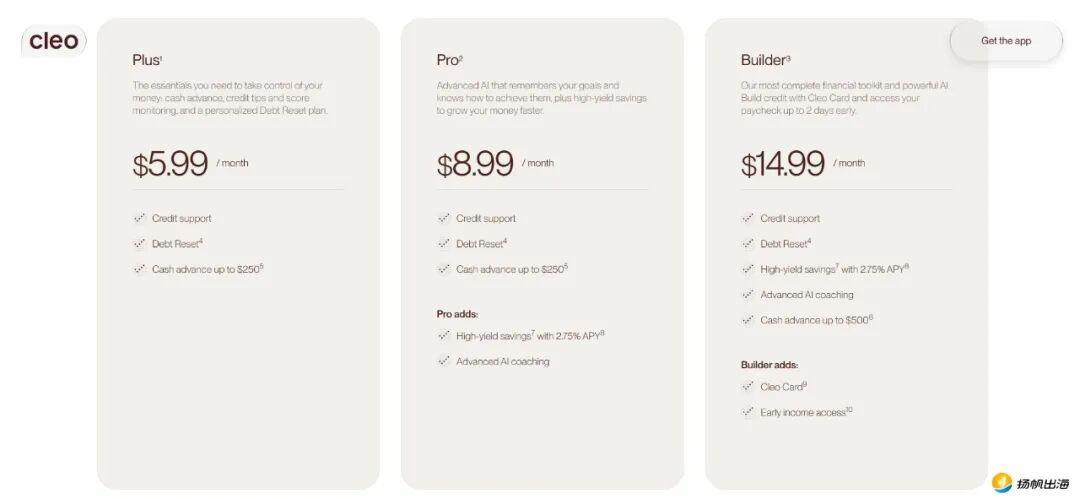
Cleo AI's paid plans. Source: Cleo AI official website
As a result, Cleo AI has formed a complete link: Expenditure data as the foundation → AI chat deepens relationships → Personalized financial advice → Monetization through subscriptions and financial services. From a free budget management tool, to a paid AI financial partner, and then to a financial service entry, Cleo AI has completed the upgrade from a tool product to an AI-driven financial platform.
Upgrading Financial Management Tools
How Can Mature Products Embed AI Capabilities and New Ideas?
In fact, by 2024, Cleo AI has achieved leapfrog growth, with its paid subscription users reaching 743,000, a significant year-on-year increase; the company's annual revenue reached 136 million USD, a year-on-year increase of 106%. What is more noteworthy behind today's Cleo AI is how a mature product that has been in operation for nearly 10 years completes positioning upgrading in the AI wave and further runs through the commercialization closed loop.
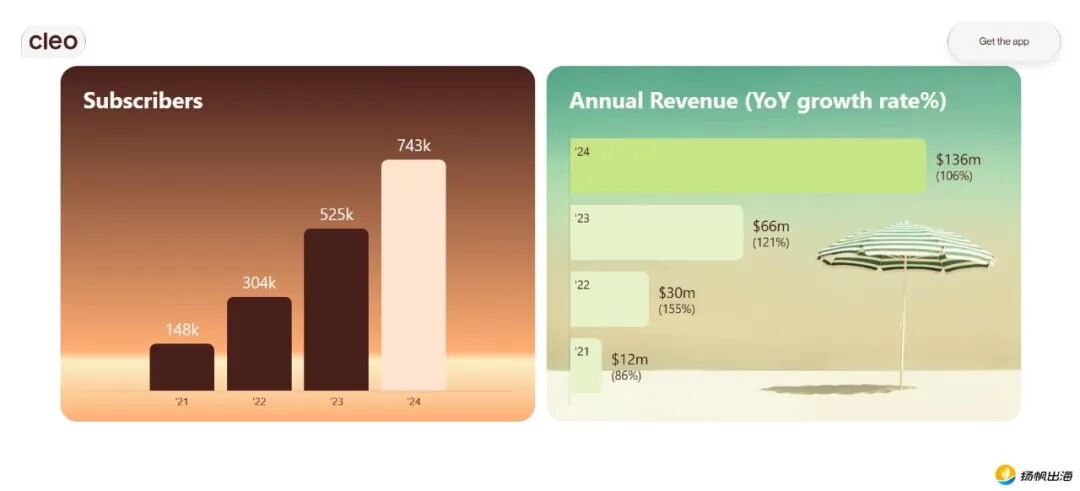
Cleo AI's 2024 subscriber and revenue data. Source: Cleo AI official website
When it was first founded in the UK in 2016, Cleo AI was a financial management tool based on chat interaction. In the early stage, Cleo AI mainly relied on channels such as Facebook and Messenger to help users check consumption, analyze expenditures and make budgets through chat. It already had the form of an "assistant", but it was more of an intelligent chatbot based on rules and data analysis.
This model was also recognized by the capital market. In 2017, Cleo AI completed a 2.8 million USD seed round of financing to promote product development. Subsequently, the company began to explore a more mature commercialization path.
In 2018, Cleo AI launched the paid subscription service Cleo Plus, turning originally free functions into a subscription model, and completed a 10 million USD Series A financing. A year later, the company launched its independent app on the US App Store, transforming from a chatbot into an AI financial assistant with a complete product entry.
As the scale of users in the US market expanded, Cleo AI completed a 44 million USD Series B financing in 2020 to accelerate the expansion of the US market and continuously improve services such as cash management and credit building. In 2022, it completed a 80 million USD Series C financing, bringing the company's valuation to 500 million USD.
With the continuous development of large model technology, Cleo AI began to further integrate intelligent interaction technology into the product core, including stronger natural language understanding, personalized financial analysis, and intelligent suggestions for different user scenarios.
Cleo 3.0, launched in 2025, further strengthens the product's AI capabilities, including stronger reasoning ability, more in-depth personalized experience, voice interaction, as well as functions such as debt reset, weekly Money IQ quiz. Cleo AI hopes to upgrade from a simple consumption management tool to an AI assistant that can help users deal with complex financial issues such as budget, savings and debt.
Behind the upgrade of AI capabilities, Cleo AI's commercialization progress continues to break through. According to the latest data on the company's official website, it has about 1.1 million paid subscription users and a team of more than 500 people. Its founder Barney Hussey-Yeo revealed at the Stripe Tour London conference held in June 2026 that the company's annual recurring revenue (ARR) has reached 400 million USD.

Cleo's ARR has reached 400 million USD. Source: dealroom.co
Paying 17 Million USD as "Tuition"
Regulatory Issues Faced by AI Financial Products
Clicking on Cleo AI's homepage on the US App Store, more than 250,000 users have given it a 4.7-point rating, indicating that this product has accumulated a certain degree of user recognition.
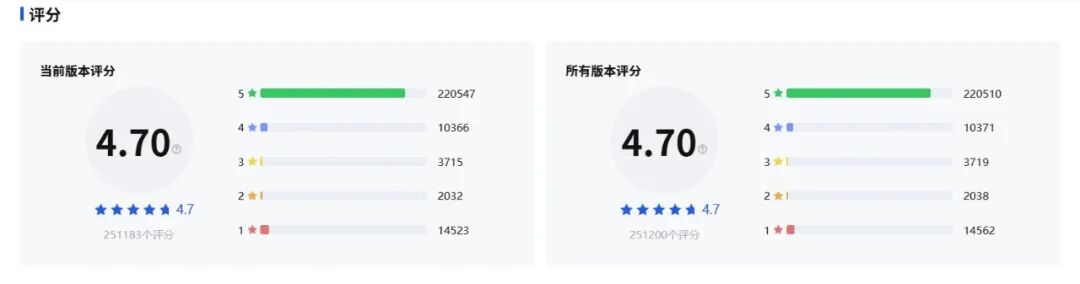
Cleo AI's US App Store rating. Source: Diandian Data
However, in 2025, the US Federal Trade Commission (FTC) once filed a charge against it, claiming that Cleo AI had deceptive practices regarding the amount of money consumers could obtain and the time required. The FTC stated that almost no one received the maximum amounts of 250 USD and 500 USD that the company advertised for customers of its Cleo Plus and Cleo Builder subscription services, and some total advance payments were only 20 USD.
Eventually, Cleo AI agreed to pay 17 million USD to settle the charges filed by the FTC. This fund will be used to provide refunds to consumers who have been harmed by the company's practices.
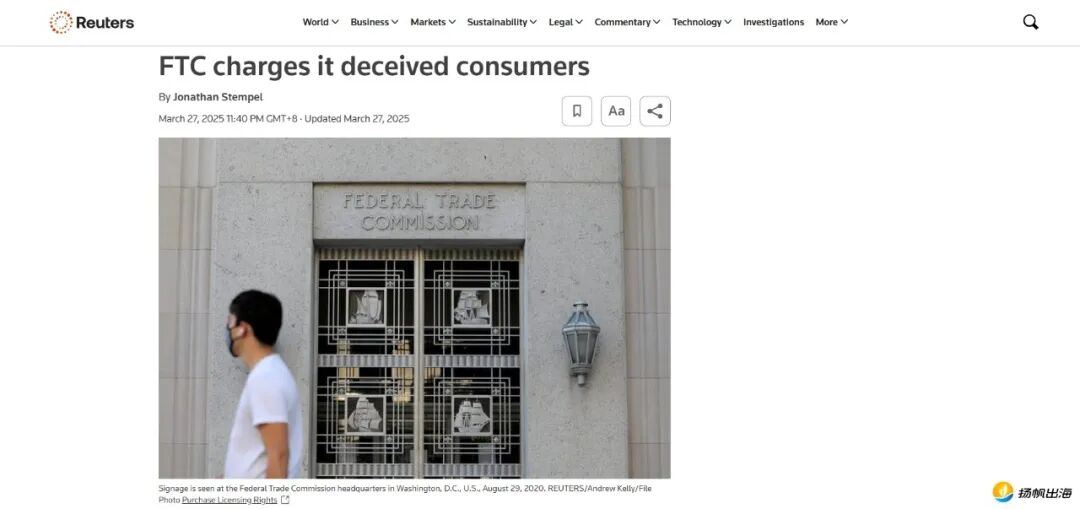
Reuters reported the settlement between FTC and Cleo AI. Source: Reuters
According to the complaint released by the FTC, the regulator mainly focused on three aspects.
First, there is a gap between the publicity of the cash advance limit and the actual service. The FTC believes that