GPT-5.6 and Fable have teamed up to solve a 25-year-old unsolved mathematical problem.
GPT-5.6 and Fable 5 have teamed up to solve a mathematical problem that has remained unsolved for 25 years.
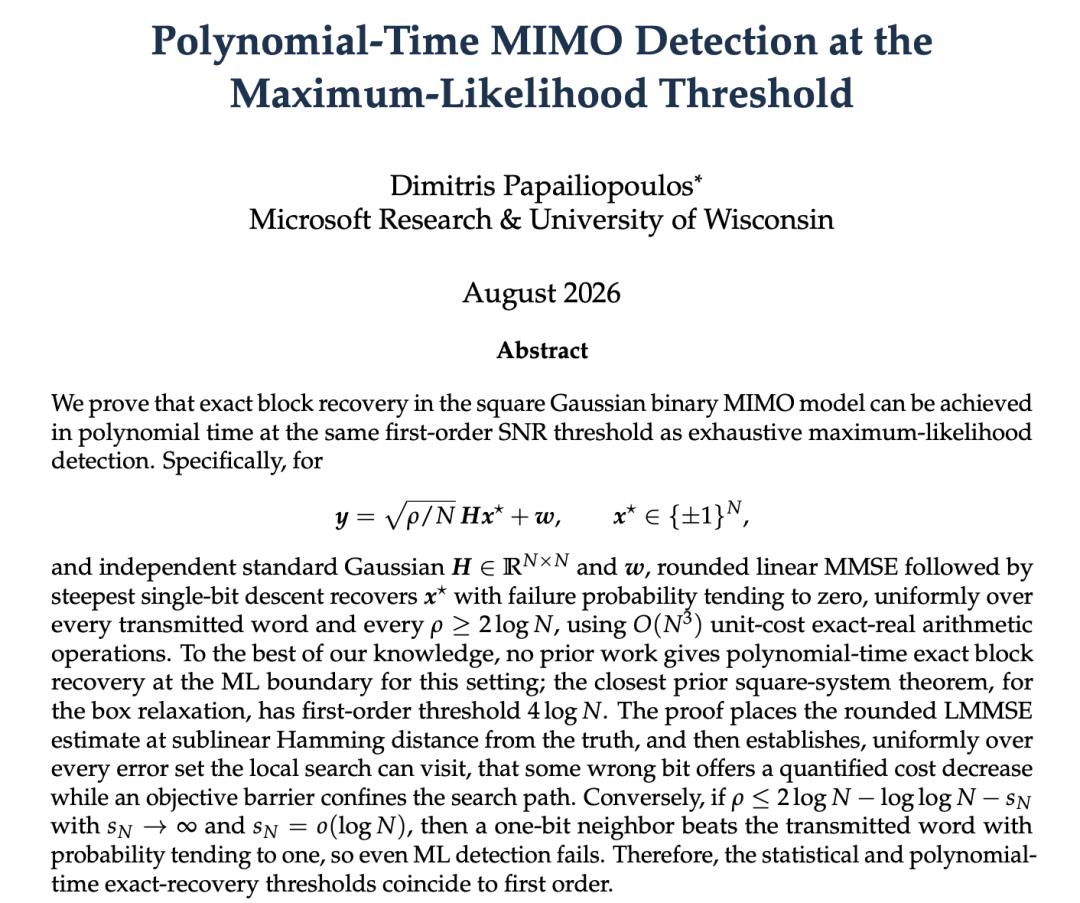
Dimitris Papailiopoulos, Principal Researcher at Microsoft Research, has proven that a polynomial-time algorithm can enable MIMO detection to precisely reach the maximum likelihood threshold.
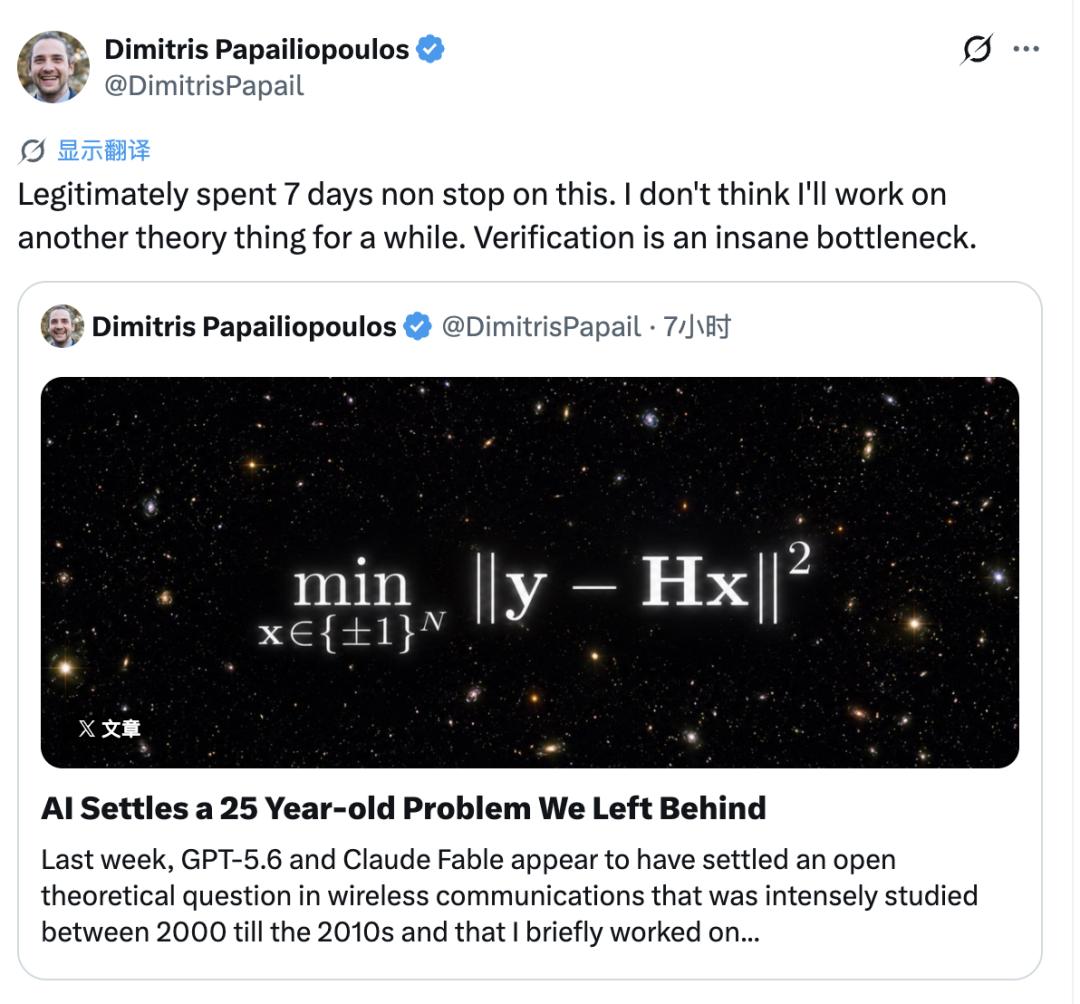
The author stated that the entire process took him a full seven days.
MIMO detection is a classic problem in the field of wireless communication, which requires the receiver to fully restore the original information sent by the transmitter from signals disturbed by noise.
Statistically, this operation is already feasible, but the methods used in the past relied on exhaustive search, which takes exponential time.
Therefore, the problem becomes whether it is possible to achieve restoration through a fast algorithm without exhaustive search.
In 2001, Hassibi and Vikalo thought they had found a breakthrough, but in 2005, Jaldén and Ottersten proved that this path was unworkable.
Since then, academia has successively tried semi-definite relaxation, bit-flipping local search, AMP, and statistical physics methods, and the closest result could only stay at a point twice as high as the theoretical threshold.
For 25 years, wave after wave of scholars have taken on this problem, but no one has managed to solve it.
For 25 Years, Exhaustive Search Was the Only Option
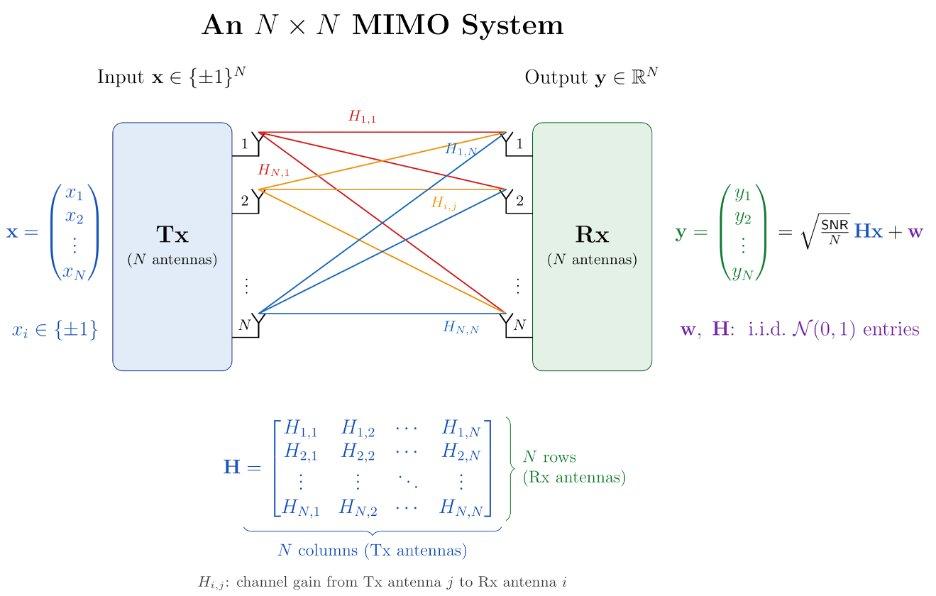
MIMO detection is a fundamental problem in wireless communication.
The transmitter sends N bits through an N×N channel, which mixes these bits together and adds noise;
The receiver only has a piece of disturbed signal at hand, and needs to retrieve the N bits originally sent by the transmitter without a single error.
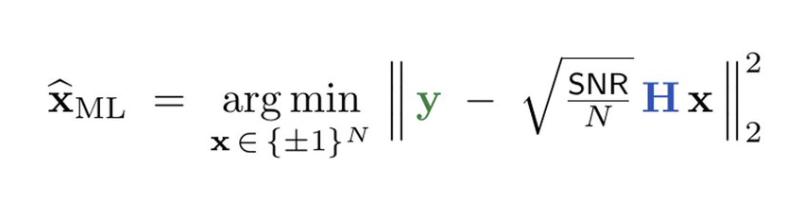
Theoretically, there is a foolproof method called maximum likelihood detection, which calculates all possible bit combinations and finds the one that best matches the received signal.
This method is guaranteed to find the correct answer, provided you are willing to wait — N bits mean 2 to the power of N combinations. When N is slightly larger, the exhaustive search will take an almost endless amount of time to complete.
In 1989, Sergio Verdú proved that this type of problem is NP-hard in the worst case, which means that no matter what algorithm is used, there are certain inputs that will cause the computational complexity to explode exponentially.
But the "worst case" refers to mathematically deliberately constructed channel matrices that are specifically designed to make algorithms difficult.
Real-world wireless channels are not deliberately constructed. Each attenuation and each noise is generated randomly, and will not pick the most computationally difficult cases to trouble the receiver.
Therefore, since the early 2000s, academia has been asking a more specific question —
If the channel is randomly generated, as long as it is statistically possible to restore the original bits, is it certain that an algorithm that does not require exhaustive search can be found?

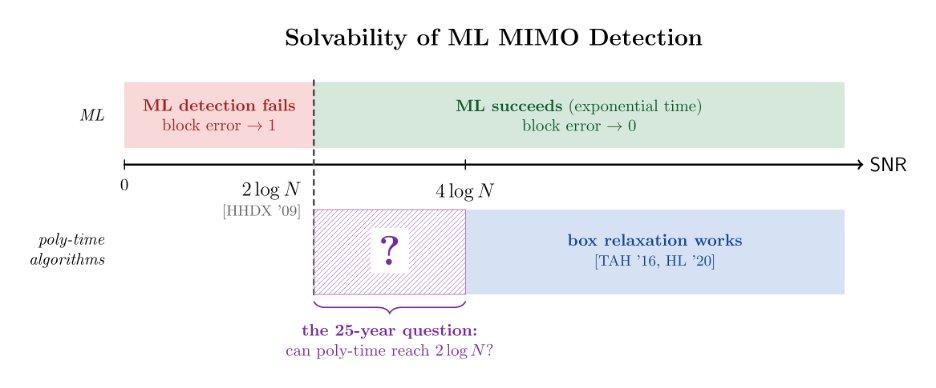
Subsequent research gave a precise dividing line: when the signal-to-noise ratio reaches 2logN, the probability that the transmitted bits can be fully restored approaches 1.
Below this line, even the maximum likelihood detection itself will begin to make mistakes. This dividing line is therefore called the maximum likelihood threshold.
The problem then becomes specific — can we design a fast algorithm that precisely hits the maximum likelihood threshold?
In 2001, Babak Hassibi and Haris Vikalo thought they had found the answer.
They analyzed an algorithm called sphere decoder.
This algorithm first draws a "sphere" around the received signal, and only searches the candidates inside the sphere, directly skipping those outside the sphere, thus narrowing the search scope through this step.
Hassibi and Vikalo derived the expected complexity formula of this algorithm, and the result appeared to be polynomial time.
If this conclusion holds, this problem would be largely solved.
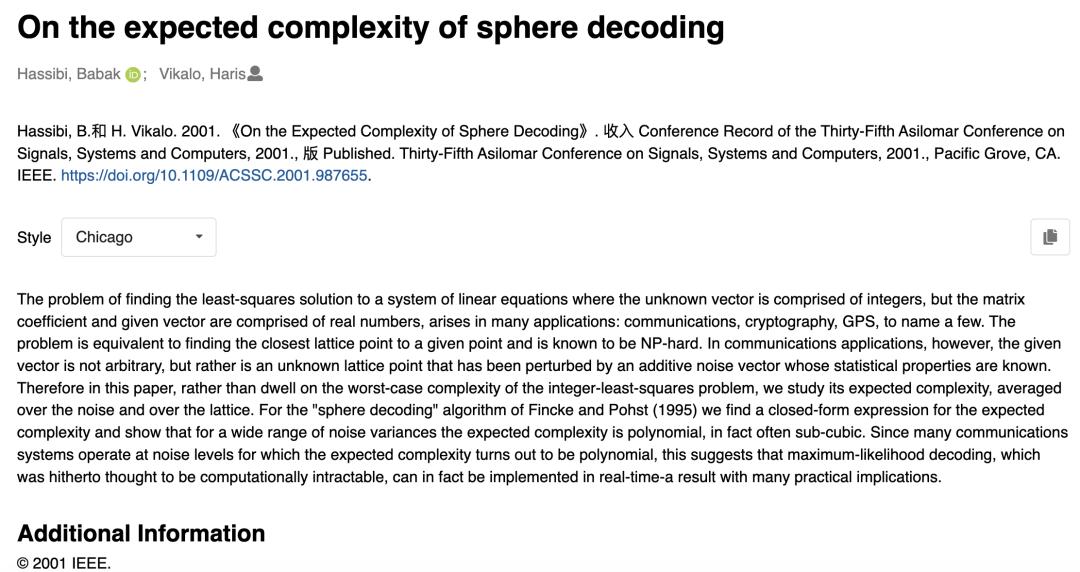
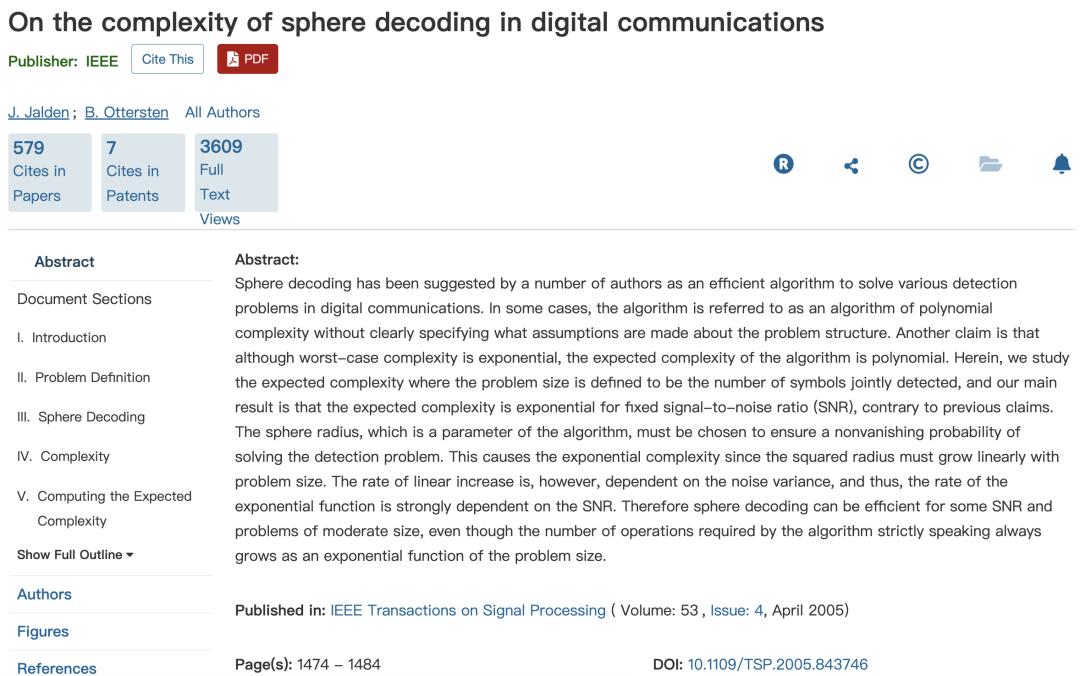
But in 2005, Joakim Jaldén and Björn Ottersten overturned this conclusion.
They proved that under any fixed signal-to-noise ratio, the expected complexity of sphere decoding is actually exponential, not polynomial.
The reason is that to enclose the transmitted signal in the "sphere" with a probability that does not approach zero, the radius of the sphere must increase with the size of the problem. Once the sphere becomes larger, the number of candidates to be searched inside the sphere will also grow exponentially.
After the path of sphere decoding became unworkable, academia turned to various approximate methods — semi-definite relaxation, bit-flipping local search, AMP (approximate message passing), and methods from statistical physics.
As a result, every method could produce elegant analysis, but none was proven to precisely match the 2logN threshold.
In 2020, a method called box relaxation, which solves discrete problems by relaxing them into continuous optimization problems, obtained the best strict proof result at that time, which can achieve precise restoration when the signal-to-noise ratio reaches 4logN, but its complexity is still twice the theoretical threshold.
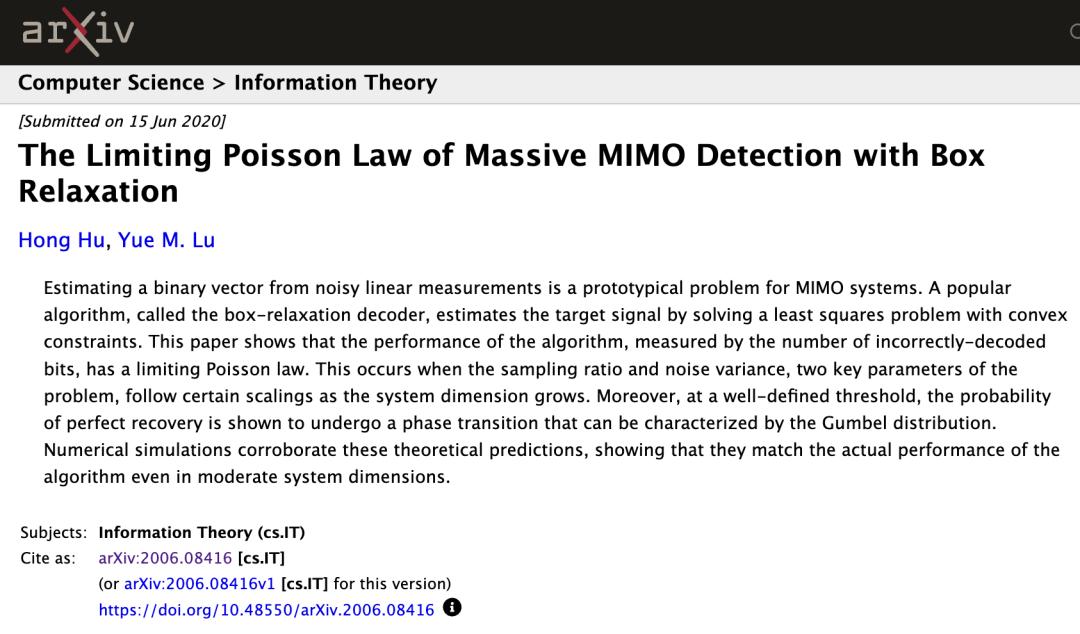
25 years later, there has always been this gap between being "statistically restorable" and being "restorable by a fast algorithm".
Last week, this gap was closed.
Dimitris Papailiopoulos, together with GPT-5.6 and Claude Fable 5, proved that a simple algorithm with only two steps can also restore all bits precisely when the signal-to-noise ratio is equal to 2logN, and it runs in polynomial time, requiring only O(N³) operations.
Moreover, this paper proves a two-way result.
On one hand, it proves that this algorithm can achieve precise signal restoration when the signal-to-noise ratio is equal to 2logN; on the other hand, it further proves that as long as the signal-to-noise ratio is slightly lower than the maximum likelihood threshold of 2logN, even the "stupid method" of maximum likelihood detection will begin to fail.
GPT-5.6 and Fable 5 Jointly Completed the Proof
Dimitris asked GPT-5.6 and Fable 5 to try this problem. The two models quickly came up with their own proof ideas respectively, but the subsequent polishing process was full of twists and turns.
GPT-5.6's approach used an algorithm called AMP, which is a type of tool whose analysis method Dimitris had never been able to fully master.
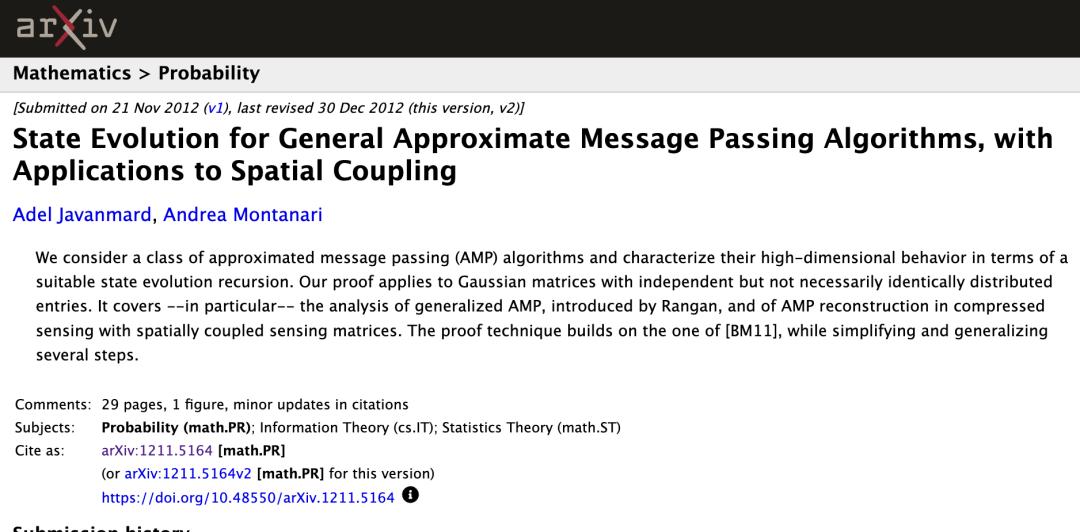
Fable 5 proposed a different approach, using "symbol LMMSE plus greedy bit-by-bit flipping", an old algorithm that has been actually used in the industry but has never been strictly proven.
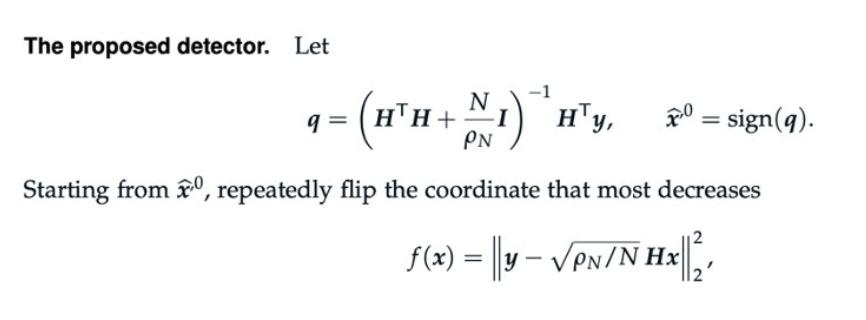
Both approaches provided complete proofs, claiming that precise restoration can be achieved at a signal-to-noise ratio of 2logN.
Dimitris finally chose the approach proposed by Fable, and let GPT take over to check and fix the loopholes inside.
GPT fixed the loopholes, but the proof after the fix became a "symbol wall": variables pointed to other variables, and those pointed variables pointed to even more variables, and it was full of matrix analysis tools that Dimitris could not understand.
In the following days, he repeatedly asked the two models to simplify each other's arguments, with the only bottom line being that no matter how the simplification was done, the 2logN threshold must be preserved in the end.
Apart from that, as long as he could understand it, any modification was acceptable.
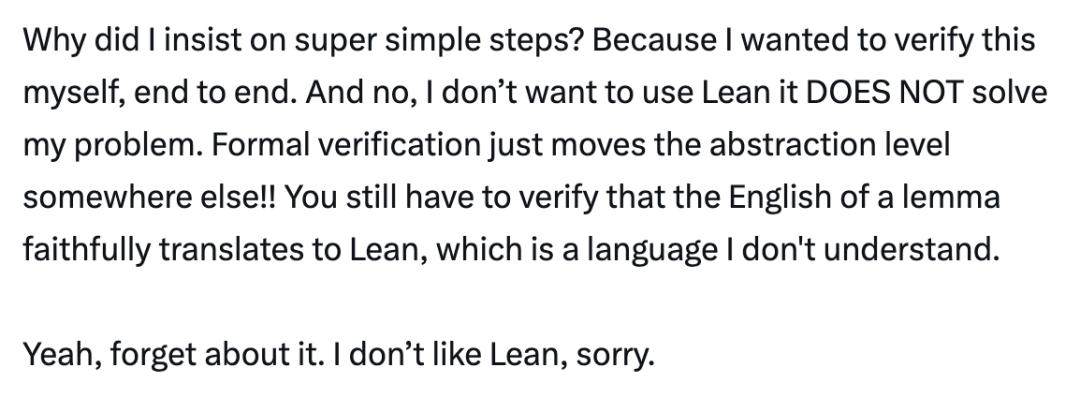
He also refused to use Lean for formal verification, and the reason was quite dramatic — because... he did not understand Lean.
Lean is a tool that allows computers to automatically check whether a mathematical proof is valid, but to use it, the proof must first be translated into a formal language that Lean can read.
This translation work itself could also be error-prone, and since Dimitris did not understand Lean, he could not check whether the translation was correct.
In short, after a week of tinkering, he finally got a proof that could be manually checked line by line.
Looking at it, this algorithm has only two core steps.
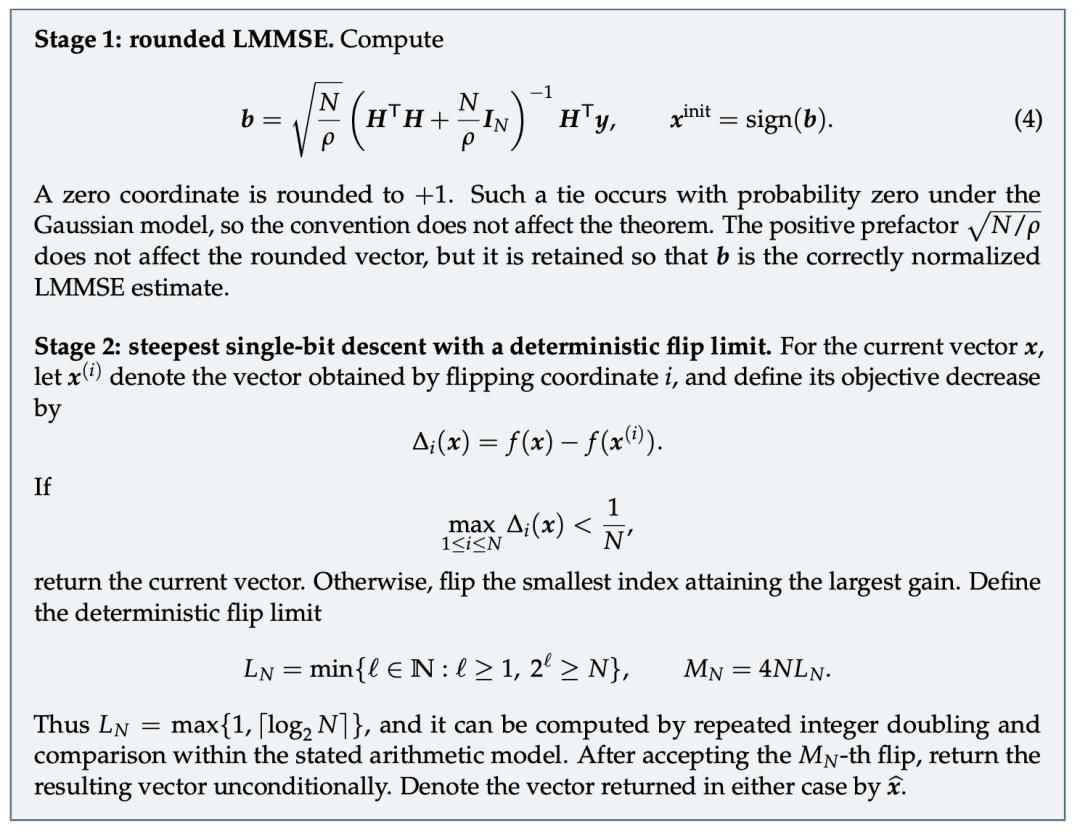
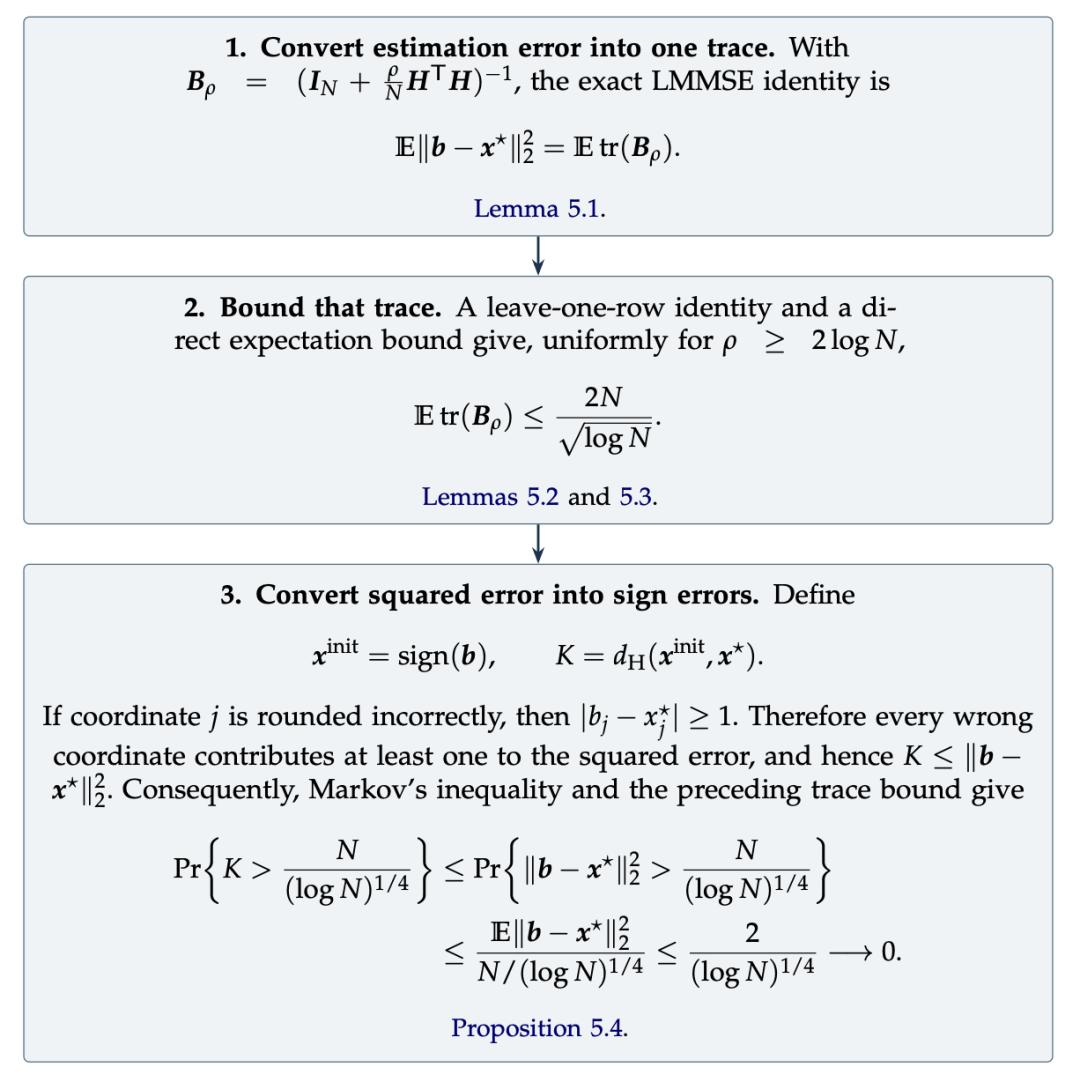
The first step is called LMMSE rounding.
LMMSE (linear minimum mean square error) is a standard estimation method in signal processing. It first gives a rough guess with continuous non-integer values, then rounds each coordinate to +1 or -1 according to its positive or negative sign.
This step does not need to guess every bit correctly precisely. The paper proves that the Hamming distance (the number of differing bits between two equal-length bit strings) between the rounded result and the real transmitted bits is only o(N).
In other words, as N increases, the proportion of incorrectly guessed bits in the total number of bits will approach zero.
The second step is called greedy bit-by-bit flipping.
This step starts from the guess given in the first step. In each round, all N bits are checked to find which bit's flipping can reduce the cost function (a value that measures the matching degree between the current guess and the received signal, the smaller the value, the better the match) the most, then flip that bit, and repeat this process.
