1.8 million US dollars, even Amazon can no longer afford to keep burning money on Claude.
The price of paper has skyrocketed, and the explosive growth of Agent usage has become a nightmare for tech companies, which have unfortunately discovered: It turns out that compared to AI, the biggest advantage of human beings is that they can defer wage payments (x).

AI does not understand emotional sentiments, and Silicon Valley does not believe in tears.
Recently, Amazon, which generates more than 700 billion US dollars in annual revenue and has a massive business scale, was also brutally beaten by Claude.
According to employees at Amazon, the company recently wanted to use Claude Sonnet to populate detailed author information for its own website.
But this seemingly simple task ended up costing Amazon 1.8 million US dollars.
Which exceeded the budget by 860%.
And the overspending was not detected until 5 months later.
Finally, the task was never successfully deployed. (In any case, this already looks more like a management problem.)

An Agent might fail, but it will also tenaciously keep retrying over and over day and night. It was a calm, uneventful day, and no one warned it "Please wait before trying again".
At present, the public price of Claude Sonnet is about 3 US dollars per million input tokens and 15 US dollars per million output tokens. The 1.8 million US dollars could burn up to 600 billion tokens at most — in terms of data volume alone, that is twice the size of the entire training corpus of GPT-3.
Cases like this have occurred many times inside Amazon, and these bugs often go unnoticed for a very long time.
It is extremely difficult for us to figure out exactly how much we have spent on anything related to AI. Small issues that are insignificant in traditional systems can lead to unimaginable costs when implemented with AI.
The Automation Dream of the Everything Store
Even so, these incidents cannot stop Amazon's pace of automation. Today, it is betting on AI at an unprecedented scale.
CEO Andy Jassy announced that Amazon's 2026 capital expenditure is expected to be around 220 billion US dollars, the vast majority of which will be invested in AWS (Amazon Web Services), self-developed AI chips and power infrastructure, representing a nearly 60% increase from 2025, making it the highest single-year capital expenditure among global large-cap companies.

This massive investment has also yielded better-than-expected returns. Just this morning, Amazon released its Q2 financial results for the period ending June 30, 2026. The data shows that AWS posted net sales of 42.2 billion US dollars in the second quarter, up 37% year on year. Moreover, of Amazon's total operating profit of 27.5 billion US dollars, AWS contributed roughly 60%, even though its revenue only accounts for 21% of the company's total revenue.
At the same time, Amazon has carried out two rounds of large-scale layoffs since October 2025, cutting a total of about 30,000 positions.
As early as last year, Jassy himself laid out a bright outlook, writing in a memo to all employees:
We already have more than 1,000 generative AI services today, but at our scale, this is just the tip of the iceberg. In the future, billions of Agents will be running on Amazon.
Not only that, this wave of automation has moved beyond the office and into Amazon's warehousing and logistics systems.
According to reports, Amazon's robotics division aims to achieve around 75% automation of warehousing operations by around 2033. That means Amazon will hire about 160,000 fewer employees in the United States by 2027, and more than 600,000 fewer by 2033.
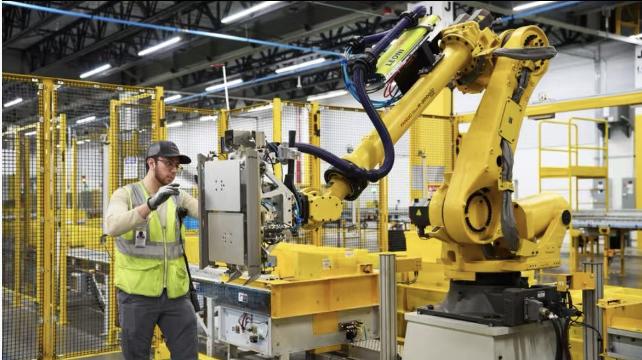
Amazon's factory
However, external observers have harsher judgments. Daron Acemoglu, the 2024 Nobel laureate in Economics and professor at MIT, warned when commenting on this plan: "If Amazon's automation dream comes true, the largest employer in the United States will turn from a net job creator into a 'net job destroyer'."
Is the era of judging performance by token consumption over? Major tech companies are starting to lock down usage
Amazon's cost overrun is not an isolated case. As early as the beginning of this year, such out-of-control token consumption occurred simultaneously at several large tech firms.
Usually, these farces all start with this sentence:
Everyone, we must use AI "as much as possible", and create "as much deep value as possible" with "as small a team as possible"!
Then, employees spontaneously built usage leaderboards, and nicknames like "Token Burning Legend", "Cache Overlord", "AFK Immortal" quickly became coveted titles that everyone competed for.
Eventually, bosses were shocked by the diligence of their own employees, and quickly announced the end of the competition with emergency statements.

Image generated by AI
Goodhart's Law, proposed by economist Charles Goodhart in 1975: When a measure becomes a target, it ceases to be a good measure.
Amazon once had an informal leaderboard called "KiroRank", which led some employees to deliberately inflate their personal metrics. Later, KiroRank was shut down, and Amazon, which is best at manipulating metrics, launched "normalized deployments" to measure employees' AI output.
In April this year, a Meta employee built a leaderboard called Claudeonomics, aggregating AI usage data from more than 85,000 employees and listing the top 250 users with the highest token consumption. During that period, the total amount of tokens consumed by Meta employees in 30 days climbed to 73.7 trillion.
Calculated based on the public pricing of Anthropic, this figure corresponds to a bill of approximately 221 million US dollars per month.
In June, Meta sent an official memo to about 6,000 employees, announcing that it would set limits on token usage and build a central "AI Gateway" platform to monitor the AI usage and spending of each team in real time, setting budgets and caps.
This out-of-control situation is not limited to companies that have leaderboards. Uber burned through its full-year AI programming budget in the first four months of 2026, and subsequently set a spending cap of 1,500 US dollars per month for each employee and each tool. Its COO admitted frankly that the connection between token spending and measurable output has not yet taken shape.
And this overly smooth "sense of loss of control" is also deeply felt by the model providers themselves.
On June 3, Sam Altman said that the AI cost issue was completely ignored by everyone at the beginning of this year, but it has now become a huge problem.
He revealed that the top individual power user inside OpenAI consumes about 100 billion tokens per month. One employee even burned through about 210 billion tokens in a single week.

Image generated by AI
In less than a year, Silicon Valley has begun to count every penny on AI usage. Compared with the excitement at the beginning of the year when people were like primitive humans who just discovered fire, it has now been replaced by budgets, caps, approvals and dashboards.
A survey shows that only 26% of enterprises have full visibility into their AI costs.
In other words, most companies do not even know exactly how much they have spent before they start cutting costs.
Does higher automation mean higher efficiency?
On August 1, 2012, Knight Capital Group, one of the largest stock market makers in the United States, updated its automated trading system to participate in the New York Stock Exchange's retail liquidity program.
During the deployment process, engineers accidentally activated a piece of old code. Then, this code started to automatically execute a series of trading instructions with no economic logic at an extremely high frequency.
"Buy at high prices, sell at low prices", without any preset stop-loss mechanism or amount cap. The whole process lasted for about 45 minutes from market open until it was manually shut down.
During this period, the system executed more than 4 million trades across 154 stocks, accumulating about 7 billion US dollars in stock positions that the company had no intention of holding at all.

When engineers finally located the problem and shut down the system, Knight Capital had to sell off these positions at low prices. After closing out all positions, the total loss was about 440 million US dollars, which was three times the company's full-year profit.
In the two trading days after the news was released, Knight Capital's market value evaporated by 75%. A few months later, Knight Capital was acquired by its then competitor GETCO, ending its 17-year legendary operation.
Generally speaking, automation promises people faster speed, lower costs and fewer human errors.
However, when an automated system malfunctions, losses will also be magnified at the same speed, scale and efficiency.
For Amazon, this tuition fee is probably not a bad deal.
Reference Links:
[1]https://www.ft.com/content/77baac40-d803-4084-94f3-a133653072cf?syn-25a6b1a6=1
[2]https://www.aboutamazon.com/news/company-news/amazon-ceo-andy-jassy-on-generative-ai
[3]https://agidaily.cc/articles/tokenmaxxing-end-ai-usage-caps-2026
[4]https://www.cnbc.com/2026/07/30/amazon-amzn-q2-earnings-report-2026.html
[5]https://www.thestreet.com/technology/amazon-joins-microsoft-in-sending-shocking-message-to-employees
This article is from the WeChat public account "QbitAI", written by Cheng Qian, authorized for release by 36Kr.