Today, the Internet no longer belongs exclusively to humans, and Cloudflare has officially confirmed that machine-generated traffic has surpassed human traffic.
Is the internet no longer going to belong to humans?
In five years, humans will become an "error term" on the internet.
At the Q2 2026 earnings call, Thomas Seifert, CFO of Cloudflare, dropped a blunt remark to investors.
Who is Cloudflare?
More than one-fifth of all websites worldwide route their traffic through its vast network — and on this very network, over half of the traffic is no longer generated by humans.
This is the first time that machine traffic has outpaced human traffic in Cloudflare's observations.
What is even more notable is the timeline.
Cloudflare CEO Matthew Prince originally predicted that this threshold would not be crossed until the end of 2027, then revised his forecast to early 2027. In May 2026, his team came to tell him directly: the threshold had already been crossed.
"It happened far faster than I expected."
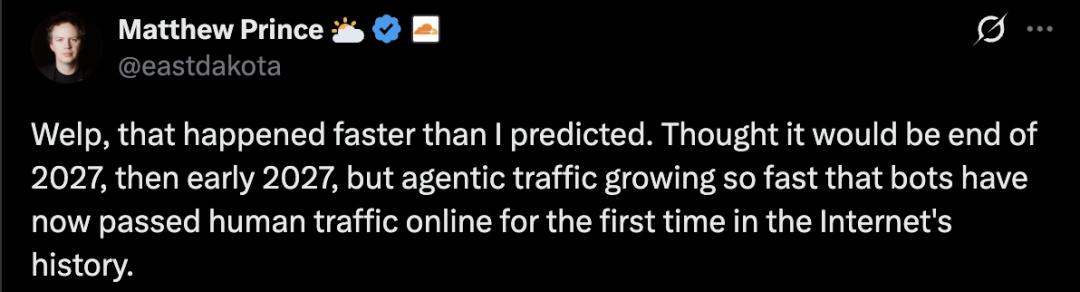
This crossing of the threshold came more than a year earlier than Prince's own prediction. And Seifert's remark that "humans will become an error term" is derived directly from this momentum:
If this growth continues, in five years, machine traffic will be 1000 times that of human traffic.
This means that the websites you browse every day, the links you click, and the ID that argues with you in the comment section will most likely no longer belong to a human.
Diluted by 1000 times more machine traffic, your traces on the internet will shrink to a mere "error term".
You Think You Are Surfing the Internet
In Fact, Machines Are Surfing It
This extra machine traffic did not appear out of nowhere. Most of it is generated by the AI you call upon.
Prince once gave a very vivid analogy.
If you want to buy a digital camera, you might open 5 websites to compare prices. But if you leave this task to AI, it will visit 5000 websites on your behalf.
A single human thought is amplified into thousands of machine actions.
This is the real reason for the total reversal of traffic: it is not that billions of new internet users have been added, but that behind every person, there is a tireless army of agents.
Therefore, the real change is that surfing the internet is shifting from "you go there yourself" to "send a machine to go there".
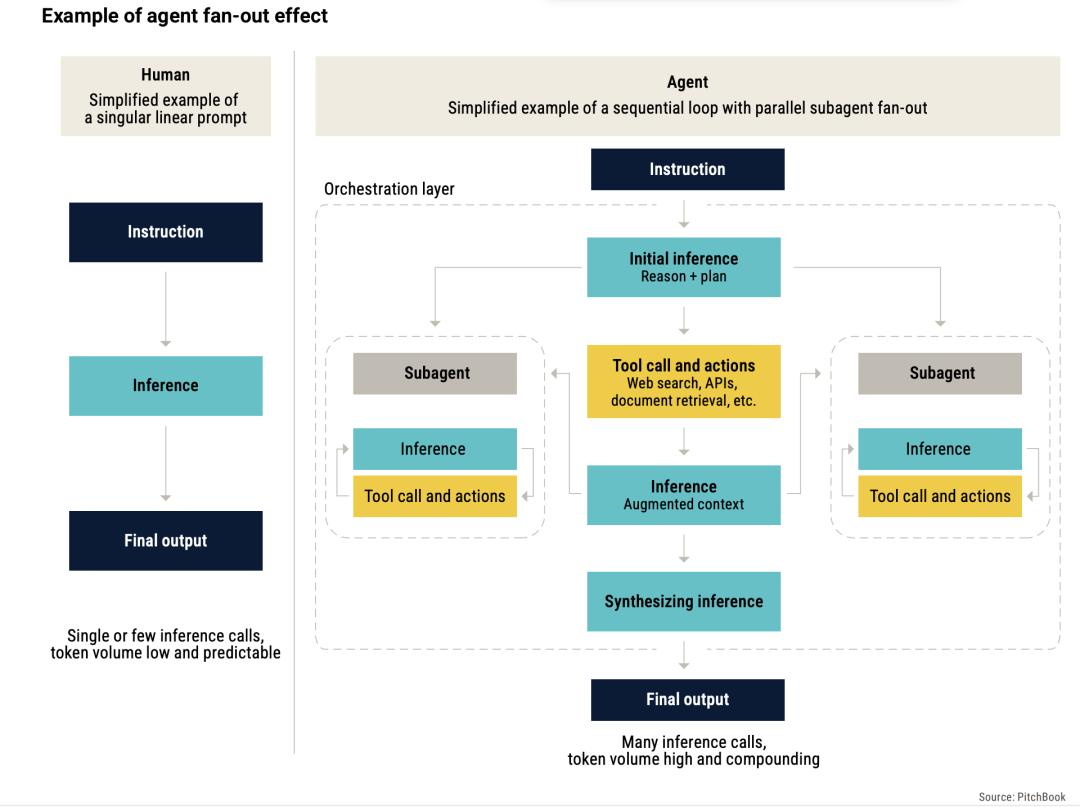
Pitchbook breaks down the "fan-out effect" of agents: on the left, a human makes several calls in a straight line; on the right, a single instruction is split into planning, tool calling, parallel sub-agents, and then aggregation, rolling into dozens or hundreds of machine actions.
Over the past three decades, internet pages have been designed for humans. The layout must be aesthetically pleasing, the interaction must be user-friendly, and advertisements must be designed to keep you browsing for three more seconds.
But now, more and more "visitors" have no eyes at all. They do not look at the layout, do not stay for the design, and leave immediately after grabbing the data.
This set of rules made for humans has failed for the first time in front of machines.
The Dead Internet Theory
Has Turned From a Joke Into Reality
There has long been a prediction about machine traffic online, called the "Dead Internet Theory".
It means that the seemingly lively internet you see actually has most of its content generated by machines, most of its interactions generated by bots, and real humans have long been a minority.
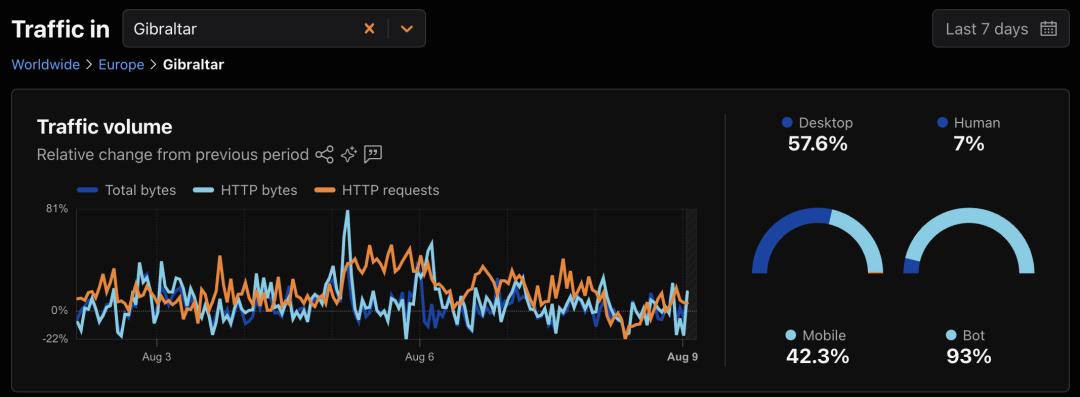
In web requests from Gibraltar, machines account for 93% and humans only 7%. The "Dead Internet" is no longer a prediction in some places.
This conspiracy theory that has been ridiculed for many years has been brought up again and again in the AI era, and now it has entered earnings calls, becoming a number presented to investors.
You may have already experienced this: endless AI-generated images and texts, comment section accounts with weird tones that look like copy-pasted content, likes and reposts that pop up overnight, etc.
A Platform Migration on the Same Scale as the Shift From Desktop to Mobile
Cloudflare announced on the call that over 50% of traffic is not generated by humans.
But on its public Radar data page, the caliber of the "Machines vs Humans" chart is clearly stated: it only counts HTTP requests that return HTML content.
In other words, it only counts the "webpage request" action itself. Ancillary requests for images, scripts, and fonts are not included, nor are machine-to-machine traffic such as API calls.
The judging criteria are: each request is assigned a Bot Score, with 1 to 29 points counted as "most likely a machine", and scores above 30 counted as "most likely a human".
Therefore, a more accurate statement is that among HTTP requests returning HTML on the Cloudflare network, according to its own scoring standards, machines account for more than half.
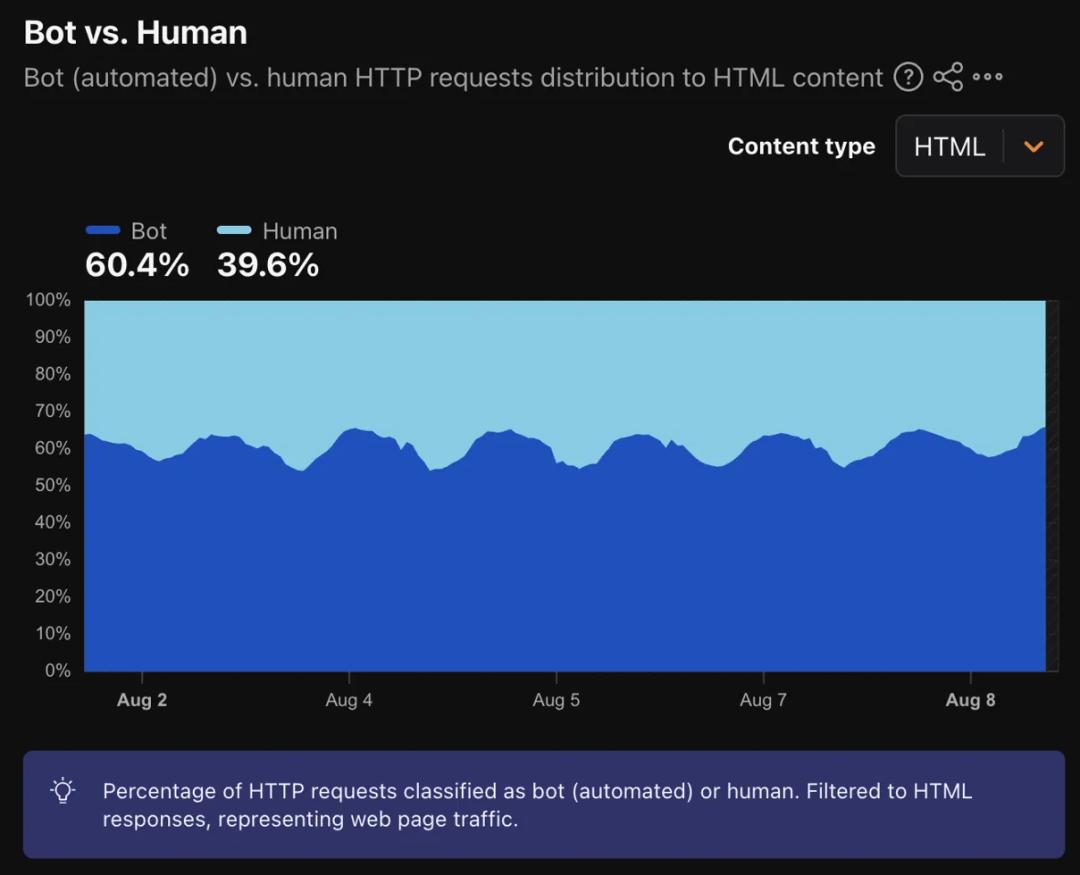
Radar's real-time "Machines vs Humans" chart, under this caliber, machines account for 60.4% and humans 39.6%.
And this half of the traffic is not all from AI. It also includes search engine crawlers, website monitoring programs, security scanners, and malicious scripts that do harm, a bunch of "old faces".
But the fastest growing and most game-changing force is undoubtedly AI.
According to the 2026 report from cybersecurity firm HUMAN Security, among AI-driven traffic, training crawlers still account for about 67.5%, but their share is declining; real-time scraping crawlers have increased by 597% year on year; and the traffic of "AI agents" that can actually click links, fill out forms, and place orders and pay on their own has skyrocketed by 7851% year on year.
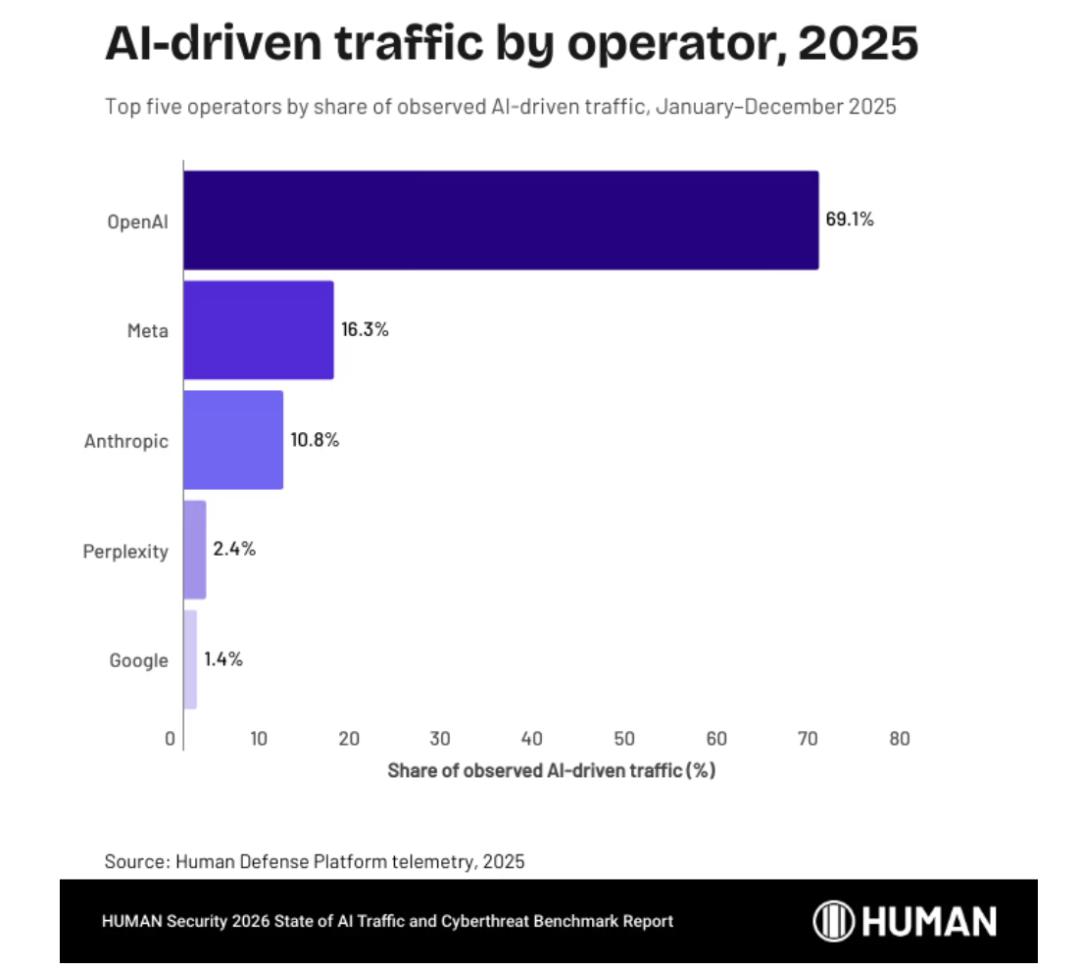
Among the observed AI bot traffic, OpenAI accounts for about 69%, Meta about 16%, and Anthropic about 11%. (Source: HUMAN Security 2026 State of AI Traffic Report)
The concentration of these observed bot traffic is surprisingly high.
OpenAI alone accounts for about 69%, Meta about 16%, Anthropic about 11%, and the remaining dozens of companies add up to less than 5%.
In other words, three AI companies are reading the internet on behalf of all people.
Prince describes this as a platform migration of the same magnitude as the "shift from desktop to mobile".
The difference lies in speed: the shift from PC to mobile took ten years, while this one is completed in just a few months.
The Internet Is Starting to Be Renovated
When the visitors change, the internet has to be renovated to cater to the tastes of the new visitors.
This is already happening.
More and more websites are starting to provide special content formats dedicated to AI, translating the fancy pages for humans into plain text that machines can consume in one go.
The craft of search engine optimization is also quietly changing. It used to be "how to get humans to find me", but now it has become "how to get AI to cite me in its answers".
When the service target of content changes from human readers to "models", much of the content you see online in the future will not be written for you at all, but for the AI that works on your behalf.
You only take a quick glance at the conclusions it has sorted out. From now on, there is a layer of machine intermediary between you and information.
The Old Model of the Internet
Is Coming to an End
There is also a more practical problem hidden here.
Over the past 20+ years, the internet has been able to serve you for free thanks to a tacit exchange:
You watch advertisements, websites earn advertising fees to sustain their operations, and then deliver content to you for free.
This exchange has a default premise: the people who come to read the content are humans. Humans watch ads, and humans make impulse purchases.
But machines do not watch ads, let alone make impulsive purchases just because they see a product they have been longing for. When most of the visitors are machines, the foundation of the advertising business begins to shake.
Prince said bluntly that the old internet model defined by Google and supported by advertising for nearly 30 years is coming to an end.
The new version he proposed is: machine-to-machine, pay-per-request. A small toll as low as a fraction of a cent is charged for every AI request that passes through.
In fact, Cloudflare has already started building this toll booth, and has launched a complete set of systems that "make AI pay for each request".
Prince even stated that he wants to build a payment network three orders of magnitude larger than Visa, dedicated to serving machines.
We spent 30 years moving the entire world onto the internet. Then in less than three years, we turned it into a place primarily for machines.
So, what is the foundation of this new internet?
Investment bank Pitchbook gives a term: the machine economy.
How big is this economy right now? Startup Forsy estimates that the current global "agent GDP" is about 36 billion US dollars per year.
That sounds quite large, but only about 1% of the tasks that AI can actually take over are currently being run by agents.

Only 1% of the payment side has been realized. On the traffic side, tens of millions of requests pass through every second, and almost none of them are charged.
Although the market is still small, its growth slope is already very steep.
Data from payment company Stripe shows that 70% of command-line requests now come from agents.
The previous generation of the internet was sustained by humans watching advertisements; the next one will likely be sustained by machines paying tolls.
Humans will not disappear from the internet. But from now on, we are no longer the only paying users.
And the definition of web traffic will also be redefined.
References:
https://radar.cloudflare.com/
https://x.com/eastdakota/status/2062212701414187452
https://www.humansecurity.com/learn/resources/2026-state-of-ai-traffic-cyberthreat-benchmarks/
https://pitchbook.brightspotcdn.com/9e/4f/cbd3ad0d49e3aba868c3f07f0d19/q3-2026-machine-economy-rising-the-market-of-limitless-cognition.pdf
This article is from the WeChat official account "Xinzhenyuan", written by ASI Revelation, edited by Yuan Yu, and published with authorization from 36Kr.