A brief chat about Apple's "Announced Protection"
Yesterday afternoon, someone spotted a new document on Apple's official China website titled "Use Qwen Intelligently with Apple Intelligence on Mac".
Guess how long it stayed up? Less than 24 hours.
This morning, the document had already vanished from Apple's official website. If you click the original link, the page redirects directly to the homepage of the Mac User Guide, and the section that previously mentioned Qwen is gone.
It's almost as if nothing ever happened. The fact is, it did happen, and the document was extremely detailed, a complete step-by-step operation manual.
It states that to use this set of capabilities, there are requirements for the device, system version, region, and the region of your Apple account; after integration, Qwen will be accessible in Siri and writing tools.
When Siri encounters issues it cannot handle on its own that are suitable for Qwen to address, it will ask for your consent; in apps like Notes and Mail, you can also directly invoke the relevant capabilities to process text and content.
Even the privacy-related descriptions were already included in the document. But it was taken down in less than a day. Isn't that quite surreal?
What's more interesting is the reaction after the document was released.
From the afternoon to the evening of August 8, media outlets at home and abroad quickly picked up the story. Reuters even directly titled its report: Apple says Mac users in China can connect to Alibaba's Qwen AI service.
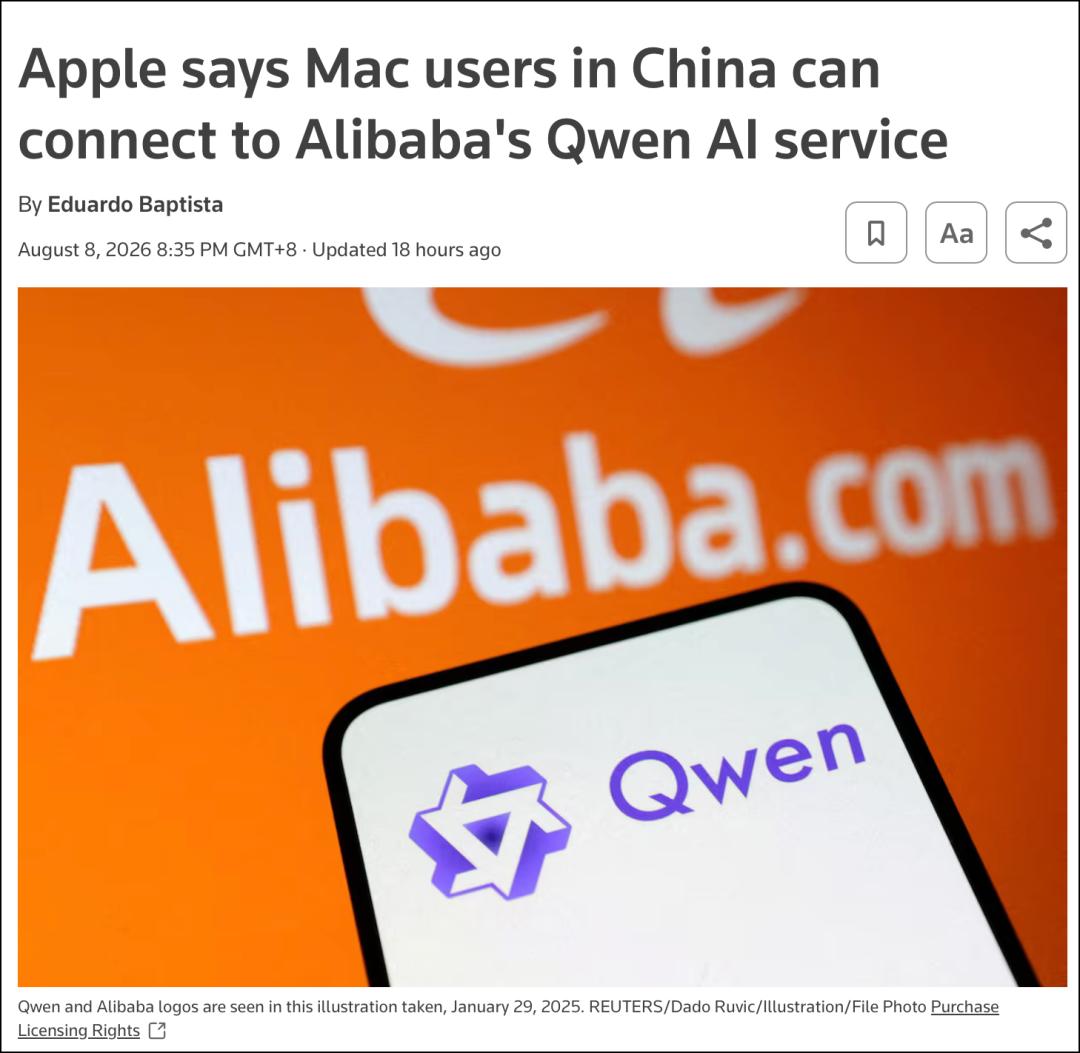
Note: An operation manual turned into "Apple says" in Reuters' coverage.
Apple did not hold a press conference, issue a press release, or make an official announcement specifically stating that "the China version of Apple Intelligence is officially integrated with Qwen".
It only launched a technical support document, but at the next stop of the communication chain, the operation manual had already been framed as a statement "from Apple".
Domestic media headlines were even more straightforward, with all sorts of terms popping up such as official announcement, first time, formal, and partnership.
A friend texted me yesterday and asked:
Apple chose Qwen, so what role does Baidu play in this? Will Baidu still be involved? Previously both companies publicly stated that they are cooperating with Apple, but this technical document only mentions Qwen. Where is Baidu in all this?
I understand his confusion. Apple never explains these things to you proactively.
I specifically called Apple's official customer service, and the representative said that the company will notify everyone in advance when there is a feature release or a new project launch.
There has been no notification about this content so far, and the feature may still take some time to roll out. To put it another way: the company has not made any official statement on this matter.
Here comes the question: Why is Apple so sensitive about "who gets to speak first"?
.......
You may think this is part of Apple's corporate personality. Everyone knows it is obsessed with confidentiality. This was the case in the Steve Jobs era, and it did not change after Tim Cook took office.
I did some recent research and found that this matter is far more specific than just the four words "confidentiality culture".
In July 2025, a job posting appeared on Apple's official website with the title: Secrecy Program Manager.
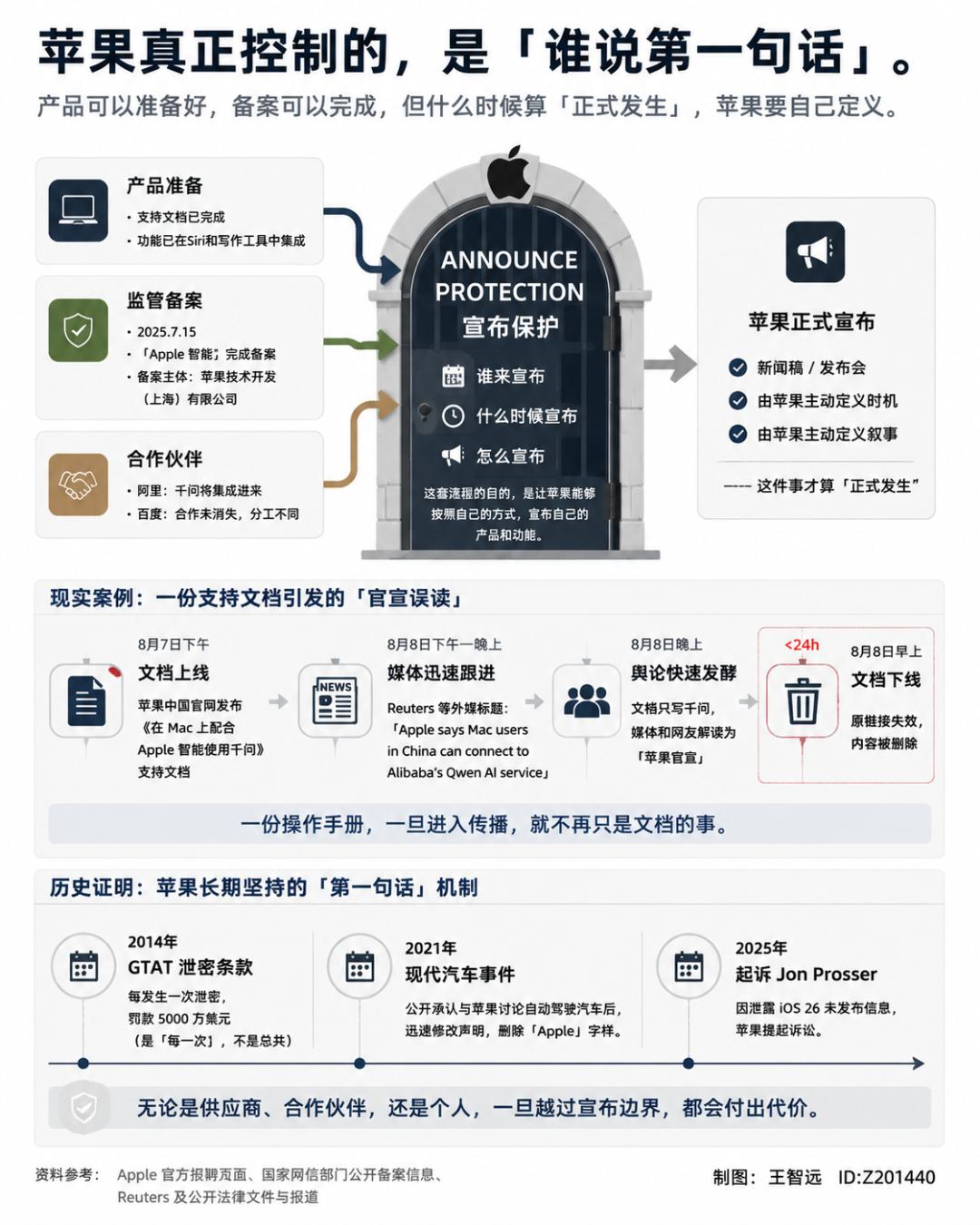
The role belongs to the New Product Security team, and this position is responsible for one core task: Announce protection.
There is an even more straightforward statement later in the job description:
The purpose of this process is to allow Apple to announce its products and features in its own way.
Think about it. Apple has even turned "how to make an announcement" into a dedicated management position. What it wants to control is: When this matter becomes news, in what form it becomes news, and who gets to say the first word.
This is not something that just started today.
In 2014, Apple signed a contract with a US company called GTAT.
This company manufactured sapphire glass for Apple, and one clause in the contract stipulated that every single leak would result in a penalty of 50 million US dollars. A penalty. Note that it is per leak, not a total sum.
Later GTAT went bankrupt. In the bankruptcy court, the company's lawyer tried to explain to the judge how they ended up in this situation, but could not make any valid explanation.
Because the non-disclosure agreement signed with Apple explicitly stated that you cannot say anything related to Apple in public, not even in court. The judge asked, what on earth went wrong then? The lawyer could only shake his head.
A representative from Apple once said to GTAT's management, a quote that was later documented in the bankruptcy filings: "Put on your big boy pants and accept this agreement."
In other words: Know exactly who you are doing business with.
Let's move on to Hyundai Motor. In 2021, Hyundai publicly acknowledged that it was in early-stage discussions with Apple about self-driving electric vehicles.
It sounds like they didn't reveal much, just a simple statement that "we are in talks".
But soon Hyundai revised its statement, removed Apple's name, and only kept vague wording such as "in contact with multiple companies".
This detail is particularly interesting, because Hyundai did not leak what the Apple Car looks like, it only confirmed one thing in advance: We have a relationship with Apple.
That was already sensitive enough.
Now let's look at more recent events. In 2025, Apple even sued YouTuber Jon Prosser over leaked information about the unreleased iOS 26, accusing him of trade secret misappropriation and unauthorized access to internal development version information.
In other words, this system is still fully operational to this day, even though Steve Jobs is no longer with us.
The rule never left. To understand Apple, you cannot only look at how strict its confidentiality measures are. Confidentiality is only the first layer. The second layer is that it wants to make information part of the product itself.
When to tell you, how much to tell you, whether to introduce the features first or the partners first, who is allowed to reference Apple's name, and at what exact moment this matter can be defined as officially happening — all of these are part of the launch process.
This is also why a single support document can become so sensitive.
For ordinary companies, an operation manual is just an operation manual. But for a company like Apple, as long as the content is hosted on apple.com, the media will treat it as a factual source.
Once this matter enters the public communication cycle, it is no longer just about a single document.
You can see that from this incident. The document only mentioned Qwen, and the public immediately started asking where Baidu was.
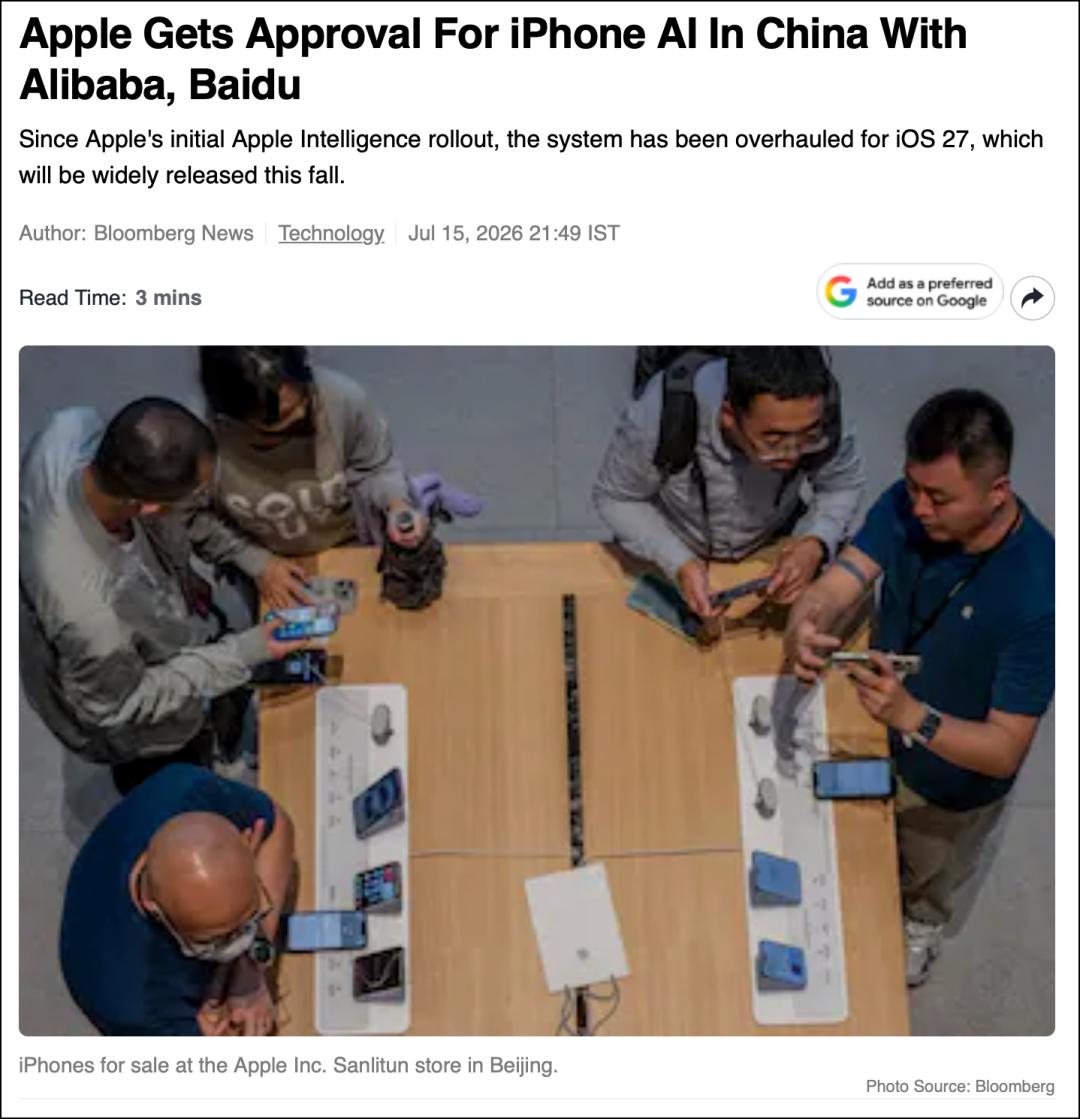
Note: Bloomberg's previous reports on Apple's cooperation with Alibaba and Baidu for China-focused AI services.
Let me sort out the facts for you: In mid-July, Apple Intelligence had already completed the regulatory filing. Alibaba confirmed that Qwen will be integrated into the system, and Baidu's cooperation has not been canceled either. The two parties are responsible for different parts of the service.
In other words, "the document only mentions Qwen" and "Apple only selected Qwen" are two completely different things.
News dissemination will not wait for Apple to explain things slowly. Once that document went public, the narrative of the story started to evolve on its own, which is probably the most interesting part of this whole incident.
.......
So what exactly is Apple waiting for right now? I initially thought the same thing: Apple might be testing the regulatory environment. It released the document to see the reaction from regulators and the public, keep it up if there are no issues, and take it down if there are problems.
After further investigation, I found that this explanation does not hold water.
On July 15, the national cyberspace administration department publicly released new filing information, and mobile-side generative AI services including Apple Intelligence had already completed the filing process.
Public information shows that the filing entity is Apple Technology Development (Shanghai) Co., Ltd., so at the very least, we cannot simply conclude that the regulatory approval is not yet passed and Apple is waiting for the green light.
The completion of the filing certainly does not mean that all product launches, system rollouts, and compliance procedures are fully finished. We currently do not have sufficient public information to confirm which exact step is still pending.
But one thing is for certain.
The features being fully ready is one timeline; how far the regulatory process has gone is another timeline; the exact moment when Apple officially defines this matter as "already happened" is a completely separate third timeline.
In fact, a similar mismatch already occurred earlier this year.
At the end of March, some China-region devices briefly showed an entry related to Apple Intelligence, which was then quickly removed. Subsequent reports described it as an accidental launch: the feature itself had been developed to a certain stage, but that did not mean the official release node had arrived.
By July, the regulatory filing process had made great progress. Then in August, even the user-facing product manual was fully written.
You will find that for Apple's China AI initiative, the real hanging question has changed: Whether the product can be developed is no longer the most critical issue. The key is which exact day Apple is willing to personally announce that it has officially arrived.
This is why when I look back at that deleted Qwen document now, I find it particularly interesting.
Its existence proves that many things have been pushed to a very advanced stage; its disappearance shows that at least according to Apple's own rhythm, that official announcement has not yet come.
As for why it was deleted — was it because the document was released ahead of schedule, the release rhythm was adjusted, not all conditions for product launch were met, or for other reasons? Apple has not made any public explanation so far, and we cannot draw a conclusion on its behalf.
But when you put this action in the context of Apple's decades-long history of information control, it is not unfamiliar at all.
Apple can wait for a very long time in the Chinese market, cooperate with different Chinese companies at the same time, and let product development, regulatory procedures and technical progress move forward at their own respective paces.
There is one thing it has always held tightly in its hands: Who gets to say the first word.
References:
[1]. Apple's official recruitment page, public filing information from the national cyberspace administration department, Reuters reports and public legal documents and coverage.
This article is from the WeChat official account "Wang Zhiyuan" (ID: Z201440), written by Wang Zhiyuan, authorized for release by 36Kr.