Elon Musk, is he going to disrupt the EUV lithography machine industry?
Some content creators released news that, based on the announcement from TeraFab, Elon Musk seems to be taking the FEL (Free Electron Laser) route to subvert the traditional monopoly of EUV.
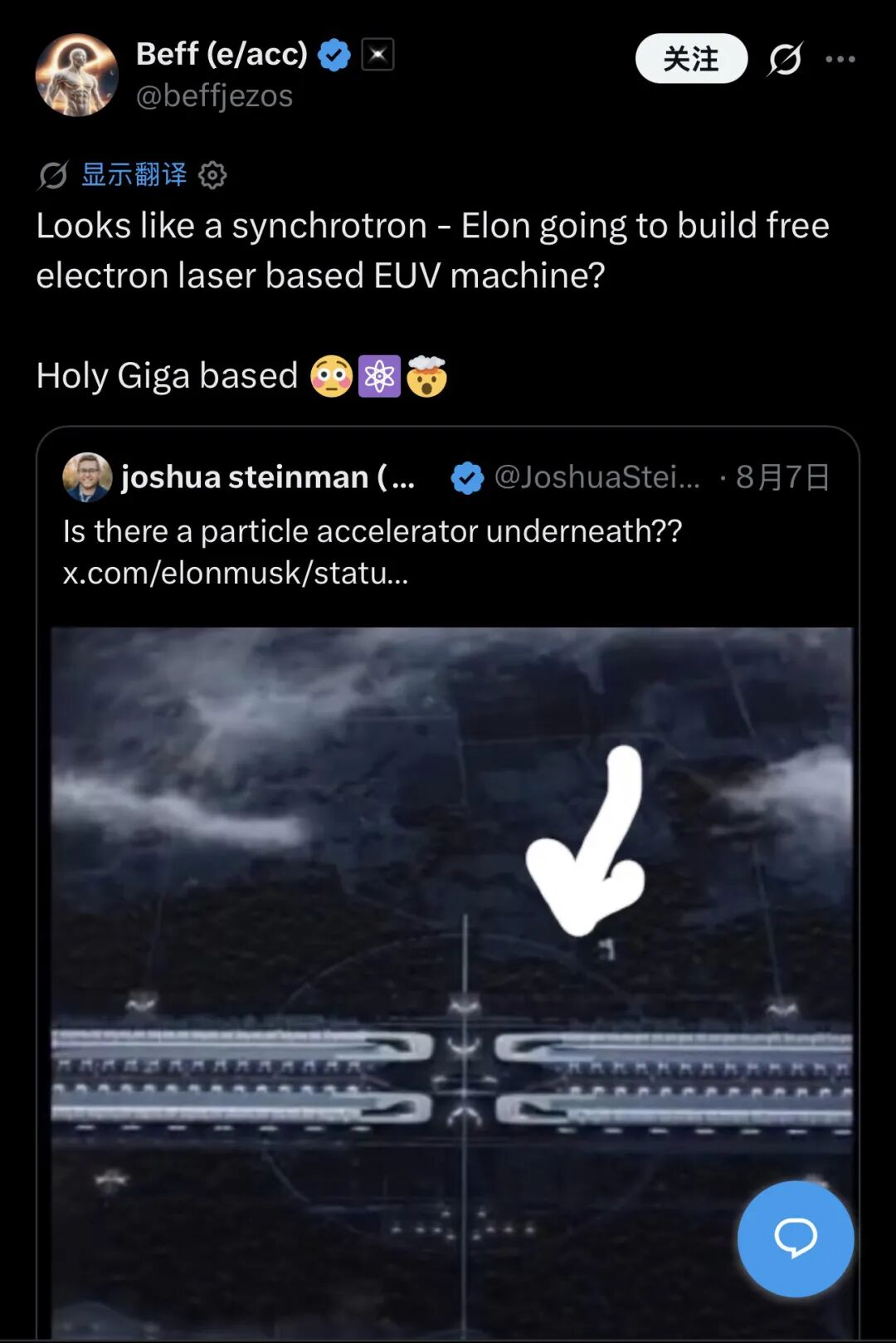
Subsequently, Elon Musk's response seems to confirm this statement.
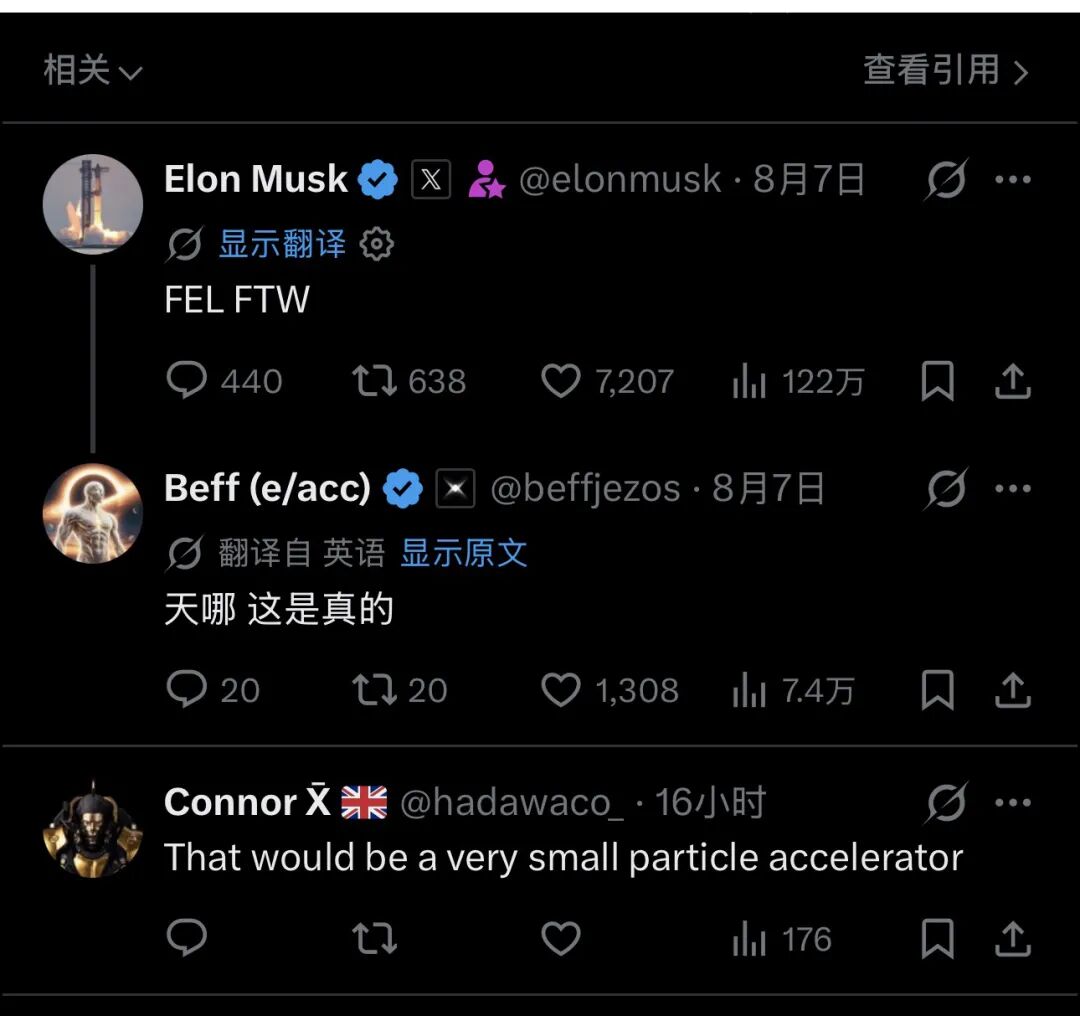
Of course, this is only a conjecture and does not represent the real situation, but we believe it is worth discussing.
FEL is Not a New Invention
We have to admit that free electron lasers (FEL) and particle accelerators are not new things. For many years, companies, R&D institutions and universities have been operating particle accelerators to generate tiny subatomic particles such as protons, neutrons and quarks. These systems are usually used in physics and other scientific applications. Free electron lasers (FEL) have long existed. As introduced, it is essentially a high-power light source that uses electrons to generate light of different wavelengths. A particle accelerator is a system that propels charged particles.
In principle, free electron laser generates laser when electrons flying at a speed close to the speed of light pass through a periodically changing magnetic field. The wavelength of this laser is related to the frequency of the periodic magnetic field process. Lasers of different wavelengths can be obtained by changing the frequency of magnetic field change or the incident speed. Therefore, to develop this FEL, a high-speed (close to the speed of light) electron source is required first. Why do we need electrons close to the speed of light? Because only under this condition, the radiated light generated by the oscillation of electrons in the direction perpendicular to the incident direction can exert a significant impact on the electron motion, causing adjacent electrons to gather into clusters (rather than a uniform electron flow).
Assuming each cluster has N electrons, the superposition energy of their radiated light is not the simple sum of the energy of N electrons, but proportional to the square of N, that is, radiation resonance, in other words, it is a laser. At present, linear accelerators are most commonly used as high-speed electron sources (synchrotron radiation is also used as free electron sources, but the power is not enough)
In other words, in FEL, electrons move freely in vacuum at a speed close to the speed of light, and exchange energy with the co-propagating electromagnetic wave, thus generating a beam of tunable and exponentially amplified light.
Specifically, it includes the following parts:
1. High-energy electron beam
This process starts with a high-energy electron beam from a particle accelerator.
The microwave amplifier accelerates electrons to a speed close to the speed of light. Taking a 1 GeV electron beam (that is, one electron charge multiplied by 1 gigavolt) as an example, the speed of the electron is only one ten-millionth slower than the speed of light. The higher the energy of the electron beam, the higher the photon energy that FEL can generate.
2. Radiation of accelerated charges
Any accelerated charged particle will radiate light. For example:
The Bremsstrahlung (German for "braking radiation") light source makes electrons decelerate rapidly by hitting electrons against the metal wall, and the electron beam consumes energy by radiating light and releasing heat.
Deflecting magnets can also achieve similar effects:
If the electron beam is bent into a circular orbit, a synchrotron radiation light source is obtained.
If the electron beam swings back and forth along a sinusoidal trajectory, a wiggler or undulator light source is formed.
Synchrotron radiation and wiggler light sources generate light with a wide frequency range, while undulators are different: under specific conditions, the electron beam passing through the undulator can achieve laser emission.
3. Undulator
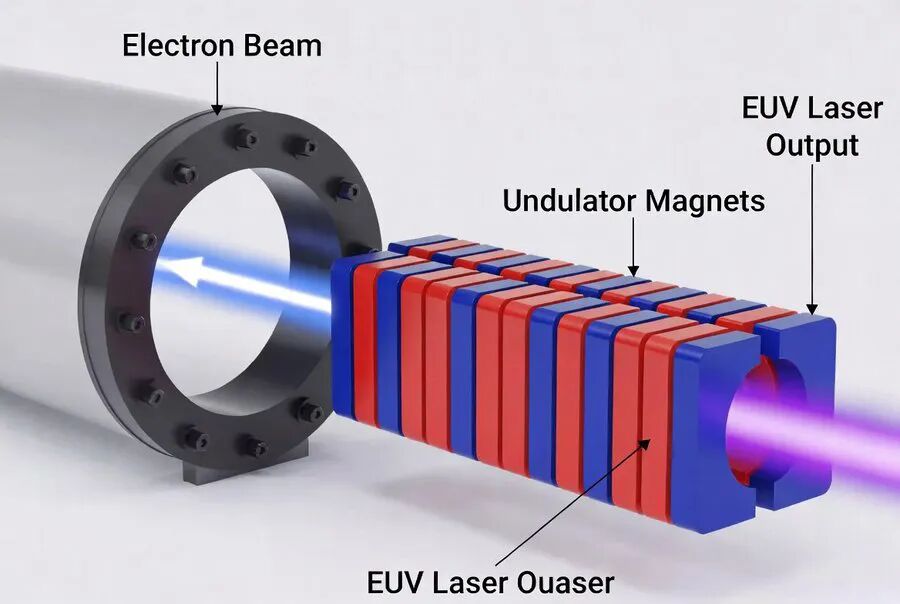
An undulator is a device composed of periodically arranged magnets, which can make the high-energy electron beam oscillate along a sine curve (that is, "swing") at a specific frequency. This controlled oscillation of the electron beam is the first step to generate precisely tuned light. The period of the undulator (λᵤ) and the electron beam energy jointly determine the wavelength of the output light.
For this reason, some people regard FEL as an alternative to EUV lithography.
A Candidate to Replace Current Light Sources
The reason why traditional EUV lithography adopts 13.5 nm is that tin plasma can generate light in this band relatively efficiently.
But the logic of FEL is completely different. It can change the wavelength of output light by adjusting electron beam energy, undulator period and magnetic field strength. Therefore, in theory, it can cover from soft X-rays, EUV all the way to longer bands. This means: Traditional EUV is more like a "lithography knife" with a fixed focal length, while FEL is more like an "optical tool" that can continuously adjust the wavelength.
Therefore, some people try to break through the limitations by adopting FEL. The US startup xLight is exactly a supporter of this path. It is worth mentioning that Pat Gelsinger, former CEO of Intel, now serves as the executive chairman of xLight.
In xLight's technology, electrons are first injected into the particle accelerator, and then enter the free electron laser (FEL). xLight said: "FEL uses electrons from the particle accelerator and makes them pass through the undulator with periodic magnetic field, so as to generate a coherent high-intensity light beam."
In simple terms, EUV light is generated in the accelerator. Then, the EUV light is transmitted from the particle accelerator equipment to the fab through a device similar to a photon pipeline. At this time, the EUV light will be guided to the sub-fab. There are various independent systems in the sub-fab called "flip stations".
According to xLight's video, each flip station is dedicated to one EUV tool in the upper fab. During operation, EUV light is transmitted to each rotating station in the sub-fab area. Then each rotating station receives the light and guides it to the EUV system on the upper floor of the fab, which in turn provides energy for the EUV equipment.
In this case, the EUV lithography equipment itself does not contain an LPP light source. On the contrary, EUV light is generated in the particle accelerator and then transmitted to the EUV equipment in the fab. This is a simple way to describe a complex process.
Nevertheless, the FEL light source of xLight produces 4 times more power than the current LPP devices. xLight said: "By providing up to 4 times EUV power, fabs can optimize pattern improvement, increase productivity and yield, so that each scanner can generate an extra billions of dollars in revenue per year, and reduce the cost per wafer by about 50%. In addition, a single xLight system can support up to 20 ASML systems with a service life of up to 30 years, thus reducing capital and operating expenses by more than 3 times."
Theoretically, xLight's technology can be used for low-numerical-aperture EUV, high-numerical-aperture EUV and even ultra-numerical-aperture EUV. In terms of R&D, ASML is developing 0.75 ultra-numerical-aperture EUV technology, which is targeted at the more distant future.
From the slender plant design of Terafab and Musk's response, it is highly possible that Terafab will use a linear accelerator as the high-speed electron source of FEL. The current femtosecond-level free electron X-ray laser has been used in university laboratories for data collection of protein crystal diffraction.
If you still don't understand how powerful this technology is, for example, if the light source of ASML's EUV lithography machine is an ordinary light bulb, then the FEL free electron EUV light source is equivalent to a high-efficiency laser, which can easily generate laser with output power of several kilowatts to tens of kilowatts, and the wavelength can be adjusted arbitrarily.
In comparison, the LPP EUV adopted by ASML has a fixed wavelength, and its power is difficult to exceed 1kW, and it cannot compare with FEL in terms of the purity of light wavelength and coherence. If it can be successfully developed, it will greatly accelerate the lithography speed and lithography quality of lithography machines. FEL also has another advantage, that is, its conversion efficiency (energy consumption ratio) is particularly high. The LPP adopted by ASML requires about 4.4 MW of electricity to produce 1kW of usable EUV (the overall efficiency is on the order of 0.05%).
The most advanced energy recovery FEL (ERL-FEL) only needs about 0.7 MW of electricity to produce 1kW EUV, with an efficiency about 6 times higher, which can be further improved in the future with better superconducting materials.
It Cannot Be Achieved Overnight
Purely from the perspective of the technology itself, FEL is obviously stronger in light source performance, but it does not mean that it is more advanced in industrial lithography. Because EUV lithography requires more than just "a beam of 13.5 nm light".
It also requires: high power + high stability + high repetition frequency + high reliability + extremely low cost + extremely high uptime + matching with reflective optical systems.
ASML's current EUV light source has undergone many years of engineering development and has formed a complete industrial system.
However, FEL usually requires large electron accelerators, undulators, vacuum systems, beam control systems, etc., and the equipment volume and cost are very huge. Therefore, from the perspective of physical performance of light source: FEL is obviously stronger and more flexible.
But from the perspective of engineering capability of semiconductor mass production lithography: The current mature EUV light source is more suitable for fabs. FEL may bring EUV light source from the "fixed wavelength of 13.5 nm" to more flexible short-wavelength lithography.
For example, if we enter the next-generation lithography exploration of 6.x nm, 5.x nm or even shorter wavelengths in the future, the light source mechanism of FEL with tunable wavelength, high coherence and high peak brightness will be very attractive.
But there is still a huge problem here: The shorter the wavelength, the more difficult the problems of optical systems, masks, photoresists, reflectivity, photon scattering, vacuum systems, etc. will become.
Therefore, the real revolution that FEL may bring is not just "replacing EUV light source", but providing a completely different short-wavelength high-brightness light source route.
In addition to FEL, solutions such as high harmonic generation (HHG), discharge produced plasma (DPP) and synchrotron radiation are all under discussion. LPP wins in maturity and mass production, FEL emphasizes high brightness, high coherence and tunable wavelength, and HHG has the potential for miniaturization. The key to future competition is to balance power, efficiency, stability and cost at shorter wavelengths.
More importantly, all of them are facing more challenges, and their development timelines are far from certain.
This article is from the WeChat Official Account "Semiconductor Industry Watch" (ID: icbank), written by the Editorial Department, and published with authorization from 36Kr.