OpenAI executives: Harnesses like Codex will only remain popular for another two months.
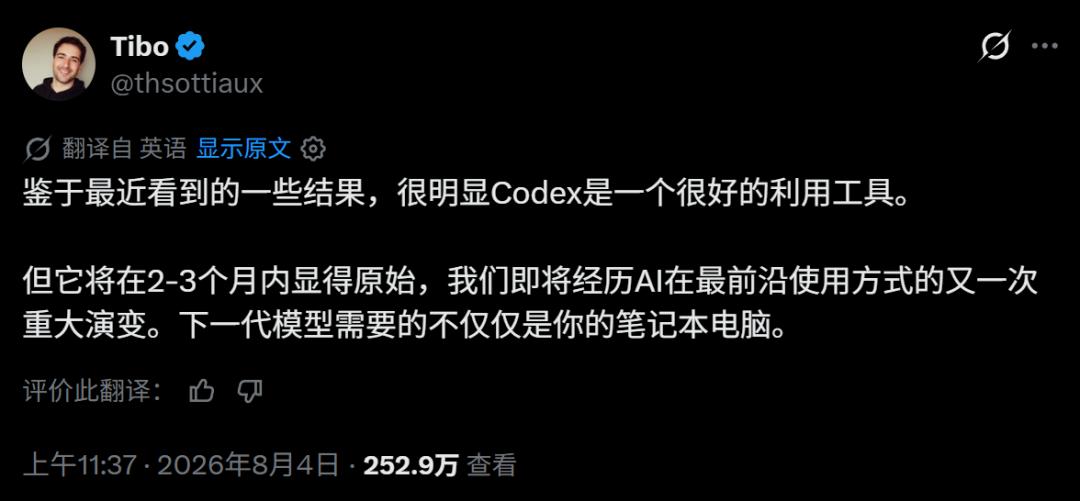
"In another 2-3 months, Codex will be nothing more than a primitive tool."
This statement did not come from a competitor, but from Thibault Sottiaux, the current General Manager of Product and Platform at OpenAI in charge of ChatGPT and Codex, who publicly shared this view himself.
Recently, the Harness framework has gradually gained widespread popularity. From developers to white-collar workers, people are adopting this type of Agent tool one after another, reaping the automation dividends brought by AI. Among these tools, OpenAI's Codex stands out as a top performer.
However, at this juncture, executives at OpenAI have already looked further ahead. The next step for AI agents may involve a paradigm evolution from standalone small tools to cloud-native infrastructure.
The phrase "laptops are no longer sufficient" from Thibault Sottiaux carries a clear meaning: we are currently using standalone Harness to drive next-generation models with long-duration reasoning and high autonomy capabilities, and this mismatched "small feet in big shoes" model is quickly becoming unsustainable.
As we know, the so-called Harness refers to a suite of components built around large models, including context management, tool invocation, state persistence, environment isolation, and exception recovery. At present, many developers complete tasks by running Agents on their laptops, for example via CLI, Cursor, Claude Code, or lightweight Agent logic.
Of course, a growing number of developers also prefer to use multiple tools and multiple models together: for instance, using Fable 5 on Claude Code to write project documentation, then switching to other models on Codex for execution.
But this approach will encounter three major physical bottlenecks when facing next-generation cutting-edge models:
Computing power and memory limitations: When an agent needs to execute 20 subtasks concurrently (such as running tests, crawling data, and compiling large projects at the same time), the memory, CPU, and concurrent sandbox (Docker/VM) resources of a local laptop will be fully occupied instantly.
Long tasks cannot tolerate device shutdown: Complex Agent tasks may take hours or even days to run, requiring the user's laptop to stay powered on, remain connected to the network, and not be closed, which is extremely impractical from an engineering perspective.
Parallel explosion of context and toolchains: Next-generation models will definitely support extremely long context and highly concurrent reasoning. Local lightweight Harness will struggle to handle context compression, state synchronization, and centralized log tracking among large-scale concurrent Agents.
Facing these challenges, signs of the transformation of Agent tools toward heavy-duty infrastructure and systematic design have gradually emerged over the past few months.
For example, OpenAI's Codex already supports cloud-based asynchronous operation. After a user issues an instruction in the terminal, the task is sent to an isolated Sandbox Container in the cloud to run autonomously, with the mobile phone or laptop only acting as a command and control interface.
At the same time, cloud-native micro-sandboxes are on the rise: cloud ultra-fast sandbox infrastructures specially designed for AI Agents, such as E2B, Daytona, Fly.io, and Modal, allow Agents to dynamically spin up hundreds of independent container environments to run code and verify results in parallel when executing tasks.
Among top AI teams including OpenAI, Anthropic, and Cognition, engineers are beginning to shift their R&D focus from optimizing prompts to "writing system-level Harness".
In February this year, the Anthropic team demonstrated a case where 16 Claude instances ran in parallel across 2000 cloud sessions to write a C language compiler. This is a milestone for generative AI moving toward multi-Agent collaboration in the software engineering field. In this case, different Claude instances played different roles: 1 architect Agent was responsible for designing the Abstract Syntax Tree (AST), 4 coding Agents were in charge of different modules, 2 testing Agents specialized in writing unit tests, and 1 auditing Agent was responsible for reviewing code flow and security.
Lead researcher Nicholas Carlini pointed out: "Most of our energy has been spent building the environment, test closed loops, and feedback infrastructure for the model."
In the next two to three months, this kind of agent workflow may become our daily norm.
Combined with Thibault Sottiaux's judgment, the "light local control, heavy cloud execution" model will become the standard configuration, and developer interfaces (such as IDE, Terminal, Web UI) will completely turn into control panels. All computationally intensive tasks, including real code refactoring, test passing, and browser automation simulation, will be processed in parallel on dynamic cloud clusters, and the final differences (Diff) and logs will be streamed back to local devices.
The deep integration of models and Harness may shift the competition from "competing for stronger model reasoning capabilities" to "competing for more thorough release of model potential". Those Agent frameworks that only rely on running Python scripts and simple API calls on local computers are about to hit their performance ceilings across the board.
This article is from the WeChat Official Account "Machine Heart" (ID: almosthuman2014), written by Zenan, and published by 36Kr with authorization.