Is Cursor about to disappear completely?
The name Cursor may not survive this autumn.
Just now, The Information exclusively broke a bombshell news. At the all-hands meeting held by Cursor on Thursday, the management made it clear on the spot: The $60 billion acquisition of Cursor by SpaceX will be completed as early as next Friday.
But the even more explosive part is not the timeline.
The Cursor management added one more sentence: The Cursor brand name will be phased out from new products over the next few months.
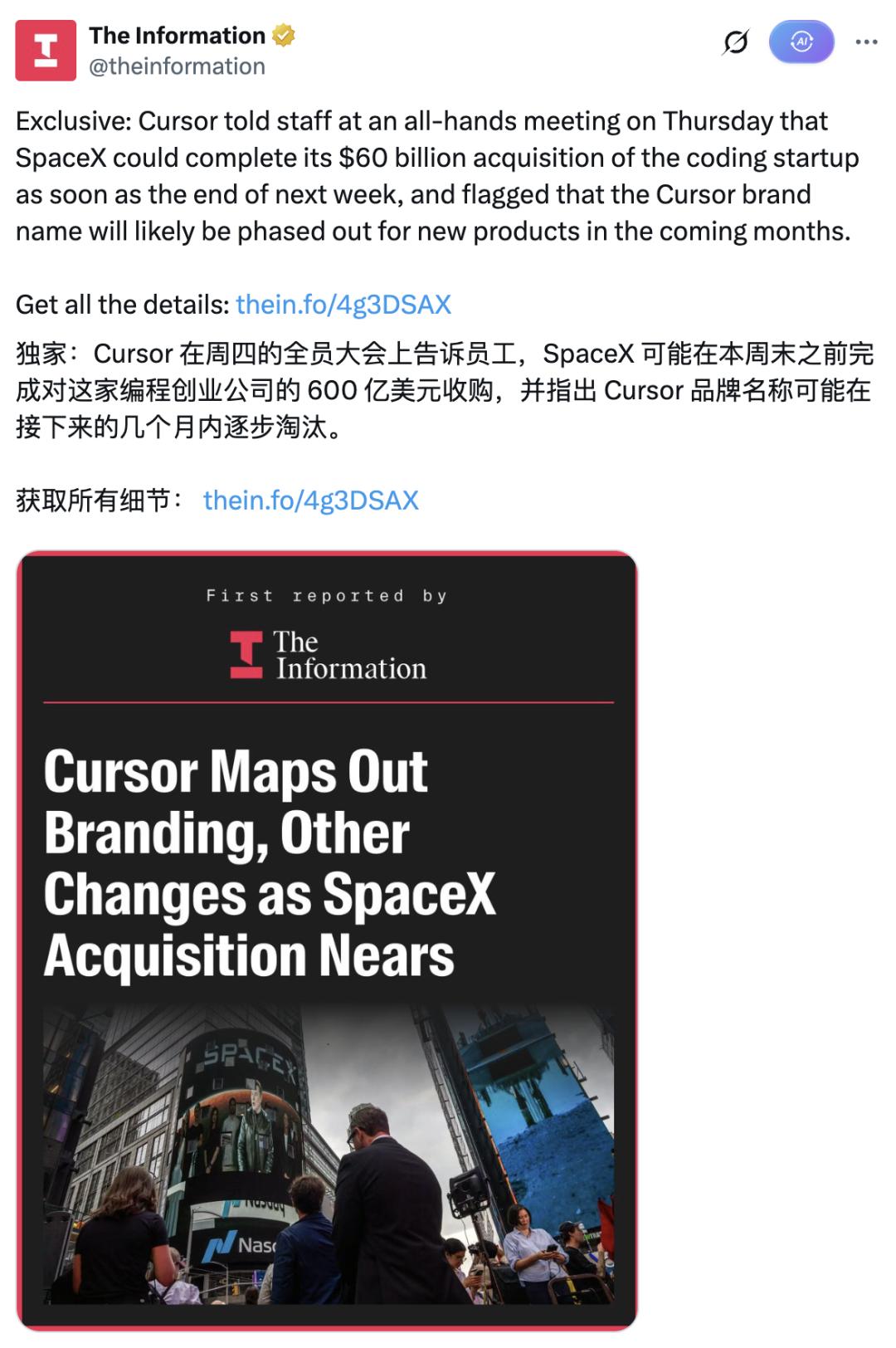
Cursor, the once most popular unicorn in the AI programming field, is disappearing completely.
$60 billion buys not just the company, but also the name
$60 billion. This is the largest startup acquisition in history.
Looking back, Cursor, a product developed by four MIT students, reached an annual revenue of 4 billion US dollars in just two years, and more than half of the Fortune 500 companies are its customers.
Now, it is directly acquired by Elon Musk.
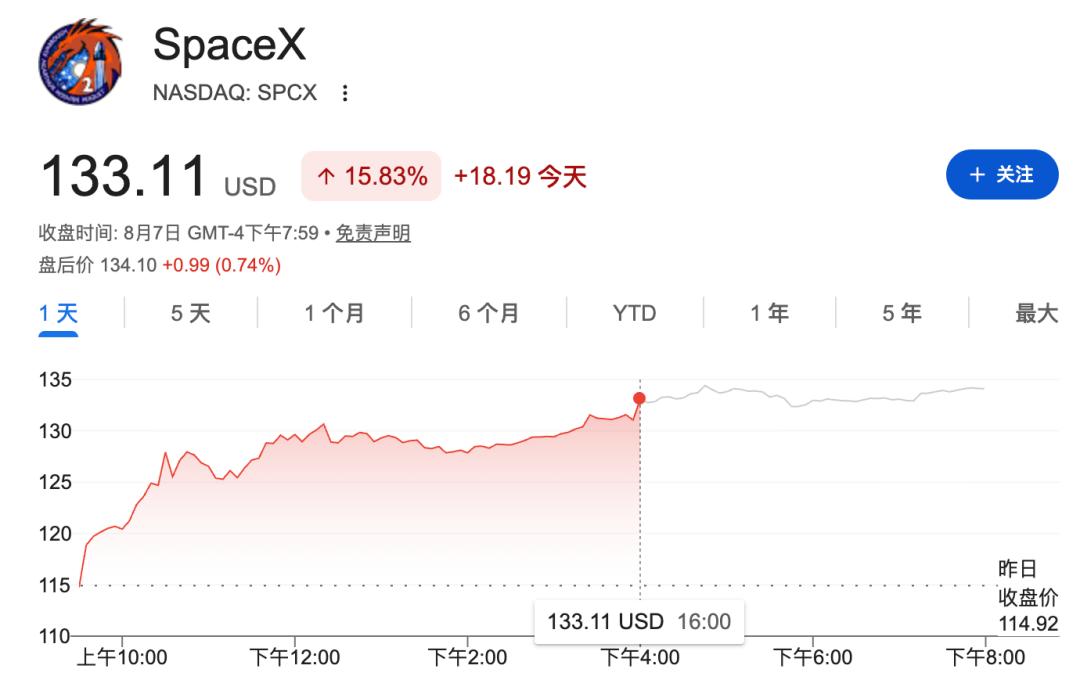
According to reports, the transaction will be closed no later than the end of August, depending on the speed of regulatory approval. At SpaceX's first earnings call after its listing this week, Elon Musk personally confirmed: the approval process is almost finished, and the deal will be signed "very soon". Right after his remarks, SPCX's stock price immediately saw a sharp surge.
Cursor has an unreleased general-purpose AI Agent with the internal code name "Sand".
According to the current plan, this product will most likely be launched under the name "Grok Bot". Of course, it is also possible to create a completely new brand without using the Grok name at all.
The only thing that is certain is that Sand will not be called Cursor.
As for the Cursor programming assistant that many people use every day, its name will not be changed for the time being. An insider said that the name of the existing tool will be retained first.
But there is a more drastic follow-up arrangement. Cursor will no longer operate as an independent entity!
This is the most shocking line in The Information's report. The company will be split up and integrated into various teams of SpaceX AI. Once the deal closes, employees will be required to move to SpaceX's Slack workspace, operation systems and reporting lines within a few days.
It will be fully absorbed directly.
A rather bittersweet scene appeared during the Q&A session after the meeting: an employee stood up on the spot and asked why the brand was to be changed to Grok.
This question is so poignant because Cursor CEO Michael Truell told the employees with full confidence earlier this year that SpaceX AI regards Cursor's brand identity and enterprise customer relationships as "key assets".
A few months later, the "key assets" have become something to be "phased out".
Why is Elon Musk so determined to make this acquisition?
The answer is only five words long: It failed to gain an upper hand in programming.
The Grok line has never made breakthroughs in the enterprise market. As of March this year, Grok's enterprise adoption rate was only 7%. In the same period, Anthropic's Claude Code has brought the company's annualized revenue to 14 billion US dollars, with programming Agent being its largest growth engine. OpenAI's Codex CLI exceeded one million developers just one month after its launch.
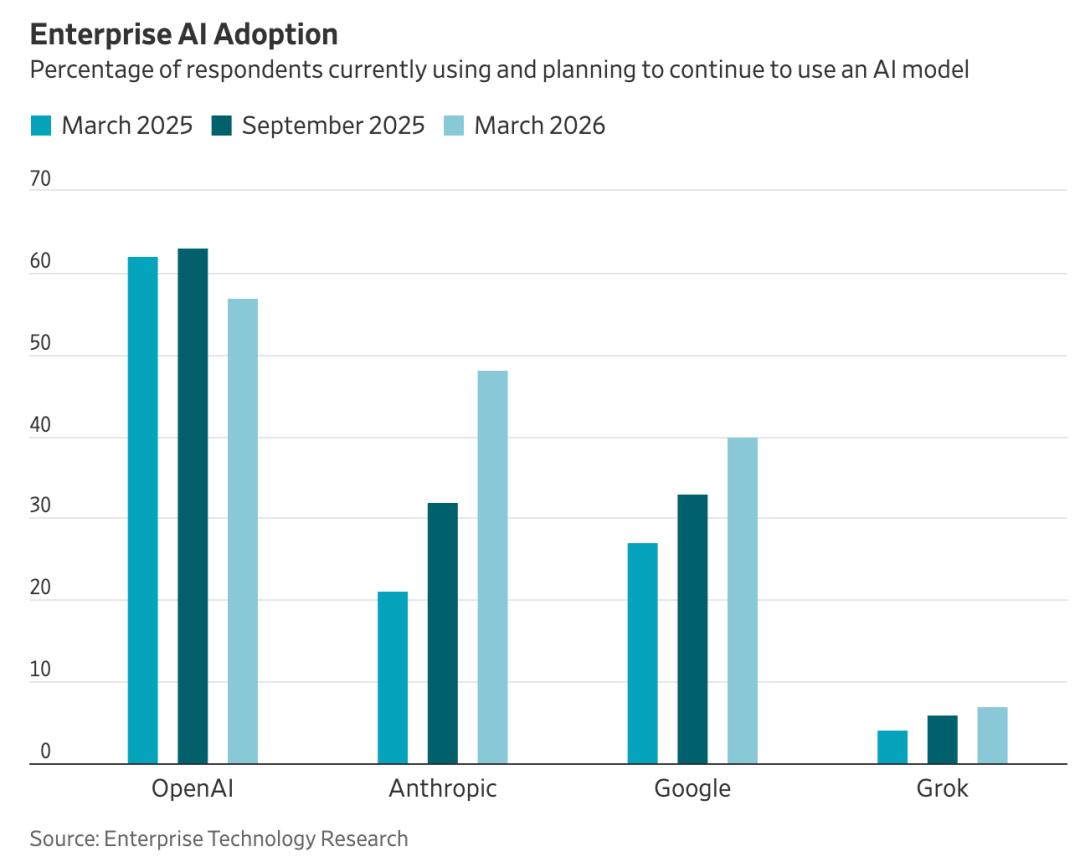
In Elon Musk's AI territory, programming is the only huge blank area.
Cursor has 50,000 enterprise customers, over one million paying users, and massive amounts of coding data generated by developers in real projects every day. In fact, Grok 4.5 has used Cursor's data for supplementary training, and its programming capability was close to Claude Opus when it was released on July 9.
Most of the $60 billion price tag is attributed to Cursor's coding data.
The pressure on the revenue side is also rising. SpaceX's Q2 earnings report has just been released: its revenue reached 7.8 billion US dollars, almost doubling; the AI sector alone brought in 2.6 billion US dollars, a more than 300% increase. Sounds impressive? But looking at the expenditure: 18.4 billion US dollars was spent on infrastructure in one quarter, of which 15.8 billion US dollars was burned on AI servers and data centers, and the company still has a loss of more than 500 million US dollars on the books.
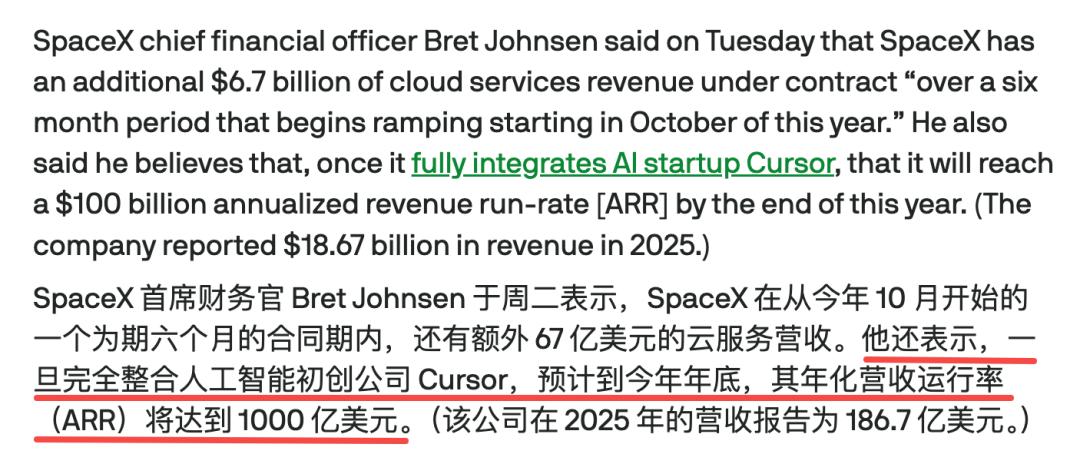
Elon Musk dropped a tough line at the earnings call: the company's annualized revenue must reach 100 billion US dollars before December. The CFO immediately added that to hit the target, the company needs to rely on both computing power sales contracts and Cursor's consolidated financial statements, two-pronged.
Developers have a different state of mind
On Reddit's r/vibecoding community, some people call this "the craziest AI programming move to date".
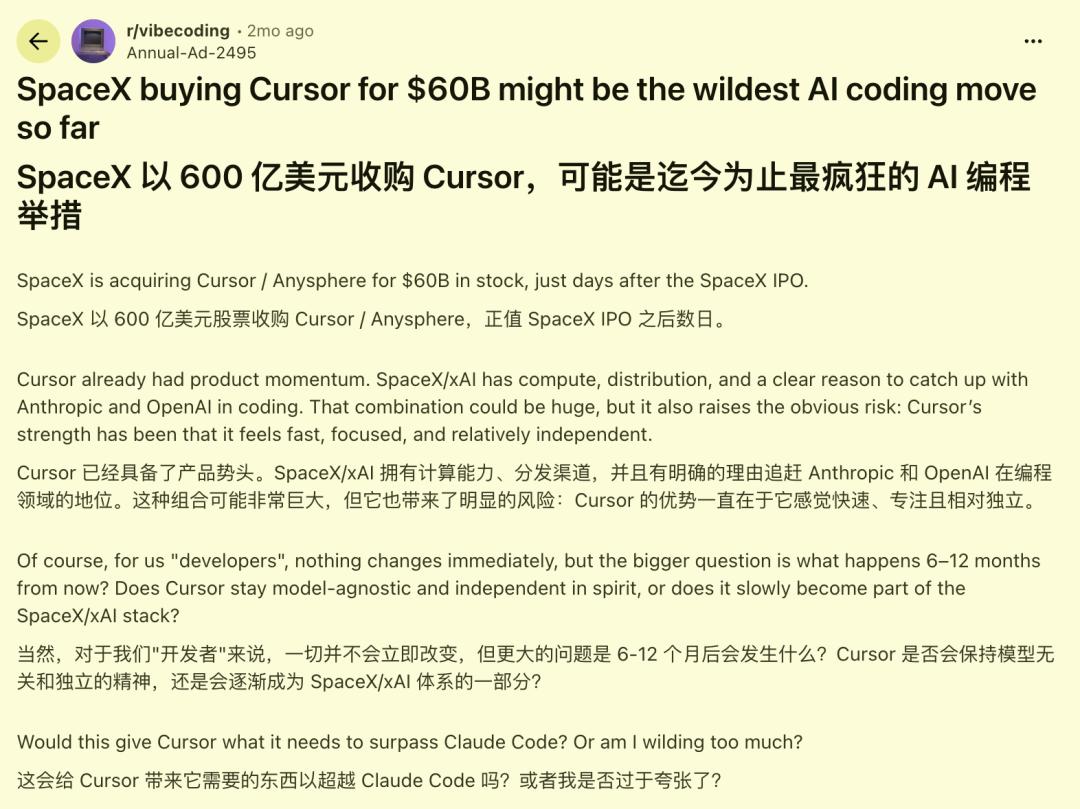
The post acknowledges that Cursor has strong product momentum, SpaceX has abundant computing power, distribution channels, and sufficient reasons to catch up with Anthropic and OpenAI. This combination may be very powerful.
But Cursor got to where it is today precisely by being fast, focused, and model-agnostic. You can use Claude if you like, or GPT if you prefer, Cursor doesn't interfere. This is the core reason why a large number of teams choose it over GitHub Copilot.
Once your parent company itself owns a cutting-edge large model, the phrase "we don't care which model you use" will no longer be convincing at all.
Nothing will change for developers at the moment. The real problem will come 6 to 12 months later: will Cursor still treat all models equally? Or will it gradually become a part of SpaceX's technology stack?
Right now, it seems that this deal is making it increasingly unlikely for Cursor to catch up with Claude Code.
The end of an era
Over the past two years, the most exciting story in the AI application layer is Cursor.
An AI code editor, founded by four young people who just graduated from school. It proved one thing: Companies that do not train their own large models can also stand at the center of the game.
Now this story has come to an end, in the form of being split up, absorbed, and renamed.
Next week, when developers turn on their computers, the interface is still the same, the cursor is still blinking there. The code completion will pop up as usual when it is supposed to. Only a few months later, the name attached to these things may be replaced by another one.
The $60 billion acquisition bought out not only a company, but also the last bit of independence of the AI application layer.
How long will the concept of model-agnosticism last?
Reference: https://x.com/theinformation/status/2085814520644075671
Editor: Solomon
This article is from the WeChat official account "Xinzhiyuan", author: ASI Revelation, published with authorization from 36Kr.