After FDE became a huge hit, the first thing that got held up was the final payment.
Several months passed, the AI was integrated and the system was running, but the project was far from truly completed.
FDEs are still at the client's site repeatedly modifying details and coordinating for acceptance. On-site support and travel expenses are all self-covered; a single line from the client like "tweak this part a bit more" or "the effect here hasn't met expectations yet" will push the acceptance further back. Costs keep piling up every day, with no clear timeline for receiving the final payment. Many people who just started working as independent FDEs eventually find that after a full project settlement, almost no profit is left.
Even so, they still have to keep looking for the next project.
Because FDE is essentially a service-heavy business. From the first communication with the client, to sorting out business workflows, designing solutions, completing POC, and then to delivery and acceptance, the part that takes up the most time is often not development, but accompanying the enterprise to implement AI step by step. The longer the project cycle, the greater the pressure the FDE bears.
Yet this "messy and exhausting" role has suddenly become extremely popular.
In recent months, from large internet companies to large model enterprises, all have started recruiting FDEs on a large scale. The recruitment requirements are mostly consistent: proficient in AI, skilled in technology, good at communicating with clients and understanding business logic, and have strong stress resistance. Some companies require project delivery experience, while others have relaxed the threshold to fresh graduates, offering an annual salary generally ranging from 400,000 to 800,000 RMB.
On one hand, the recruitment market continues to heat up; on the other hand, real projects face thin profits, difficult customer acquisition, and slow payment collection. Hailed by capital and enterprises on one side, and facing the most direct commercial tests in reality on the other, is FDE essentially software outsourcing in the AI era, a type of consulting service, or a brand new role?
The same title brings different answers for different people.
Chen Hong: To cut down on on-site travel expenses, we need to finish the project as soon as possible
I just started working as an FDE recently, but I don't take every project that comes my way, I only focus on the financial industry vertically.
At present, I am pushing forward the AI transformation of several VC and PE institutions at the same time, and most of them are still in the POC stage. The whole process from consulting, solution design, POC verification, to subsequent optimization and official delivery is still being explored step by step.
I originally thought there would be many difficulties in the early stage, but I didn't expect the project to progress more smoothly than I imagined.
From the very beginning, we connected directly with the people who can make real decisions in the enterprise. Whether the organization should implement AI, which processes are worth modifying, and where the budget should be invested, only real decision-makers can answer these questions. Talking directly with the boss is far more efficient than passing information layer by layer, and avoids a lot of meaningless communication costs. What FDE does is not a small tool for a certain department, but the transformation of the entire organization. If the general direction cannot be determined, even the best technology can hardly be truly implemented.
For me personally, working as an FDE is not a strict career transformation.
I used to be based in Singapore, working as an LLM engineer at a large internet company, responsible for work related to Agent Memory. It is essentially a B-end, customized service that requires continuous understanding of clients, solution design, and has certain consulting attributes. Now working as an FDE, I am essentially just taking the work I have been doing a step further.
So rather than a career transformation, it is more of a change in service mode. In the past, I focused more on technology research, but now I face enterprises directly. Of course I still need to write code, but more of my work turns to understanding clients, communicating requirements, designing solutions, and then translating these requirements into real technical implementations.
This is why in my opinion, FDE is more like a new role that combines consulting and software delivery.
If the client already knows exactly what they want and only needs a team to develop it, this scenario is more like traditional software outsourcing; real FDE usually happens in another scenario — the enterprise knows AI is very important and can create value, but has no idea where to start the first step, let alone which parts are truly worth modifying.
So my work usually starts with chatting with the enterprise.
Communication in the early stage is mostly about listening. I listen to the boss talk about the business, listen to employees talk about their daily work, then go through the workflows with them, to see how a requirement is generated, circulated, and where it gets stuck.
Most of the time, enterprises put forward a series of requirements, FDE needs to be able to judge which requirements are worth implementing, and which ones have no value even if they are completed.
This is exactly where the real difficulty lies.
There is no shortcut for this kind of judgment, you can only keep working on projects, accumulate industry experience, and gradually form your own understanding and prediction of the industry. One of the reasons why consulting firms are valuable is that they have seen enough cases. FDE also needs this kind of accumulation.
A very typical example: many enterprises have CRM systems, and bosses force employees to fill in data, but sales staff are naturally unwilling to use CRM. Essentially, this is a confrontation between managers and employees.
To solve this problem, many people's first reaction is to add an AI module to the CRM. But the key is not the "adding AI" action itself, but how to make sales staff willing to fill in the data actively.
If the Agent in the CRM can directly help sales staff improve transaction closing rates and get more commissions, they will naturally be willing to maintain the data; the boss no longer needs to force everyone to fill in data through regulations, and the enterprise's data assets will become more and more complete instead.
The final output is not just an efficiency-improving tool, but the operating mode of the entire organization has changed.
Enterprises may not even realize this kind of requirement on their own. The boss sees it as a management problem, employees see it as extra work burden. Being able to connect the two sides is the hardest and most valuable part of FDE's work.
Because of this, almost all our current projects are carried out in a customized way. Consulting, solution design, POC, optimization, acceptance — the process of each enterprise is similar, but the delivered content is never exactly the same.
Almost all team members have engineering backgrounds, with no mature sales experience. From sales to solution design to delivery, we are still polishing our capabilities step by step. How to gradually precipitate our customized capabilities into reusable standardized methods is what we have been thinking about recently.
This is also why we decided at the very beginning to dive into a specific industry, instead of taking every project that comes along. The more vertical the industry, the easier it is to precipitate a methodology that truly belongs to this industry. If you work on finance projects today, manufacturing projects tomorrow, and retail projects the day after tomorrow, it is very difficult to form your own competitive moat.
After all, the organizational structure of each industry is completely different. Without understanding the industry, it is difficult to judge which requirements are real demands; without industry experience, it is also difficult to make accurate predictions for the future.
At this stage, most of the projects we serve are domestic clients. On one hand, we are more familiar with the business environment and market characteristics of domestic enterprises; on the other hand, the AI transformation demand of domestic enterprises is indeed growing rapidly. After working on many projects, we gradually found an interesting phenomenon: the FDE discussed in China is not the same concept as the FDE in the Silicon Valley context.
Large model companies in Silicon Valley mostly serve large enterprises, a single order can reach tens of millions of dollars, so their requirements for FDE are much higher; while in China, most of the clients are small and medium-sized enterprises, especially those in traditional industries. They do not have enough AI engineers, and cannot afford to maintain a high-cost technical team for a long time. Compared with building their own team, an external FDE has lower cost and higher flexibility. So for many people, FDE is closer to software delivery, with an extra layer of AI consulting on top of delivery.
In addition, there is a very realistic problem in the domestic market: the final payment of many projects cannot be recovered. Costs for on-site support and travel also need to be covered by the FDE themselves. Every extra day the project drags on, the cost increases by one more day. So for FDE, it is not only about doing the project well, but more importantly, finishing the project as soon as possible, making development efficiency more and more critical.
Functions that can be precipitated into standard capabilities will be standardized as much as possible; for parts that must be customized, we use AI Coding to complete them quickly. Only by continuously compressing the delivery cycle can the entire business model operate smoothly.
I see many people on social media asking if now is the best time to transition to become an FDE.
In fact, it is obvious that two groups of people are moving into this field: consultants start to learn technology, and engineers start to learn consulting. The talents the market really needs in the future will probably not be pure programmers, nor pure consultants, but people who can understand the industry, understand the organization, understand the client, and can truly implement AI into business scenarios.
As for whether FDE will exist forever, I don't think it matters that much. It will eventually become more and more like a consulting firm in the AI era, or in other words, a new form formed by the continuous integration of consulting firms and SaaS services.
Athena: The most energy we invest is still in customer acquisition
I am currently based in Japan, and I have organized a global FDE team with partners from all over the world.
After coming to Japan, the most impressive delivery project I have done is for a cross-border trading enterprise in Osaka.
They operate a large number of toy SKUs. Every different season, they need to arrange procurement and inventory based on sales data from previous years. The data has always been there, and they have used local SaaS systems for many years, but the final decision on whether to restock and when to procure still relies on the experience of several senior employees. Opening different systems to check data, making statistics, and doing analysis every day has almost become their fixed workflow.
At the very beginning, I also considered redesigning a brand new system for them.
But after I walked into the enterprise and fully understood the entire business workflow, I gave up this idea. The problem is not technical development, but the working habits formed over decades. Many receipts, approvals and even business documents are still kept in paper form, and the enterprise does not want to overturn their original working methods because of AI.
So I added an Agent layer on top of their existing data and knowledge base. New employees no longer need to search for information everywhere, they can directly ask questions to find out when a certain SKU sold best in previous years, how much inventory is left now, and whether restocking is needed; when inventory abnormalities occur, the Agent will take the initiative to send reminders, instead of waiting for people to search for data manually.
The entire workflow has hardly changed, but there is an extra digital employee that keeps learning business experience.
This project almost condenses all the work of being an FDE right now, and makes me understand that what enterprises really need to solve is not AI itself, but the problems that happen repeatedly every day.
In fact, a year ago, I never thought I would become an FDE.
In the past few years, I worked as a product manager in the internet and fintech industries. After AI started to be rapidly adopted by enterprises, people around me kept consulting me: which work can be handed over to AI? Which processes can be further optimized? A CTO friend of mine was thinking about the same thing, so we hit it off immediately, formed a small team, and started to deliver AI services directly to enterprises. Team members are mainly distributed in Tokyo, North America, Hong Kong China and mainland China. When clients require offline communication, we can arrive at the site at the first time.
I originally thought technical development would take up most of my time, but after I actually started working as an FDE, I found that is not the case.
Most of the time, enterprises cannot accurately describe what they need, they only know which processes are inefficient, and which work is repeated every day. Before a project officially starts, a lot of time is spent on accompanying clients to sort out business, understand workflows, and find real pain points.
The point where enterprises are truly willing to pay is not entirely about AI.
No matter in China or overseas, clients only care about a few questions in the end: Has efficiency improved? Has cost decreased? Has business grown? AI is just a way to achieve these results, not the end goal. So our cooperation with clients usually does not start with a full set of transformation at the very beginning, but starts from the most painful scenario first, letting the client see the effect, then decide whether to continue the cooperation.
This is also the reason why we insist on building our own underlying capabilities.
Different from fully customized delivery of many projects, for each new client we take, we will not develop a whole new system from scratch, but continue to iterate based on our team's own AIOS and underlying base model. New Agents, workflows and industry experience will be continuously precipitated into this base model, and then reused in subsequent projects.
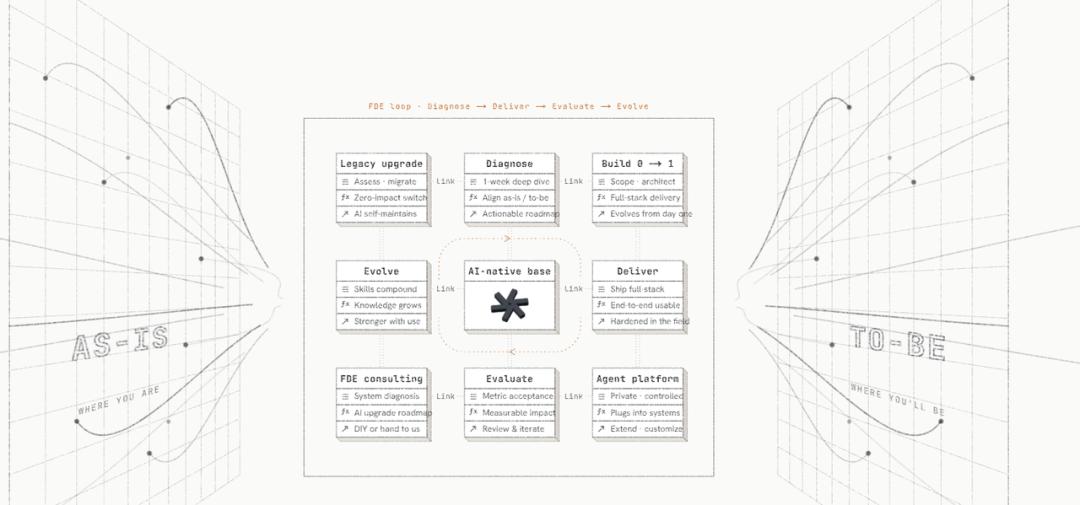
Team capability: Connect exclusive AI operating systems for enterprises by stages
Therefore, the cycle of most projects is not long. Simple requirements can be completed in about two weeks; a full project usually takes around one month. On one hand, the underlying capabilities have been built in advance, so we don't need to develop from scratch every time; on the other hand, we connect with people who have real decision-making power in the enterprise from the very beginning, many things can be decided on site, so our overall progress is relatively smooth now, we don't need to go through lengthy internal approvals, the client's cooperation willingness is relatively high, and the promotion speed is much faster. Although we consider ourselves to be in the outsourcing nature, we are treated as consultants and teachers by clients, and get a lot of respect.
In addition, project delivery does not mean the end of the service.
We adopt a system subscription model, which provides continuous maintenance, upgrades and after-sales support. After the enterprise subscribes for several years, they can buy out the entire system directly.
At present, our team's clients cover China, Japan, Indonesia and North America. One obvious observation is: the real differences come from two aspects, one is the digitalization process gap between different regions, the other is the different development stages and industries of the enterprises themselves.
Many large technology companies have their own engineering teams, and prefer to complete AI construction on their own; the enterprises that really need support from external teams are traditional enterprises that have completed certain digitalization but do not have complete R&D capabilities.
As for whether to choose local engineers or Chinese engineers to be FDEs, that is not the key point. The real difficulty is building trust.
Why should an enterprise hand over its business to a team that has not been established for long? Is the data secure? What is the capability boundary of AI? Almost every client will ask these questions. Until now, the most energy we invest is still in customer acquisition.
We try almost all channels: friend referrals, official websites, self-media content, offline sharing, partner referrals. Compared with active marketing, we prefer to continuously output content and real cases, letting clients with real demands come to us on their own, because this way the cooperation efficiency is higher, and it is easier to build long-term trust.
Since the emergence of FDE, there has never been a unified definition for it.
In my opinion, it is more like a combination of pre-sales, product manager and Agent engineer. There are only two core capabilities that matter: first, being able to truly understand the client's business; second, knowing how to use the latest AI technology to turn these requirements into implementable solutions.
No one in our team was a born FDE. Some used to be engineers, some worked as product managers, and some were long responsible for enterprise solutions. Everyone has their own professional capabilities, and after AI emerged, they gradually supplemented other missing parts of the required skill set.
