Crushed by DeepSeek with three times the call volume, GPT-5.6 is finally available for free.
In the past couple of days, a scene of "extreme contrast between hot and cold" has played out in the AI industry.
On one hand, OpenAI announced that starting next week, free ChatGPT users will have unlimited access to plain text conversations, with the default model upgraded to GPT-5.6 Luna, and a new "Think" button added to enable free users to carry out "in-depth thinking". On the other hand, DeepSeek released an announcement that it plans to raise the overall pricing of its API services in the near future, with "an expected significant increase".
On the very same day, the two global AI stars — one is sparing no effort to burn cash to expand its user territory, the other is biting the bullet to raise prices to restore operating cash flow.
The situation is of course far more complicated than it appears on the surface. OpenAI is not running a charity, and DeepSeek is not being greedy. These two seemingly contradictory pieces of news point to the same industry truth: The "cost calculation" of AI is being completely recalculated, and the signal of industry reshuffling has already lit up.
Some see the dividend of free services, while others see the pressure of price hikes. But what is really worth pondering is — in this differentiation, who is on the offensive, who is on the defensive? Who is the real winner, and who will pay the price?
01. Unlimited free access, what is OpenAI actually pursuing?
Let's first look at what OpenAI has given out in this wave of "generous offers".
The default model for free users has been upgraded from GPT-5.5 Instant to GPT-5.6 Luna, with the factual error rate reduced by about 62% in internal evaluations across the financial, healthcare and legal sectors. Starting next week, there will be no upper limit on the number of plain text chats, and a new Think button will be added — when encountering complex problems, click it to let the AI spend more time "thinking through".
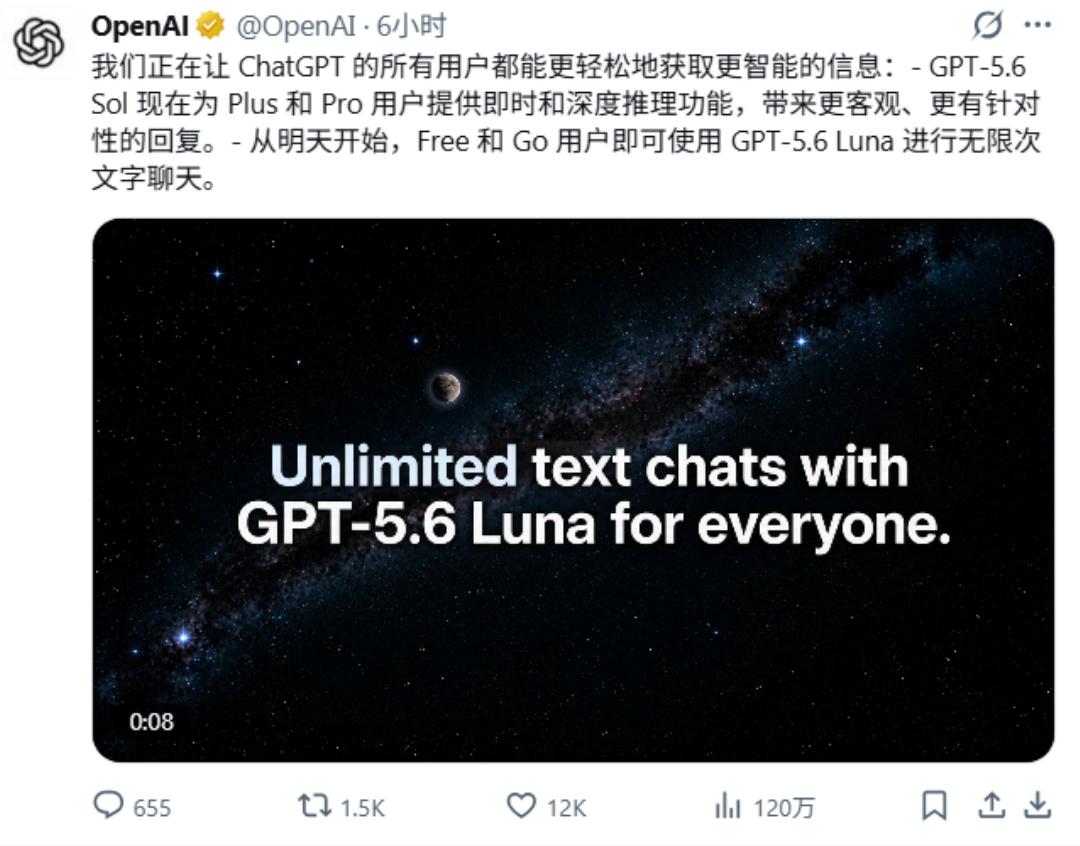
But the boundaries are also very clear: only text chats are unlimited, and functions that consume more computing power such as file upload, image generation, and voice conversations still have usage quotas for the free tier.
To put it bluntly, what OpenAI gives away is "chatting capability" not "practical work capability". You get unlimited chatting time, but you still have to pay if you want it to handle practical work for you.
So the question arises: what is OpenAI aiming for?
First, the cost of plain text inference has really hit rock bottom.
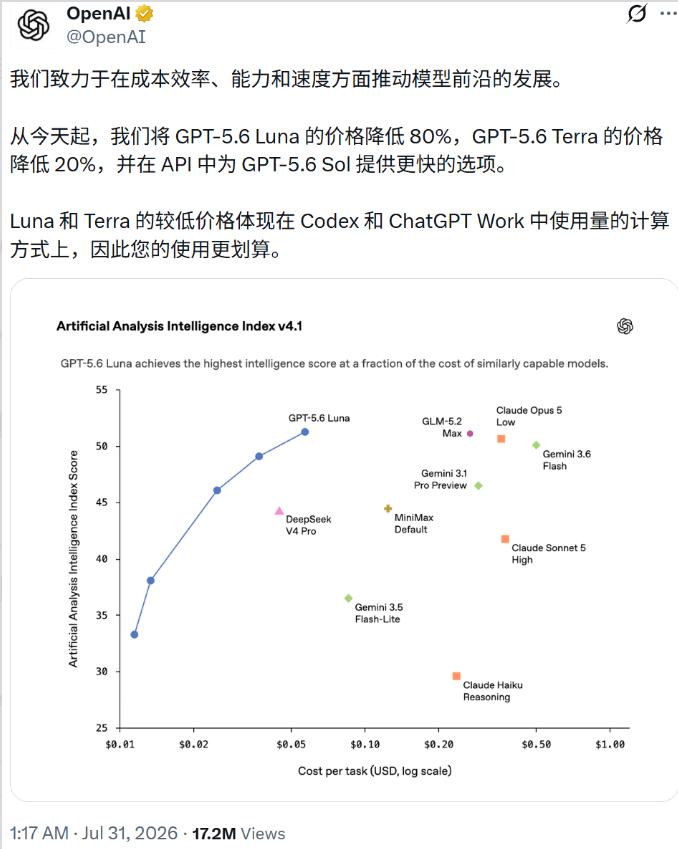
On July 30, only three weeks after the official release of the GPT-5.6 series, OpenAI cut the API price of Luna by 80% — only $0.2 per million input tokens. When the cost drops to this level, the cost of opening up the free tier is already lower than the value of traffic and public praise it brings. The free quota is no longer a burden, but has become a "customer acquisition purchase order".
Second, the data flywheel of 1 billion weekly active users is far more valuable than subscription fees.
The first sentence of the announcement reads: 1 billion people open ChatGPT every week. If free users chat dozens more times, that will generate billions of real conversation feedback entries. These reflect human-computer interaction habits, long-tail problem distributions, and are the fuel for reinforcement learning. A simple calculation shows that exchanging a small amount of computing power cost for massive real interactive data is an extremely cost-effective deal.
Third, the entrance battle has reached the doorstep.
According to industry expectations, Apple will launch Siri AI next month, embedding AI chat directly into the mobile operating system; in China, the web version of DeepSeek is free, and Kimi and Doubao offer more generous benefits than each other. If OpenAI still holds onto the old attitude that "you have to pay to use a good model", its core user entrance will be snatched by competitors. Expanding the free tier is the most straightforward defensive move.
So the logic of OpenAI's move is very clear: With marginal cost close to zero, it locks in the usage habits and data of 1 billion users, making "using ChatGPT" as natural as "using a search engine". As for monetization, it will rely on the enterprise version, APIs and those high-level services that truly deliver practical work value.
02. DeepSeek raises prices, who is actually panicking?
Turning to DeepSeek, the situation is completely different.
The announcement on August 6 has only one sentence: "We plan to raise the overall pricing of DeepSeek API services in the near future, with an expected significant increase." There is no specific figure, no effective date, but just the phrase "significant increase" has already made many developers very nervous.

It is worth noting that only three months ago, DeepSeek just permanently reduced the API price of its flagship model to a quarter of the original price, a 75% drop. From "extreme price cuts" to "significant price hikes", this 180-degree turn took less than a quarter.
What happened during this period?
The most intuitive answer: There are not enough available tokens.
According to data from the open source project OpenCode, the daily token processing volume of DeepSeek V4 Flash once reached 8 trillion. On August 4, the model even experienced insufficient capacity due to "unprecedented access volume". In the global AI model call volume list for the first week of August, DeepSeek V4 Flash ranked first steadily with 7.22 trillion tokens.
When your free/low-priced service is used close to the limit, there are only two options: either expand capacity, or raise prices. And expanding capacity means purchasing more GPUs and building more data centers — under the current background of tight chip supply, the cost and difficulty of this move are not low.
But what DeepSeek's price hike really makes panic is not the computing power side, but the downstream application side.
Let's do a simple calculation. Assuming an Agent product consumes 1 billion output tokens per day, using V4-Pro at the current price of 6 yuan per million tokens, the daily cost is about 6,000 yuan, and the monthly cost is about 180,000 yuan. If the API price doubles, the monthly cost will become 360,000 yuan.
For large tech companies, 360,000 yuan is negligible. But for a small team that sells subscriptions through AI functions, or a To B service provider that has already locked the price into annual contracts, this may be the dividing line between having positive profit and zero profit.
The problem is that different applications have vastly different "cost transmission capabilities".
The first category: Those that can pass on the cost. Financial risk control, pharmaceutical R&D, enterprise knowledge management — customers pay for the final results, not the number of tokens consumed. Helping banks reduce non-performing loans, helping pharmaceutical companies shorten the R&D cycle by several weeks, customers may not be sensitive even if the API cost doubles. The moat of such products is the return on investment, not cheap models.
The second category: Those that cannot pass on the cost. C-end subscribed AI writing, AI customer service, AI companionship — the monthly fee is only 20 or 30 yuan, and users are extremely sensitive to prices. Once the API price rises, the gross profit margin will be swallowed up instantly, but users will not accept the price hike just because the underlying model becomes more expensive. They either bear the cost themselves, or switch to a cheaper model, or shut down the business.
The third category: The most difficult hit ones. To B service providers that have already signed annual contracts — their revenue is fixed, but their costs are floating. They originally thought they could dilute costs through scale expansion, but the larger the scale, the faster they lose money.
So when it comes to DeepSeek's price hike, the ones under real pressure are those applications built on the assumption that "tokens will get cheaper and cheaper". When tokens are no longer cheap, the question of who is willing to pay will be the stress test that the AI application layer must answer next.
03. Two routes, a game over the "cost baseline"
Putting OpenAI and DeepSeek together, you will find an interesting contrast.
OpenAI chooses to push the cost of "plain text chat" to nearly zero, and then give it to users for free — this is buying user entrance, buying interaction data, buying long-term user habits. Its logic is: as long as you lock in users, there is always a way to make money from other businesses.
DeepSeek chooses to raise API prices — this is telling developers that computing power has a real cost, and the era of extremely low prices may be passing. Its judgment is that even if prices rise, developers have no better alternative options.
The two strategies seem to be opposite, but their underlying logic is actually the same: Both are redefining the boundary between "what should be free and what should be charged".
The line drawn by OpenAI is: chatting with you can be free, but if you want it to handle practical work for you, please pay. The line drawn by DeepSeek is: you have tried the low-price version, now it is time to pay for real productivity.
The intersection of these two lines points to the same trend: The AI industry is moving from "burning money for scale expansion" to "commercialization under controllable costs".
This trend has three levels of impact.
First of all, for model vendors, the strategy of "unlimited low prices" is losing effectiveness.
In the past two years, the domestic large model industry has fallen into a prisoner's dilemma — you cut prices, I cut even more, you offer free services, I even give subsidies. But in the second half of 2026, the supply and demand of computing power is tight, chip costs are rising, and financing windows are shrinking. The model of exchanging scale for low prices is unsustainable. Doubao starts charging, Kimi suspends new user subscriptions, DeepSeek raises prices — these signals together clearly mean: The stage of pure price competition is coming to an end, and the next step is to compete for who can provide truly valuable capabilities under affordable costs.
Secondly, for the application layer, "which model to choose" is changing from a technical issue to a financial issue.
In the past, when developers chose models, they mainly looked at effect and speed. Now they have to add a new criterion: the unit token cost, and whether this cost can be passed on to customers. Products that can convert token consumption into customer value will survive and even benefit from the price hike wave; while products that only wrap a simple shell around the model, run demos with cheap models but cannot deliver real value, will be the first to be eliminated under cost pressure.
Finally, for ordinary users, there will be more and more free "chatting capabilities", but the paid "practical work capabilities" will also become more and more expensive.
ChatGPT allows you to chat unlimitedly, Doubao allows you to ask daily questions for free — these basic interactions are becoming public infrastructure like search engines, and free access has become the industry consensus. But once you need AI to handle practical work for you — generate PPTs, analyze data, write code, do research — you have to pay. And as model capabilities improve, the pricing of "practical work services" will only get higher and higher.
04. The AI "cost calculation" is being recalculated, who will be eliminated?
Back to the original question: On the same day, why is one side offering unlimited free services and the other raising prices significantly?
The answer is: The two are not selling the same product at all.
What OpenAI gives away for free is "Chat" — conversation itself is becoming a low-cost, high-frequency entrance-level service used to lock in users. What DeepSeek charges for is "API" — it outputs model capabilities as a quantifiable productivity tool, and the cost must be borne by someone.
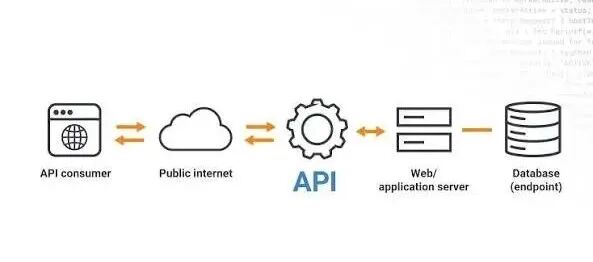
One is seizing the traffic entrance, the other is realizing productivity value. The two routes are not inherently right or wrong, but they both point to a reality: The cost structure of the AI industry is moving from "burning money for pioneering" to "intensive refined operation", and this process is inevitably accompanied by industry elimination.
Who will be the first to be eliminated?
First of all, applications that survive by "wrapping shells". They have no self-owned data, no scenario barriers, no user stickiness, and only run demos by calling low-cost APIs — when APIs raise prices, they will be the first to collapse.
Secondly, products that promise "unlimited quantity" but cannot calculate clear costs. Teams that write "unlimited AI functions" into contracts to grab customers but do not do a good job in underlying cost optimization and cache reuse will face greater risks as their business scale grows.
Thirdly, developers that rely on a single model and have no alternative plans. They bind the entire product architecture to one API, and can only bear the price hike passively with no other options.
And the players that can survive must be those who truly understand the meaning of "cost" — know what capabilities are worth paying for, what scenarios can be free; know how to convert token consumption into customer value; know to maintain flexibility in model selection and achieve the ultimate in cost optimization.
This "extreme contrast between hot and cold" between OpenAI and DeepSeek essentially tells the industry one thing in two different ways: The free lunch of AI is becoming a "menu" — some things are always free, some things are getting more and more expensive, and there is only one criterion to distinguish them: how much real value can it create for you.
As for whether DeepSeek's price hike this time is caused by stronger-than-expected demand or unsustainable supply constraints, it cannot be clearly distinguished for now. But one thing is certain: when the assumption that "tokens will get cheaper and cheaper" is broken, the cost accounting, pricing logic and competition pattern of the entire AI