AI programming is more profitable, so why are all major tech giants flocking to the AI office sector?
In March this year, Tencent WorkBuddy was launched. Over three months into its public beta, Shuzhi Qianxian interviewed Wang Shengjie, the author of its first line of code and its first product manager, asking who delivers greater value, CodeBuddy or WorkBuddy. "It depends on the target user groups," he said. When pressed on "whether WorkBuddy will have more users in the long run, his answer was 'not necessarily'".
Two months later, the latest data was released. According to statistics from Analysys as of the end of June, WorkBuddy recorded 20.97 million monthly visits on China's domestic PC-side AI-native office agent market, ranking first, which is nearly 2.4 times higher than the 8.85 million visits in the month of its March release. However, in terms of current revenue, AI programming is more profitable.
Shortly after that, three major tech giants adjusted their layouts simultaneously within two weeks. On July 20, Tencent adjusted the team related to QClaw to the 6th Cloud Product Division, bringing it under the same management system as WorkBuddy. On July 30, ByteDance's Feishu product team was merged into Doubao to form a new Doubao product team. On August 3, Alibaba's Qwen Office officially launched public beta, integrated from three products QoderWork, MuleRun and Wukong, with Chen Yusen, the new CEO of DingTalk, taking overall charge. Baidu launched DuMate, Kimi launched Kimi Work, and 360 launched Nano Work.
This battle did not break out suddenly. Behind it lies a four-year period that was "submerged".
01 Restructuring within two weeks
"The window period for desktop-level office products is closing rapidly on a monthly basis." Some analysts pointed out that it is no coincidence that the three major tech giants carried out organizational adjustments within two weeks.
Previously, nearly one year after the launch of Claude Code, Anthropic launched Claude Cowork in January this year, targeting ordinary office workers who do not use command lines — finance staff, HR, operation and marketing personnel. Yang Zhilin from Kimi did the math in June this year: Programming scenarios account for more than 90% of the model's token consumption, but there are only 30 million programmers worldwide, while the number of knowledge workers exceeds 1 billion. "The next two to three years will see major paradigm breakthroughs."
The underlying foundation of WorkBuddy is CodeBuddy — an AI programming tool developed by Tencent three years ago. Liu Yi, Vice President of Tencent Cloud and head of CodeBuddy & WorkBuddy, explained that they spent more than two years developing code products and polished a "Coding Agent kernel", which was embedded into WorkBuddy, giving it "a solid foundation from the very first day of its launch". In contrast, many peers' work products built based on the open-source project Openclaw "cannot deliver satisfactory performance".
Liu Yi was very frank about the gap, "There is definitely a gap between Chinese models and Silicon Valley models. If we only use domestic models, we will definitely not have capabilities comparable to Claude Opus, which is the reality." But he then added: Since the middle of 2025, there has been "hardly any gap in product features". CodeBuddy's score in the SWE-bench test "is no lower than that of open-source projects".
However, a Tencent insider told Shuzhi Qianxian that coding products are more profitable at the current stage. Many enterprises are still in the trial phase of office products, and are still evaluating the value of high token consumption costs in terms of enterprise cost reduction and new business expansion.
So why is everyone shifting from AI programming to AI office solutions?
A senior insider from a major tech giant broke down the underlying logic. First, the user base is huge. There are hundreds of millions of white-collar workers, including administrative, business and HR personnel, who can use the products, and "once they start using them, they will never go back". Second, the user stickiness is strong. Programmers compare multiple options, switch quickly, and choose the cheapest one; white-collar workers do not focus on technical details, and will not leave once they build their own exclusive workspace. Third, and the most critical point, is data. Programmers have narrow work scenarios, attach great importance to privacy, and will enable privacy mode; but the office scenario is different, users will upload 100 files for the agent to sort out, providing extremely rich data dimensions. In the domestic environment where major tech giants have ecological barriers, these data barriers are extremely valuable in the long run.
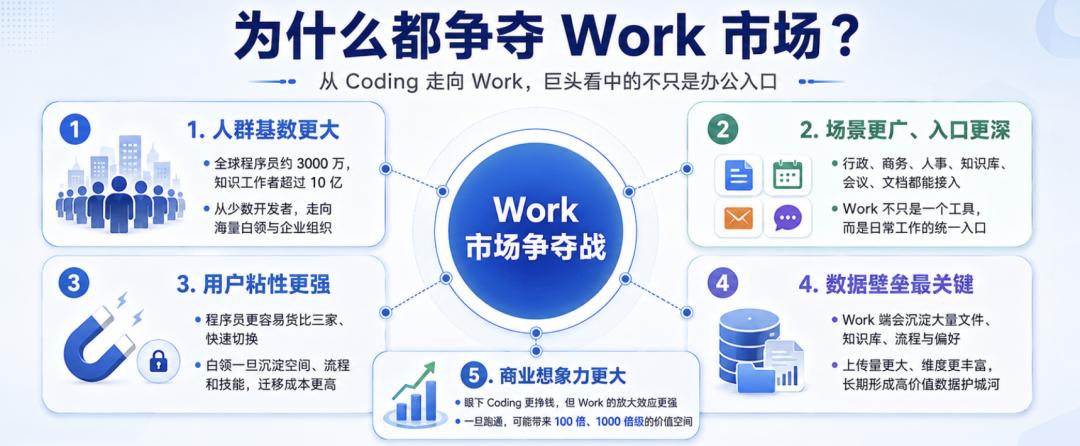
"A programmer and a white-collar female office worker are not at the same level of consumption power. This is the battle that major tech giants are keen on. Once the office product market is fully opened, the market size will be amplified 100 times or 1000 times."
But everyone is still exploring how to realize monetization in the enterprise-level market. The good experience of Feishu Meeting Minutes drives users to pay, and WorkBuddy may charge by storage after connecting to the knowledge base — in the past, enterprise cloud disks were not widely recognized in China, and Feishu actually adopted this exact monetization model. Wang Shengjie's vision is to make WorkBuddy a "general entry point for work and life". Codex and ChatGPT in Silicon Valley are also merging. After users get used to using one AI as their work entry point, they will continue to use it even after leaving their workstations for 8 hours.
Here comes a question. If the underlying foundation of Work products is Coding Agent, who exactly won the last Coding war? The answer is not Tencent, Alibaba or ByteDance. We need to go back four years.
02 The widening gap
In October 2024, US AI coding startup Bolt.new went online. Four weeks later, its annualized revenue hit 4 million US dollars. Dario, President of Anthropic, excitedly called the CEO of Bolt: "You are the fastest growing customer we have ever seen." Bolt used Anthropic's newly launched Claude 3.5 Sonnet, and the skyrocketing call volume once fully occupied Anthropic's GPU resources.
At almost the same time, the AI programming team of a major Chinese tech giant "was relatively free and did not need to work overtime". Another enterprise received a batch of customized projects, and multiple teams began to work on site at client locations. Several other major tech giants were preparing for the Spring Festival traffic war. Later, AI Coding became one of the clearest commercialization directions for large models, but at that stage, it was not the most important battle for Chinese tech giants.
"There are many accidental factors in this." A senior insider from a major tech giant said.
As of August 6 this year, on the developer platform Vercel, Anthropic accounts for 24.9% of the total token consumption, but takes 71.8% of the total consumption amount. Cursor's annualized revenue has exceeded 4 billion US dollars. In contrast, none of Alibaba, Tencent or ByteDance has publicly disclosed the revenue of their coding products.
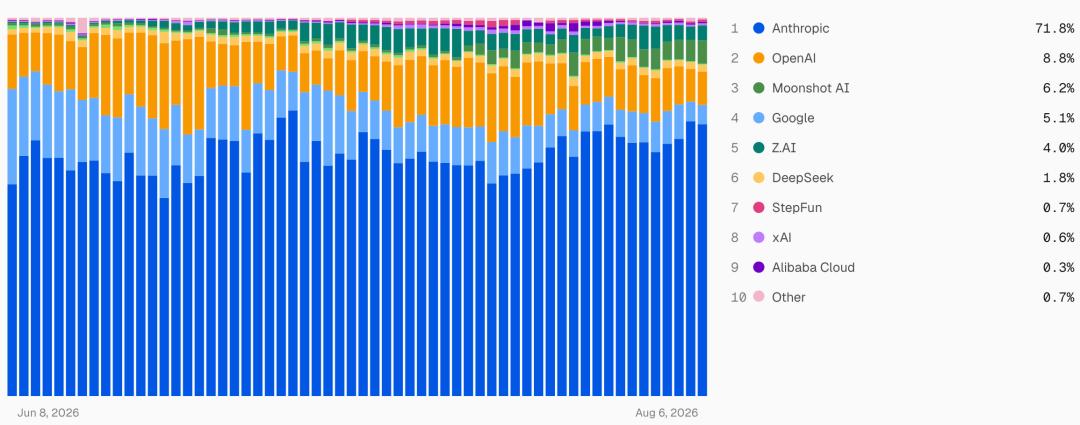
The middle of 2025 seems to be a dividing line. Before that, three forces including strategic direction, business model and data closed-loop widened the gap between China and the United States.
Before the middle of 2025, the main benchmark for Chinese large model companies was OpenAI. "We chased general capabilities, text-to-image, text-to-video, covered both C-end and B-end scenarios, and did whatever OpenAI did." A insider from Zhipu recalled. At that time, OpenAI's valuation had reached hundreds of billions of US dollars. In contrast, Coding seemed to be just a small vertical market.
But Anthropic took a different path very early. In July 2026, Anthropic published its oral history The Making of Claude Code. It was disclosed that as early as 2021, the company had developed a VS Code programming assistant; in early 2022, its reinforcement learning team began to build a platform to train models that can independently complete software engineering tasks. They formed a judgment at that time: the path to AGI will most likely go through large-scale automated software engineering. From 2023 to 2024, a tool named "clide" had already appeared inside Anthropic. It was very crude, but already had the embryonic form of the later Claude Code.
Huang Tiejun, Chairman of the Board of the Institute for Artificial Intelligence, told Shuzhi Qianxian that the code tokens used by Anthropic to train the model reached 4.2 trillion, accounting for more than one third of the total, about half of which came from commercial software codes. "All enterprises engaged in large language models attach importance to code from the very beginning, but the degree of emphasis varies." He believes that what is really worth reflecting on is that China's AI industry has underestimated the importance of the digital world in the past. "Modern society runs on power grids, on top of which there is an information network. Aren't all the underlying layers of our numerous information systems made up of computer codes?"
Chinese enterprises found very early that Coding can make money. A insider from Baidu Intelligent Cloud told Shuzhi Qianxian that in the large model procurement and bidding in 2024, the transaction amount and quantity of code-based AI applications are already very high, with finance, pan-technology internet, traditional software and manufacturing as the main demand industries. But what has thrived in China is another type of business: customization and on-site delivery. Alibaba's Tongyi Lingma not only develops standard products, but also undertakes customized development projects; Zhipu once expanded its government and enterprise project team, with a large number of personnel invested in project delivery. This model can generate revenue, but it is difficult to achieve exponential growth. "Customization is a tough, tiring job with an obvious ceiling for growth." A major tech giant insider said that without a beautiful growth curve, it is impossible to compete for internal resources within the giant.
Another growth curve overseas has already taken off. "Since the middle of 2024, the Coding track has become hot." Chen Qiuwu, CTO of Coding Tech focusing on AI programming, told Shuzhi Qianxian, "The annualized revenue of Lovable, Bolt.new, and GitHub Copilot are all at the 100 million US dollar level, not just one company, but more than a dozen companies." They mainly adopt standardized subscription and MaaS models. Every slight improvement in model capabilities can be directly converted into revenue through more users and higher call volume.
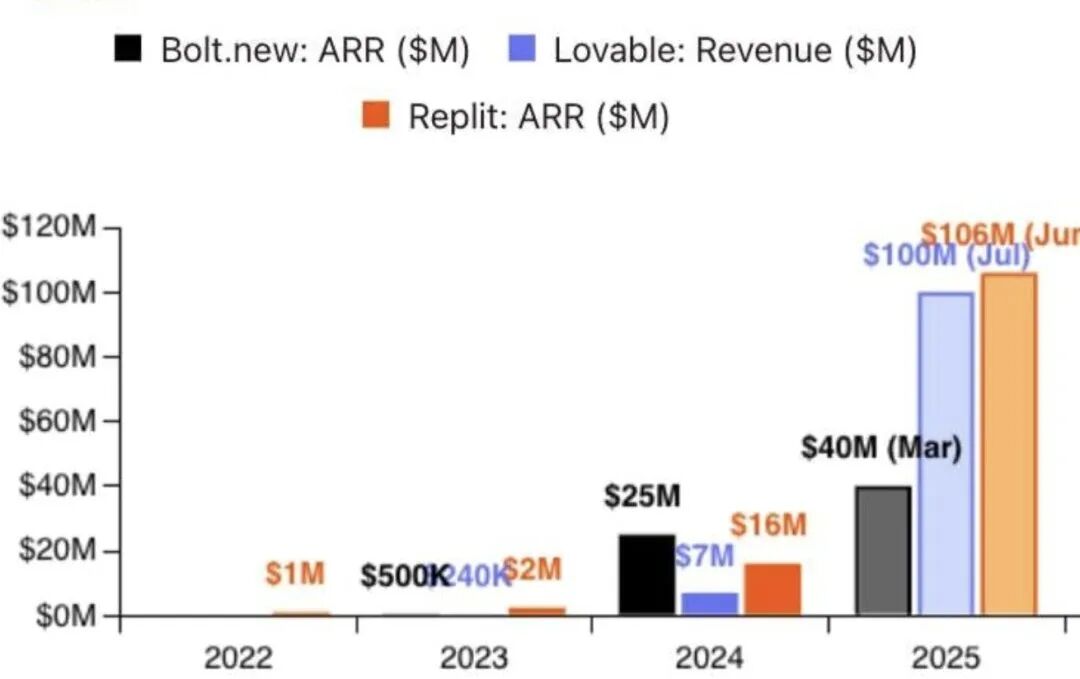
But what is more critical than revenue is data.
In September 2024, Boris Cherny joined Anthropic. When he first joined, his handwritten code submission was rejected by his colleague, the reason being: "You should try the company's code tool clide." Shortly after, Anthropic launched Tool Use. Boris did an experiment: give the model a tool, then ask, "What music am I listening to right now?" The model wrote AppleScript by itself, queried the player, and succeeded at the first attempt. This small experiment made him realize that the model should not be limited to a fixed workflow. Humans only need to give it goals and tools, let it read, write, run programs by itself, and take further actions according to the results. This has become one of the most important product ideas of Claude Code.
In the second half of 2024, coding startups built on the Claude model grew rapidly, and Anthropic also began to accelerate internally. The team completed the product in a two-week sprint. In February 2025, Claude Code was officially released along with Claude 3.7 Sonnet. Claude Code is not only an export of model capabilities, but also a data entry point. It has signed agreements with developers, and developers' input instructions, code modification operations, test failure reasons, and code review focuses — these real software engineering processes are continuously generating data.
"Now model training capabilities and methods are no longer the biggest bottleneck, the core is the data flywheel." A insider from the Coding product Maidao of Huawei Cloud told Shuzhi Qianxian. GitHub has massive amounts of code, but it is difficult to tell the model how a real software engineer works. The code warehouses of major tech giants themselves cannot completely solve this problem either.
"The amount of code in major tech giants is not particularly rich, and the quality is uneven, a lot of which is accumulated 'spaghetti code' over years." A major tech giant insider said.
The better Claude is, the more users Claude Code has; the more users there are, the richer the real software engineering data is; the richer the data is, the better Claude can be trained. Models, products, users and data begin to accelerate each other. Chinese companies have lacked this closed loop for quite a long time.
Worse still, in 2025, Chinese major tech giants had a more important war to fight — the general AI assistant entry point. Doubao, Yuanbao and Qwen competed for users in turn. By the end of the year, ByteDance secured the Spring Festival Gala partnership, Tencent invested huge cash red envelopes through Yuanbao, and Alibaba also launched large-scale market investment through the Qwen App. "Inside our company, the work of aggregating all Apps to Qwen is very difficult, no matter for internal or cross-company collaboration. ByteDance and we are doing the same thing, it just depends on who runs faster." A senior Alibaba insider told Shuzhi Qianxian. Coding was submerged once again.
At this stage, the gap between Chinese and American enterprises has been accumulated comprehensively by three major factors: strategic investment, business model and data closed loop.
But in 2025, a variable emerged. DeepSeek R1 was released.
03 Making up lessons, and the next war
"Tang Jie sent an internal letter, saying that he felt regretful that we did not develop it, but at the same time, it rekindled hope." A Zhipu insider recalled.
In early 2025, DeepSeek R1 was released, bringing a strong impact to the whole industry. Before that, everyone was more or less slack, but now they see again that there is still huge innovation space for basic models.
Zhipu and Moonshot AI made new choices almost at the same time.
Zhipu had internal debates for many nights, and finally decided to allocate more resources to Coding and Agent. "Zhipu made the right bet, and its market value reached one trillion yuan." A ByteDance Trae insider commented. In July 2025, Zhipu released GLM-4.5, which integrated Coding, Agentic and Reasoning, and proposed the concept of "ARC". In September, Anthropic stopped serving Chinese users, and Zhipu quickly launched a migration plan to compete for developers with low-priced Coding Plan. By the end of the year, the relevant MaaS revenue began to grow significantly. At the 2026 March performance conference call, CEO Zhang Peng clearly proposed for the first time to benchmark against "Anthropic".
Almost at the same time, Moonshot AI, two kilometers away, also narrowed its front lines. After suffering setbacks in the C-end traffic investment war against Doubao, Kimi stopped large-scale investment, and re-concentrated resources on underlying models. Yang Zhilin said that startups must have their own "Bet", otherwise they can only be dragged into the war of attrition that major tech giants are good at. Later, this Bet became increasingly clear, pointing to Coding and Agent.
In January 2026, after the release of Kimi's new model, its ARR quickly exceeded 100 million US dollars, making it the first among the "six emerging large model startups". In March, Cursor released Composer 2, and developers found in less than 24 hours that the underlying layer used the Kimi open source model for training. For the first time, a Chinese model entered the real workflow of global developers on a large scale through Coding.
But a fact