The growth rate continues to rank at the bottom, and Foshan aims to stage a rebound by embracing the electric industry.
Foshan has not yet emerged from its "pain adjustment period".
In the first half of the year, Foshan's GDP reached 6.32186 trillion yuan, up 0.2% year on year. Following the first quarter, its economic growth rate continued to rank last among the "1 Trillion Yuan GDP City Club"; its economic scale dropped three consecutive places to 24th nationwide, 10.543 billion yuan behind Dongguan, failing to regain its position as the "third most economically vibrant city in Guangdong".
Transformation has long been no new topic for Foshan. When traditional advantageous industries such as home appliances and home furnishings encounter a "new cycle", Foshan is fully betting on emerging tracks, and at the moment, the energy and power sector is becoming its "biggest breakthrough point" ——
On August 5, the 2026 Foshan New Power System Equipment Industry Investment Promotion Conference (hereinafter referred to as the "Investment Promotion Conference") was held, attracting senior executives of leading enterprises including China Southern Power Grid, State Grid Corporation of China, Dongfang Electric, China Electrical Equipment Group, and Shanghai Electric to attend. Tang Yifeng, Secretary of the Foshan Municipal Party Committee, stated that the city will "jointly build a highland for the new power system equipment industry in the Guangdong-Hong Kong-Macao Greater Bay Area".
This is not only a high-standard investment promotion event, but also a clear demonstration of Foshan's industrial roadmap. The upgrading of traditional industries is inseparable from the restructuring of the power system. As the country's only comprehensive pilot city for manufacturing transformation and upgrading, Foshan is at the historical intersection of "traditional industries laying a solid foundation" and "emerging industries achieving breakthroughs", and the new power system equipment industry ranks first among its ten strategic emerging industries.
Against the general trend of current energy transformation, can betting on the power sector allow Foshan to redefine its industrial coordinates and achieve accelerated overtaking?
"Contrast"
In the first half of this year, Guangdong's GDP reached 7.23 trillion yuan, up 4.5% year on year, firmly occupying the position of the province with the largest economy in China. However, if we look at the provincial economic landscape, the differentiation is very obvious.
The two core cities of Guangzhou and Shenzhen both recorded a 5.8% growth, stabilizing the fundamental economic base. The growth rates of Dongguan, Zhongshan, Zhuhai and other places also exceeded 5%, but the growth rate of Foshan, a major manufacturing city, was only 0.2%.
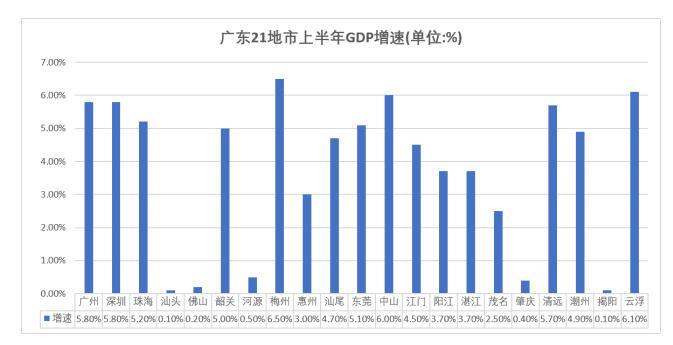
Image source: Nanfang Plus Client
"This is an old issue that has existed for the past two years." Peng Peng, Executive President of the Guangdong Reform Research Association, analyzed to Urban Evolution that Foshan's industrial structure is heavily dependent on the real estate sector, which is also a key area of bulk consumption. Compared with Dongguan, Foshan's industrial structure is more traditional and is more affected by economic transformation and upgrading.
From the perspective of the "three troikas" driving economic growth, Foshan's foreign trade has grown rapidly, but fixed asset investment has declined sharply, and the total retail sales of consumer goods has only seen a slight year-on-year increase. Data shows that Foshan's total import and export volume reached 257.54 billion yuan, up 10.1% year on year. The total retail sales of consumer goods stood at 200.99 billion yuan, up 0.1% year on year. Fixed asset investment fell by 42.8%.
This also reflects the "tug-of-war" between the conversion of old and new growth drivers in Foshan. Foshan's foreign trade is gradually recovering, and new kinetic energy products are driving growth significantly. For example, the exports of mechanical and electrical products, high-tech products, and the "three new major products" increased by 6.0%, 8.8% and 54.5% respectively.
The optimization of foreign trade structure also drives the explosion of emerging industries. In the first half of the year, the added value of high-tech manufacturing above designated size in Foshan rose against the trend by 11.6%, and the output of products such as lithium-ion batteries, industrial robots, optoelectronic devices, sensors, and semiconductor discrete devices increased by 41.0%, 27.6%, 10.3%, 16.0% and 11.1% year on year respectively.
These data clearly outline the trajectory of Foshan's industrial system accelerating its shift from traditional advantageous industries such as home appliances and ceramics to high value-added tracks including new energy, intelligent manufacturing, and electronic information. Over the past five years, the proportion of the added value of advanced manufacturing in the added value of industries above designated size in Foshan has jumped from 50.2% to 55.7%, becoming the core engine supporting industrial growth.
The positive momentum is beginning to show, but the pain period is not over. In terms of the proportion of advanced manufacturing in industries above designated size, Foshan is far lower than strong manufacturing cities such as Shenzhen and Guangzhou, and even lower than the provincial average level (57.2%), failing to reverse the dilemma of "sluggish growth of traditional industries and insufficient scale of emerging industries".
This is reflected in the city's economic development as a downturn that has lasted for more than two years. Foshan's GDP growth rates in 2024 and 2025 were 1.3% and 0.2% respectively; in the first quarter of this year, it fell to -2.4%, overtaken by Dongguan and losing its status as the "third most economically vibrant city in Guangdong"; in the first half of this year, Foshan's economic growth rate rebounded to 0.2%, but it was still outpaced by Dongguan, dropping three consecutive places in the national "1 Trillion Yuan GDP City Club".
Betting on "Power"
NVIDIA CEO Jensen Huang compares the AI industry architecture to a "five-layer cake" —— consisting of energy, chips, infrastructure, models and applications, with energy being the bottom layer. In other words, without power, the upper four layers will all be reduced to zero.
While the spotlight is on optical modules and chips, Foshan, one of the three major manufacturing bases for medium-voltage switchgear in China, has quietly turned to tackle the more underlying core component —— the power infrastructure for AI.
Not long ago, Foshan held the Working Conference on Accelerating the Construction of Modern Industrial System (hereinafter referred to as the "Foshan Industrial Conference"), launching the "1+7+3+N" modern industrial promotion mechanism. Seven key industries including energy and power, intelligent robots, and intelligent connected vehicles have been listed as key breakthrough tracks, aiming to add two new 100-billion-yuan emerging industrial clusters within three years.
As the top of the seven key industries, the importance of the energy and power sector is self-evident. At the moment, Foshan is targeting the "highland of new power system equipment industry in the Guangdong-Hong Kong-Macao Greater Bay Area". The Investment Promotion Conference released a series of power equipment application scenarios in Foshan, covering six dimensions of "source, grid, load, storage, computing, and carbon", with a total investment of over 1000 billion yuan to be unleashed, directly driving power equipment procurement demand of more than 600 billion yuan.
This also demonstrates Foshan's full determination to bet on the power sector. In Peng Peng's view, Foshan has made many efforts in developing emerging industries, such as industrial robots and hydrogen energy.
"The new power system equipment industry is the focus of national industrial development recently. By seizing this new opportunity, Foshan can not only align with national strategies, but also give full play to the heritage of its traditional industries. This should be a new transformation for the digital and intelligent upgrading of Foshan's traditional industries," he said.
The recently issued "15th Five-Year Plan" for the Construction of New Power System proposes that by 2030, the proportion of non-fossil energy power generation will reach 50%, the total national installed capacity will reach 5.4 billion kilowatts, and the high-level consumption of more than 2.8 billion kilowatts of new energy will be realized.
The end of computing power is power, and the foundation of power is equipment. According to the latest report released by the International Energy Agency, the average annual growth rate of global power demand will exceed 3.5% from 2026 to 2030.
Behind this, projects such as the integration of computing and power, direct connection of green power, and source-grid-load-storage integration continue to expand the imagination space of the power equipment industry. As a leading manufacturer of new energy transformers in China, Foshan's Eaglerise Electric & Electronic has a clear perception of this trend.
Its prospectus shows that in 2025, the orders for data center transformers increased by more than 400% year on year. The company successively won orders of 250 million yuan from Google and 180 million yuan from Microsoft, and won the bid for a 500 million yuan project of a large data center in Tokyo, Japan. The order scheduling has been extended to the second quarter of 2026.
For Foshan, the explosive potential of the new power system equipment industry has been verified. In 2025, Foshan introduced 50 new power system equipment industry projects in total, with a total contracted investment of more than 36 billion yuan. Among them, 22 projects settled in the Preferential Zone around the Two Rivers, with a contracted investment of 16.17 billion yuan.
With a century-old accumulation in the power transmission and distribution sector, Foshan has formed a complete industrial chain covering "power generation, transmission, distribution, utilization and storage", with a local supporting rate of 75%. It gathers more than 5000 power equipment enterprises including leading players such as Eaglerise and Shengye Electric, and more than 400 enterprises above designated size, which is expected to build a 100-billion-yuan new power system equipment industrial cluster by 2027.
This will also become the vanguard of Foshan's "growing and expanding emerging industries".
Breakthrough
A month ago, Foshan Station of the Guangzhou-Zhanjiang High-speed Railway was officially put into operation, realizing the fastest 18-minute direct access to Guangzhou and 1.5-hour access to Zhanjiang, reshaping Foshan's external transportation pattern. According to the third-quarter railway train operation diagram of China State Railway Group, Foshan Station will operate a total of 98 regular trains of various types, which not only diverts the passenger flow pressure of the Guangzhou hub, but also densifies the channels between Guangzhou and Foshan, Shenzhen and Foshan, Foshan and Zhanjiang, as well as the channels connecting eastern and western Guangdong.
This is the deepening of the full integration of Guangzhou and Foshan, and also the improvement of Foshan's capacity as a factor hub. From the perspective of the "Golden Inner Bay" around the Pearl River Estuary, Guangzhou and Foshan are the key hubs connecting the east and west banks. The depth of their full integration will determine whether the resource elements in the Greater Bay Area can flow fully and the transmission radius.
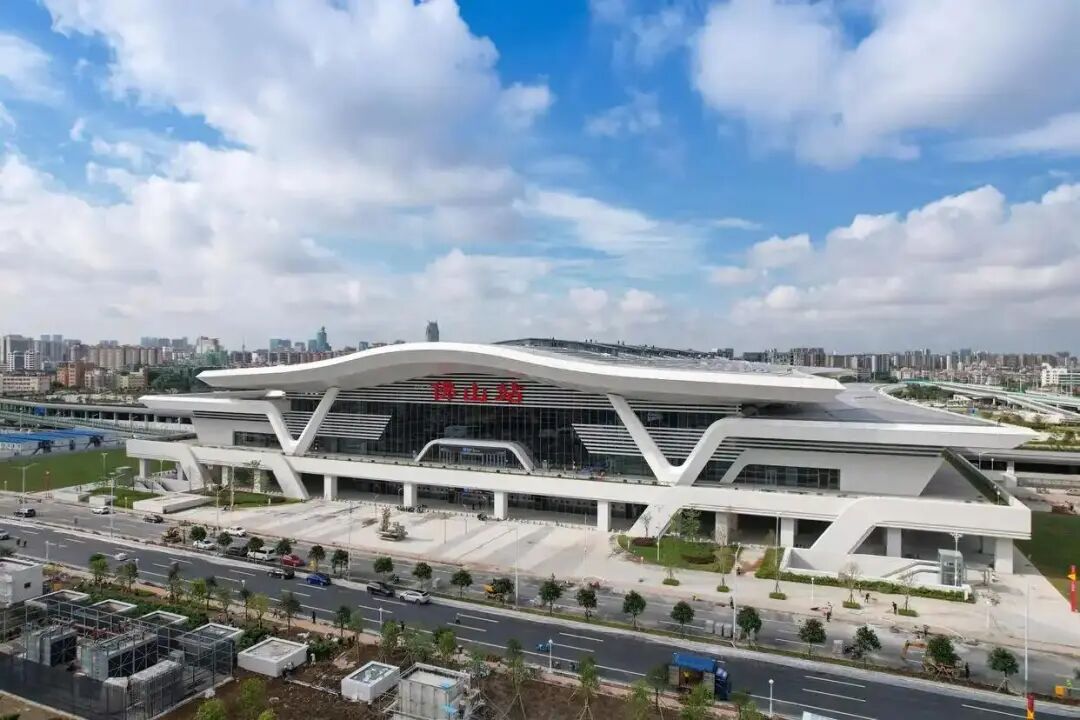
Image source: Xinhua News Agency
The outline of Foshan's 15th Five-Year Plan points out that relying on its key geographical location connecting the east and the west, the city will expand the depth and breadth of cooperation with Hong Kong and Macao, promote the high-quality development of the Guangzhou metropolitan area driven by the full integration of Guangzhou and Foshan, comprehensively strengthen the connection with Shenzhen, deeply participate in the construction of the "Golden Inner Bay" around the Pearl River Estuary, boost the coordinated development of the east and west banks of the Pearl River Estuary, and strengthen the radiation-driven role to the southwest hinterland of China.
This is also a precise positioning of Foshan based on the overall development situation of the Greater Bay Area. However, judging from the development trend in the past two years, the reality is very "unoptimistic" ——
Data shows that in 2025, the total economic volume of Guangzhou and Foshan reached 4.52 trillion yuan, contributing 31% of the total GDP with 6% of the province's land area. However, in terms of growth rate, the driving force of the "Guangzhou-Foshan Pole" has differentiated. The GDP growth rates of the two cities in 2024 were 2.1% and 1.3% respectively, 4% and 0.2% in 2025, and 5.8% and 0.2% in the first half of 2026.
Guangzhou is gradually recovering, but Foshan continues to hover at a low level. Once the gear of "Guangzhou R&D + Foshan Manufacturing" cannot mesh accurately, the traction force of the pole will be greatly reduced. To this end, Foshan has proposed the "three-pronged approach" (optimization and upgrading of traditional industries, cultivation and development of emerging industries, and forward-looking layout of future industries), and systematically promotes the construction of a modern industrial system with the determination to "rebuild a new Foshan" and the attitude of second entrepreneurship.
Obviously, this is a systematic upgrade of the industrial system. Peng Peng believes that Foshan is in the process of converting old and new growth drivers, and tracks such as new power system equipment and intelligent robots are its most promising development directions, which will effectively drive the transformation of traditional industries.
Not long ago, the outline of Guangdong Province's 15th Five-Year Plan proposed to support Foshan and Dongguan to build provincial economic center cities, and "promote the linked development of full integration of Guangzhou and Foshan". At the moment, Foshan is also trying to break away from the logic of "undertaking overflow industries" and embed itself more deeply into the industrial innovation network of Guangzhou and Shenzhen.
Especially in tracks such as energy and power, intelligent connected vehicles, and intelligent robots, how Foshan deepens the division of labor model of "Guangzhou and Shenzhen R&D + pilot testing" and "Foshan manufacturing + mass production" to transform industrial potential energy into real growth momentum has become the key to its breakthrough.
This article is from the WeChat official account "Urban Evolution", written by Dan Zhongkui, and published with authorization from 36Kr.