All costs are rising across the board, while the quotation competition is still extremely fierce: the energy storage sector has entered "hell mode" in 2026.
Large-scale energy storage is seeing a frantic rush-to-install spree, while investment in commercial and industrial energy storage has come to a standstill.
"This year, almost every component you can see inside an energy storage cabinet is getting more expensive."
Xiao Zhang, who works on system integration, stood beside an energy storage cabinet at his company and listed the rising costs for us: cell prices are going up, PCS prices are going up, copper busbars and cables are going up, even electronic components that rarely drew much attention in the past such as PCBs and IGBTs are also seeing price increases.
Over the past two years, the two most familiar words in the energy storage industry were "price reduction".
This year, the situation has completely reversed. According to incomplete compilation by New Energy Industrialist, at least 9 enterprises highly related to the energy storage industrial chain have publicly released price increase notices.
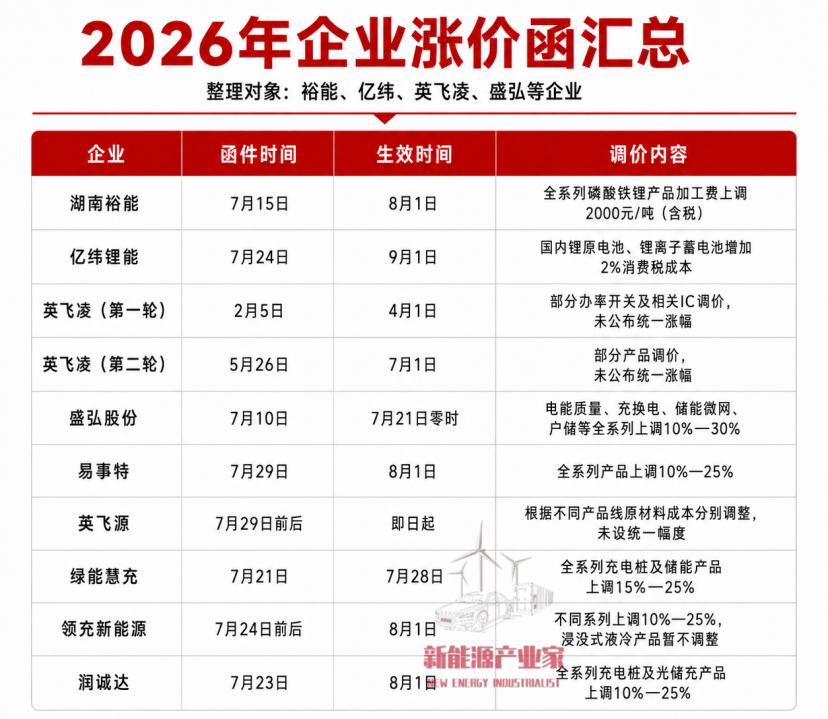
Source: Compiled by New Energy Industrialist
The first to change is the cell, which accounts for the highest proportion of cost in the energy storage system.
Xiao Zhang told us that before April, cells could basically be bought for under 0.25 yuan/Wh, and better quality ones for 0.28 yuan/Wh, but now the price has risen to more than 0.4 yuan/Wh.
Worse still, the price of lithium carbonate has fallen now, but cell prices remain at a high level.
Following closely behind is the PCS.
A leading brand raised the prices of all its medium-voltage products by 3%-5% in March this year; by June, affected by the rise in upstream raw material prices, the price of its high-voltage inverters also saw a small increase.
Further upstream at the raw material and component end, the increase is even more staggering:
Prices of non-ferrous metals such as gold, silver, copper, aluminum and tin have increased by 30%-200%;
The prices of core electronic components such as PCBs, memory chips, magnetic devices and IGBTs have increased by 50%-800%.
From cells and PCS to cables, structural parts and electronic components, this round of price hikes has covered almost every major component of the energy storage system.
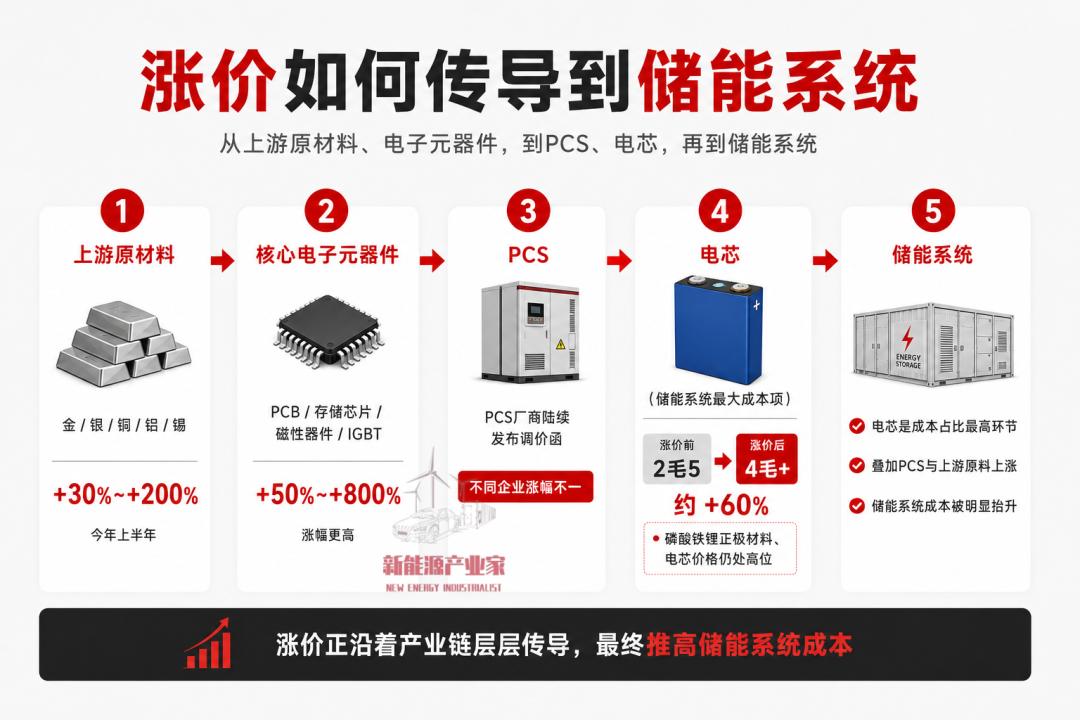
Source: Compiled by New Energy Industrialist
The problem is:
The downstream of the energy storage industry can barely raise prices.
Since the middle of this year, the total quoted price for the AC and DC sides of large-scale energy storage projects has increased by about 0.01 yuan/Wh, and in some bidding projects, the quoted price of energy storage systems is still hovering around 0.5 yuan/Wh.
For energy storage developers and integrators, this means entering a nearly "hell" mode:
The upstream keeps raising prices more fiercely, while the downstream is caught in increasingly cutthroat competition.
The most dangerous stage of the energy storage industry may not be the "low-price competition" in the past, but this two-way squeeze happening right now.
We interviewed multiple practitioners in the energy storage sector. Some of them are on the front line of large-scale energy storage project development, some have deep experience in commercial and industrial energy storage, and others are responsible for industrial chain procurement. Through their accounts, we try to restore the real situation of the end energy storage market under this round of price hikes.
Independent Energy Storage: Costs Rise, But Grid Connection Windows Cannot Be Missed
In this round of price hikes across the energy storage industrial chain, independent energy storage was the first segment to feel the pressure.
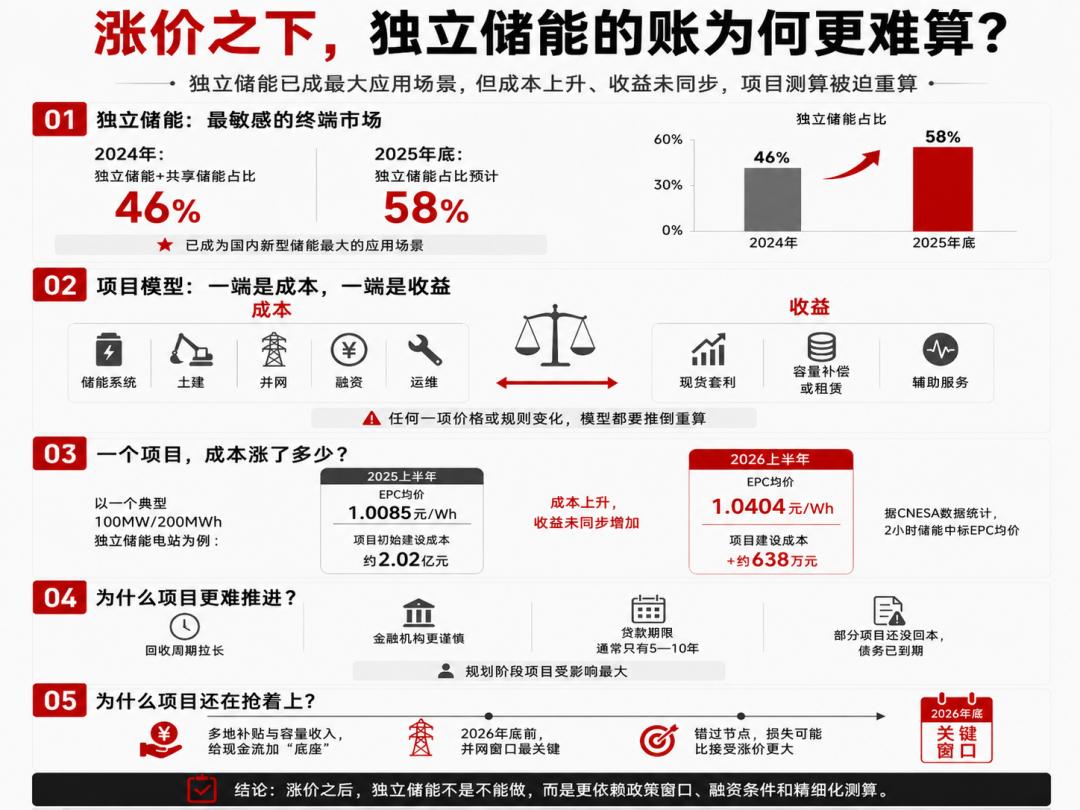
This is the sub-sector with the most active investment and the largest scale of project implementation in the energy storage industry in the past two years. According to statistics from CNESA, independent energy storage accounted for 58% of the country's new installed capacity of new-type energy storage in 2025, becoming the largest energy storage application scenario in China.
But once equipment prices rise, the originally calculated project model has to be completely overturned and recalculated.
Whether an independent energy storage project can make a profit mainly depends on two sets of accounts.
One is the cost, including the energy storage system, civil engineering, grid connection, financing and later operation and maintenance; the other is the revenue, which mainly comes from peak-valley arbitrage in the spot market, capacity compensation or capacity leasing, and auxiliary services.
If any item's price or rule changes, the originally calculated model will need to be completely recalculated.
Take a typical 100MW/200MWh independent energy storage power station as an example:
According to CNESA statistics, in the first half of 2025, the average winning EPC bid price for 2-hour energy storage was about 1.0085 yuan/Wh, and the initial construction cost of the project was about 202 million yuan.
In the first half of 2026, the average winning EPC bid price for 2-hour energy storage rose to 1.0404 yuan/Wh, and the project construction cost directly increased by about 6.38 million yuan.
For a heavy-asset project, this is no small fluctuation.
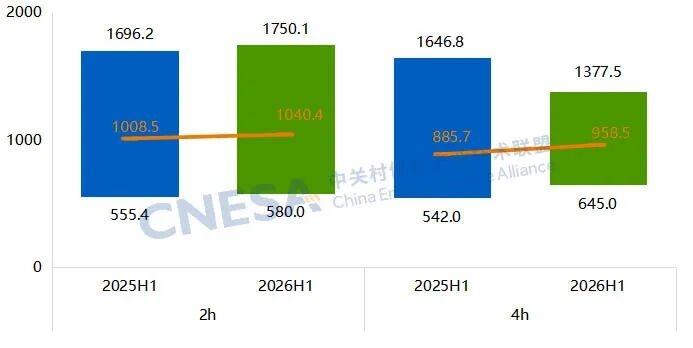
Source: CNESA
Project costs have gone up, but revenue has not increased synchronously.
The most direct impact is — the static payback period of costs is extended, and financing becomes more difficult.
"The funds for independent energy storage basically still come from financial institutions," a general manager Li in charge of the supply chain at an energy storage enterprise told us, "Once the revenue cannot cover the principal and interest repayment required by financial institutions, the project is not commercially viable."
Independent energy storage projects have large investment scales, and few enterprises can rely entirely on their own funds for construction. Financial institutions such as banks, financial leasing companies and funds are the main sources of funds for projects.
Financial institutions will comprehensively evaluate the credit status of the project development company, whether the project has the ability to repay principal and interest, the cell brand and attenuation, before deciding whether to grant the loan.
General Manager Li did the math for us:
"Leaving land factors aside, in regions like Gansu, Ningxia, Inner Mongolia and Xinjiang, the EPC price for 4-hour energy storage must be controlled at ≤ 0.65 yuan/Wh for the static investment model of the entire project to be viable."
This is also the main reason why many independent energy storage projects are facing difficulties in advancing this year.
More importantly, even if the accounts are hard to balance, the projects cannot stop.
CNESA data shows that in the first quarter of 2026, China's new installed capacity of new-type energy storage reached 27.1GWh, of which independent energy storage was the main force, with new installed capacity of 23.0GWh, a year-on-year increase of 205%.
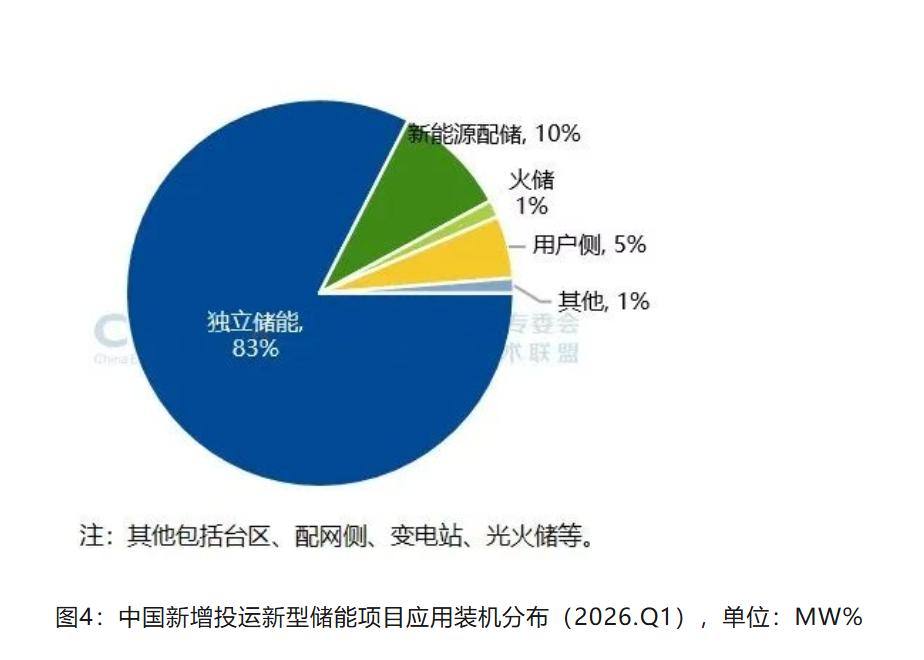
Source: CNESA
On one hand, the whole industry is complaining about difficulties, and on the other hand, a large number of projects are still being implemented.
Why does this phenomenon happen?
The answer is: policies.
Since the beginning of this year, more than ten provinces and cities across the country have successively introduced or improved subsidy policies, which is equivalent to adding a "base" of revenue for the projects.
With relatively stable capacity income or subsidies, project cash flow is easier to predict, and it is easier to get recognition from financial institutions.
But the policy window will not exist forever.
"In some regions with capacity subsidies, everyone is rushing to meet the deadline at the end of this year," General Manager Li said, "Because the subsidies may be reduced, or even disappear next year."
The accessible energy storage scale, capacity leasing demand and grid dispatching space in a region are all limited.
Whoever seizes the spot first will be the first to enjoy this round of policy dividends.
Therefore, despite the rise in equipment prices, many developers are still competing for the grid connection window before the end of 2026. For them, the revenue loss caused by missing the deadline may be more serious than accepting the price increase.
Source: Compiled by New Energy Industrialist
Commercial and Industrial Energy Storage: Payback Period Extended, Private Enterprise Investment Nearly Stalled
"Commercial and industrial energy storage was already difficult, and after costs rose, the accounts became even harder to balance."
General Manager Zhang, a commercial and industrial energy storage development lead who has deep experience in the Guangdong market for many years, told us, "Now private enterprises have basically stopped investing in commercial and industrial energy storage. Only a small number of central and state-owned enterprises are still investing, but they have also tightened their investment conditions."
Different from independent energy storage, commercial and industrial energy storage has no "backstop revenue". Its main source of income is — making profits from peak-valley price differentials: charging at low prices and discharging at high prices.
In the past, peak and valley periods and electricity prices were mostly stipulated in advance manually. How many times a project can be charged and discharged per day, how much money it can make per year, and how many years it will take to get the investment back could basically be calculated clearly in advance.
By the end of 2025, the National Energy Administration clearly stipulated that starting from March 1, 2026, for business entities directly participating in market transactions, the time-of-use electricity price levels and time periods will no longer be artificially stipulated.
This means that when energy storage charges and discharges will no longer only depend on fixed time periods, but change with the real-time market prices.
Whether the same set of equipment can make profits depends more and more on spot trading, load forecasting and operation capabilities.
Commercial and industrial energy storage has changed from the past "you can make money as long as you install the equipment" to "you can only make money if you are good at operation".
At the same time, affected by the price hikes of cells, PCS and other core equipment, the cost of commercial and industrial energy storage is still rising.
At present, the procurement price of energy storage systems has increased by about 0.08—0.10 yuan/Wh, with an overall increase of more than ten percent;
According to statistics from Xun entropy Research Institute, the average EPC quotation for 2-hour commercial and industrial energy storage projects has risen from 1.113 yuan/Wh in 2025 to 1.176 yuan/Wh.
How big is the impact? General Manager Zhang did a calculation for us:
Take a 1MWh project in Guangdong as an example.
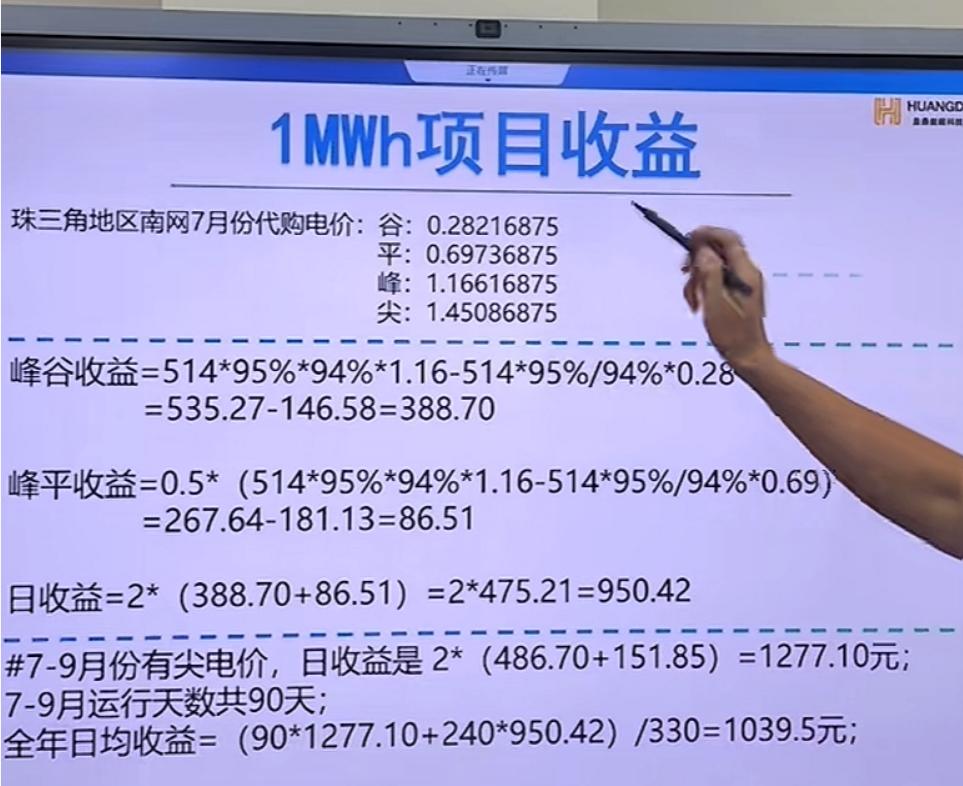
Calculation of commercial and industrial energy storage projects in Guangdong
Calculated at a price of 1 yuan/Wh, the initial investment of the project is about 1 million yuan. Assuming 1.5 times of charge-discharge cycles per day and 330 days of operation throughout the year, without considering charge-discharge loss, operation and maintenance costs, demand management and battery attenuation, the theoretical revenue in the first year is about 343,000 yuan.
Based on this calculation, the static investment payback period of the project is about 3.5 years. If the system cost rises, the payback will not be achieved until the fifth year.
And this is only the ideal state. In actual operation, the energy storage system has charge-discharge efficiency loss, and also needs to bear costs such as operation and maintenance, insurance, site leasing and financing.
As the battery capacity attenuates year by year, the annual revenue of the project in subsequent periods will continue to decline.
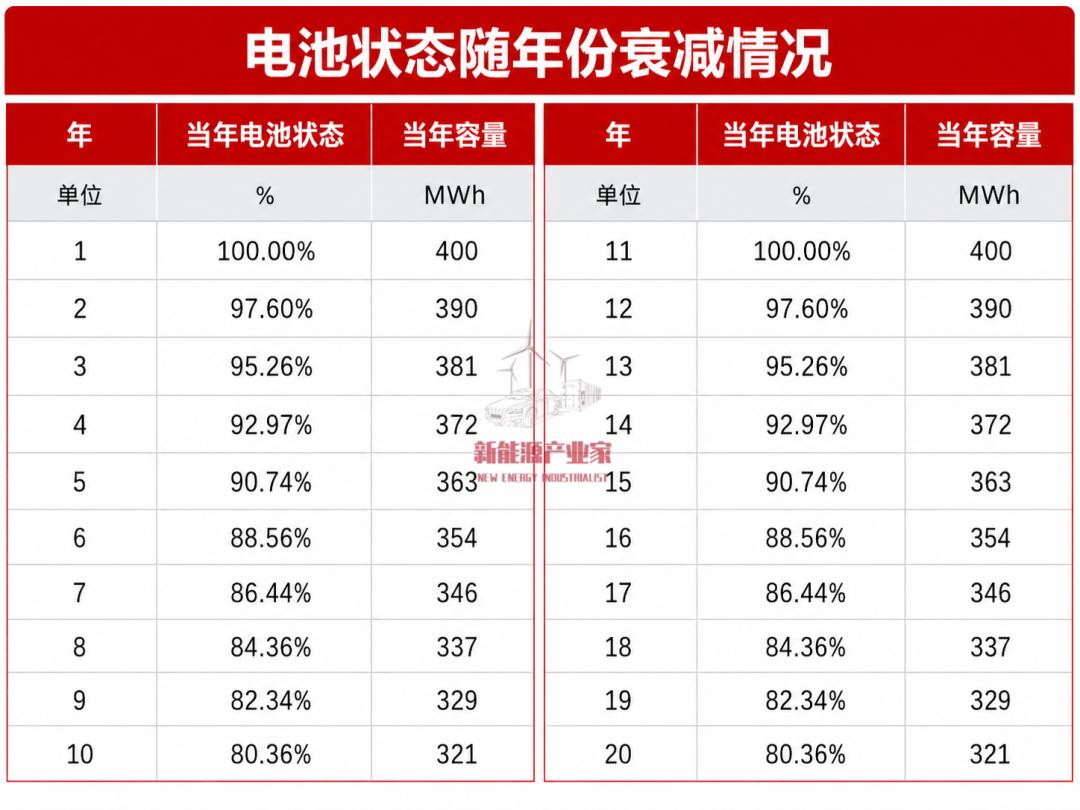
Source: Compiled by New Energy Industrialist
The actual payback period will only be longer.
More importantly, Guangdong is already one of the regions with relatively high commercial and industrial peak-valley price differentials across the country.
The peak-valley price differential in many cities is only around 0.3 yuan/kWh.
In these regions, even if a stable full charge-discharge cycle can be completed every day, the project payback period may be extended to more than 10 years.
When the service life of equipment, revenue attenuation and future electricity price policies all have uncertainties, investors are naturally unwilling to place bets anymore.
The impact of rising costs is directly reflected in the installed capacity data.
In the first quarter of 2026, the