Breakthrough in Science: AI has generated a complete, viable phage genome capable of inhibiting bacteria for the first time
Welcome to the era of generative genome design!
Today, Stanford University, with the first complete phage genome design realized by artificial intelligence (AI), has been published in the authoritative journal Science. This engineered phage is not only viable and capable of inhibiting bacteria, but also exhibits lytic capacity comparable to that of natural ΦX174-like phages.
Paper link: http://www.science.org/doi/10.1126/science.aec2657
Cryo-electron microscopy results show that the AI-generated Evo-Φ36 forms a new protein-compatible combination; in addition, the generated phage mixture can inhibit the growth of ΦX174-resistant Escherichia coli after 1 to 2 passages, while the natural ΦX174-like mixture does not produce the same effect after 5 passages.
The research team believes that this breakthrough paves the way for AI-generated phage therapy, which is expected to tackle rapidly evolving bacterial pathogens in the future. With the development of technology, genome design is expected to become a core biotechnology just like genome sequencing, synthesis and editing, and be used to generate larger and more complex genome systems.
However, this capability may also bring biosafety and biosecurity issues. A concurrent perspective article points out that the research team has responded to related risks more proactively than most developers of powerful biological AI models. The research team emphasizes that future whole-genome design projects need to involve safety and security experts throughout the entire cycle, and establish more robust mechanisms to prevent misuse.
AI designs the complete phage genome
For a long time, designing a complete genome has been a daunting challenge: the genome is highly sensitive to sequence composition, and a single mutation can render it inactive. Despite advances in protein design and biological circuit engineering, there is still no universal framework for complete genome design.
Different from previous studies that mostly focused on individual genes or gene circuits, this work is the first attempt to generate a complete phage genome with AI. Based on the pre-trained Evo 1 and Evo 2, the research team first tested their ability to generate phage-like sequences, and then screened candidate genomes through Microviridae fine-tuning, ΦX174 initiation prompting, genetic architecture constraints and host tropism filtering.
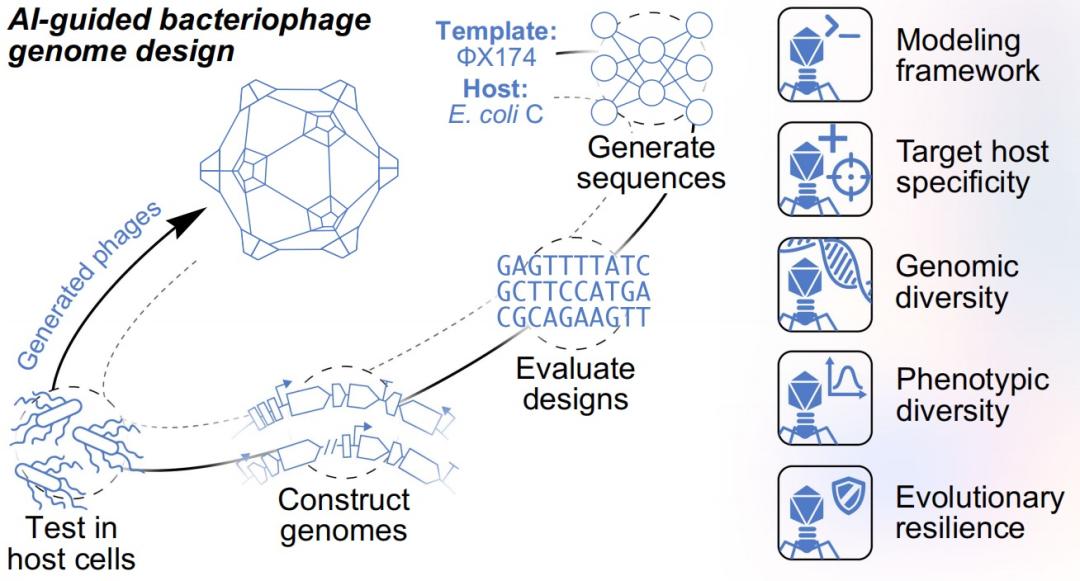
Figure|AI-guided phage genome design framework.
1. Test the basic generation capability of the model
The research team first tested the basic generation capabilities of Evo 1 and Evo 2. Both models have been pre-trained on large-scale DNA sequences, including more than 2 million phage genomes. The team used three types of viral labels to guide the models to generate sequences, and conducted evaluation through geNomad, BLAST, coding density, protein structure prediction and PHROGs annotation. The results show that both models can generate sequences with phage characteristics, and Evo 2 has stronger basic performance.
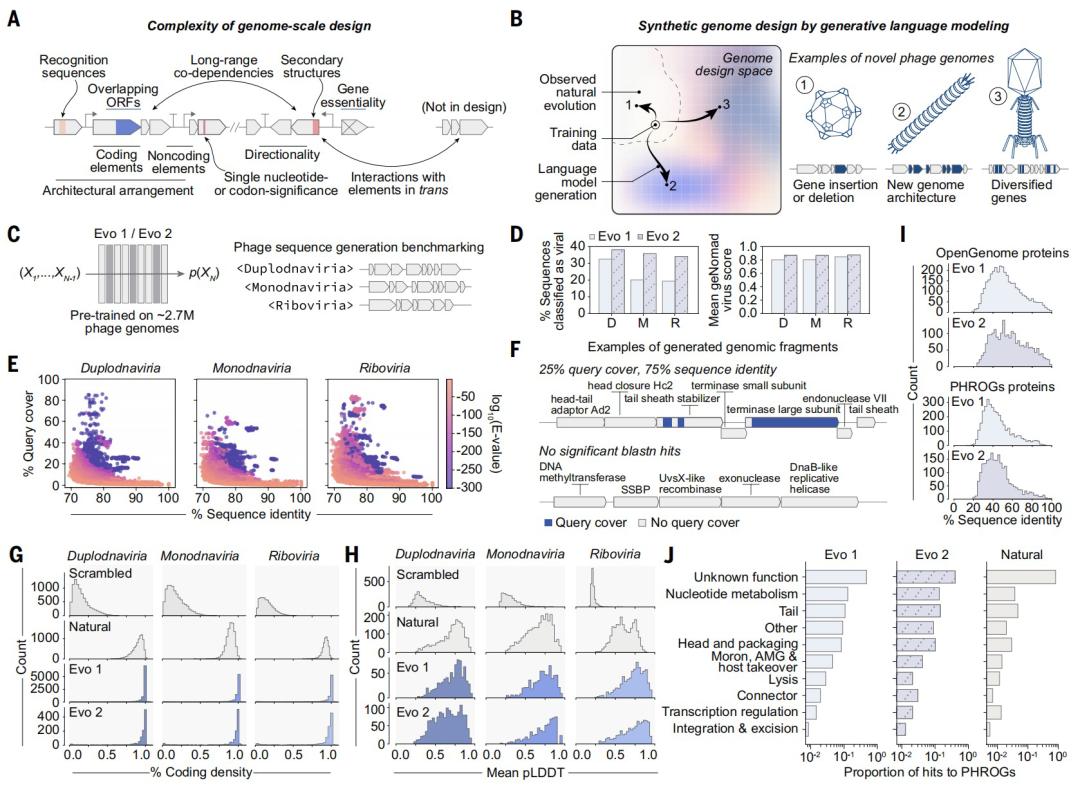
Figure|Evo generates phage genome sequences with realistic features.
2. Generate ΦX174-like genomes
The research team selected ΦX174 phage and host Escherichia coli C as the design objects. The ΦX174 genome is small with sufficient research foundation, and Escherichia coli C is non-pathogenic and easy to verify, making it suitable as a test system. Subsequently, the team fine-tuned Evo 1 and Evo 2 on about 15,000 Microviridae sequences, and used the initial consensus sequence of ΦX174-like genomes to guide the model to generate outputs. Finally, they controlled the prompt length at about 4-9 nucleotides and the sampling temperature at 0.7-0.9 to generate more diverse ΦX174-like candidate genomes.
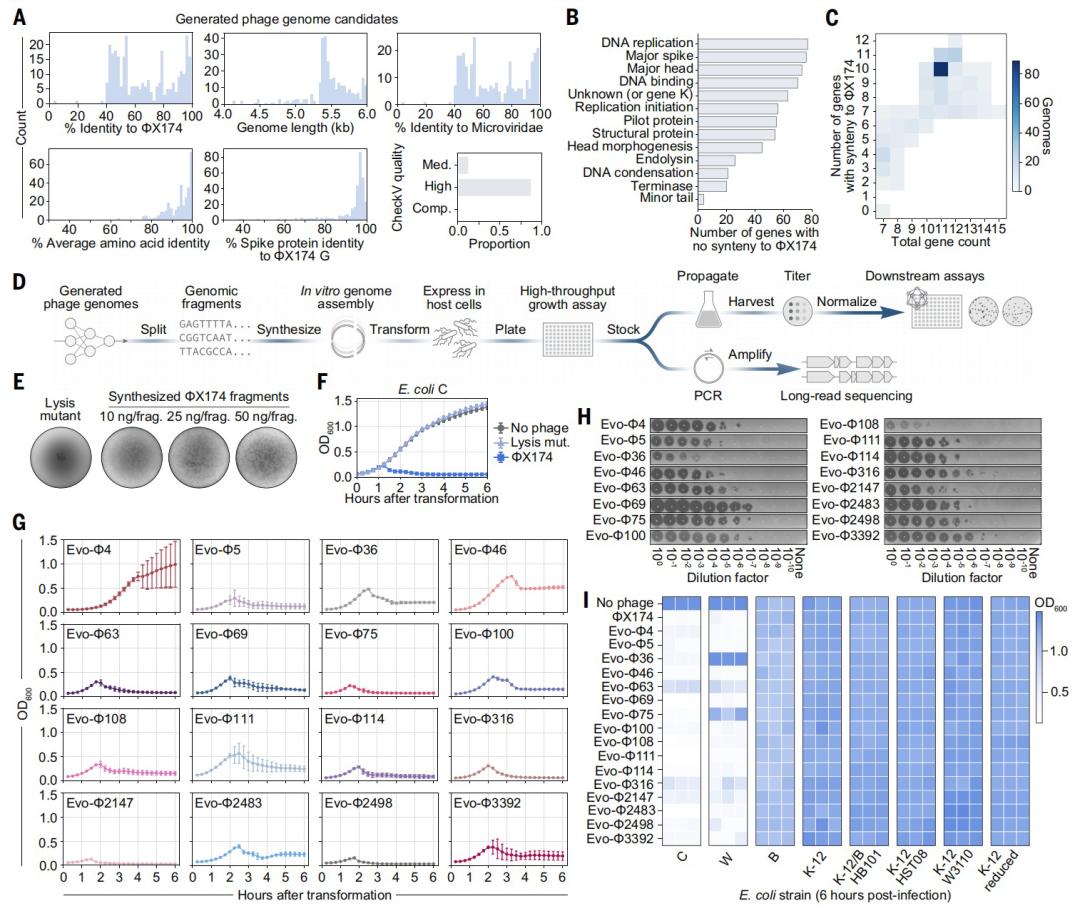
Figure|Creation of viable generated phage genomes.
After obtaining the generated sequences, the research team screened the candidate genomes with multiple constraints, including basic quality indicators such as length and GC content, as well as ΦX174-like gene structure and target host tropism. At the same time, they also avoided sequences that were too close to the wild-type ΦX174, and developed a dedicated gene prediction method for the overlapping genes of ΦX174.
"AI-generated phages" are viable and capable of inhibiting bacteria
Overall, the screened AI-generated phages are viable and exhibit different fitness characteristics. Among them, cryo-electron microscopy confirmed that Evo-Φ36 is compatible with DNA packaging proteins from distantly related phages. The generated phage mixture can inhibit the growth of ΦX174-resistant Escherichia coli after 1 to 2 passages, while the natural ΦX174-like mixture does not produce the same effect after 5 passages.
1. Genome screening and survival rate
The research team tested nearly 300 AI-designed genomes, and finally obtained 16 viable phages. The results show that the closer the candidate sequence is to the known natural genome, the easier it is to survive. All these phages can infect the target host Escherichia coli C, but do not inhibit the growth of the other 6 tested strains. In general, after combining the model with guidance during inference and subsequent filtering, it is able to generate phage genomes that are viable and meet the expected host tropism.
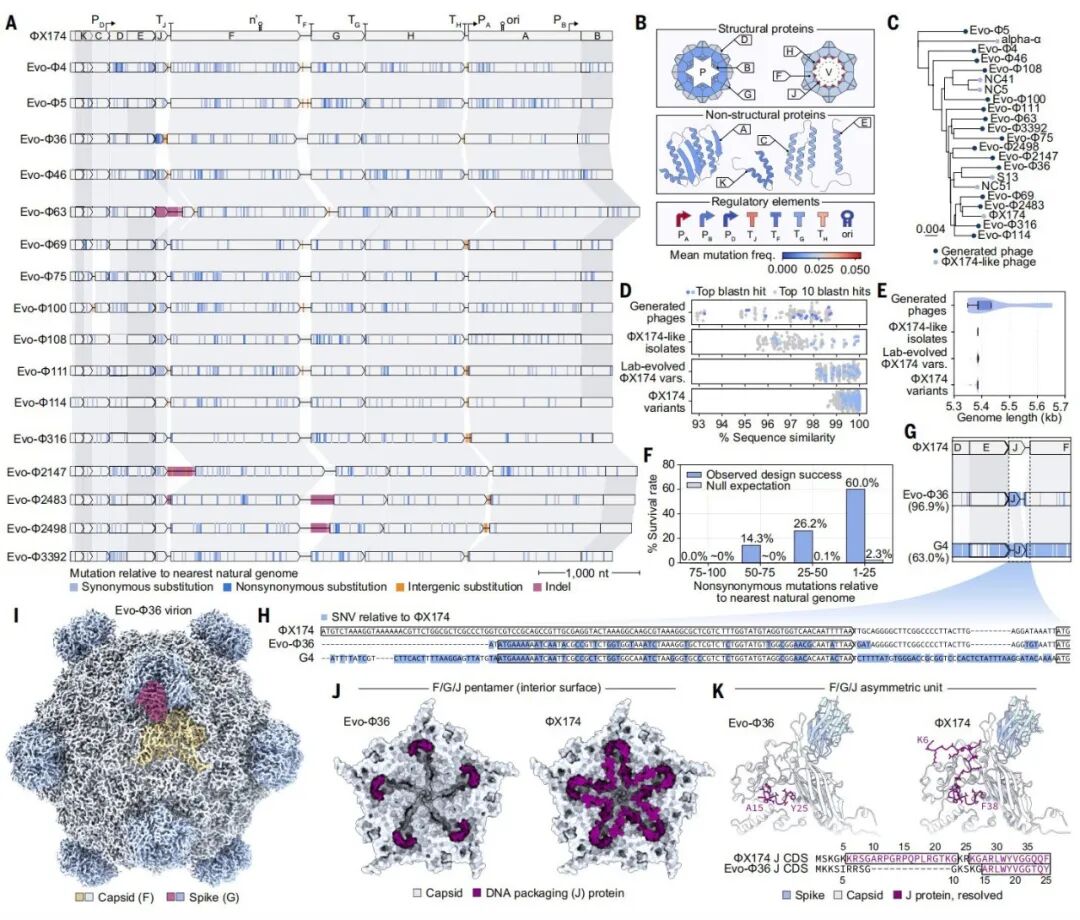
Figure|Generated phages reveal sequence and structural insights.
2. Generate new sequence combinations
The generated phages have significant sequence diversity, and all 13 viable genomes contain mutations that cannot be explained by a single known natural sequence. Evo-Φ36 is a typical example: it replaces the original DNA packaging protein J with a shorter homologous protein from the distantly related phage G4; previous studies have shown that this type of replacement is not viable in the ΦX174 background. The cryo-electron microscopy structure shows that the new J protein can still maintain compatible interactions with the capsid, indicating that generative design can discover new sequence compatibility schemes.
3. Fitness characteristics
Generated phages can not only survive, but also exhibit different fitness characteristics. Compared with natural ΦX174-like phages, they cover a wider range of lytic kinetics: Evo-Φ2483, Evo-Φ69 and others show strong lytic phenotypes, while Evo-Φ63 has the slowest lytic kinetics and the lowest amplitude. In competition experiments, Evo-Φ69 became dominant 6 hours after infection; in this experiment, there was no obvious correlation between sequence similarity and competitiveness. Overall, the genomic diversity generated by AI corresponds to observable phenotypic differences.
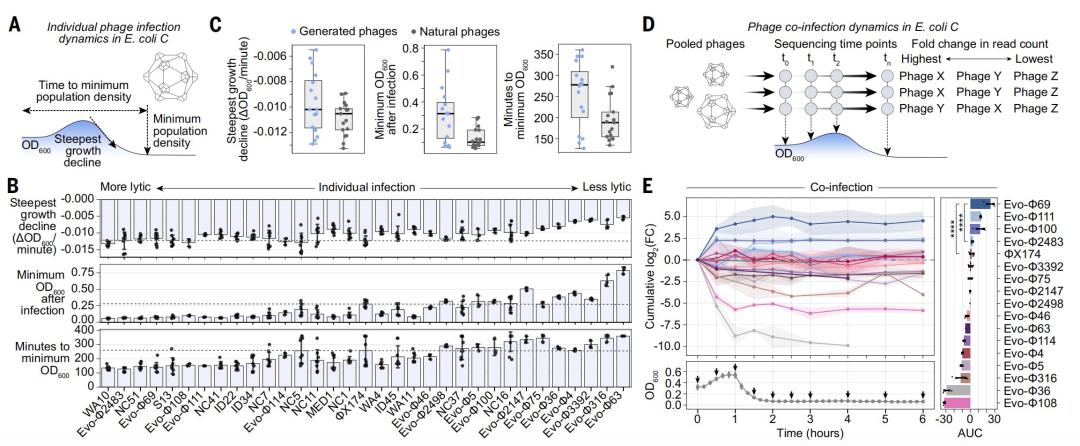
Figure|Generated phages exhibit a wide range of fitness characteristics.
4. Overcome bacterial resistance
The generated phage mixture can quickly break through bacterial resistance to phages. The research team evolved two ΦX174-resistant strains CR1 and CR2, and found that the generated phage mixture broke through the resistance of the two strains after 1 and 2 passages respectively, and maintained the effect for at least 5 passages. In contrast, the individual ΦX174 and the natural ΦX174-like phage mixture still failed to break through after 5 passages. Sequencing showed that the phages that successfully broke through the resistance were recombined from 2-3 generated phage fragments, and carried multiple Evo-generated capsid and spike protein mutations. The research team believes that these results suggest that generative models can be used to produce phage mixtures with greater genetic diversity and potentially improve therapeutic effects.
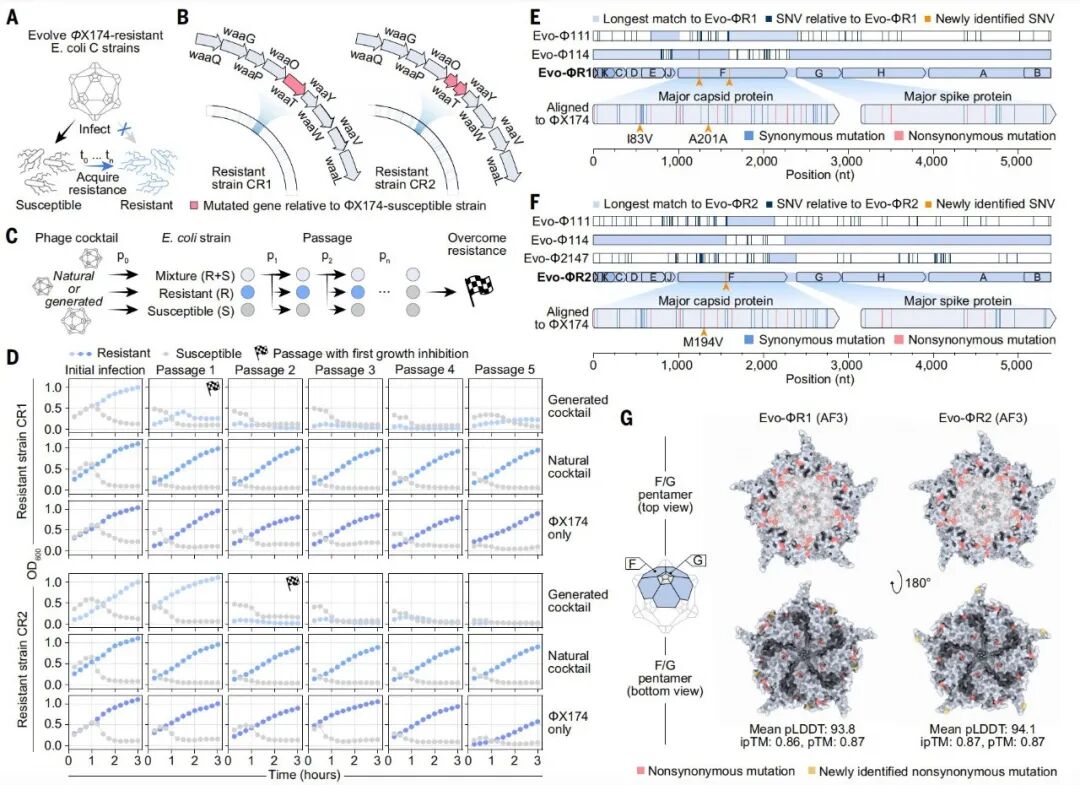
Figure|Generated phages can quickly overcome bacterial resistance.
Limitations and future directions
However, this study still has some limitations.
The research team points out that although AI has been able to generate viable phage genomes with different fitness characteristics, it also brings biosafety and biosecurity issues. In the future, whole-genome design projects need to incorporate safety assessments throughout the entire cycle, carry out experiments under appropriate biosafety levels, and establish governance mechanisms to prevent misuse.
At the same time, this work only uses the ΦX174 model phage as a reference, proving that AI can generate viable genomes in a constrained genome space. In the future, whether this method can be applied to larger, more complex phages with a wider host range still needs further verification.
In addition, the design of larger phages is still restricted by DNA synthesis and assembly, which also requires additional methodological innovations and better training datasets. In the future, researchers still need to further improve the model conditioning methods, and utilize more data from genome and metagenome sequencing projects; multi-fragment assembly, combinatorial oligonucleotide pools and in vitro transcription-translation systems may also become important paths for designing complex genomes.
Furthermore, generative design also provides new opportunities for studying phage evolution. By sampling the genomic distribution learned by the model, researchers can explore large mutational landscapes and analyze the genetic basis of traits such as host tropism. In the future, the rapid design of phages with adjustable host range, fitness and resistance escape characteristics may promote more adaptive antibacterial strategies.
For more technical details, please refer to the original paper.
This article is from the WeChat official account "Academic Headlines" (ID: SciTouTiao), written by Xia Qiansi, and published with authorization from 36Kr.