Two Battles for Tencent, Alibaba and ByteDance: Making Up for Old Coding Debts and Betting on the Future of Work
In October 2024, Bolt.new, a U.S.-based AI coding startup, officially went live. Four weeks later, its annualized revenue reached 4 million U.S. dollars. Dario, President of Anthropic, excitedly called the CEO of Bolt: "You are the fastest-growing customer we have ever met." Bolt adopted Anthropic's newly launched model Claude 3.5 Sonnet, which fully utilized all of Anthropic's GPU resources.
At almost the same time, the AI programming team of a large Chinese tech enterprise was "rather idle and did not need to work overtime". Another enterprise took on a number of customized projects, with multiple teams starting to provide on-site services. Several other large tech companies were making preparations for the red envelope campaign of the Spring Festival Gala, and the AI coding track that contains huge value was largely overlooked. "There are many accidental factors behind this," a senior employee of a large tech company concluded.
As of August 6 this year, on the developer platform Vercel, Anthropic accounts for 24.9% of total token consumption and 71.8% of total consumption amount; its annualized revenue reached 470 billion U.S. dollars in May, while the annualized revenue of Cursor exceeded 40 billion U.S. dollars. None of Alibaba, Tencent and ByteDance has disclosed the revenue of their coding products.
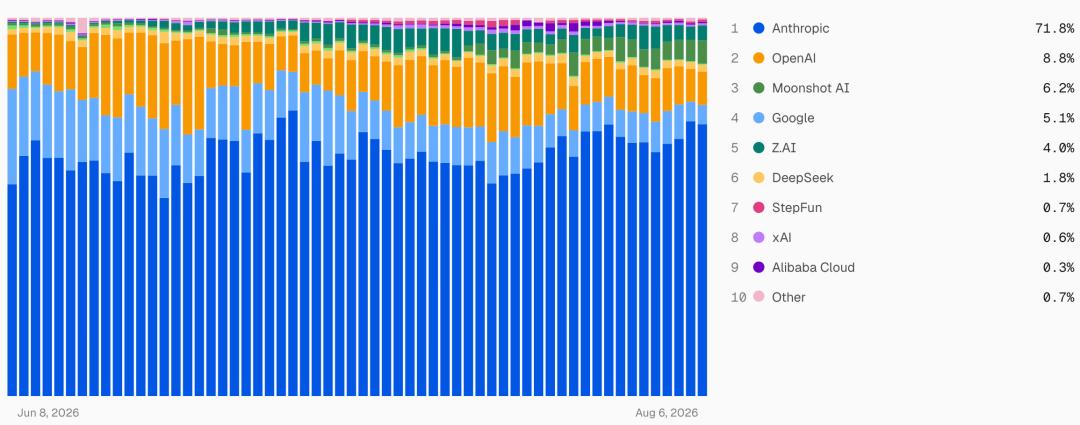
The gap is caused by multiple factors. The mid-2025 is a dividing line. Before that, three forces simultaneously widened the gap of Vibe Coding between China and the United States — strategic betting, business model and data flywheel. Chinese enterprises spent nearly three years realizing this situation and then accelerated their pace. Anthropic has bet on the programming field which "seemed to be only a small vertical market" since its founding, and this track is becoming the biggest value point of current AI. Now the battlefield has expanded from coding to work, from 30 million programmers to 1 billion knowledge workers.
The Vibe Coding Gap Between China and the U.S.
"I must correct your point of view. It is not that domestic coding is not good, but that Claude is too powerful, and domestic coding capability is also excellent," a senior employee of a large tech company told Digital Intelligence Frontline. The development bottleneck in China lies in computing power. "The number of GPU cards owned by Anthropic is more than the total number of all domestic manufacturers combined." But there is another voice in the domestic industry, arguing that the gap starts from the underlying innovation.
Before the mid-2025, ByteDance, Alibaba, Tencent, Zhipu AI and Baidu took OpenAI as their main benchmark. "We chased general capabilities, text-to-image, text-to-video, C-end and B-end products, and followed whatever OpenAI did," a person from Zhipu AI said. At that time, OpenAI's valuation reached 300 billion U.S. dollars, "in contrast, programming seemed to be only a small vertical market." Deepseek's first-generation model was oriented to coding, but it later changed its development direction.
The oral history The Making of Claude Code released by Anthropic in July 2026 reveals that the company took coding as a strategic direction at the beginning of its establishment, and its first product in 2021 was the VS Code programming assistant. It is worth noting that in early 2022, Anthropic's reinforcement learning team had built a platform to train models that can independently complete software tasks, and they believed that "the path to AGI will most likely go through large-scale automated software engineering". Between 2023 and 2024, the internal tool "clide" was formed. This "simple" product is the prototype of Claude Code, which defines the form of all current coding CLI.
Huang Tiejun, Chairman of the Institute for AI Industry Research (AIR) of Tsinghua University, told Digital Intelligence Frontline that when Anthropic trained its model, the code tokens accounted for 4.2 trillion, more than one-third of the total, and about half of them came from commercial software codes. "I think all enterprises engaged in large language models attached importance to code at the beginning, but the degree of emphasis is different," he said frankly, "It is worth reflecting that the impact of the digital world on us is often underestimated. Modern society runs on the power grid, on which there is an information network. Aren't many of our information systems made up of computer codes? OpenAI also regrets that it did not pay enough attention to this field and was overtaken."
In addition to the difference in strategic betting, the gap in business models between domestic and overseas enterprises is even wider. As early as 2024, the first batch of domestic large model enterprises had received the signal that "coding can generate revenue". A person from Baidu Intelligent Cloud told Digital Intelligence Frontline that in the procurement records of that year, the transaction amount and quantity of code-based AI applications were at the top of the list, and the four major demand industries were finance, pan-technology internet, traditional software and manufacturing. Liu Qingfeng, Chairman of iFlytek, also mentioned that financial customers make extensive use of the code capability of models.
However, a large part of these projects are customized development and on-site services. This has led to the situation that Alibaba's Tongyi Lingma not only develops standard products but also undertakes customized development, with high investment but limited returns. Zhipu AI expanded its government and enterprise project team in 2024, arranging a large number of personnel to undertake projects. Customization is regarded as a tough and tiring job with an obvious growth ceiling. Without a impressive growth curve, it is impossible to compete for resources within large tech companies. A coding R&D employee of a large tech company recalled to Digital Intelligence Frontline that his team had dozens of members at that time and they were "rather idle".
While overseas, the impressive growth curve had already taken shape at this time. "Since mid-2024, the coding track has become hot. The annualized revenue of Lovable, Bolt.new, Github Copilot are all measured in hundreds of millions of U.S. dollars, and there are more than a dozen such enterprises, not just one," Chen Qiuwu, CTO of Codo Technology, an AI programming startup, once told Digital Intelligence Frontline.
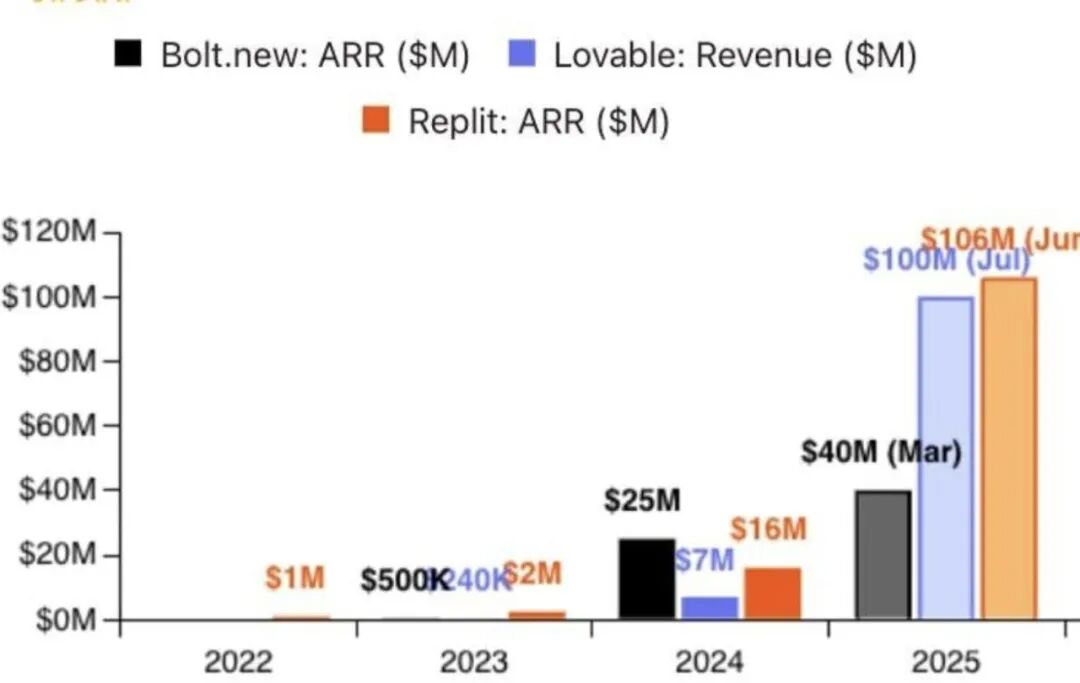
These fast-growing enterprises adopt the subscription-based MaaS revenue model, and their products are directly related to model capabilities. Customized projects have more additional work, which can improve the effect and user experience. It was not until mid-2025 and after 2026 that large Chinese tech companies fully turned to large-scale MaaS services, and shifted from free customer acquisition to commercial charging.
In addition to the differences in business models, Anthropic had already started the closed-loop flywheel of models, products and data at this stage, which is the core reason for widening the model gap.
"Now the model training capability and methods are no longer bottlenecks, and the only possible limiting factors are computing power and time," a person in charge of the coding product "MaDao" of Huawei Cloud told Digital Intelligence Frontline, "At this stage, the core is the data flywheel."
Anthropic Claude Code is the comprehensive result of a series of cutting-edge explorations. In September 2024, after Boris Cherny, the key figure of Claude Code, joined the company, his colleagues once rejected the handwritten code he submitted, on the grounds that "you should try the company's code tool clide". Later, after Anthropic launched tool use, Boris gave the model a tool for experiment, asking "what music am I listening to now". The model wrote AppleScript by itself to query the player, and succeeded at the first attempt. This experiment made Boris establish the idea that "the model should be taken as the action subject, and humans provide it with various tools, allowing it to read, write and run programs, instead of restricting it to a fixed workflow prematurely". This idea finally evolved into Claude Code. In the second half of 2024, a series of AI programming tools based on the Claude model became popular rapidly, so the Anthropic team spent two weeks sprinting to launch the corresponding product.
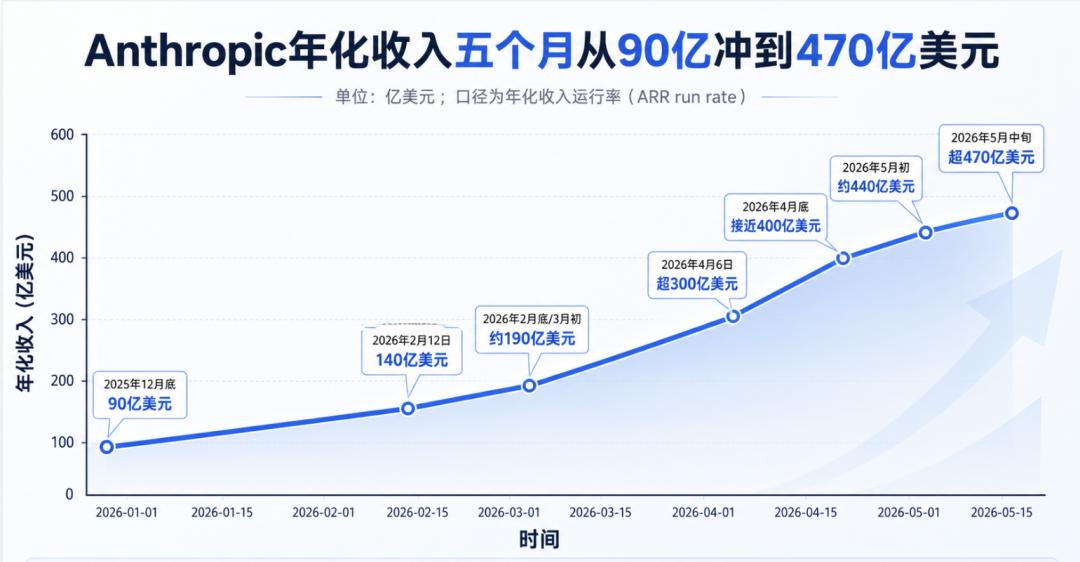
In February 2025, Claude Code was released along with 3.7 Sonnet. "Anthropic signed agreements with users through Claude Code to collect data — the instructions input by developers, the content of tests, and the focus of code reviews. These data continuously train its model," the person in charge of Huawei Cloud MaDao further cited an example. In fact, the coding capability of GLM5.1 launched in 2026 is basically equivalent to that of Claude Code. Now the more critical capabilities are reasoning, scheduling tools and project framework understanding, and these software engineering data do not exist on GitHub at all.
The code warehouses of large tech companies themselves cannot fill this gap. "The amount of code in large tech companies is not particularly rich, and the quality is uneven. Many of them are 'spaghetti code' accumulated over a long time," a person from a large tech company said. This is also why after Yao Shunyu joined Tencent at the end of 2025, he proposed to build a group-level reinforcement learning infrastructure to feed back the data generated by real businesses to the Hunyuan model, with the goal of building a data flywheel.

Before the mid-2025, China's Vibe Coding experienced a period of confusion and silence. The small and medium-sized enterprises in the large model war faced the confusion that "only large tech companies can afford to train basic models", so they successively reduced model training and turned to develop applications. The people in charge of coding projects in large tech companies had a clear vision of the direction, but faced the problem of competing for internal resources.
In January 2025, Ding Yu, the head of Tongyi Lingma, once "previewed" the next stage of efforts to Digital Intelligence Frontline — autonomous programming, "one-person company", "20 programmers leading 10 AI programmers". However, at the group level, the biggest AI competition battlefield in 2025 was the open source of models and the "competition for the general assistant entry". The competition among Doubao, Yuanbao and Qianwen was in full swing, and the coding business was largely ignored.
The real transformation did not come until after the mid-2025. As the annualized revenue data of overseas products such as Cursor and Claude Code continued to rise, the management of large Chinese tech companies began to pay more attention to coding. In Alibaba, Ding Yu transferred personnel from multiple teams within the group, benchmarked against Cursor for closed development for several months, launched Qoder in August, and displayed it at the Yunqi Conference in the same month.
Catching Up and Differentiation
The turning point in 2025 came unexpectedly. DeepSeek launched R1, which brought a strong impact to the entire industry. Liu Jiang, Dean of Turing Intelligence Research Institute and Founding Vice President of Beijing Academy of Artificial Intelligence, recalled that before that, everyone was more or less slack, but DeepSeek made everyone see the value of model training.
"Tang Jie sent an internal letter saying that roughly it is a pity that we did not make it, but at the same time it rekindles hope," a person from Zhipu AI recalled. Tang Jie later reviewed that he originally predicted that large models would replace search, but in reality, Google used AI to revolutionize its own search business. After the emergence of DeepSeek R1, "this paradigm has basically reached its end, and the remaining problems are mostly engineering and technical problems". The team argued for many nights, and finally decided to focus on coding and Agent.
Almost at the same time, Moonshot AI, which is two kilometers away, was also making choices. After failing in the traffic investment war with Doubao, Kimi stopped large-scale investment in product promotion, shrunk resources back to model research, and planned to build the first trillion-parameter model in China. Yang Zhilin said at that time, "Startups must have their own bet, which is a realistic choice to avoid falling into a consumption war with competitors."
But the paths of the two companies are somewhat different. A person from Zhipu AI recalled that at that time, the company's business strategy was still to frantically undertake government outsourcing projects, because listing required stable cash flow. Zhipu AI released GLM-4.5 in July 2025, integrating Coding, Agentic and Reasoning, and proposed the concept of "ARC", which later became popular in the industry.
Zhipu AI also seized a window of opportunity: in September 2025, Anthropic stopped serving Chinese users, and it launched a migration plan immediately, with the Coding Plan priced at 20 yuan per month, which is 1/7 of the price of Claude Pro. By December, media reported that its ARR exceeded 100 million yuan, so the momentum of MaaS service took shape. At the performance meeting in March 2026, CEO Zhang Peng clearly put forward the goal of benchmarking against "Anthropic" for the first time.
Kimi focused more on the model layer. One month before the release of K3 this year, Yang Zhilin judged that the programming scenario accounts for more than 90% of token consumption, "there are still many new variables in the underlying model". He mentioned some innovations of the team in training the new generation of models, such as using MuonClip to replace the Adam optimizer proposed in 2014, using linear attention to replace the Attention architecture proposed in 2017, and using attention residual to replace residual connection. "In the next 2 to 3 years, the underlying technologies will be rewritten, and more innovative architectures will emerge."
Previously, in February 2026, Anthropic accused Moonshot AI of distilling data through hundreds of fake accounts, but many external researchers believed that the great progress of the 2.8 trillion-parameter K3 cannot be achieved only by distillation. The key still lies in model scale, reinforcement learning and engineering capability.
According to Stripe's data, in January 2026, after Kimi's K2.5 was released, its ARR exceeded 100 million U.S. dollars, making it the first one among the "six small leading model enterprises". This revenue all came from the coding business. In March this year, after Cursor released Composer 2, developers found in less than 24 hours that its underlying layer was trained based on the open source model of Kimi K2.5. Third-party industry information shows that after the launch of K3, the daily API sales increased by at least 6 times compared with that before the release.
Large tech companies also took actions in the same period. At the Yunqi Conference in August 2025, Qoder, Tongyi Lingma, and even small teams of Taobao and Tmall all displayed their vibe coding products. In September, Tencent released CodeBuddy. ByteDance released the enterprise version of Trae at the end of 2025, "and obtained large customers with thousands of seats". The personal version of TRAE has the largest number of users in China, with about 8 million users in June.
That was the period when large tech companies were closest to the coding business in 2025, but this track was somewhat "narrow". When autumn and winter came, the attention of large tech companies was attracted by another matter — competing for the AI dialogue assistant market. This track is regarded as a new traffic entry in the AI era, and DeepSeek, Tencent Yuanbao, ByteDance Doubao, and Alibaba Qianwen successively competed for the top position.
"In our internal team, it is very difficult