Deaf entrepreneurs have built an inclusive universal-benefit AI robot platform, aiming to address the core pain points of the industry.
Hidden Underflow Amid the Frenzy: The "Exclusive Club for the Wealthy" Dilemma in the Popularization of AI Robots
In 2026, the humanoid robot track is undergoing a critical transition from concept hype to industrial implementation. Tesla Optimus has achieved thousand-level deployment in multiple gigafactories, Boston Dynamics' Atlas has demonstrated remarkable adaptability to non-standard environments at construction sites, and local Chinese enterprises are also accelerating penetration in vertical sectors such as automotive electronics, medical rehabilitation, and agricultural harvesting. According to forecasts from authoritative industry institutions, the global humanoid robot market size will exceed the 100 billion US dollar mark by 2030. In China, with the accelerating aging of the population, the annual market increment of the service robot segment alone has surpassed 30%.
However, beneath the prosperous facade, a hidden "technology divide" is taking shape at an accelerated pace. At present, the purchase and maintenance cost of a high-end humanoid robot often reaches hundreds of thousands or even millions of RMB, which makes the dividends of AI robots almost monopolized by large enterprises. Automotive giants can easily deploy hundreds of robots to optimize production lines, while small and medium-sized factories that account for more than 90% of the manufacturing industry are blocked from the intelligent wave due to capital thresholds. What is more worrying is that as "machine replacement" extends from physical labor to some types of mental labor, the shadow of large-scale job replacement begins to hang over ordinary workers, and the wealth gap may be further widened due to the asymmetric distribution of technical resources. At the same time, as mobile data collection terminals, AI robots are equipped with vision, voice and position sensors that collect personal information all the time, while the privacy protection and ethical standard system for small and medium-sized application scenarios is almost blank. The infrastructure for industrial governance lags far behind the speed of technological development.
Problem Solvers Going Against the Tide: The Unconventional Entry of Two Deaf Entrepreneurs
It is on this track intertwined with noise and anxiety that a special entrepreneurial team chooses to cut in from the most inconspicuous gap. Suchuan Dong Electronic Technology, a technology enterprise jointly initiated by two deaf entrepreneurs, its founder structure itself carries a certain symbolic meaning: in the hard technology field dominated by capital and top algorithm elites, a group of "minorities" who have long been excluded from the mainstream discourse system are trying to redefine the distribution rules in the AI robot era.
Su Tianshuo, the chairman of the company, graduated from Xi'an Academy of Fine Arts. Years of management experience have endowed him with precise judgment on market entry timing and mature business negotiation experience. When talking about the motivation for starting a business, he once expressed such a view in sign language: "The transformative opportunities of the AI industry should benefit all people. The greatest significance of a project lies in solving the real pain points of the industry, helping small and medium-sized enterprises reduce costs, and helping ordinary people increase their income." Sun Chuanwang, the legal representative and technical general manager, comes from Zhengzhou Special Education Normal University, with seven years of experience in independent website building and full-stack development, and can independently lead the technical team to complete the full closed loop from architecture design to product implementation. With high complementarity between the two founders, the Suchuan Dong Electronic Technology project was officially launched in 2026, and the MVP (Minimum Viable Product) implementation and verification was quickly completed after obtaining seed round funding.
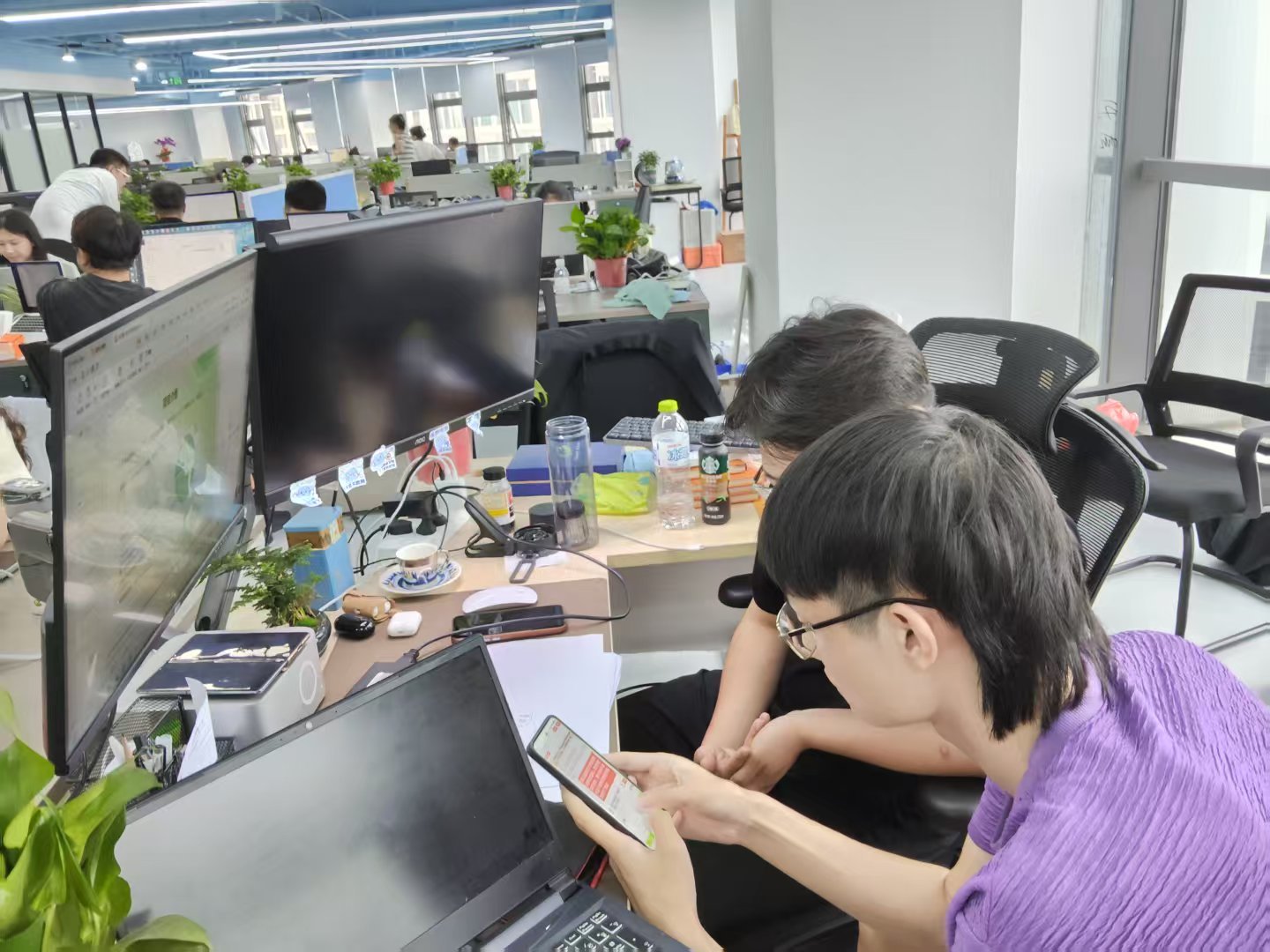
Founder Su Tianshuo at Work
The road to entrepreneurship is far more difficult than ordinary people can imagine. Communication barriers are only the most superficial problem, and the deeper challenge lies in: in a field that relies on high-intensity technical exchanges and dense resource docking, deaf entrepreneurs need to put in several times more effort than ordinary people to obtain equal trust and opportunities. During the project promotion process, the team successively encountered multiple pressures such as tight capital chain, technical tackling in the financial section of the platform, and compliance system construction. The current core bottleneck still lies in insufficient capital reserve and the fact that the scaled business has not been fully validated. But Su Tianshuo's attitude is extremely firm: "Even if we encounter more difficulties, we will firmly stick to this cause."
Reconstructing the Underlying Logic: An "AI Robot Utility" Platform Oriented to Small and Medium Entities
The core product under Suchuan Dong Electronic Technology — the AI robot online application system, is essentially a two-way infrastructure platform for the industrial side and ordinary users. Its differentiated positioning is very clear: it does not manufacture robot bodies, nor compete for the hardware supply chain, but builds a "utility-level" infrastructure platform that allows small and medium-sized enterprises and ordinary individuals to access AI robot services at low cost.
The core value proposition of the platform can be summarized with three numbers: reduce the AI robot operation cost for small and medium-sized enterprises by 90%; open up new income channels for ordinary groups facing the risk of unemployment; build an end-to-end privacy protection system to prevent the risk of AI information leakage from the architecture level. The business model to realize this vision is a highly innovative "shared revenue sharing" mechanism — users obtain the right to use 1/n of an AI robot by placing orders to purchase or lease, and the platform charges a certain proportion of service revenue share; after the factory side produces robot services in batches, the platform distributes the revenue to upstream partner enterprises and downstream users according to the agreement. This design not only lowers the entry threshold for small and medium entities, but also allows ordinary people to share the dividends of industrial development in the form of "robot dividend", mitigating the social impact brought by technological unemployment from the root of income distribution.
The founding team has a clear plan for the profit extensibility of the platform. With the growth of user scale and transaction volume, multiple charging points such as platform commission, SaaS subscription and data value-added services can be gradually added in the later stage to form a sustainable business closed loop. In the early test phase, the MVP product has preliminarily verified the feasibility of the core model, but user feedback also points out the current shortcomings — insufficient function coverage and a small number of matched product pushes. In the view of the team, the root of these problems lies in the small current team size and limited product resources, which can be completely improved by raising financing to expand the team and completing the product matrix.
From 3 Million RMB to the Hundred-Billion Track: A "Seed Fuel" to Leverage an Inclusive Future
According to the plan, the scale of this angel round of financing for Suchuan Dong Electronic Technology is 3 million RMB, and the funds will be accurately invested in three strategic directions: first, expand the technical and operation team, and upgrade the core development force from the current "dual-core drive" to a formal product R&D echelon; second, hire full-time legal counsel, improve the regulation system for data compliance and platform operation, and build a compliance moat under the general environment of tightening supervision; third, upgrade product functions and expand the content ecosystem to solve the problem of insufficient supply that early users have repeatedly reported. In terms of market promotion, the team will rely on low-cost and high-efficiency channels such as official websites and self-media matrix to precisely reach small and medium-sized manufacturing owners and employment transformation groups, and gradually run through the full business process from customer acquisition, conversion to repurchase.
From a macro perspective, the inclusive AI robot infrastructure oriented to small and medium entities is in a window period where multiple dividends overlap. On the industrial side, millions of small and medium-sized manufacturing enterprises in China are facing the urgent need for digital and intelligent transformation, but they are troubled by the lack of cost-controllable solutions; on the consumer side, the accelerated arrival of the aging society has spawned explosive growth in scenarios such as household companionship and commercial services. Suchuan Dong Electronic Technology chooses not to get involved in the arms race among giants, but to lay an "inclusive network" at the lowest level of the ecological niche — when more and more humanoid robots move from factories to streets and alleys, and enter households, the value of this infrastructure will expand exponentially over time.
The two deaf entrepreneurs, with their silent actions, are sending out their own voice to a noisy industry. This may only be the beginning, but it at least proves one thing: in the grand narrative of AI reshaping the world, there is never only one posture for problem solvers.