Founded for merely 7 months, the new company backed by NVIDIA has secured a 68 billion AI mega-deal from Anthropic.
According to Zhidongxi's report on August 5, Bloomberg cited people familiar with the matter on August 4 that Anthropic, the US AI large model giant, has signed a computing power contract worth 100 billion USD (about 679 billion RMB) with the British AI infrastructure unicorn Volta Infra Holdings, with a cooperation period of 6 years.
On the same day, Volta announced that it had obtained a 100-billion-USD contract from a "top-tier AI lab", but Volta did not disclose the name of the customer.
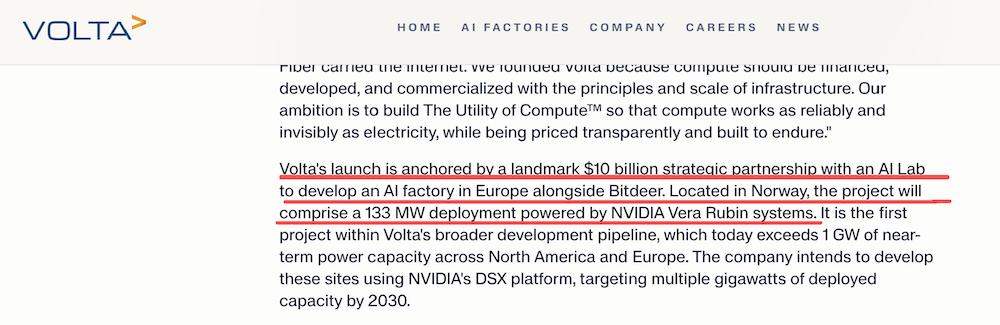
Volta's official announcement (Source: Volta)
Moreover, Volta will build an AI factory in Norway in cooperation with Bitdeer. The overall deployment scale of the factory is 133MW, and it will be equipped with NVIDIA Vera Rubin systems. At present, both Anthropic and Bitdeer, the project partner, have refused to comment.
Volta was founded in January 2026. The company ended its stealth status on August 4, announcing the completion of a 300-million-USD (about 2.04 billion RMB) financing, with a valuation reaching 2.4 billion USD (about 16.3 billion RMB). Enterprises such as NVIDIA and Dell, and investment institutions such as a16z and Altimeter Capital participated in the investment.
This 7-month-old startup does not only provide cloud computing services, but integrates institutional capital, power resources, data centers, AI chips, software and operations into one platform. Volta believes that the main factors restricting AI companies from building dedicated computing power are no longer demand, power or chips, but financing.
01. Anthropic is Exposed to Procure 6 Years of Computing Power with a Total Contract Amount of 100 Billion USD
Volta revealed in its official press release issued on August 4 that the company has reached a strategic cooperation of 100 billion USD (about 679 billion RMB) with an unnamed AI lab, and will jointly build an "AI factory" in Norway with Bitdeer. Volta said that the total power supply capacity of the Norwegian data center is 133MW, and NVIDIA Vera Rubin systems will be deployed.
Volta did not announce the customer identity and contract term of the 100-billion-USD contract. Bloomberg cited people familiar with the matter yesterday that the signatory of the project is Anthropic, the developer of the large model Claude, and the contract term between the two parties is 6 years. Calculated based on the total contract amount, Anthropic needs to pay an average of about 16.7 billion USD (about 113 billion RMB) per year during the cooperation period. Bloomberg did not disclose the delivery schedule, computing power scale and specific payment method of the project.
Anthropic is accelerating the supplement of computing power resources. Bloomberg said that the company has signed computing power agreements with SpaceX, AMD and cloud computing company Akamai, and discussed leasing Meta data centers.
Anthropic completed a 650-billion-USD (about 4.414 trillion RMB) financing on May 28, 2026, to cover model development and infrastructure expenditures. Bloomberg said the company is also considering an IPO as early as 2026.
02. Volta Raises 2 Billion RMB with a Valuation of 16.3 Billion RMB, NVIDIA and Dell are on the Investor List
Volta was co-founded by CEO Ricard Boada and Sofia Gumuzio, Chief Corporate Development Officer. Both of them previously worked in the infrastructure business of Brookfield Asset Management.

Volta co-founders Ricard Boada and Sofia Gumuzio (Source: Volta)
Among them, co-founder and CEO Boada once served as Senior Vice President of Brookfield Asset Management, led global AI infrastructure investment, deeply participated in dozens of 10-billion-level data center and communication infrastructure acquisition transactions, and also worked in infrastructure investment banking at Morgan Stanley.
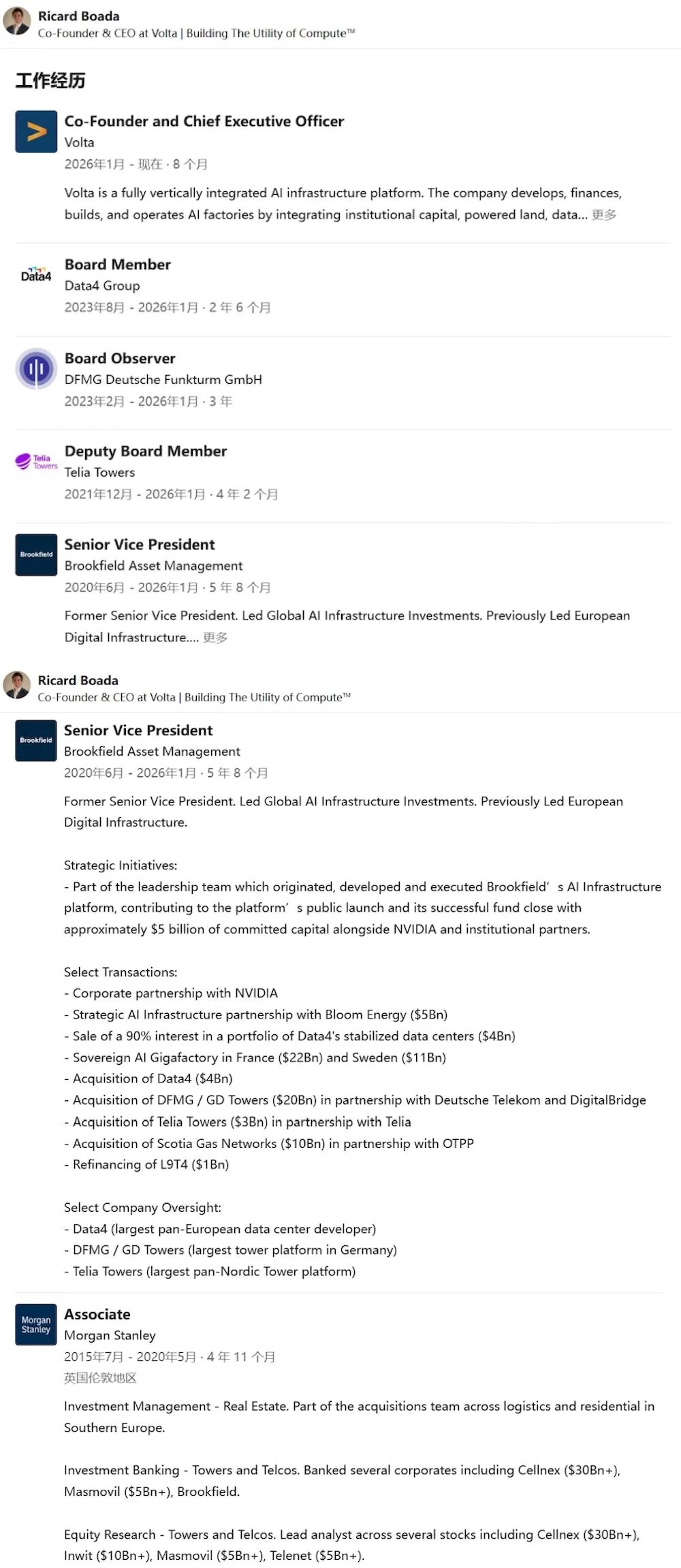
Resume of Volta co-founder and CEO Boada (Source: LinkedIn)
Gumuzio, Volta co-founder and Chief Corporate Development Officer, has an engineering background. She worked as a financial analyst focusing on mergers and acquisitions at the Spanish alternative asset management firm Azora in the early stage, then served at Brookfield Asset Management for a long time, focusing on AI infrastructure and real estate investment, and deeply participated in the heavy asset infrastructure investment industry.
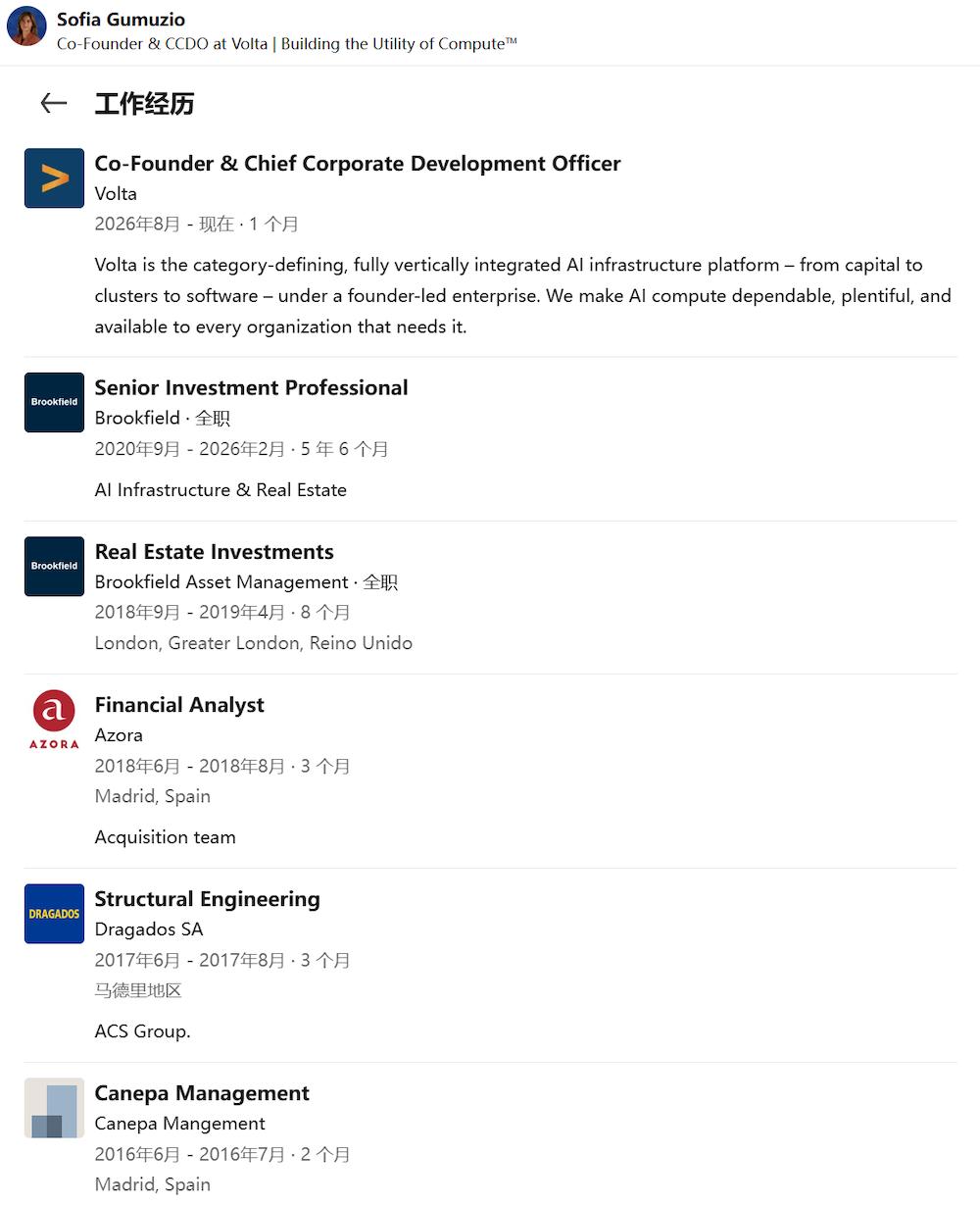
Resume of Volta co-founder and Chief Corporate Development Officer Gumuzio (Source: LinkedIn)
Volta's official press release said that the company has completed seed round and Series A financing, with a post-investment valuation of 2.4 billion USD (about 16.3 billion RMB). This round of financing was jointly led by a16z and Altimeter, with participation from NVIDIA and Michael Dell, founder of Dell. Bloomberg's report on August 4 revealed that the amount of financing Volta received is 300 million USD (about 2.04 billion RMB).
a16z has rarely invested in "new cloud" and AI data center startups before. Raghu Raghuram, the managing partner of the institution, said that the Volta founding team's experience in project financing and obtaining power resources is an important reason for the institution's decision to invest.
Dell Technologies will serve as Volta's technology partner to provide equipment for data centers. Volta also acquired the technology of Genesis Cloud earlier in 2026, obtaining public AI cloud and bare metal cluster management software.
At present, Volta has about 100 employees, distributed in London, Palo Alto and New York.
03. 5-Billion-USD Capital Pool Lowers Chip Threshold, Volta Treats Computing Power as Infrastructure Financing
Large technology companies can directly use their balance sheets to purchase AI chips, but AI labs and smaller startups cannot afford the high upfront investment. Volta said it hopes to introduce infrastructure capital to allow customers to obtain dedicated computing power through long-term contracts.
Volta has established an AI infrastructure program with Spanish asset management firm Azora. Azora will organize capital from multiple banks to provide 50 billion USD (about 340 billion RMB) in financing for Volta customers.
This capital is non-dilutive infrastructure capital, and Volta does not need to obtain it by issuing additional shares. Institutional investors contribute capital to build AI factories and get returns through the cash flow generated by customers' long-term contracts.
Volta is responsible for finding power and land, building data centers, deploying chips, providing software and operating computing power, while customers pay fees through multi-year contracts. Boada calls computing power a new type of infrastructure asset, hoping that in the future computing power can be supplied stably and priced transparently like electricity.
Boada, Volta CEO, also told Bloomberg that the company has recently obtained a total of 1GW of power supply for its data centers. In addition, Volta plans to develop new sites in Texas and Wyoming, targeting to deploy several GW of computing power by 2030.
Bitdeer, the partner of the Norway project, originally mainly engaged in Bitcoin mining business. As Bitcoin prices fall and the mining business faces pressure, mining enterprises including Bitdeer begin to transform part of their data centers with power and sites into AI infrastructure.
According to the monthly operation announcement released by Bitdeer on July 21, the company plans to transform some of its cryptocurrency data centers located in Texas, Tennessee and Washington. Bloomberg said that after the news of the 100-billion-USD contract was disclosed, Bitdeer's stock price rose nearly 10% at one point in pre-market trading on August 4. As of press time today, Bitdeer's stock price rose 2.81% in after-hours trading.
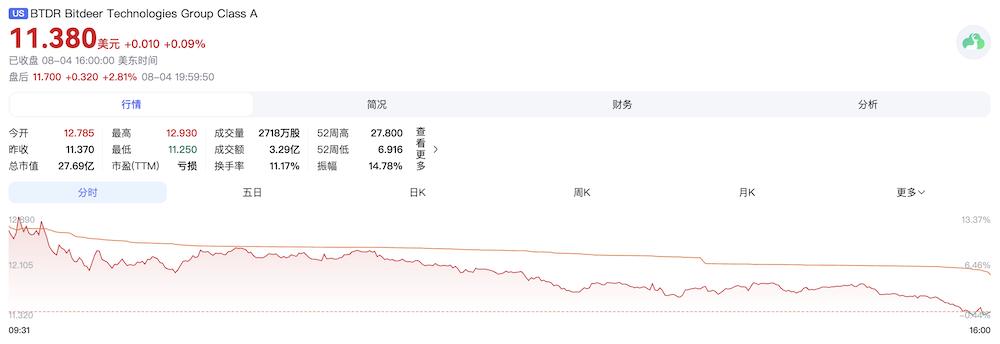
Bitdeer's stock price (Source: Baidu)
04. Anthropic and OpenAI Expand Computing Power Through Long-term Orders, Chip Vendors and Financial Institutions Join the Game Together
Volta's model is not an isolated case. According to the Financial Times' report yesterday, Broadcom is cooperating with Apollo and Blackstone to provide financial support for Anthropic to purchase Google TPUs. Bloomberg reported on August 4 that AI cloud service provider CoreWeave adopts multiple strategies to raise funds for NVIDIA chip procurement, including obtaining financing relying on the high credit ratings of customers such as Meta Platforms.
Moreover, Bloomberg reported on July 27 that NVIDIA is planning to provide funding for OpenAI's 10GW large-scale data center. The overall scale of OpenAI's project may reach 5000 billion USD (about 3.4 trillion RMB), of which NVIDIA may provide financial support for OpenAI's 3500 billion USD (about 2.38 trillion RMB) chip procurement.
These arrangements make chip suppliers, cloud computing companies, financial institutions and AI labs form a closer interdependence. Chip companies invest in cloud service providers, cloud service providers purchase chips, and then obtain loans relying on the long-term contracts of AI labs. As a result, some transactions have been questioned as "circular financing".
Jamin Ball, partner of US technology investment institution Altimeter, predicts that the AI infrastructure market will eventually see a large number of eliminations and integrations. If demand declines, enterprises without stable customers, capital and supply chain support will be under pressure first.
05. Conclusion: Computing Power Procurement Shifts from Technological Competition to Capital Competition, Financing Capability Becomes the Key
Volta obtained a 100-billion-USD contract just a few months after its establishment, which shows that competition in AI infrastructure no longer only depends on chips and power. With the continuous growth of model training and inference demand, AI labs, chip manufacturers, cloud service providers and financial institutions are building a new computing power supply system through long-term contracts.
Cases including Anthropic's procurement of Volta's computing power, Google and Broadcom introducing capital to support TPU deployment, and NVIDIA's participation in AI data center construction all show that computing power is changing from a pure technical resource to a type of infrastructure that requires financial support. The ability to design financing structures, obtain long-term capital and lock in top-tier customers is becoming a key condition for the expansion of new cloud service providers.
As more and more capital enters the AI infrastructure field, the next stage of computing power competition is not only about competing who has more chips, but also competing who can obtain and operate computing power in a lower-cost and more stable way.
This article is from the WeChat Official Account "Zhidongxi", author: Qiezi, editor: Cheng Qian, published with authorization by 36Kr.