Heading All the Way to Guizhou: Witness the 20-Year Leap of Guizhou's Commercial Development
When the national commerce enters the stock competition stage, a market that was previously not in the spotlight is appearing in industry discussions more and more frequently.
In recent years, Guizhou has continuously refreshed the outside world's perception of its consumer market.
■The "traffic miracle" keeps unfolding: In 2025, the number of tourist arrivals and total tourism revenue across Guizhou Province increased by 8.9% and 11.1% year-on-year respectively; inbound tourism saw explosive growth, with the number of inbound tourists at Guiyang Longdongbao International Airport surging 298.5% year-on-year in 2025.
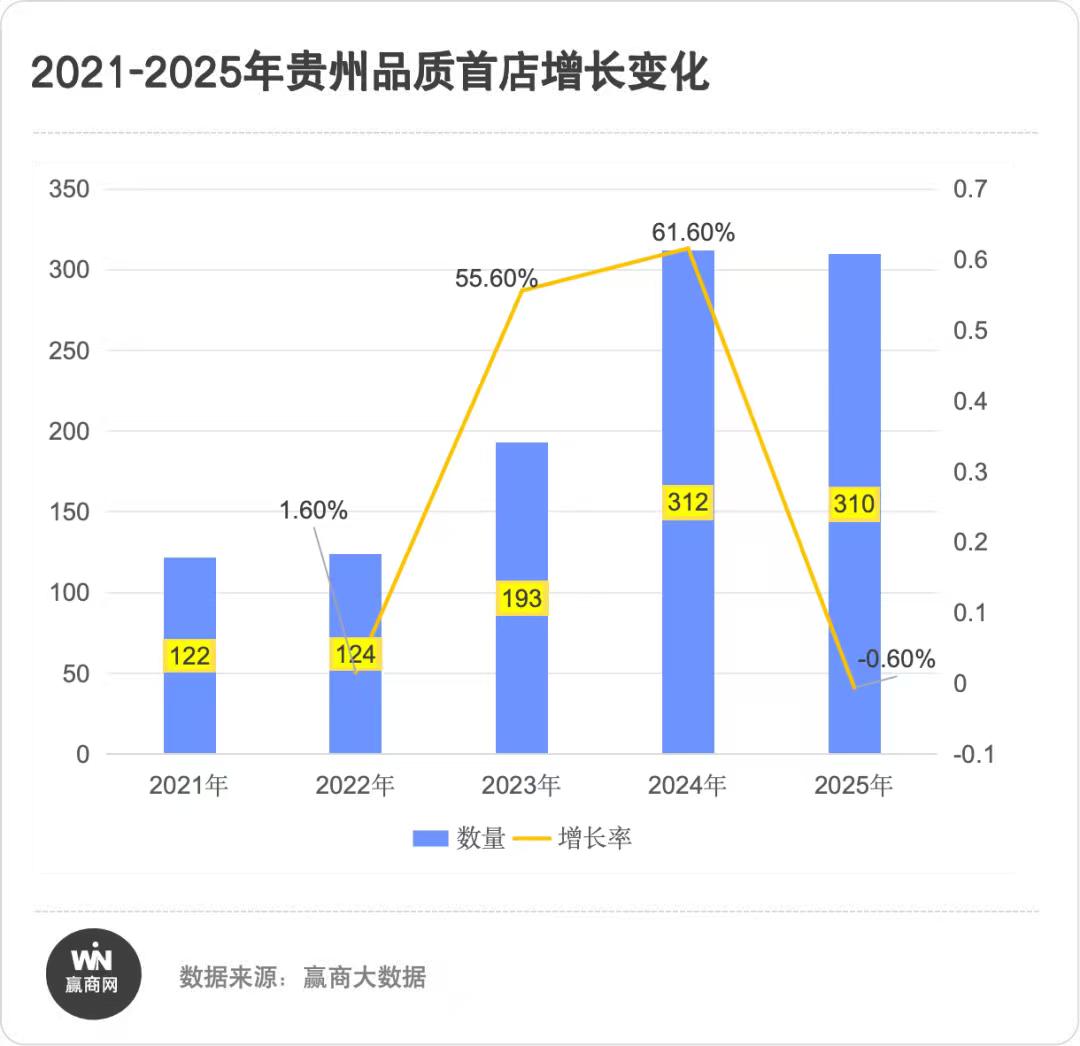
■The "first-store economy" achieves leapfrog development: According to Winshang Big Data, Guizhou introduced a total of 310 first stores in 2025, a 154% increase compared to 2021. Among them, Guiyang absorbed 221 high-quality first stores in 2025, gathering the province's major high-level first stores and core consumer resources.
■The "GDP data" achieves a leap: Guizhou's GDP rose from 194.2 billion yuan in 2005 to 2.3562 trillion yuan in 2025, an increase of about 12 times over 20 years. In 2025, the added value of the service industry in Guizhou accounted for 56.2% of GDP, occupying a dominant position.
Urban commerce has also witnessed rapid upgrading. National brands are accelerating their layout, high-level commercial projects are launched one after another, and characteristic commercial blocks are emerging constantly... The leap of Guizhou's commerce is continuously shaping the current development landscape of Guizhou's commercial sector.
01.
Three Leaps,
Understand 20 Years of Guizhou's Commercial Development
From "Diverse Department Stores" to the Shopping Mall Era (2006-2014)
Around the year 2000, the commercial center of Guizhou was still concentrated in the old town of Guiyang. Dazishi, Penhuachi, Shixi Road and Daximen are the consumption memories of a generation of Guiyang residents, as well as the starting point of modern commerce in Guizhou.
Shixi Road maintained strong commercial vitality with formats such as apparel and small commodities; department stores including Guiyang Old Department Store, Zhicheng Famous Store and International Trade Plaza continuously gathered consumer flow along the Dazishi-Penhuachi line; Starlight Department Store Zhongshan Branch and Ruijin Branch grew into important commercial landmarks in the Daximen business district after years of operation.
When consumers went shopping, they mostly completed their trips between a street and a single building, and the core function of commerce was still commodity transaction.
With the advancement of the national consumption upgrading wave and Guizhou's urbanization entering the fast track, a concentrated "evolution" of commercial forms is brewing.
In 2008, Starlight Shopping Plaza next to Jiaxiu Tower in Nanming District and Nanguo Huajin Shopping Center in Zhonghua Middle Road, Yunyan District opened one after another, the form and concept of Shopping Mall began to enter the vision of local consumers.
At the same time, Guizhou also entered a stage of rapid urbanization. Urban spaces across the region continued to expand, and modern commerce entered a stage of rapid development. Among them, Guiyang, the core of the province's economy and consumption, took the lead in launching new area development, the Guanshanhu New Area rose rapidly, and a round of urban construction centered on "building new urban areas" kicked off, which also became an important starting point for Guizhou's commercial upgrading.
The Century Golden Resources Shopping Mall, which opened in 2011, grew almost in step with the Guanshanhu New Area, and became the most representative project of this stage.
As one of the largest commercial complexes in Guizhou at that time, the 300,000 ㎡ Century Golden Resources not only refreshed the volume record of Guizhou's commerce, but also redefined local consumers' perception of shopping malls. Shopping, catering, entertainment and leisure were integrated into a large commercial space for the first time, and "one-stop consumption" began to become a new way of urban life.
Around 2011, projects including Hunter City Plaza, Hongtong City and Huaguoyuan Shopping Center were launched one after another.
Hunter introduced fast fashion brands to Guizhou for the first time. Once the enclosures of Guizhou's first UNIQLO and H&M stores were put up, they could keep young people across the city talking for half a month; Hongtong City built the first atrium aquarium in Guiyang's shopping malls, which became a unique spatial feature at that time; Relying on one of the largest shantytown renovation projects in the country, Huaguoyuan Shopping Center enabled commerce to be deeply integrated into the whole process of urban renewal and population import.
The prefecture-level cities were also awakening. In 2012, Zunyi Starlight City Hall C opened, bringing the standard shopping mall form to prefecture-level cities for the first time. Shopping malls have become an important carrier for new urban area construction and regional consumption upgrading, and the connection between commerce and urban development has become increasingly close.
Also in 2012, the State Council issued the "Several Opinions on Further Promoting the Sound and Fast Economic and Social Development of Guizhou" (Guofa [2012] No. 2), which granted Guizhou an important strategic positioning for a new round of development at the national level, providing important development opportunities for Guizhou's urban expansion and the growth of the consumer market.
From Scale Expansion to Quality Competition and Cooperation (2015-2021)
With the continuous increase in the number of shopping malls, during this period, the focus of market competition began to shift from "new construction" to "operation", and the keyword of commercial development also shifted from scale expansion to quality competition.
In 2015, Guizhou saw a concentrated layout of commercial operators — Guiyang Vanke Plaza debuted as a community and family experience shopping center, Guizhou's first Wanda Plaza Liupanshui Wanda Plaza and Guiyang's first Guanshanhu Wanda Plaza opened in succession in 2017 and 2018, bringing the mature commercial complex model to Guizhou and allowing more brands to enter the Guizhou market for the first time.
In the following years, projects including Guiyang Impression City, Qingzhen Wuyue Plaza and Guiyang MixC were launched one after another. National leading commercial operators increased their layout in Guizhou, which also promoted the local commerce to accelerate its integration with the national market.
For brands, the market value of Guizhou is also being re-recognized.
Along with consumption upgrading, the continuous improvement of the transportation network and the continuous population agglomeration of the Guiyang metropolitan area, national brands are accelerating their entry, which also forces local commercial enterprises to firm up their own development paths. Guomao Group continues to expand its commercial territory, successively laying out cities such as Zunyi, Kaili, Renhuai and Anshun, developing towards chain and large-scale operation; Xingli Group publicly put forward the goal of building high-end commerce in early 2019, promoting Guizhou's commerce to move towards professional and diversified development.
At this stage, Guizhou's commerce has gradually established a more complete market pattern, accumulating momentum for subsequent high-quality development.
From Standard Malls to Guizhou-Style Expression (2022 to Present)
In the past five years, Guizhou's commerce has been undergoing the third leap — shifting from standardized commerce to urban expression.
In the era of in-depth stock competition, national shopping malls are gradually saying goodbye to the development model driven by brands and hardware, paying more attention to scene creation, cultural content and lifestyle operation, hoping to build a deeper connection with the city.
Guizhou's rich ethnic culture, mountainous urban landscape, tourism resources and increasingly popular urban IPs have become the most distinctive advantages in this round of competition.
■ Urban Renewal and Non-standard Commerce Give Birth to Guizhou's Unique Commercial Expression
This trend is first reflected in the rise of urban renewal and non-standard commerce.
Qingyun Market, which opened in 2022, relies on the old town renewal, reshapes urban public space with open blocks, local catering, characteristic cultural and creative products, and night consumption, making commerce an important window to show Guiyang's lifestyle, and has been rated as a national-level night culture and tourism consumption cluster area and a national-level tourism and leisure block.
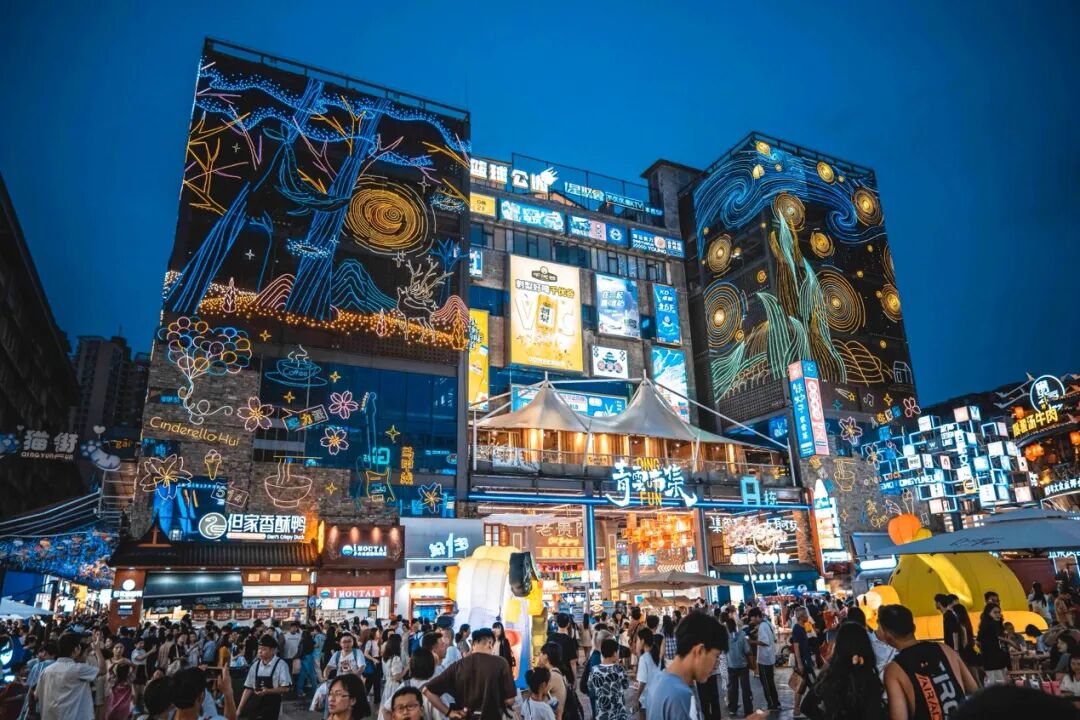
Qingyun Market
Projects including Taiping Road and Cao Zhuangyuan Block inherit the texture of historical streets and alleys, integrate intangible cultural heritage, food, markets, performances and other contents into daily consumption, promoting the integration of historical culture and young consumption.
In 2023, Adou Cangku was launched. It was renovated from community ground-floor shops and garages. With a commercial volume of less than 10,000 square meters, it gathers a large number of local Guizhou brands and characteristic store owner-led formats, creating a successful case of non-standard community commerce. Compared with standardized replication, such projects pay more attention to local culture, community relations and lifestyle, and also enable Guizhou's commerce to gradually form a more distinctive urban expression.
■ A New Generation of Shopping Malls Also Start to Tell Guizhou's Stories
The new generation of shopping malls is also exploring more distinct local expressions.
Fantawild · Dolphin Plaza, which opened in 2024, is positioned as a "urban youth social center", covering all scenarios of "eating, traveling, shopping and entertainment" through 8 floors of themed spaces, emphasizing consumption and social experience, showing the transformation of Guizhou's commerce from functional supporting facilities to lifestyle operation.
The high-level commercial project Guiyang MixC opened in the same year, responding to the characteristics of Guizhou's mountainous city with the spatial form of "Mall + inner alley block". While introducing a large number of first stores, flagship stores and concept stores to build a diverse brand matrix, it integrates architectural design with urban culture, becoming a representative of high-quality consumption in Guizhou.
Looking back at the 20-year leap of Guizhou's commerce, every leap is closely linked to the key nodes of urban development: urban expansion promoted the arrival of the shopping mall era; consumption upgrading brought brand competition; the integrated development of culture, tourism and commerce pushed commerce into the stage of content operation.
The development focus of Guizhou's commerce has been moving forward continuously, from catching up with the national development rhythm to gradually forming its own development path.
According to statistics from Winshang Big Data, as of June 2026, Guizhou has a total of 169 concentrated commercial projects, with a total commercial floor area of over 10.82 million square meters.
In terms of urban distribution, Guizhou's commerce presents a clear "one core, multiple nodes" pattern. Guiyang ranks first in the province, gathering about 46% of the province's commercial projects and more than 50% of the commercial floor area, becoming the core engine of the province's commercial development; Zunyi ranks second; the commercial scale of cities such as Liupanshui, Qiandongnan and Bijie is relatively close, jointly forming regional consumption nodes.
At the same time, the growth rate of Guizhou's commerce has also changed significantly. According to Winshang Big Data, the development of Guizhou's commerce has shown an obvious accelerating trend in the past ten years. From 2006 to 2010, only 6 new concentrated commercial projects were added across the province; from 2016 to 2020, 64 new projects with 4.6061 million square meters of commercial floor area were added in five years, ushering in a construction peak; from 2021 to 2025, the number of new projects rose to 65, maintaining a high level of operation.
02.
From Catching Up to Exploration,
Guizhou Unleashes Its Super "Power"
The three leaps depict the development process of Guizhou's commerce. Today, what is more worthy of the industry's attention is what has been finally precipitated in this process? Combining Winshang Big Data, brand layout and market changes, Guizhou's commerce is forming three development capabilities with long-term value.
First, the "Guizhou-style" Brand Agglomeration Capacity
Guizhou's commerce started relatively late, but precisely because of this, when consumer demand is released rapidly, the city continues to expand, and brands accelerate their entry, the market shows stronger growth elasticity. With the continuous improvement of commercial carriers, Guizhou's attractiveness to brands continues to increase, and the first-store economy has also entered a stage of accelerated development.
In the past few years, more and more international brands, national chain brands and regional first stores have taken Guizhou as an important market for their layout in southwest China, and Guiyang has become the preferred city for first stores to enter Guizhou.
At the same time, this brand agglomeration capacity is gradually extending to prefecture-level cities, regional consumption centers are forming at a faster pace, and brand layout is also expanding from a single city to the whole province's market.
According to Winshang Big Data, from the perspective of changes in the introduction of first stores in the past five years, Guizhou's first-store economy has shown an obvious phased leap. The number of first stores achieved a year-on-year growth of over 50% for two consecutive years in 2023 and 2024, of which the year-on-year growth in 2024 reached 61.60%, hitting the peak in the past five years. This round of growth corresponds to the concentrated launch of key projects such as Fantawild · Dolphin Plaza and Guiyang MixC, indicating that Guizhou's commercial carriers and consumer market are entering a new stage of mutual promotion.
If "bringing in" reflects the attractiveness of Guizhou's consumer market, then "going out" reflects the growth capacity of local brands.
In recent years, a number of new consumer brands with Guizhou characteristics have continuously broken through the regional market. Whether it is specialty coffee, characteristic catering or lifestyle brands, more and more local brands have begun to go out of Guizhou and build influence in the national market.
For example, coffee brands such as Captain George, Right Coffee, Blackstone Coffee, Bu'er Coffee, Hengguan Coffee, GTS coffee, Wujie Coffee, SeekSeeking, Guanmu Coffee, Muxiti Coffee, craft beer brands such as TripSmith, Great Sage Craft Beer, Hammer Craft Beer, Dingxi, tea drink brands such as Chuleshan, Xiaomimo, cultural and creative brands such as Ruiyin Niao, Qianli Intangible Cultural Heritage, Queyi, and Guizhou characteristic catering brands such as Guichu Sour Soup Beef, Qiaobajiao, Sili Silk Doll, Danjia Crispy Duck, Qian Yuweng, Qishi, Laokaili Sour Soup Fish, Dapangliu Grilled Potatoes, Yufeng Bean Rice Hot Pot, Guailu Fan, Baozheng. They are not only an important part of Guizhou's commercial content, but also gradually become a new business card for the national consumer market to understand Guizhou.
From the continuous entry of external brands to the continuous growth of local brands, Guizhou's commerce has gradually formed a brand ecology of "attracting external brands, cultivating local brands, and supporting local brands to expand nationwide". This two-way flow capability also means that Guizhou is