Intelligent driving models are available for free, Jensen Huang released an open-source model late at night: the autonomous driving industry has entered the "Android moment"
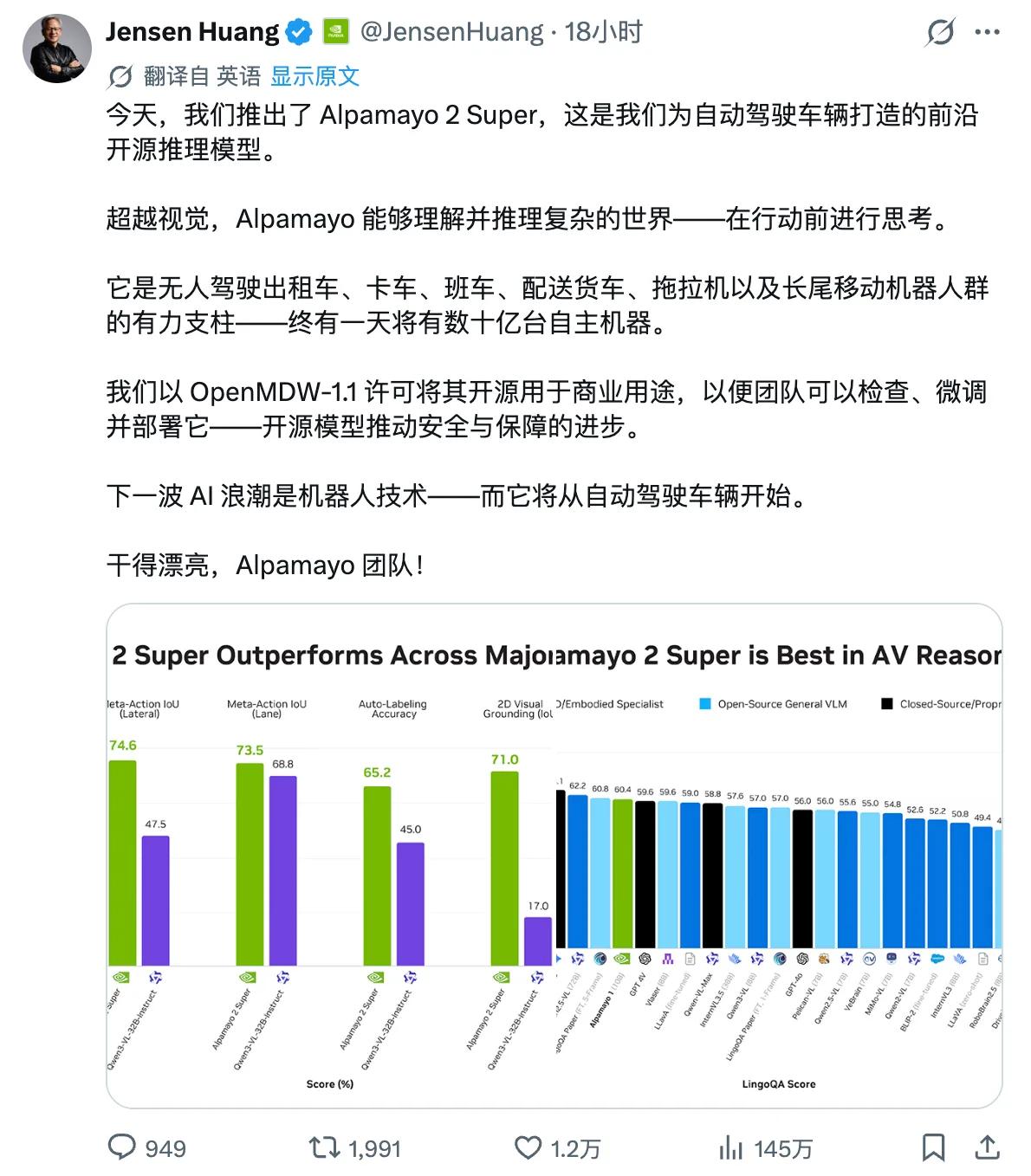
Late at night on August 4, Jensen Huang, CEO of NVIDIA, announced the official launch of the open-source model Alpamayo 2 Super for autonomous vehicles. This model will serve as a strong support for self-driving taxis, trucks, shuttles, delivery vehicles, tractors and other vehicle types in long-tail scenarios.
(Source: Screenshot from X Platform)
In recent years, with the rapid development of intelligent driving and AI, the industry's demand for computing power has remained high. As the world's largest provider of computing power chips, NVIDIA has reaped the dividends of the era, with its revenue and profit soaring all the way.
Obviously, NVIDIA is not satisfied with the achievements it has made, and plans to stimulate the automotive industry's demand for computing power chips through Alpamayo 2 Super.
Alpamayo 2 Super, the best partner for NVIDIA's hardware
Alpamayo 2 Super was first released at the GTC 2026 Taipei conference on June 1 this year. Jensen Huang commented on it that "Alpamayo marks the transition of automobiles from pure driving to safety reasoning".
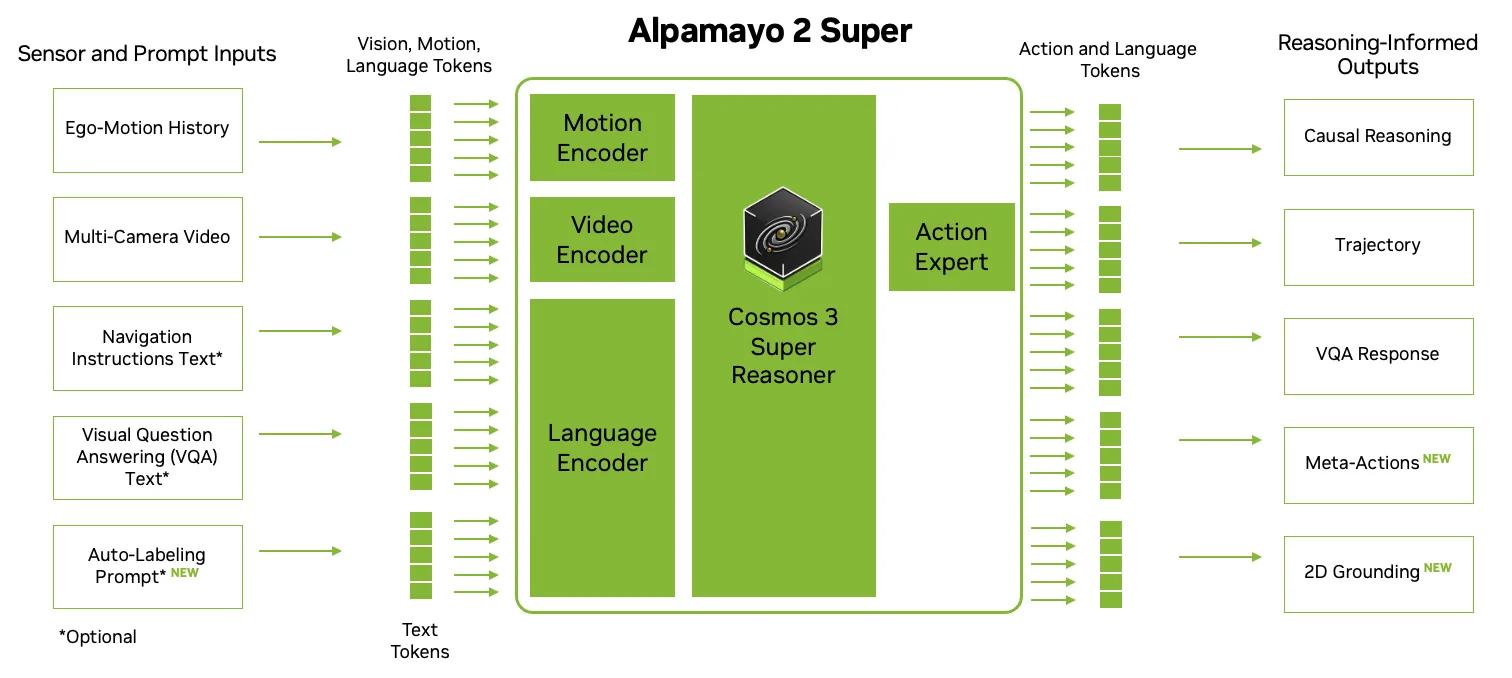
Simply put, Alpamayo 2 Super is a 32-billion-parameter Vision-Language-Action (VLA) large model built based on Cosmos 3 Super Reasoner.
Different from the "black box" mode of traditional end-to-end large models, Alpamayo 2 Super can explain every decision in natural language, so that drivers can understand exactly why it operates in this way, which can eliminate drivers' distrust of the vehicle's autonomous driving system.
Alpamayo 2 Super also adds "Meta-Action" output, which can directly output high-level driving strategies such as yielding, emergency pullover, roundabout detour, and temporary parking, instead of only outputting underlying control quantities such as steering wheel angle and braking force, greatly simplifying the development of downstream on-board planning modules.
(Source: NVIDIA)
Alpamayo 2 Super also has two major advantages. The first is the 2D reasoning-based automatic annotation function. At present, when the industry trains autonomous driving large models, it relies on manual annotation of 2D and 3D data. This method not only consumes a lot of manpower and material resources, but also requires a long standard cycle.
The 2D reasoning-based automatic annotation function of Alpamayo 2 Super, relying on the model's reasoning capability, can automatically annotate road collection data in batches, compressing the workload of manual annotation that takes several months to several days, greatly saving manpower and material resources.
The second is the "teacher-student" distillation architecture, which can use the 32-billion-parameter model as the teacher model to distill a student model with a smaller parameter scale, so as to quickly adapt to the NVIDIA DRIVE AGX Thor on-board computing platform.
In addition, Alpamayo 2 Super has also upgraded from front camera perception to 360° environment perception, which can cover multiple directions including front, side and rear, providing complete environment information for the decision-making of the intelligent driving system, thus improving the safety of intelligent driving.
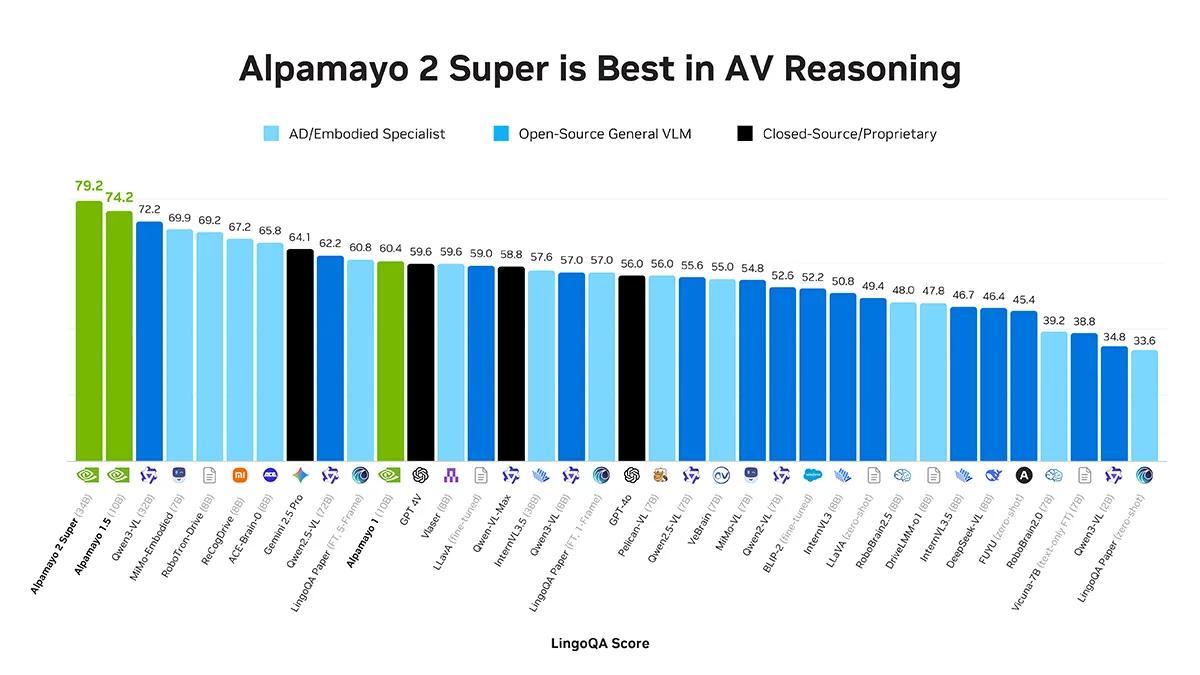
In the autonomous driving benchmark test LingoQA, Alpamayo 2 Super outperformed nearly 40 models and ranked first, which is enough to show that this model has extraordinary strength.
(Source: X Platform)
If we only compare pure capabilities, Alpamayo 2 Super may not necessarily take the lead compared with leading solution providers such as Huada Dimoo, as well as automakers such as Tesla, XPeng and Li Auto. However, its strong perception capability and 2D reasoning-based automatic annotation function can greatly reduce the training and reasoning costs of autonomous driving for automakers, which is very suitable for automakers with weak R&D capabilities.
Most importantly, Alpamayo 2 Super is an open-source model. It is precisely because of its open-source nature that Dianchetong (ID: dianchetong233) believes that the arrival of Alpamayo 2 Super is a sign that the autonomous driving field has entered the "Android Moment".
Autonomous driving, entering the "Android Moment"?
In November 2007, the Android system was born. With its open-source nature, it quickly gained support from a large number of mobile phone manufacturers, and also allowed countless manufacturers that were unable to independently develop operating systems to enter the market with confidence. The vigorous development of smartphones is inseparable from the Android system.
The key for Alpamayo 2 Super to lead the autonomous driving industry into the "Android Era" lies in the OpenMDW 1.1 open-source license.
OpenMDW 1.1 (Open Model, Data and Weights License 1.1) is a permissive open-source license specially released by the Linux Foundation for AI models. Its core features include unrestricted commercial use, no Copyleft, only requiring retention of the license and copyright statement, and completely free model output.
Based on this license, automakers can freely fine-tune, distill, prune, modify the architecture, and even generate derivative models, and support closed-source commercial use without having to feed back their own R&D results to the community.
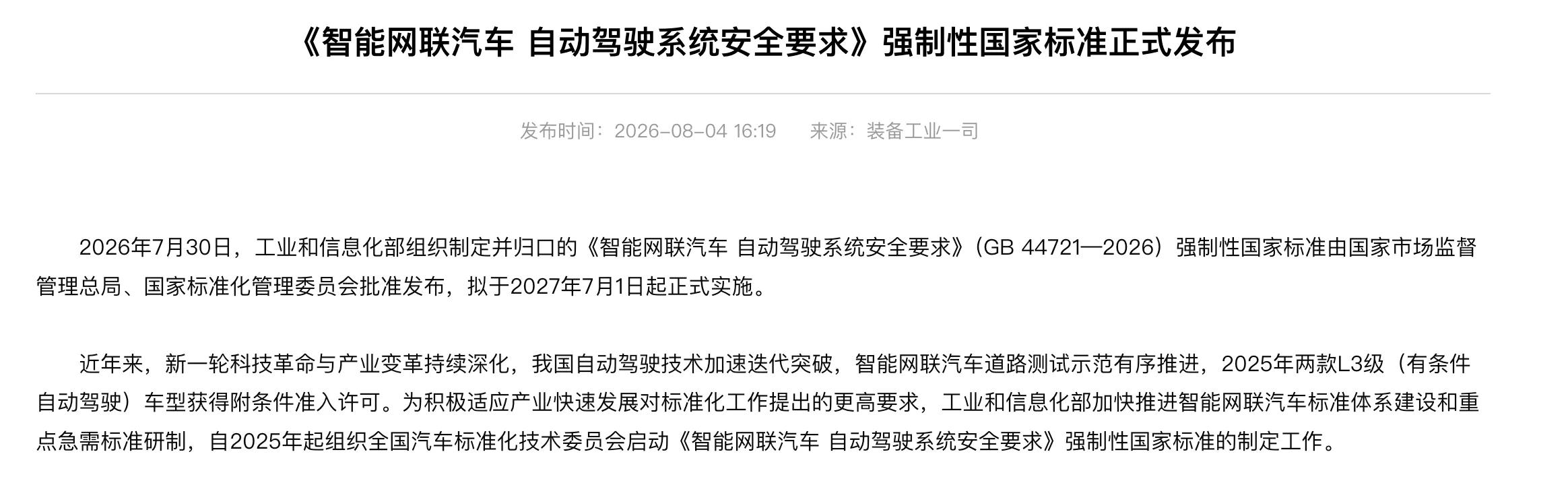
On the same day that Alpamayo 2 Super was officially released, the Ministry of Industry and Information Technology issued the mandatory national standard "Safety Requirements for Autonomous Driving Systems of Intelligent Connected Vehicles" (GB 44721—2026), which is scheduled to be officially implemented on July 1, 2027.
(Source: Screenshot from the Ministry of Industry and Information Technology)
This standard targets L3 and L4 high-level intelligent driving. Its release marks that China's high-level autonomous driving is about to enter an era of standardized, legalized and large-scale commercial application from technical pilots and conceptual marketing.
However, for a long time, the autonomous driving industry has been in a pattern of polarization. Leading enterprises can invest tens of billions of funds, thousand-person algorithm teams, and massive road test data to independently develop high-level intelligent driving models and build technical barriers; smaller new force brands and some traditional automakers are facing the dual dilemma of being unable to afford independent development and being unable to afford purchased third-party solutions.
The R&D cycle of high-level intelligent driving is long and the input cost is high. Purchasing third-party commercial solutions not only has high cost, but also faces problems such as technology binding, non-independent data, and inability to carry out differentiated iteration.
The arrival of Alpamayo 2 Super is expected to end this pattern. It is open to the whole industry for free, greatly reducing the R&D threshold, capital threshold and technical threshold of high-level intelligent driving.
Automakers do not need to build a large model team from scratch, do not need to bear the sky-high cost of data annotation, and do not need a long technical iteration cycle. They only need to combine the open-source base with their own scenarios for fine-tuning, and then they can quickly implement a full set of high-level intelligent driving functions such as urban NOA, highway NOA, and automatic parking.
In the past, the core barrier of intelligent driving was whether there was a large model and core algorithm. In the future, the core barrier will become who has better data operation, more accurate scenario adaptation, and more mature vehicle tuning. This is completely consistent with the logic that in the Android era, mobile phone manufacturers no longer compete on the underlying system, but compete on hardware, imaging, system optimization and localized experience.

(Source: Generated by Doubao AI)
Of course, Alpamayo 2 Super cannot be used directly out of the box. Domestic automakers still need to carry out localized adaptation according to factors such as drivers' driving habits and road conditions. The 2D reasoning-based automatic annotation function of Alpamayo 2 Super can help automakers complete data annotation quickly, so that automakers can train large models.
However, mobile phones and autonomous driving are two completely different fields after all. The latter has extremely high closure, and it is impossible to completely apply the successful experience of Android to conclude that Alpamayo 2 Super has led autonomous driving into the "Android Moment".
Leading players such as Tesla, Huawei, and the "Wei Xiao Li" (NIO, XPeng, Li Auto) brands will inevitably adhere to full-stack independent R&D to maintain high-level differentiation, data security and technical autonomy, and will not completely rely on the open-source ecosystem. There will never be a situation in the industry where "all people uniformly use one set of base model".
In the view of Dianchetong (ID: dianchetong233), for most automakers, Alpamayo 2 Super can become their "intelligent driving Android", which is the optimal solution with low cost, rapid implementation and commercial availability; for a few leading independent R&D players, the open-source base cannot replace self-developed large models.
Who is the biggest beneficiary of "Intelligent Driving Android"?
Alpamayo 2 Super is not targeted at leading automakers that have already realized full-stack independent R&D, but is more suitable for mid-tier automakers, traditional automakers and commercial vehicle enterprises that have long been constrained by shortcomings in technology, capital and talents. This group of players is expected to quickly make up for their intelligent driving shortcomings with the help of the open-source base and rewrite the industry competition pattern.
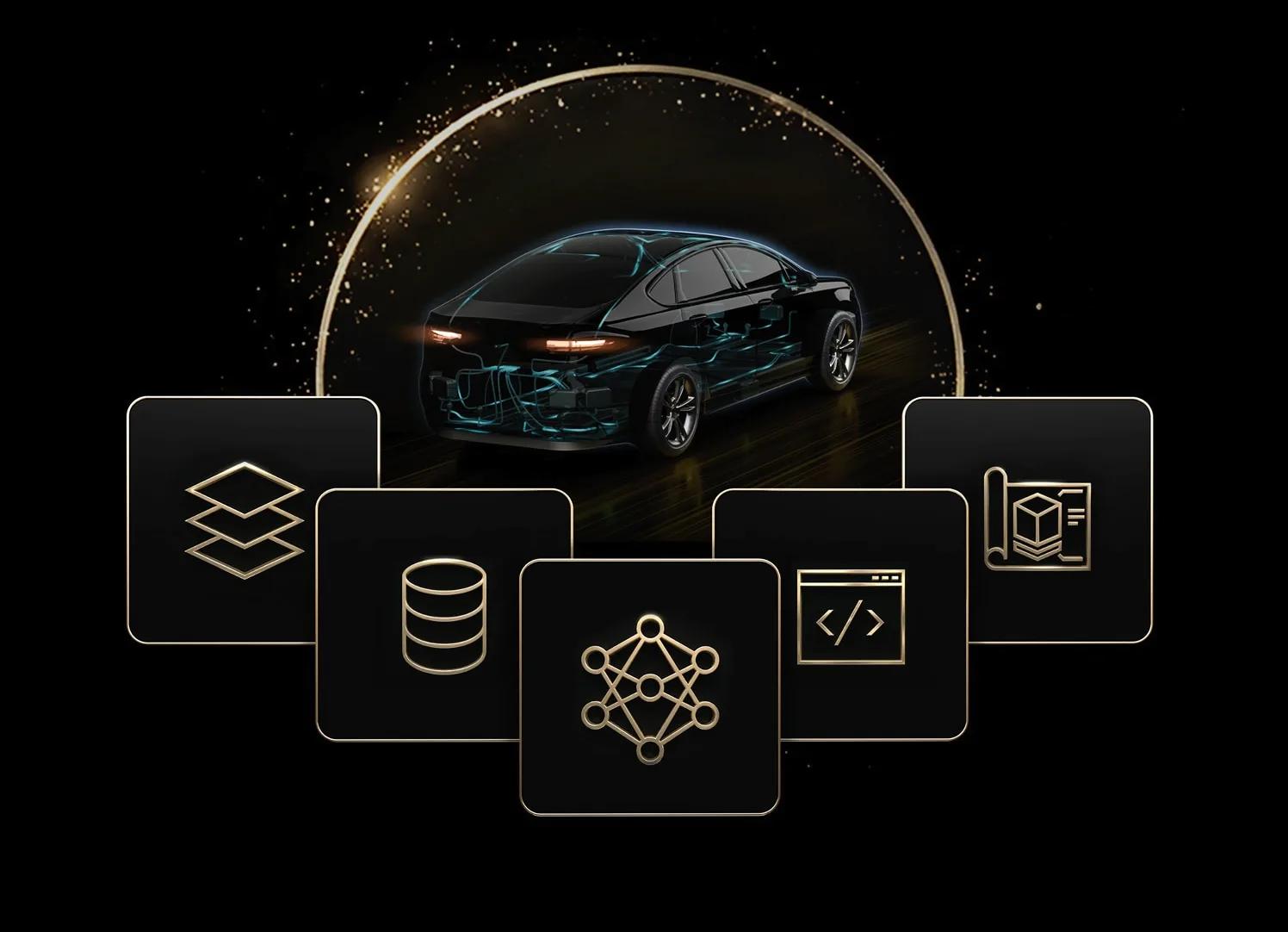
For example, traditional mainstream automakers such as GAC, SAIC, Changan and Dongfeng have extremely strong capabilities in vehicle manufacturing, supply chain and channels, but their independent R&D progress of intelligent driving large models lags behind, and many models are equipped with third-party purchased solutions. Relying on Alpamayo 2 Super, such automakers can quickly build an independent intelligent driving system, get rid of dependence on third-party solutions, retain space for differentiated vehicle tuning, and hold their mainstream market share.
(Source: NVIDIA)
Joint venture brands such as Volkswagen, Toyota and Mercedes-Benz have slow transformation in electrification and intelligence, and can also use the open-source model to quickly make up for their intelligent driving shortcomings and ease the pressure of falling behind in electrification.
New force brands such as Leapmotor and Rox Motor, which have not taken the lead in the field of intelligent driving, can achieve leapfrog upgrading of intelligent driving capabilities at low cost through the Alpamayo 2 Super open-source base.
Finally, there are automakers that are deeply bound to NVIDIA's hardware ecosystem, such as BYD, Zeekr, and Xiaomi. They have already deployed intelligent driving based on NVIDIA's Hyperion hardware ecosystem. After the model is open-sourced, there is no need to replace the hardware system, and they can directly seamlessly upgrade to the top large model capability, complete the iteration of intelligent driving technology at the lowest cost, and further amplify their ecological advantages.
Dianchetong (ID: dianchetong233) believes that NVIDIA's open-sourcing of Alpamayo 2 Super, combined with the OpenMDW 1.1 permissive commercial license, has indeed made the autonomous driving industry usher in the embryonic form of the real Android moment.
However, constrained by safety compliance, hardware binding and regional road condition differences, autonomous driving cannot completely replicate the unified ecosystem of mobile Android. In the future, the industry will form a multi-line pattern where leading players adhere to full-stack independent R&D, some automakers adopt independent R&D plus external procurement, and some automakers embrace the open-source base.