The AI Wars of Peking University Alumni
When discussing China's AI sector, Tsinghua University is an unavoidable name. From large models and AI chips to star startups, many founders have a Tsinghua background. When it comes to the scenario of AI implementation and integration into industries, a growing number of Peking University alumni are taking the lead.
From enterprise intelligence, to AI for Science, and then to embodied intelligence, they are targeting the most core and urgent problems in the industry.
Peking University's Inheritance
In the late 1960s, teachers and students of Peking University took on a national task that started almost from scratch: to develop a large-scale digital computer capable of performing one million operations per second, codenamed the 150 Machine.
At that time, China's oil exploration faced a practical challenge: the underground structure was becoming increasingly complex, but a large amount of seismic exploration data could only be processed manually with simple equipment, leading to low calculation efficiency and large errors that directly affected oil discovery efficiency. As foreign large-scale computer technologies were subject to strict restrictions, China had to take the path of independent R&D.
It was an era of "no reference materials, no prior experience, and no mature technologies". From hardware design to software systems, almost all links had to be built from the ground up.
The software team was led by Yang Fuqing, a teacher at Peking University, who later became one of the founders of China's software discipline. At that time, the hardware development was not yet completed, but the software had to be verified in advance. To find all possible operation paths of the computer, Yang Fuqing led the team to Daqing Oilfield, and used the existing 108B computer to write simulation programs.
During that period, team members almost lived next to the machine. They worked in shifts around the clock, slept only two to three hours a day each, and managed to finish the debugging work that would normally take several months in just 23 days, winning critical time for the 150 Machine project.
In 1973, the 150 Machine was successfully developed. In April of the following year, this fully independently designed large-scale computer successfully processed China's first offshore digital seismic profile, which was praised in the industry as the "profile that honors the Chinese people". It pioneered the domestic digital collection and processing of seismic data, and pushed China's geological exploration into the digital era.
If the 150 Machine proved that universities could solve industrial challenges, then the person who truly brought scientific research achievements to the market was Wang Xuan.
In 1974, China launched the "748 Project" aiming to solve the challenges of Chinese character information processing. In 1975, Wang Xuan, a teaching assistant at Peking University, joined the project and took charge of the research on Chinese character laser phototypesetting technology.
At that time, foreign phototypesetting technologies had already developed to the second and third generations. After repeated demonstration, Wang Xuan's team chose to skip the existing technical routes and directly tackle the yet-to-be-matured fourth-generation laser phototypesetting technology.
However, the path was not smooth, and the biggest bottleneck came from Chinese characters themselves. The number of Western characters is limited, but there are as many as six to seven thousand commonly used Chinese characters. Coupled with the combination of different fonts and font sizes, the difficulty of information processing far exceeded that of Western languages.
Wang Xuan made a bold choice: to solve the problem of Chinese character digitization with mathematical methods.
He created an original method of "using parameters to represent regular strokes and contours to represent irregular strokes", which reduced the storage volume of Chinese characters to 1/500 to 1/1000 of the original, greatly lowering the difficulty of processing Chinese characters with computers and making large-scale Chinese character information processing truly possible for industrial application.
In 1979, Wang Xuan's team output the first newspaper proof using the self-developed Chinese character laser phototypesetting system. Later, this technology was gradually applied to the publishing and printing industry, pushing China's printing industry to bid farewell to the era of "lead and fire" and enter the era of "light and electricity".
From the 150 Machine to laser phototypesetting, Peking University has gradually formed a distinct technical tradition: targeting the most difficult underlying problems in the industry, achieving breakthroughs through basic research, and then bringing the technology to the market for real application.
Multiple Breakthroughs in the AI Era
In the Internet era, Peking University entrepreneurs represented by Robin Li solved the problem of "how information can be found". In the AI era, Peking University entrepreneurs are answering another question: how to make machines truly understand the world.
This change has also led to a clear shift in the direction of Peking University entrepreneurs.
Enterprise intelligence is the first field where AI has achieved large-scale implementation.
In 2006, Wu Minghui, a master's student studying in the Department of Computer Science of Peking University, founded Miaozhen Systems, starting from advertising monitoring and consumer analysis to help enterprises understand data and support decision-making. Later, he founded Mingyue Technology, applying AI to knowledge graphs, business analysis and intelligent decision-making. Today, Mingyue Technology serves more than 2000 enterprise clients, and was listed on the Hong Kong Stock Exchange in 2025, becoming "the first global Agentic AI stock".
Image source: Mingyue Technology
Another representative is Chen Zhenjie. In 2014, Chen Zhenjie, a master's student at Peking University's Guanghua School of Management, and his undergraduate classmate launched a startup project, and founded VisionStar the following year. Unlike most AI entrepreneurs, he did not have a technical background, and switched from life science to supply chain management, and then to enterprise management. Because of this experience, he pays more attention to how AI can truly enter industrial scenarios.
VisionStar did not choose to simply develop algorithms, but built an AI algorithm platform to transform enterprise demands into algorithm solutions, connecting developers with industrial scenarios. Today, the company has served more than 3000 government and enterprise clients, and was listed on the Hong Kong Stock Exchange in March this year.
If enterprise intelligence solves operational efficiency, then AI for Science focuses on scientific discovery itself.
In 2014, Lai Lipeng, an alumnus with double degrees in physics and mathematics from Peking University, co-founded Crysta Technology, combining AI, quantum physics and automated experiments to simulate molecular structures and predict drug effects through computation, reduce trial and error in traditional R&D, and accelerate the R&D of new drugs and new materials. In 2024, Crysta Technology was listed on the Hong Kong Stock Exchange, becoming "China's first AI pharmaceutical stock".
In 2018, Zhang Linfeng and Sun Weijie, alumni of Peking University's Yuanpei College, founded Deep Potential, introducing AI into scientific computing to solve the problems of high computing cost and low efficiency in traditional scientific research. The team has long been engaged in molecular simulation, and its related achievements have won the Gordon Bell Prize, known as the "Nobel Prize in the supercomputing industry".
Today, Deep Potential is enabling AI to participate in the exploration of scientific laws and accelerate R&D in fields such as drugs and materials. It has served more than 1000 universities and scientific research institutions around the world, and completed a Series C financing of over 800 million RMB, ranking among the AI for Science unicorns.
The boundary of AI is still expanding further, moving from the digital world and scientific computing to the physical world.
In 2023, Wang He, an assistant professor at Peking University's Center for Frontiers in Computing, founded Galaxy Universal, targeting the embodied intelligence track to bring robots from laboratories to real environments. Traditional robots rely on fixed programs and can only complete specific tasks. Galaxy Universal hopes to enable robots to have the capabilities of perception, understanding, decision-making and execution through embodied large models, so that they can truly adapt to complex and open real environments.
Founded for more than three years, the company's accumulated financing has exceeded 69.6 billion RMB, with a valuation of over 200 billion RMB, making it one of the most concerned startups in the embodied intelligence field. At present, its robots have been applied in multiple scenarios such as industry, warehousing and retail.
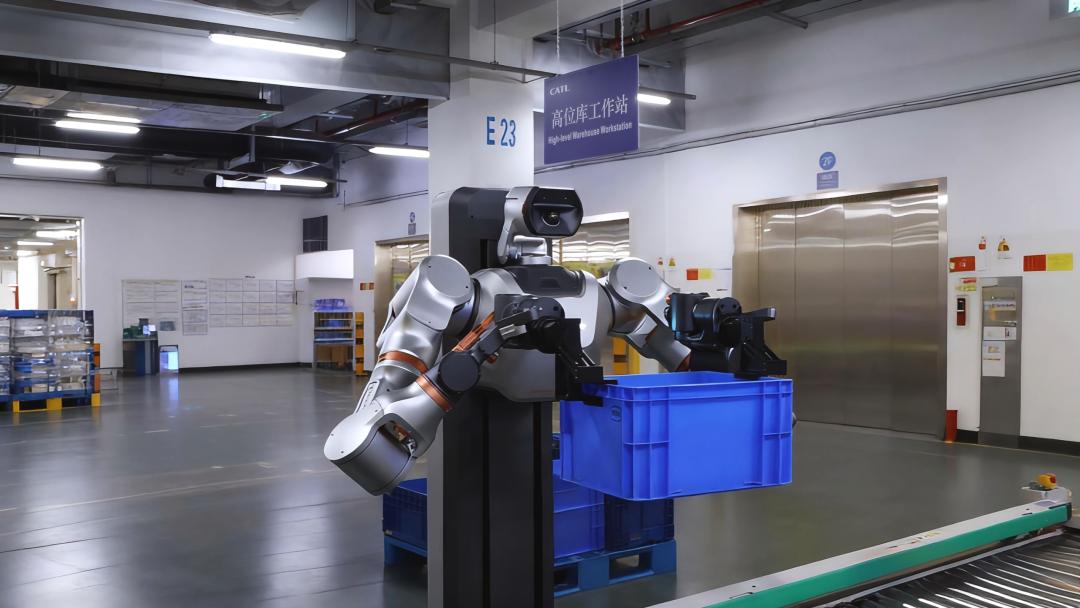
Galaxy Universal Galbot S1 embodied heavy-duty robot operates on a regular basis in CATL's factory, image source: Galaxy Universal
At the same time, Peking University AI entrepreneurs are also exploring more new scenarios. Ning Kunpeng and Yao Jiayu, two doctoral students at Peking University's Shenzhen Graduate School, developed the campus project ChatExcel into the startup Meta Smart, enabling users to complete office tasks such as spreadsheet processing and data analysis through natural language, and promoting AI office assistants to practical application.
Chen Boyuan, an alumnus of Peking University, entered the more cutting-edge world model track and founded Inverse Matrix Technology, hoping to build a general world foundation model, enable AI to learn the operation laws of the real world, and provide underlying capabilities for future applications such as embodied intelligence and physical simulation.
From enterprise intelligence, to AI for Science, and then to embodied intelligence, AI is constantly breaking boundaries in their hands, gradually evolving from a technical tool to a new type of underlying capability for exploring the unknown and connecting the real world.
From Individual Heroes to Systematic Output
Why can Peking University continuously nurture AI entrepreneurs?
The answer first lies in the long-term accumulation of basic disciplines.
Wu Minghui studied mathematics for his bachelor's degree, Lai Lipeng has double degrees in physics and mathematics, and Zhang Linfeng has a background in physics and applied mathematics. These seemingly different paths share a similar way of thinking behind them: modeling business problems with mathematics, understanding complex laws in drug R&D with quantum physics, and exploring unknown problems in scientific computing with AI.
Their training is essentially one thing: to find the computable and understandable underlying structure behind complex systems.
This advantage in basic disciplines continues to this day. After the US MATLAB software was banned in 2020, the Peking University mathematics team promoted the R&D of the Beita Tianyuan scientific computing software, trying to break the long-term reliance on foreign tools in the scientific computing field. Today, this domestic scientific computing software has been applied in university scientific research and industrial scenarios, taking an important step for the domestication of scientific computing software.
However, the capability of a single discipline is not enough. The AI era increasingly requires cross-disciplinary integration.
Among these AI entrepreneurs, alumni from Yuanpei College appear many times. Zhang Linfeng, Sun Weijie, Chen Boyuan and others all have Yuanpei backgrounds.
The Yuanpei Program launched in 2001 is an important attempt by Peking University to explore general education and interdisciplinary training, emphasizing breaking the boundaries of traditional majors to allow students to find new integration points between different disciplines. In 2007, the Yuanpei Program was officially upgraded to Yuanpei College, and this training concept has been institutionalized and normalized ever since.
This kind of cross-disciplinary training also makes it easier for them to find connection points between different fields, and introduce AI into fields with higher technical thresholds such as pharmaceuticals, materials, scientific computing and robotics.
The real change is that Peking University is gradually transforming the achievement transformation that used to rely on a few teams into a set of continuously operable innovation systems.
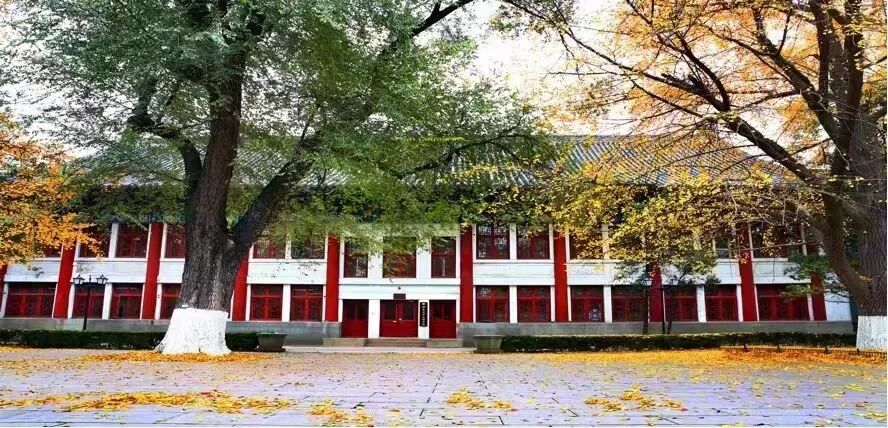
Yuanpei College of Peking University, image source: Peking University
In 2021, Peking University and the Beijing Science and Technology Innovation Fund jointly established the Yuanpei Fund, with a scale of about 1 billion RMB, focusing on supporting early scientific research projects with original innovation potential. Compared with traditional investment, the Yuanpei Fund pays more attention to technical barriers and long-term innovation value, rather than requiring projects to have a mature business model from the very beginning.
On this basis, Peking University further promoted the establishment of Yanyuan Venture Capital, focusing on "investing in early-stage, small-scale and hard technology projects", connecting university scientific research resources with industrial capital.
By 2025, Yanyuan Incubator was officially launched, positioned as "the early partner of scientists and entrepreneurs". Together with the Yuanpei Fund and Yanyuan Venture Capital, it forms the "first kilometer" of Peking University's scientific and technological achievement transformation, helping early scientific research projects complete the key leap from technical verification to entrepreneurial implementation.
From fund investment, to incubation services, and then to industrial connection, Peking University is building an innovation chain covering "scientific discovery - technical verification - enterprise incubation - capital support".
The technological breakthrough that Wang Xuan led his team to complete in those years has now become a set of continuously operable innovation system.
Looking back on the past more than half a century, from the 150 Machine and laser phototypesetting to today's AI, the era is constantly changing, but the capability of transforming basic research into industrial breakthroughs has always been inherited by Peking University people.
This article is from the WeChat official account "Huashang Taolue" (ID: hstl8888), written by Huashang Taolue, and authorized for release by 36Kr.