Apple, the slowest mover in the AI space, was once one of the large corporations that saw the sharpest stock price rally in July.
Over the past few years, among the major U.S. tech giants, Apple has always been the "slowest" in taking AI-related actions.
In 2023, when Microsoft, Google and Meta successively launched large models, AI assistants and enterprise-level products, pushing the AI competition into an accelerated phase, Apple did not officially release Apple Intelligence until June 2024; the new version of Siri, which was originally scheduled to launch in 2025, was also postponed to this year.
Apple's "slowness" once made its stock price underperform U.S. tech stocks. In 2025, the Nasdaq 100 ETF rose by 20.77%, while Apple's increase was only 9.05%. This is because Apple may need AI more than many other companies — without AI, it will be difficult to drive consumers to buy new iPhones, and iPhone alone contributes nearly half of its total revenue.
From the close of June 30 to the close of July 30, right before Apple released its financial results after hours that day, Apple's cumulative share price increase reached 15.2%, outperforming many capital-heavy companies such as Meta and Alphabet, ranking second only to Microsoft among large-cap U.S. tech stocks.
Although on July 31 after the earnings release, Apple's share price fell by 7.4% dragged down by multiple factors including memory chips, Microsoft and Amazon saw sharp stock price surges thanks to their strong cloud business performance.
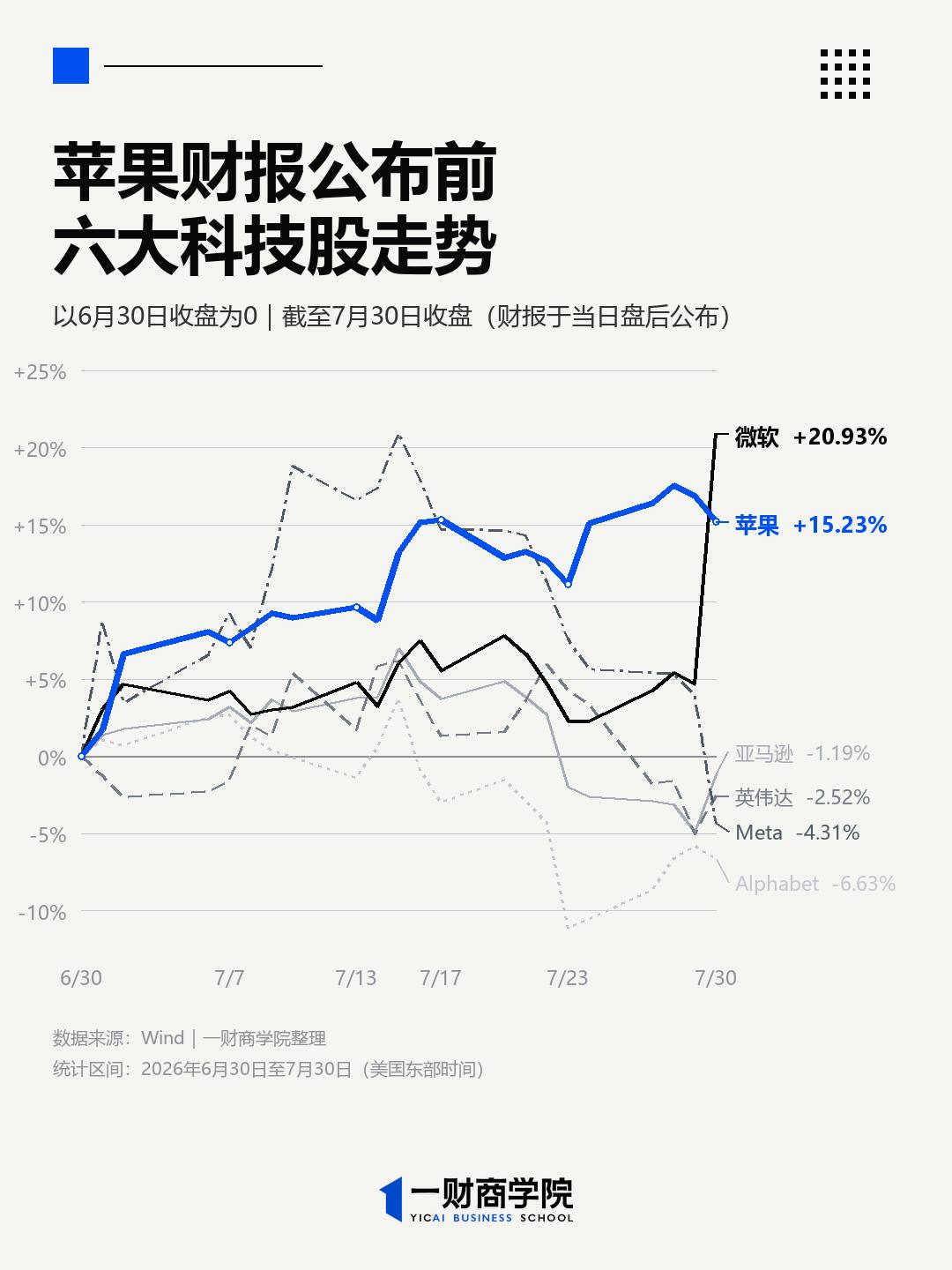
However, the fluctuating trend in July fully demonstrates that the capital market is re-evaluating the AI infrastructure investments of large tech companies. When the AI sector rotates, Apple's non-capital-burning AI story also gets a chance to enter the vision of investors.
From Automotive Manufacturing to AI: Apple Always Avoids the Most Capital-intensive Links in the Industrial Chain
In the 12 months ending June 2026, Apple's capital expenditure on cash basis was about 10 billion U.S. dollars, only roughly one-tenth of that of other large tech companies. Microsoft, Meta, Alphabet and Amazon recorded around 115.9 billion, 89.3 billion, 132.4 billion and 167.4 billion U.S. dollars respectively.
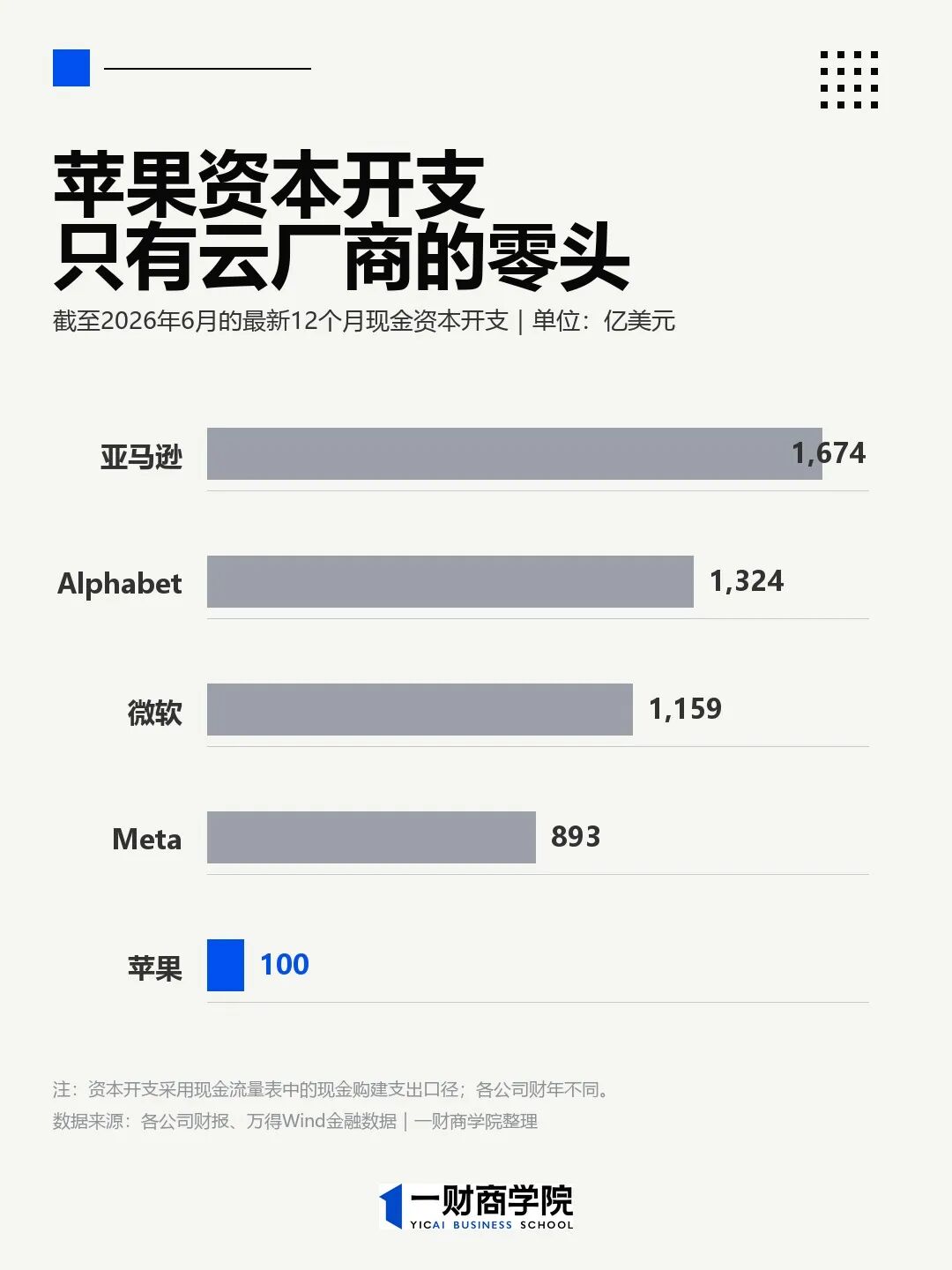
These investments are used on one hand to train larger and more powerful models, and on the other hand to continuously support the inference load generated by user calls and Agent tasks after the models are launched.
Although Apple is also training its own models, they are mostly small on-device models. On-device inference can reduce cloud calls during device usage. In terms of large-parameter cloud model services, Apple prefers to cooperate with large model vendors that own cloud infrastructure: the global version of Apple Intelligence partners with Google and its Gemini model, while in China, it introduces local technology partners such as Alibaba's Tongyi and Baidu. By leveraging ready-made models and computing power from its partners, Apple does not need to bear all the cloud infrastructure investment on its own, and can also deliver large model capabilities to users.
Apple's vigilance against heavy assets was already demonstrated in its electric vehicle project.
Starting around 2014, Apple explored its automotive project for as long as ten years, and the market once expected it to enter the fields of whole vehicle manufacturing and autonomous driving. According to media reports, Project Titan cost over 10 billion U.S. dollars in total, with an average annual investment of about 1 billion U.S. dollars, and the team size once approached 2,000 people, but the automotive project was abruptly terminated in 2024.
Apple would rather admit that ten years of R&D investment cannot be converted into products than be locked in by larger, longer-term manufacturing capital expenditures. However, Apple did not completely abandon the automotive sector, but continued to occupy the digital entry point in vehicles through CarPlay.
Instead of taking on heavy asset links on its own, Apple always keeps control of the operating system, interactive entry points and user relationships, and concentrates resources on the positions closest to end users. Apple's non-capital-burning strategy allows it to avoid a full-scale computing power race.
The Third Year of AI Capital Burning: The Market Shifts Focus from Computing Power Scale to Return on Capital
In the early stage of generative AI boom, computing power was the scarcest resource. Whoever had more computing power could train more powerful models. When an enterprise announced to expand its AI investment, it was itself a reason for valuation expansion.
Two landmark events: At the beginning of 2023, Microsoft expanded its cooperation with OpenAI, and the combination of "leading model + cloud infrastructure" was recognized by the market, driving Microsoft's stock price to rise by about 58% that year; In June 2024, NVIDIA's market cap exceeded 3 trillion U.S. dollars and once surpassed Apple — computing power assets replaced consumer electronics as the core of tech stock valuation.
The arrival of Agents further pushed computing power demand to "continuous task execution". Traditional chatbots usually work on a one-question-one-answer basis, while Agents can break down tasks, repeatedly call models and external tools. The resulting growing computing power demand further pushes up upstream hardware prices, turning AI competition into sustained capital expenditure pressure for capacity expansion. The computing power construction once regarded as a competitive barrier has gradually become a heavy cost that large model vendors and cloud service providers have to digest in the long run.
In addition to cost pressure, it is still unknown whether AI-related businesses can form long-lasting competitive barriers. So far, almost no vendor can ensure that its model capabilities will not be caught up by latecomers within a few weeks.
On June 9, 2026, Anthropic released Claude Fable 5, which was at the cutting edge of the industry at that time; 37 days later, Moonshot AI launched Kimi K3 on July 16. According to official Kimi materials, the overall performance of K3 still lags behind Fable 5, but it has shown competitiveness close to Fable 5 in some programming and Agent evaluations, which means huge capital expenditure does not necessarily bring lasting technological leadership.
That is why the evaluation criteria for AI assets are changing. In the past, the market rewarded those who owned more GPUs, larger models and more abundant computing power; when model capabilities are no longer scarce, the market will further pursue the return on AI capital.
None of these companies have separately disclosed their full AI revenue and AI capital expenditure, and trailing twelve months (TTM) free cash flow can be used as an alternative observation indicator: if the incremental revenue growth brought by AI from cloud services, subscriptions, advertising and other sectors outpaces capital expenditure, the incremental operating cash flow will eventually cover the investment in servers and data centers, and drive free cash flow to bottom out and rebound.
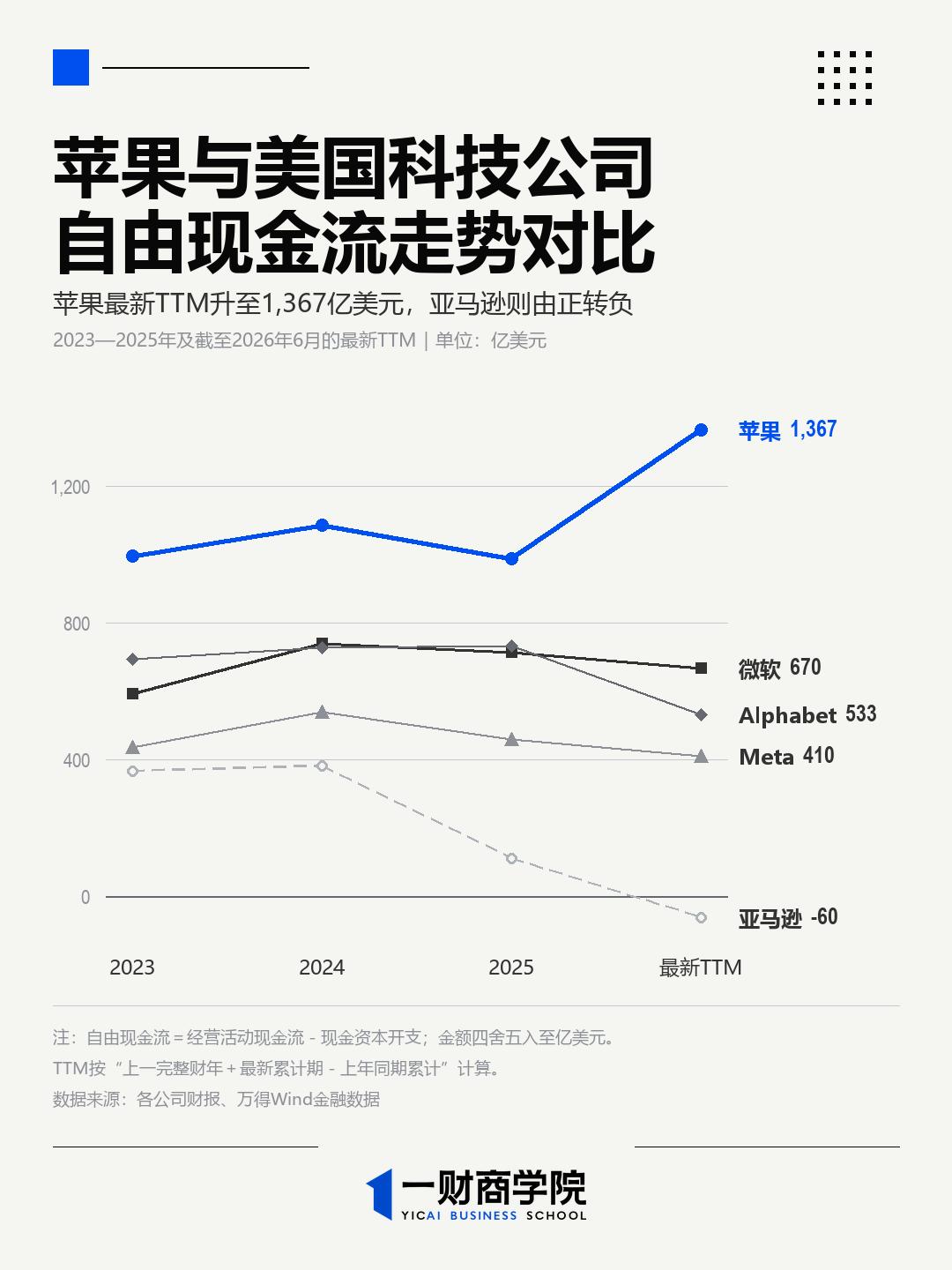
However, according to the post-earnings data, several large U.S. tech companies with heavy investment still show no sign of sustained rebound in free cash flow. This means that the incremental operating cash flow of these companies is currently not enough to fully cover their data center expenditures.
In contrast, Apple's latest TTM free cash flow has risen to about 136.7 billion U.S. dollars, making it the only one among the five large tech companies that exceeds the historical high recorded between 2023 and 2025. Moreover, Apple's cost-control strategy does not mean that it will always be excluded from the AI track.
Apple's Real Advantage: It Can Earn AI Revenue Without Becoming the Largest Model Company
According to Apple's latest financial report, the highly anticipated iPhone revenue reached 54.252 billion U.S. dollars, up 21.69% year on year. In the previous three fiscal years, the iPhone revenue growth rates were -2.4%, 0.3% and 4.2% respectively.
Although Apple has not joined the fierce computing power competition, it has already obtained the hardest-to-acquire assets for AI commercialization: over 2.5 billion active devices covering iPhone, iPad, Mac and Apple Watch, as well as full control over the operating system, payment accounts, App Store, personal data and cross-device scenarios.
Other companies need to build computing power, train models, acquire users and then find a viable business model; Apple can directly integrate AI capabilities into its existing ecosystem without acquiring users from scratch.
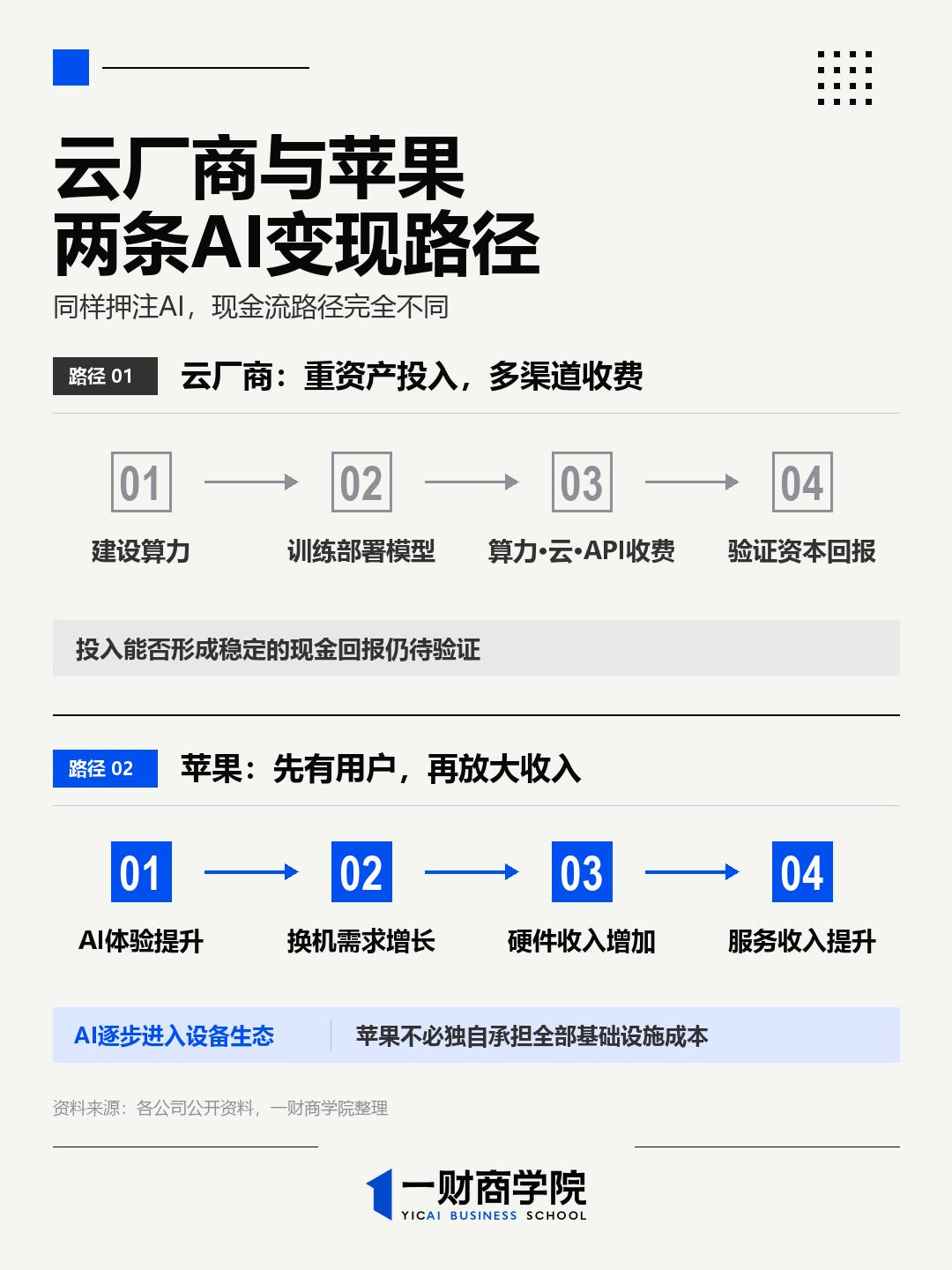
Apple's AI revenue does not necessarily come from selling Tokens, and its certainty comes from its existing hardware business. Apple Intelligence itself can be free of separate charge — as long as it improves the attractiveness of iPhones, Macs and other devices, for every additional device sold, Apple can immediately recognize a product revenue and corresponding gross profit.
The open-source Agent OpenClaw that became a hit in early 2026 unexpectedly provided another sample. Due to the low power consumption and large unified memory capacity of Mac mini, which is suitable for long-term local Agent operation, products were once out of stock in Huaqiangbei, Shenzhen, and the delivery cycle of some high-spec Macs was reported to be significantly extended. In the third fiscal quarter of Apple's 2026 fiscal year, the revenue of the Mac category reached 10.352 billion U.S. dollars, up 28.66% year on year.
This intuitively demonstrates Apple's AI monetization logic: popular AI applications do not have to be developed by Apple itself. As long as they are eventually converted into device demand, Apple can gain revenue through its existing hardware business. So the core question for Apple still lies in how many iPhones AI can help it sell.
Although rising supply chain costs will force Apple to raise the prices of some Mac and iPad products, according to Apple's disclosure on the fiscal 2026 Q3 earnings call, the number of iPhone users switching to new devices hit a record high for the June quarter, and the number of Mac switchers and first-time Mac buyers both hit all-time highs, which indicates the revenue growth of hardware devices is still driven by device replacement demand.
This is probably exactly why Wall Street is re-evaluating Apple. As AI enters its third year of heavy capital burning, the competition outcome is no longer only determined by who owns the most GPUs, but by who can convert AI into revenue, profits and free cash flow.
As models gradually become standardized and inference costs keep declining, Apple, which seems conservative today, may instead become the beneficiary with the highest capital efficiency and the most options in the AI cycle.
This article is from the WeChat official account "Yicai Business Review", author: Xu Ming, published with authorization from 36Kr.