The cost has been slashed by 100 times, Liang Wenfeng has pushed Claude to the "kill line".
Exclusive report from Caijing shows that DeepSeek has restarted its second round of financing, planning to raise 500 billion yuan, with a pre-money valuation of about 5 trillion yuan, and the signing is expected to be completed in late August.
In June this year, DeepSeek just completed its first round of 500 billion yuan financing, setting a record for the scale of the first round of financing for domestic large models, with a post-money valuation exceeding 3.5 trillion yuan. Only two months later, its pre-money valuation has risen by about 43%, and the total amount after the two rounds of fundraising will exceed 1 trillion yuan.
The confidence behind the skyrocketing valuation comes from DeepSeek's billing rules that are rewriting the industry rules.
The specific situation is as follows: the authoritative model testing media Artificial Analysis has released a set of measured data, using multiple mainstream models to run the same set of benchmark tests to compare which one has a lower average cost.
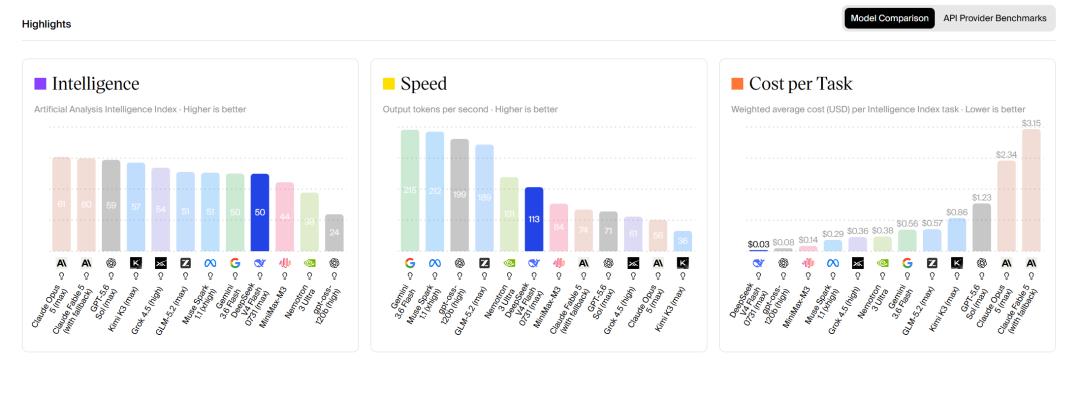
The test results show that after DeepSeek V4-Flash runs the full set of benchmark tests, the average cost of one task is only 3 cents.
At first glance, this data may not seem remarkable, but when other mainstream models are brought in for comparison, everything changes. Under the same benchmark, the average cost of Anthropic's flagship model Claude Fable 5 is 3.15 US dollars, GPT-5.6 Sol costs 1.86 US dollars, which means DeepSeek is 100 times cheaper than Claude.
And this is only the monetary cost. Another major feature of DeepSeek V4-Flash is its high speed. According to the actual measurement data from Artificial Analysis, the output speed of DeepSeek V4 Flash (Max Effort mode) is about 113 tokens per second, while the comparable Anthropic flagship model Claude Opus 5 is about 74 tokens per second, nearly 1.5 times faster.
In other words, when DeepSeek finishes running all the benchmark tests, Claude has only run half of them.
What's the trade-off?
To achieve this ultimate cost-effectiveness and efficiency, DeepSeek V4-Flash has made certain trade-offs in intelligence level. Data from Artificial Analysis shows that in terms of intelligence index, V4-Flash scores 50 points, on par with Google Gemini 3.6 Flash, only about 10 points behind the flagship models — Claude Opus 5 scores 61 points, and Fable 5 scores 60 points.
100 times cheaper, 1.5 times faster, with performance less than 20% lower. Especially for enterprises that need to purchase model APIs, their accounts may need to be recalculated.
1
In the past few years, the pricing method of the large model industry has been simple and crude: charging by the number of tokens run. It costs a certain amount of money per million input tokens, and a certain amount per million output tokens. Users pay according to the pricing set by manufacturers.
However, this calculation method has a problem, it compares the "raw material price" rather than the "finished product price".
It's like eating at a restaurant where the menu says "rice is 5 yuan per jin", but all I care about is "how much a bowl of rice costs". Tokens are equivalent to rice, and the task is the bowl of rice. Even if the rice is very cheap, the process of steaming it into rice will still affect the final price of the rice.
The official pricing of DeepSeek V4-Flash is $0.14 per million input tokens and $0.28 per million output tokens. The RMB pricing is 1 yuan per million inputs when input cache misses, 0.02 yuan per million inputs when input cache hits, and 2 yuan per million outputs.
This price is already in the lowest tier of the industry. But the problem is that low token price does not equal low task cost. If a model needs to generate more tokens to complete the same task, the low unit token price may result in an expensive bill.
What Artificial Analysis does is to complete this layer of "translation". What they compare is "how much it costs to run the same set of benchmark tests". This metric is called "Cost per Task", which integrates all variables such as token usage, inference depth, cache hit rate, and thinking time, and directly gives an ultimate answer: how much does it cost to finish a task.
But here comes the question: why can DeepSeek be so cheap?
The V4-Flash model has a total of 284 billion parameters, but only 13 billion are actually activated during each inference, less than 5% of the total parameters.
But that's not enough. V4 has made great efforts in the attention mechanism, designing a hybrid architecture with alternating arrangement of CSA (Compressed Sparse Attention) and HCA (Heavy Compressed Attention).
The core of these two mechanisms is to store information of different distances with different precision.
For example, it remembers very clearly what happened in the last few minutes, and can describe every detail; for things that happened a few days ago, it can only roughly remember what happened, with blurred details; for things that happened a few months ago, it may only retain a general impression.
CSA and HCA simulate this memory rule of "clear near, fuzzy far". As the context grows, important information is retained, and unimportant information is erased.
Under the context of millions of tokens, the single-token computation amount of V4 Flash is only 10% of that of V3.2, and the KV cache only needs 7%. Moreover, the longer the context, the greater this advantage.
But the architecture is only half of the story. V4-Flash has undergone an "in-situ upgrade" from the preview version to the official version.
The two versions of the model have not changed a single parameter, the only difference lies in post-training.
Behind this is DeepSeek's unique two-stage post-training method.
The first stage is called "Specialized Training". In fields such as mathematics, code, Agent, and instruction following, expert models are trained separately. Each expert first uses Supervised Fine-Tuning (SFT) to lay a foundation, and then uses GRPO reinforcement learning for repeated polishing. GRPO is a concept first proposed by Guo Daya in the paper DeepSeekMath published when he was at DeepSeek.
The traditional PPO algorithm requires additional training of a value function model, which consumes both video memory and computing power, while GRPO directly removes this step, and instead lets the model generate multiple answers to the same question, uses the relative ranking within the group to replace the absolute value evaluation, making the model compete and learn against itself. It not only saves training costs, but also achieves better effects.
The second stage is called "Unified Integration", which uses On-Policy Distillation to merge the capabilities of multiple domain experts back into the same model. During distillation, instead of simply copying the outputs, the target model generates data under its own policy distribution, and then uses the outputs of the expert models for correction, ensuring that the merged model will not "forget the old while learning the new".
In the past, model distillation usually meant letting the high-performance model generate answers first, and then letting the low-performance model learn from them. But On-Policy Distillation is the opposite: the student does the exercises first, and the teacher watches and guides alongside. The student adjusts their thinking in real time based on feedback from various teachers, and continues to work on the task. After finishing one exercise, they move on to the next, learning while doing.
"On-policy" means that the student and the teacher are synchronized, and the teacher gives real-time feedback to the student. "Policy" means that what it learns is not the answer to a specific question, but the thinking method of "how to think when encountering a problem".
As a result, the Terminal Bench 2.1 score rose from 61.8 to 82.7. This test measures the model's ability to complete complex command line tasks in a real terminal environment. The score directly exceeds the 72.1 points of its elder brother V4-Pro preview version, approaching the 85.0 points of Anthropic's flagship Opus 4.8.
What's more remarkable is DeepSWE, a benchmark specially designed to test the ability to solve real GitHub issues. The score of DeepSeek V4-Flash skyrocketed from 7.3 to 54.4, an increase of 645%. A light Flash-level model fully outperforms the preview version of its own flagship Pro on 9 Agent benchmark tests.
2
The 100-fold price difference is likely to change enterprises' procurement logic for model APIs.
In the past few years, the process of enterprises selecting models is like selecting suppliers, comparing parameters, benchmark scores, and prices, and finally choosing a "comprehensive optimal" option. The premise of this idea is that the price gap between models is small, within the same order of magnitude, so of course everyone will choose the most capable one.
However, after Artificial Analysis proposed the "Cost per Task" metric, this premise no longer holds.
Assuming an enterprise needs to process 1 million API calls every day, using Claude would cost $31,500 per day, while using DeepSeek only costs $300 per day. The annual gap is 11.3 million US dollars. This is no longer a matter of saving some money, it is a matter of whether the enterprise can survive.
Especially for enterprises whose daily operations include scenarios such as e-commerce customer service, code review, and data cleaning, 1 million API calls per day are very common.
Therefore, the core proposition of enterprises is no longer "which model to use", but now becomes "how to distribute tasks to the most suitable model". This idea has a name in the industry, called Model Routing.
The logic of Model Routing is very simple: assign complex tasks with high value and high failure cost to models with high upper limit such as Claude Opus 5 or GPT-5.6, such as architecture design in automatic programming, key analysis of financial reports, clause review of legal documents, etc. Enterprises pay for the intelligence level and success rate of the model.
However, the number of these tasks is actually not large. Since task failure will cause huge losses to the enterprise, using expensive models is a completely reasonable investment.
"Hard labor tasks" such as batch classification, initial code screening, data cleaning, and low-risk Agent tasks often account for 80% of enterprise operations. Therefore, assigning all of them to DeepSeek will save every penny as pure profit.
According to Menlo Ventures' enterprise AI survey, 37% of enterprises have used more than 5 models in production environments. The academic circle also draws the same conclusion: the RouteLLM study published by the LMSYS team (UC Berkeley, Anyscale) at ICLR 2025 found that on the MT Bench benchmark, intelligent routing can reduce costs by 85% while maintaining 95% of GPT-4's quality.
In the publicly disclosed industry practices, under different task distributions and routing strategies, the cost reduction range is usually between 40% and 85%.
The quality of routing directly determines the enterprise's AI cost. An enterprise with a rough routing strategy may send 80% of its tasks to the flagship model; while an enterprise with fine-grained routing may only need the flagship model for 20% of its tasks, and the remaining 80% are diverted to high cost-effective models.
Two enterprises doing the same thing may have an AI cost difference of 5 to 10 times.
The most primitive routing method is "static rules". For example, tasks from the customer service department use cheap models, and tasks from the algorithm department use expensive models. Or keyword matching: when the keyword "code" is mentioned, use a mid-to-low tier model, and when the keyword "analysis" is mentioned, use the flagship model.
This method is simple and crude, but not accurate. Many mismatches occur: simple tasks are assigned to expensive models, while complex tasks are assigned to cheap models that cannot complete them well and need to be redone, which is even more expensive.
A more advanced method is to use a classifier. First, train a small model specially to judge "which model this request should use". When a request comes in, it passes through the classifier first. If the classifier judges it as simple, it is sent to the cheap model; if the classifier judges it as difficult, it is sent to the expensive model.
This method is more accurate than static rules, but it still has problems. The classifier itself can make mistakes, and it can only judge based on the literal meaning of the request, without knowing how well the model actually performs the task.
An even more advanced method is called "Try First, Upgrade Later". No matter what the request is, let the cheapest model try it first. If the result quality is good enough, use it directly; if the quality is not enough, automatically upgrade to a more expensive model to redo the task.
For example, a task would cost $3 if you use Claude directly. If you try with DeepSeek first, it only costs 3 cents, you make a profit if it succeeds; if it fails, you use Claude, the total cost is $3.03, which is only 1% more than using Claude directly.
As long as the success rate is not zero, this deal is cost-effective.
Therefore, the days of closed-source manufacturers will get more and more difficult. They must keep moving upward to take on more difficult, more complex, and higher-value tasks, and dig deeper moats for themselves, because the lower-tier market has been fully occupied by DeepSeek.
The most uncomfortable are the mid-tier models, which are slightly better than DeepSeek but not by much, yet are dozens of times more expensive.
They cannot beat flagship models in capability, and cannot beat DeepSeek in price.
This has led to a new phenomenon, the DeepSeek Kill Line.
3
Artificial Analysis created a diagram that places all mainstream models in a coordinate system. The horizontal axis is the cost per task, on a logarithmic scale; the vertical axis is the intelligence index score.
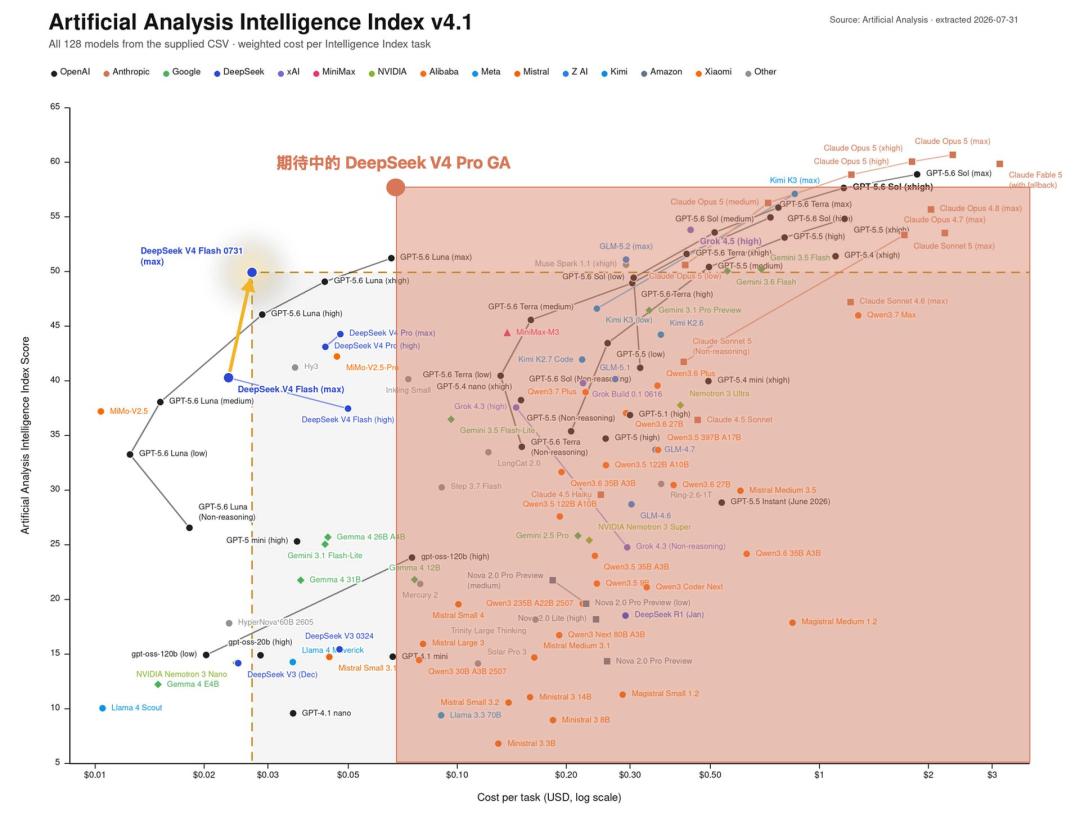
The dotted line in the picture represents the cost-effectiveness kill line of the official version of DeepSeek V4-Flash. Any model below the dotted line cannot be cheaper than DeepSeek in tasks that DeepSeek can complete.
Previously, the industry often used models such as GPT-4o, Claude Sonnet, and Gemini Pro as references, and their cost-effectiveness became the industry benchmark. Models more expensive than them have to prove that they are stronger; models weaker than them have to prove that they are cheaper.
However, as can be seen from the picture, the kill line of these models that were used as industry benchmarks is very low, and any model with slightly higher inference intensity can easily escape being killed. The emergence of the official version of DeepSeek V4-Flash has raised the entire kill line to a very high level, and nearly 70% of the world's models are in the killed area.
The orange-yellow area on the other side of the picture is Artificial Analysis's prediction of the performance and price of the official version of the flagship model V4-Pro, based on the difference between the V4-Flash preview version and the official version.
The current pricing of V4-Pro is 1 RMB per million tokens for input cache hits, 12 RMB for cache misses, and 24 RMB for outputs. During the limited-time promotion, it is even cheaper: input only costs 2.5 RMB, and output only costs 12 RMB.
Although the price is much higher than that of Flash, its performance has also been greatly improved.
This means that including Fable 5 and GPT-5.6 with low inference intensity, 90% of the world's models are killed by DeepSeek in terms of cost-effectiveness of task completion. What's worse, no matter whether you increase or decrease the inference intensity, you still cannot escape the fate of being fully killed by DeepSeek.
And DeepSeek has another card in hand: Harness.
In early August, Cui Tianyi, head of DeepSeek Harness, posted on X that "If you are a developer of open source projects related to Agent Harness and want to participate in the internal test of DeepSeek Harness, you can reply or send me a private message. Please attach your GitHub ID and representative open source works."